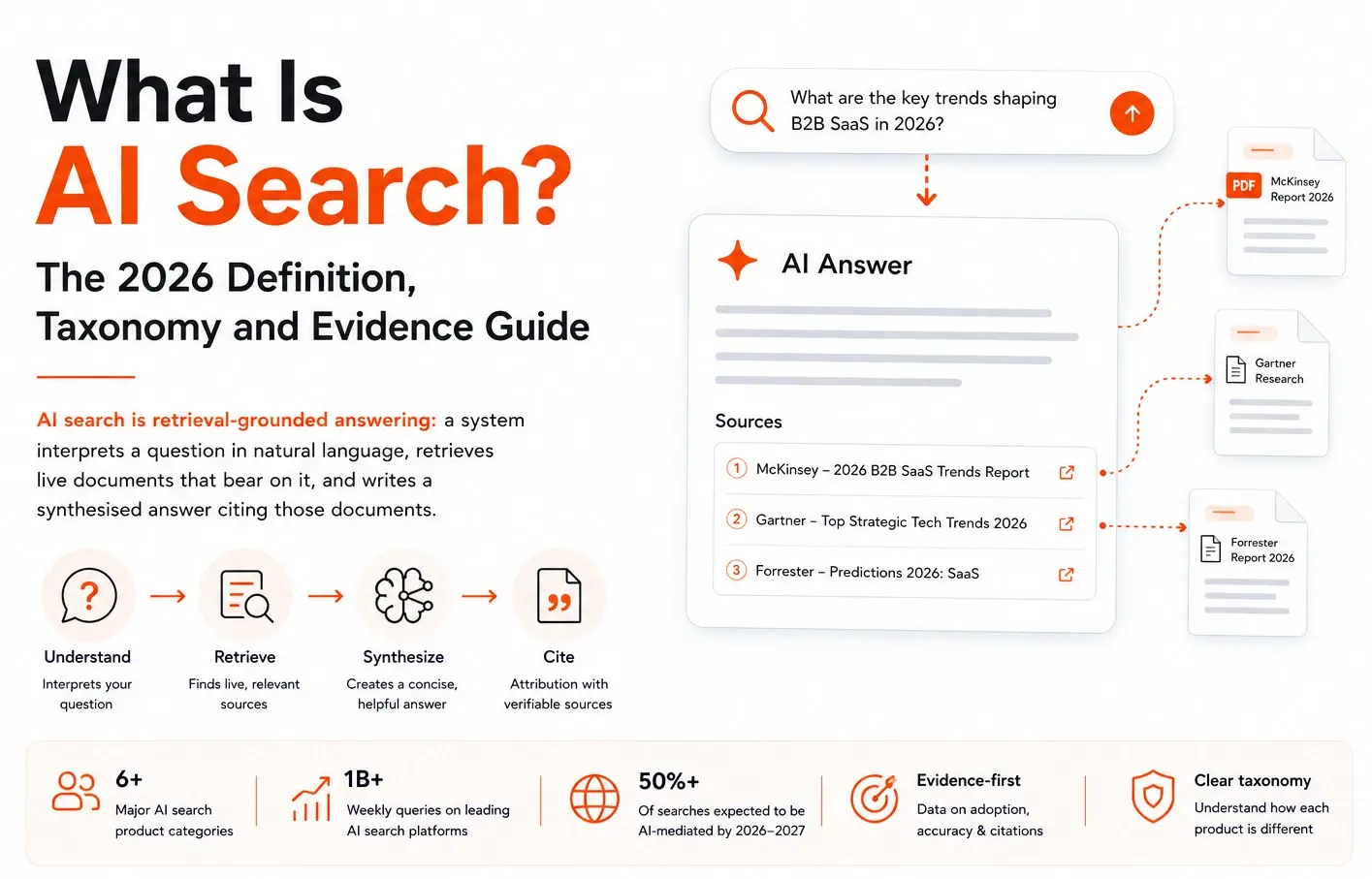


AI search is retrieval-grounded answering: a system interprets a question in natural language, retrieves live documents that bear on it, and writes a synthesised answer citing those documents. The defining feature is not that a language model is involved — it is that the answer is grounded in sources fetched at query time rather than recalled from training data.
That distinction does most of the work. A chatbot answering from memory is not AI search. A keyword engine returning ten blue links is not AI search. AI search is the middle case: retrieval plus synthesis plus attribution, delivered as one response.
The term now covers at least six different products, from a summary box on a results page to an agent that spends ten minutes researching and books something for you. They share a mechanism and differ in almost everything else what corpus they search, whether they cite, whether they send traffic, and how often they are wrong. This guide defines each, sets out the evidence on adoption and accuracy as of August 2026, and flags where the widely quoted numbers do not mean what people think they mean.
Key takeaways
- AI search means retrieval-grounded answering. The underlying pattern — retrieve documents, then generate an answer conditioned on them — was formalised as retrieval-augmented generation by Lewis et al. at NeurIPS 2020, four years before it reached mainstream search products.
- Adoption is real and large. Alphabet reported in July 2026 that AI Mode had "surpassed 1 billion monthly active users" and the Gemini app had 950 million, with daily active users tripling year over year.
- It is layering onto search, not replacing it. Similarweb found that 461 million of ChatGPT's 494 million users — 95% — also used Google, a ratio it reports as flat from September 2025 to May 2026, and traditional search still drew roughly five times the monthly unique visitors of all AI chatbots combined.
- Units matter more than headlines here. Google's 1 billion AI Mode monthly users and SparkToro's finding that AI Mode accounted for 0.34% of US searches in early 2026 are both plausible: one counts people reached, the other counts queries served.
- The traffic AI search sends is small but unusually engaged. Adobe Digital Insights reported AI-sourced retail traffic up 393% year over year in Q1 2026, with AI-referred retail visits converting 42% better than non-AI visits in March 2026 — a reversal from a year earlier, when AI visits converted 38% worse.
- Accuracy remains a documented problem. In the largest study of its kind, 22 public service broadcasters coordinated by the EBU and BBC found 45% of AI assistant answers about news contained at least one significant issue, with sourcing problems in 31%.
- Consumer enthusiasm has cooled even as usage grows. Fractl's 2026 survey of 1,008 US consumers found 54% considered AI more helpful than traditional search, down from 82% a year earlier, while 70% said their AI use for search had increased.
- Publishers are absorbing the cost. Chartbeat data in the Reuters Institute's 2026 trends report showed global publisher traffic from Google search down 33% year on year to November 2025, with surveyed media leaders expecting a further 43% decline over three years.
What AI search is — and what it is not
AI search is a system that converts a natural-language question into one or more retrieval operations, selects documents, and uses a language model to compose an answer grounded in those documents, usually with citations. Three things must be present: live retrieval, generative synthesis, and conditioning of the output on the retrieved material.
Strip any one of those away and it is something else:
| It has | It lacks | What it actually is |
|---|---|---|
| Generation, citations | Live retrieval | A chatbot answering from training data — fluent, unverifiable, frozen at its cutoff |
| Live retrieval, ranking | Generation | Classic keyword or semantic search — a list of documents, not an answer |
| Retrieval, generation | Grounding discipline | An answer that names sources without being constrained by them — the failure mode behind most citation errors |
The mechanism has a name and a paper. Retrieval-augmented generation (RAG) was introduced by Patrick Lewis and colleagues at Facebook AI Research, UCL and NYU in 2020, combining a parametric model with a non-parametric memory the model queries at inference time. Every consumer AI search product in 2026 is a commercial elaboration of that pattern: better retrievers, larger context windows, multi-step planning, and a citation layer on top.
A definition worth being precise about: "AI search" is used for both public-web answering and private-corpus answering. The engineering is similar; the constraints are not. As Databricks describes it, enterprise AI search must respect access permissions so "users only see what they're authorized to see," and keep data inside a governed environment. Web AI search has no such obligation and no view of your internal systems. Conflating the two is the most common definitional error in this topic.
The six surfaces that share the name
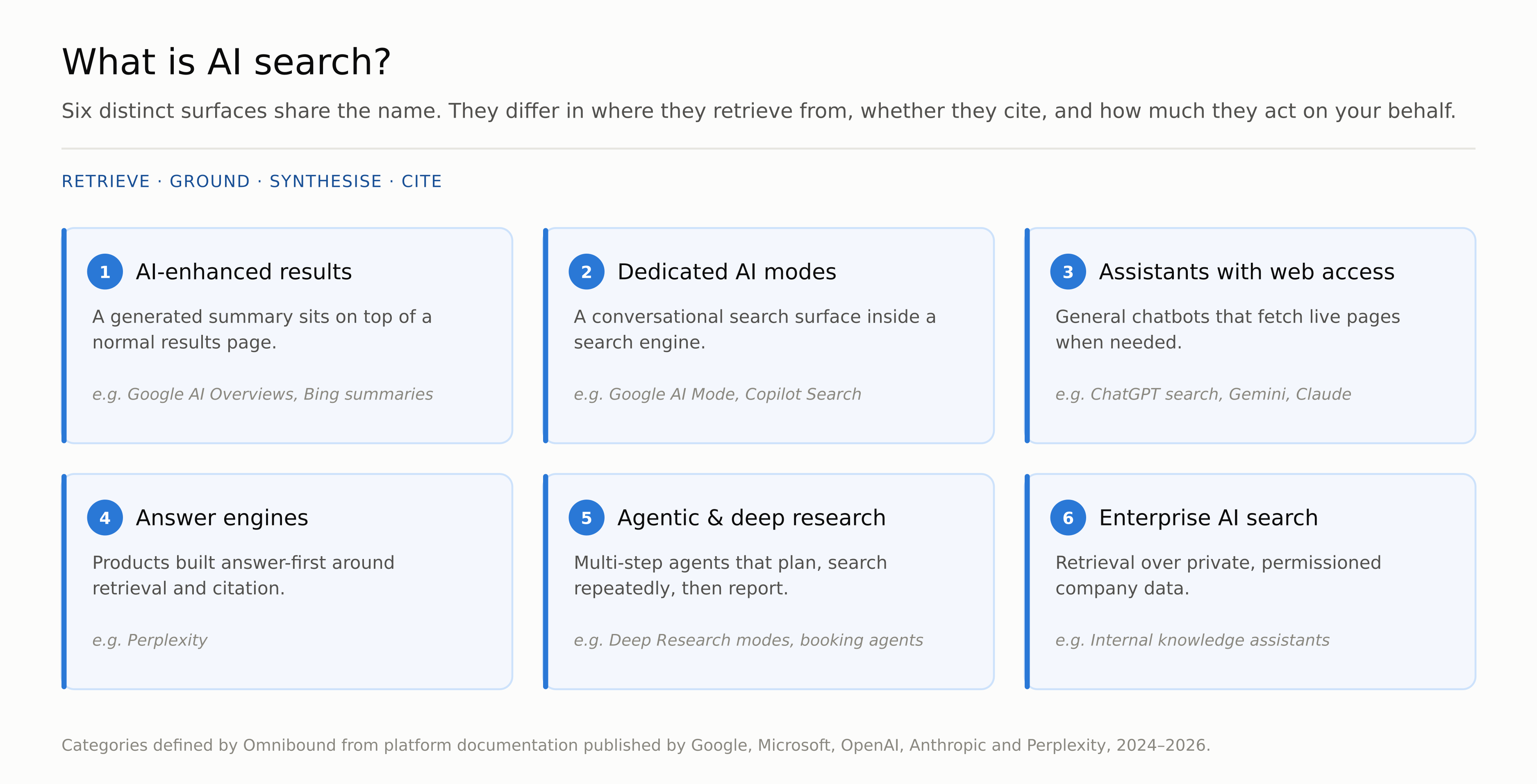
In 2026, "AI search" refers to six distinguishable product types. They differ in corpus, citation behaviour, autonomy and commercial effect.
| Surface | What it does | Corpus | Cites sources? | Examples |
|---|---|---|---|---|
| AI-enhanced results | Generated summary above a conventional results page | Public web index | Yes, inline links | Google AI Overviews |
| Dedicated AI modes | A conversational search surface inside a search engine | Public web index plus first-party data | Yes | Google AI Mode, Copilot Search |
| Assistants with web access | General chatbot that retrieves live pages when the question requires it | Public web via a search partner or own crawler | Sometimes — see the link-rate data below | ChatGPT search, Gemini, Claude |
| Answer engines | Product built answer-first, with citation as a core interface element | Own index and crawler | Yes, prominently | Perplexity |
| Agentic & deep research | Multi-step agents that plan, search repeatedly, and produce a report or take an action | Web plus tools and connected accounts | Usually, in a report format | Deep Research modes; Google's agentic booking features |
| Enterprise AI search | Retrieval over private, permissioned company data | Internal documents, tickets, code, CRM | Internally, to source documents | Internal knowledge assistants |
The boundaries are blurring by design. Google announced at I/O 2026 that AI Mode now runs on Gemini 3.5 Flash by default, that agents will monitor the web continuously and report back on user-defined topics, and that Search can generate custom visual tools for a query. Alphabet's earnings language describes AI Overviews and AI Mode being combined into "one seamless Search experience."
For planning purposes, treat surfaces 1–4 as one competitive arena — they draw on overlapping public content and reward similar things — and surfaces 5 and 6 as separate programmes. Agentic search changes what a "conversion" is; enterprise AI search is an internal data project with almost nothing in common with marketing.
How AI search works, step by step
A modern AI search response is produced in roughly six steps: interpret the query, expand it into sub-queries, retrieve candidates, rerank and select what fits in the context window, generate an answer conditioned on the selected passages, and attach citations.
1. Query understanding. The system parses intent from natural language rather than matching tokens. This is why AI search handles long, conditional, comparative questions that would return poor keyword results.
2. Query expansion — "fan-out." Google describes AI Mode as using a "query fan-out" technique, "issuing multiple related searches concurrently across subtopics and multiple data sources and then [bringing] those results together." The consequence for anyone publishing content: your page competes against sub-queries you never see, not against the question the user typed.
3. Retrieval. Candidate documents are fetched, typically through a mix of keyword and vector similarity — the question and the source content are embedded as numerical representations so that conceptually similar passages can be found without shared wording.
4. Reranking and context assembly. Candidates are scored and the survivors are packed into the model's context window. This stage is invisible from outside and is where most brand visibility is won or lost.
5. Grounded generation. The model writes the answer conditioned on the assembled passages. Grounding quality varies: Anthropic's Citations feature chunks supplied documents to sentence level and extracts exact cited_text spans, so each claim is traceable by construction — a stricter approach than prompting a model to add references after the fact.
6. Citation and presentation. Links are rendered inline, in a sidebar, or in a reference list — or omitted. Similarweb measured citation presence in only 6.8% of US ChatGPT prompts in May 2026 — though that was more than four times the 1.6% recorded in June 2025.
Eligibility is prosaic. Google's own guidance states that to appear in its generative AI features, "a page must be indexed and eligible to be shown in Google Search with a snippet," and that structured data "isn't required for generative AI search." There is no separate AI index to submit to.
AI search vs traditional search: what actually changed
The retrieval layer changed less than the interface did. What changed most is who reads the source: in traditional search a human evaluates ten results, in AI search a model evaluates dozens of passages and reports a conclusion.
| Traditional search | AI search | |
|---|---|---|
| Input | Keywords, ~2–4 words typical | Full questions, constraints, follow-ups |
| Unit of competition | A page ranking for a query | A passage answering a sub-query |
| Output | Ranked list of links | Synthesised answer, variable citation |
| Who evaluates sources | The user | The model, then the user |
| Result stability | Broadly stable day to day | Varies between runs of the same prompt |
| Traffic effect | Click is the default outcome | Click is the exception |
| Measurement | Rankings, impressions, clicks | Mentions, citations, referrals — three separate things |
The traffic consequence is the best-documented change. Pew Research Center tracked 68,879 Google searches by 900 US adults in March 2025: when an AI summary appeared, users clicked a traditional result in 8% of visits versus 15% without one, and clicked a link inside the summary in just 1%. SparkToro's analysis of Similarweb clickstream data put US zero-click Google searches at 68.01% between January and April 2026, up from 60.45% in 2024.
What did not change: the substrate. AI answers are assembled from crawled web pages, so crawlability, indexing and clear writing still gate everything — a point we develop in AI search visibility optimization and in our zero-click search statistics tracker.
How many people actually use it
Hundreds of millions of people use AI search monthly, and almost all of them still use conventional search too. AI search is currently additive.
Read this table by its units — most public confusion about AI search adoption comes from comparing a user count to a query share.
| Figure | Value | Unit | Source and date |
|---|---|---|---|
| Google AI Mode | >1 billion | Monthly active users | Alphabet Q2 2026 earnings, July 2026 |
| Gemini app | 950 million | Monthly active users | Alphabet Q2 2026 earnings, July 2026 |
| ChatGPT | 900 million+ | Weekly active users | OpenAI disclosure (Feb 2026), quoted in Similarweb's 2026 GenAI Visibility Index |
| All AI chatbots | 655 million | Monthly unique visitors (web) | Similarweb, June 2025–May 2026 |
| Traditional search | 3.3 billion | Monthly unique visitors (web) | Similarweb, same window |
| AI Mode share of US searches | 0.34% | Share of search events | SparkToro/Similarweb clickstream, Jan–Apr 2026 |
| AI Overview presence | >20% | Share of Google searches | SparkToro/Similarweb, Jan–Apr 2026 |
Two of those rows appear to contradict each other and do not. A billion people can open AI Mode in a month while AI Mode still serves a fraction of a percent of all search events, because the average person runs many searches and only a few of them in that surface. Any argument that "AI has replaced search" or that "nobody uses AI Mode" is usually built on picking one row and ignoring the other.
The overlap data settles the substitution question for now: Similarweb reported that 95% of ChatGPT users also used Google (461 million of 494 million), a ratio it describes as flat from September 2025 through May 2026. Google's own framing is consistent — Sundar Pichai told investors that "AI continues to drive an expansionary moment… driving growth in queries."
Composition is shifting inside the AI category itself.
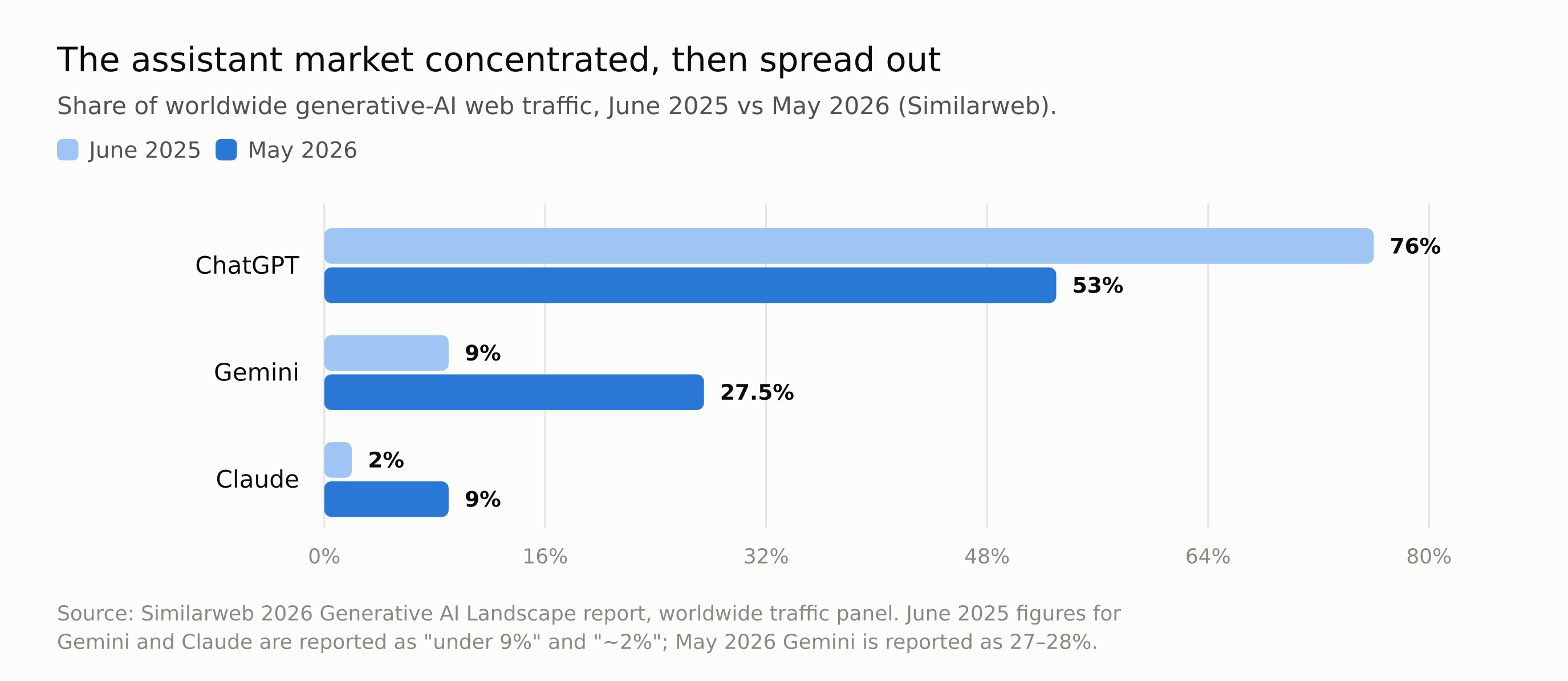
ChatGPT's share of worldwide generative-AI web traffic fell from roughly 76% to about 53% between June 2025 and May 2026, while Gemini rose from under 9% to roughly 27–28% and Claude from about 2% to 9%. The category grew at the same time — average monthly visits reached 9.5 billion, up about 70% year over year — so these are shares of a larger pie, not a shrinking one. For a fuller breakdown of platform usage, see our ChatGPT user statistics page.
What AI search sends back: small volume, better visits
AI search currently returns a small fraction of the traffic that conventional search does, but the visits it returns convert and engage better in several sectors — and the volume is growing quickly from a low base.
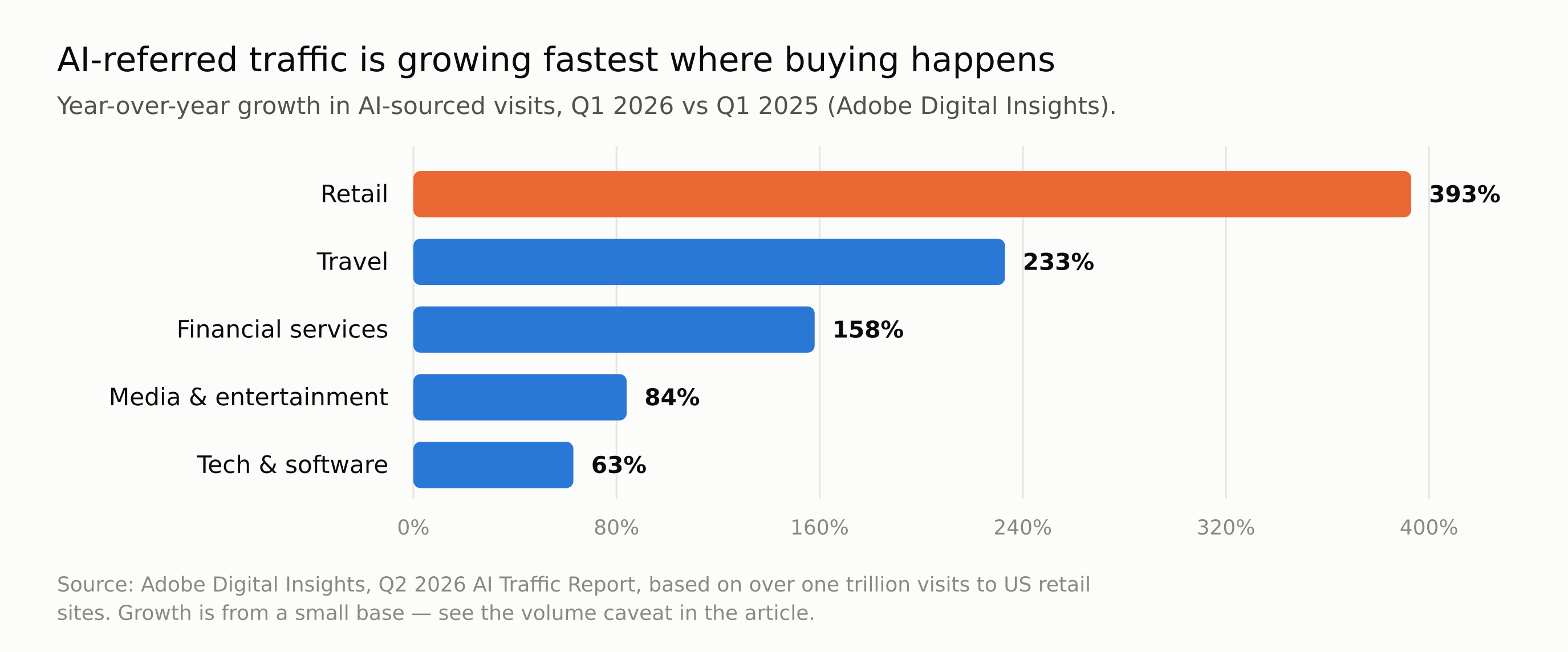
Adobe Digital Insights, analysing more than one trillion visits to US retail sites plus a March 2026 survey of over 5,000 consumers, recorded year-over-year growth in AI-sourced traffic of 393% in retail, 233% in travel, 158% in financial services, 84% in media and entertainment, and 63% in tech and software.
Growth rates alone would be an unreliable story, a small base produces large percentages. The engagement data is the more interesting part.
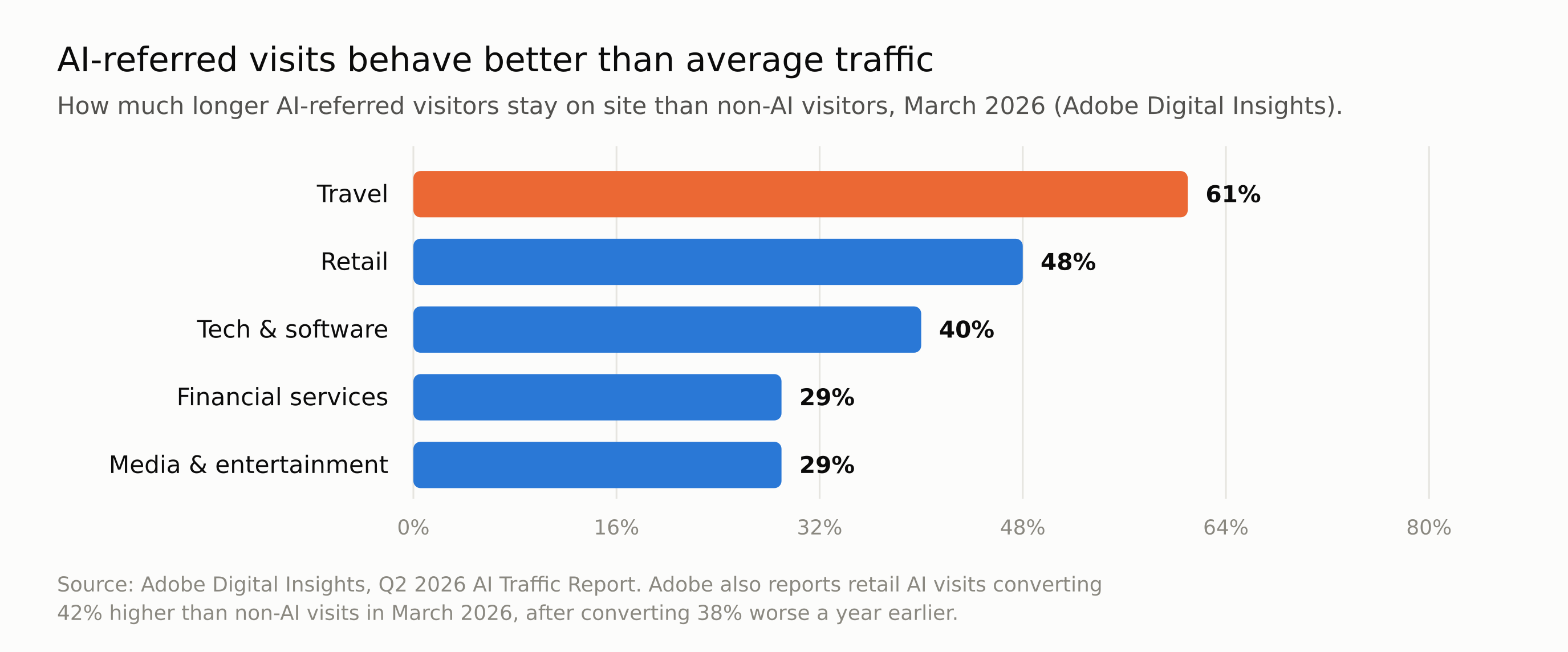
In March 2026 Adobe found AI-referred visits lasted 61% longer in travel, 48% longer in retail and 40% longer in tech and software than non-AI visits, with bounce rates 32–41% lower in retail, travel and tech. Retail AI visits converted 42% better than non-AI visits and produced 37% higher revenue per visit. Both are reversals: a year earlier AI visits converted 38% worse, and non-AI traffic was worth 128% more per visit. The most credible reading is selection: people arriving from an AI answer have already had the question answered and are further along, so the visit that does happen is worth more.
Now the volume caveat, which is severe for publishers. Chartbeat data in the Reuters Institute's 2026 trends report put ChatGPT at 0.02% of total publisher referral traffic and Perplexity at 0.002%, against Google search referrals that had fallen 33% globally year on year to November 2025 (38% in the US). Similarweb's index recorded generative-AI platforms referring 226.8 million US visitors to third-party sites in January 2026, down from 267.4 million in October 2025, with the session-level referral rate falling from 18.8% to 15.8%.
Interpretation: AI search is a high-quality, low-volume channel that is not replacing the traffic it displaces. For commerce and B2B software it can already justify attention on conversion quality alone; for ad-funded publishing the arithmetic does not currently work, which is why so many publishers block AI crawlers. Our AI SEO statistics page tracks the traffic side of this in more detail.
Where AI search still fails
The documented weaknesses are attribution accuracy, factual reliability on news and current events, and instability between identical runs. These are measurement problems as much as product problems.
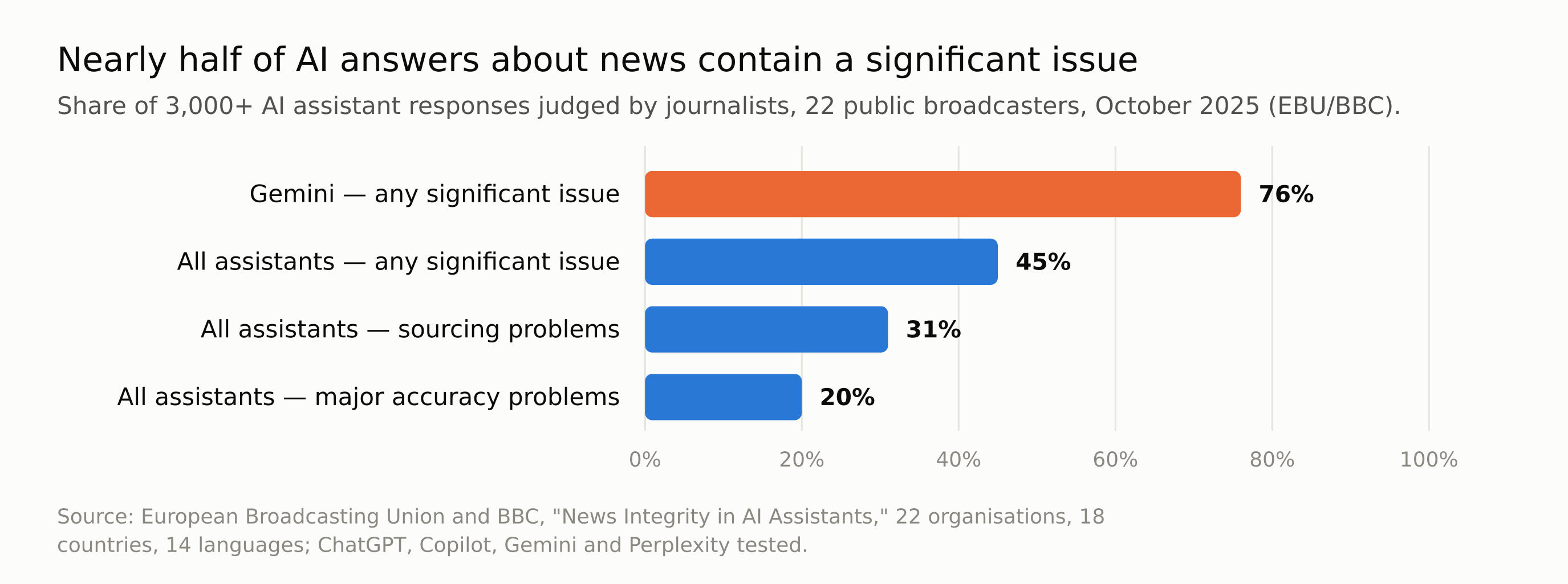
The EBU/BBC study is the largest controlled assessment published so far: 22 public service media organisations across 18 countries and 14 languages, with professional journalists evaluating more than 3,000 responses from ChatGPT, Copilot, Gemini and Perplexity. 45% of answers contained at least one significant issue; 31% had serious sourcing problems; 20% had major accuracy problems including hallucinated details. Gemini performed worst at 76%, driven largely by sourcing.
Independent work points the same direction. The Tow Center at Columbia tested 1,600 queries across eight AI search tools in February 2025 and found incorrect answers in more than 60% of cases, with error rates from 37% (Perplexity) to 94% (Grok 3). The earliest controlled measurement of citation fidelity — Liu, Zhang and Liang at EMNLP 2023, the oldest evidence cited here — found only 51.5% of generated sentences were fully supported by their citations.
Instability is the least-discussed failure mode. A 2026 survey of 45 studies reports daily source-level overlap between repeated runs of around 0.34–0.42 (Jaccard) across four engines over 45 days, and decisions changing in 9–28% of temperature-zero reruns. Practically: the same question asked twice can produce different sources, so a single screenshot proves very little.
Users have noticed. Fractl's Q2 2026 survey of 1,008 US consumers found the share rating AI more helpful than traditional search fell from 82% to 54% in a year, while those rating it less helpful rose from 3% to 17%. Asked which source they trust most for purchase recommendations, 39% named Google search results against 14% for AI tools, and respondents checked an average of 2.4 platforms before buying.
A conflict worth naming. G2's March 2026 survey of B2B software buyers found the opposite trend in its own population: 53% said research with AI chatbots was more productive than conventional search, up from 36% in August 2025. Both can hold — consumers and professional buyers ask different questions, and "productive" and "helpful" are not the same measure — but anyone citing a single trust statistic for "users" in general is overreaching.
What AI search means for B2B buying
In B2B software, AI search has moved from a research aid to a shortlist mechanism, and the evidence a model uses is mostly not the vendor's own site.
G2 surveyed 1,076 B2B decision-makers in March 2026. 51% now begin research with AI chatbots more often than with Google, 71% use them somewhere in the process, and 54% rank chatbots as the single biggest influence on their shortlist — ahead of review sites (43%) and vendor sites (36%). 69% chose a different vendor than they had expected because of chatbot guidance, and 33% bought from a vendor they had not previously known. 85% view a vendor more favourably when an AI mentions it.
The evidence base behind those recommendations sits largely off your domain. A DerivateX study completed in June 2026 posed one buyer-style question in each of 40 B2B SaaS categories, repeated ten times with web search enabled: across 233 recommendations, 87.4% of citations pointed to third parties and only 11.6% to the recommended vendor's own website.
Practical consequence: a B2B AI search programme is two programmes. One makes your own pages retrievable and quotable. The other makes sure independent sources — comparison content, communities, review profiles, analyst and press coverage — describe you accurately in the language buyers use. Our B2B buying statistics page covers how the buying committee has shifted around this.
How to measure presence in AI search
Direct answer: Measure three distinct things — mentions, citations and referrals — and sample repeatedly, because single checks are not measurement.
The three are routinely conflated and behave differently:
- Mention: your brand name appears in an answer. Can come from model memory; no link required.
- Citation: a page of yours is named as a source. Requires retrieval.
- Referral: a human clicks through. Rare, and unevenly reported.
First-party tooling arrived in 2026 for two of the three. Google added generative AI performance reports to Search Console on 3 June 2026, covering AI Overviews, AI Mode and generative features in Discover, with impressions, pages, countries, devices and dates — initially for a subset of sites. Microsoft's AI Performance report in Bing Webmaster Tools entered public preview in February 2026, exposing total citations, average cited pages per day, page-level counts, and — most usefully — the grounding queries the system used to retrieve your content.
A workable protocol:
- Fix a prompt set drawn from real buyer language, including paraphrases of the same intent.
- Run it on a schedule across the platforms your buyers use, not just the one you use.
- Record mention, citation, whose page was cited, prominence, and factual accuracy as separate fields.
- Report ranges and variance rather than a single number, given the documented run-to-run instability.
- Reconcile against Search Console and Bing Webmaster Tools for your own domain.
If you are evaluating vendors for this, the criteria for AI search tools that deliver citation intelligence are a useful filter, and our definition of AI search visibility sets out what a defensible score contains.
What changes next
Three developments have enough evidence behind them to plan around, stated at the confidence the data supports.
Well supported: agentic search moves from answering to acting. Google announced at I/O 2026 that agentic booking is expanding to local experiences and services, with Google able to call businesses on a user's behalf, and that information agents will monitor the web continuously for subscribers. When an agent completes a task, the "impression" and the "conversion" collapse into one event that your analytics may never see as a visit.
Moderately supported: answers are becoming an ad surface. Similarweb's panel data indicates roughly 26% of ChatGPT responses contained ads by 2026, concentrated in the first response of a session. If that holds, organic presence in AI answers will face the same paid-organic dynamics that reshaped search results pages.
Contested: whether the traffic economics recover. Google states it is "sending billions of clicks to websites every week through AI features in Search." Publisher-side measurement — Chartbeat, Reuters Institute, Cloudflare's crawl-to-refer ratios — describes a steep decline. Both parties are measuring real things at different scopes, and there is no neutral dataset that reconciles them. Treat confident claims in either direction as advocacy.
What to do next
- Decide which surface you are actually targeting. A plan for AI Overviews is not a plan for ChatGPT, and neither is a plan for enterprise search.
- Verify machine access per bot. Retrieval bots and training bots are separate; check each in
robots.txtand confirm your key answers exist in server-rendered HTML. - Write for passage extraction. Direct answer under the heading, dated figures with sources, comparison tables, real FAQs — content a model can lift without the surrounding page.
- Invest in third-party corroboration. In B2B software, most of the evidence AI cites is not on your domain.
- Instrument mentions, citations and referrals separately, sample repeatedly, and report variance.
- Re-check quarterly. Source preferences, link rates and market shares in this category all moved materially within twelve months.