




Table Of Contents
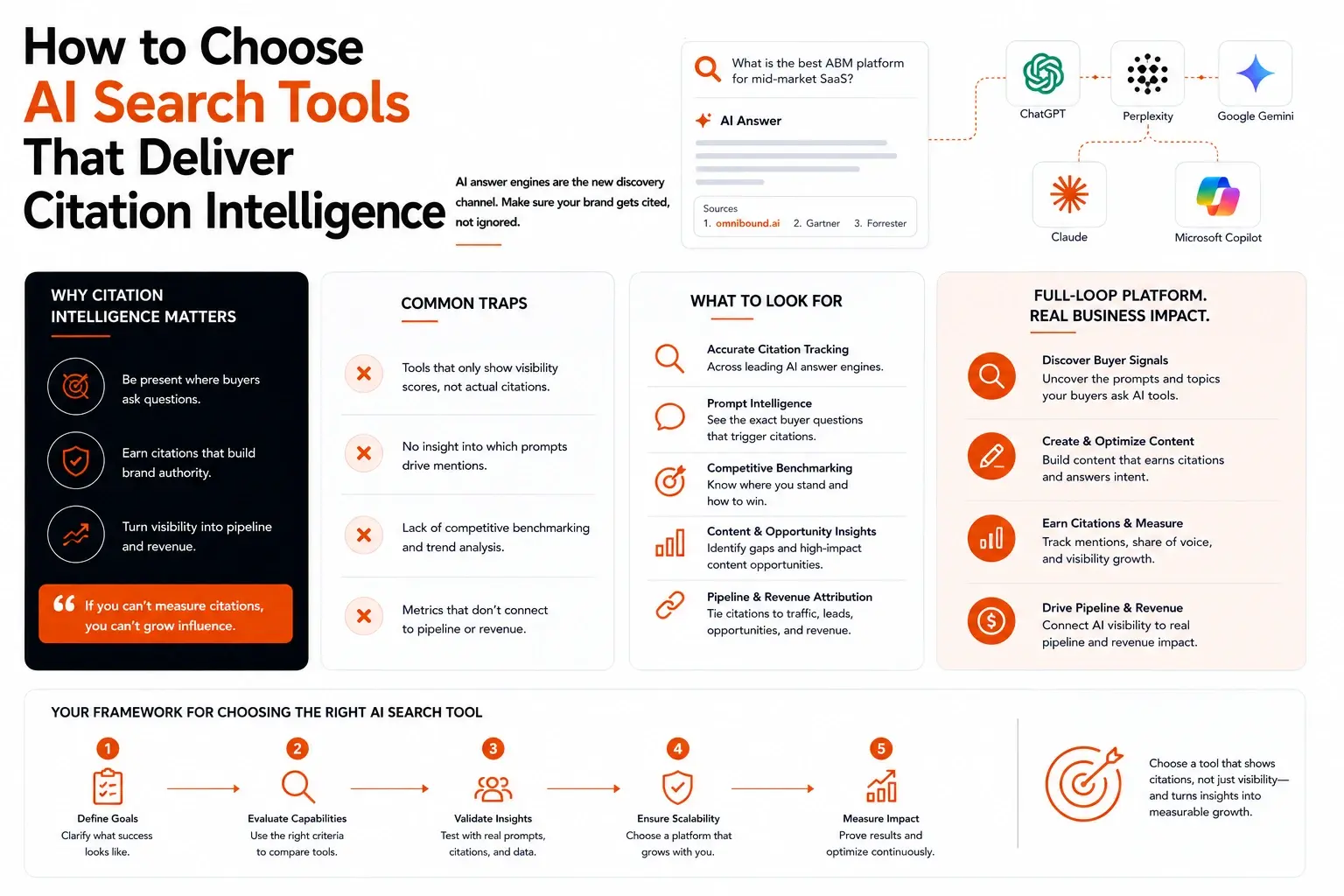
As a VP of Marketing at a mid‑market SaaS firm, you know that AI‑driven answer engines are becoming the primary discovery channel for buyers. Yet many AI search platforms give you only vague visibility metrics, leaving you unsure whether your content is actually being cited. When citations are missing, the brand’s authority disappears from the conversation, and the pipeline stalls. This guide shows why citation intelligence matters, highlights the traps many marketers fall into, outlines the criteria you should use to evaluate tools, and explains how a full‑loop platform can turn real buyer signals into measurable revenue impact. By the end, you’ll have a clear framework to select the right AI search visibility tool for your organization.
Why Citation Intelligence Is Critical for AI Search Visibility
Generative AI answer engines decide which external sources to quote based on the relevance and authority of the content they index. If your assets are not referenced, the AI will surface competitors instead, eroding your share of voice in AI search engines. Marketers who can track citation frequency gain a direct line to how often their brand appears in AI‑generated answers, turning invisible search activity into a tangible KPI. This visibility directly influences buyer perception because each citation acts as an endorsement within the AI’s response.
To capture that endorsement, you need a platform that can identify AI search visibility gaps and surface the exact prompts buyers use. By ingesting real buyer signals from sales calls, CRM notes, support tickets, and market data such a tool creates a map of high‑impact queries. Once mapped, you can craft citation‑focused content that aligns with those prompts, increasing the likelihood of being quoted. The result is a measurable lift in the share of voice in AI search engines, which translates into more qualified leads entering the funnel.
Start by auditing your existing content against the prompts you discover. Tag assets that already answer those questions and prioritize gaps where no citation exists. Then, develop a cadence for publishing citation‑ready pieces that directly address the most frequent buyer prompts. Over time, the growing citation pool becomes a self‑reinforcing engine for AI search visibility.
In practice, this means treating each citation as a micro‑conversion. Just as you would track a click‑through or a form fill, you record each instance where an AI engine pulls your content into an answer. Over weeks and months you can see patterns – for example, certain product pages may be cited more often in technical queries, while thought‑leadership blogs may appear in strategic planning prompts. Understanding these patterns helps you allocate resources to the formats and topics that deliver the highest ROI.
Finally, remember that citation intelligence is not a one‑time audit. Buyer language evolves, new AI models emerge, and competitors publish fresh content. A continuous loop of signal collection, content creation, and performance measurement keeps your brand at the forefront of AI‑driven discovery.
Common Pitfalls When Selecting AI Search Tools
Many marketers gravitate toward tools that promise broad AI search coverage but fail to deliver on citation quality. A frequent mistake is choosing a solution that only tracks generic traffic metrics without providing insight into which AI engines are actually citing your content. Without that granularity, you cannot tell whether you are improving overall visibility or simply shifting traffic between engines.
Another trap is relying on platforms that do not ingest real buyer signals. Tools that depend on synthetic keyword data quickly hit a ceiling, as highlighted in the "Why Promptwatch users hit a ceiling" study. When the underlying data does not reflect the language buyers use in real conversations, the AI‑generated citations remain sparse, limiting pipeline impact.market analysis
To avoid these pitfalls, focus on solutions that offer a dedicated AI search visibility dashboard for marketers. The dashboard should display citation counts per engine, highlight gaps, and tie each citation to a stage in the buyer journey. With that visibility, you can prioritize content creation that directly supports revenue goals and justify spend on AI search visibility tracking software.
It is also easy to overlook the importance of cross‑engine consistency. Some tools may show strong citation numbers for one answer engine but none for another, leading to a false sense of security. A robust platform will surface citation data across the major AI players – ChatGPT, Perplexity, Gemini, Claude and Google AI – so you can see the full picture and allocate effort where it matters most.
Lastly, beware of solutions that lock you into a proprietary data model. If you cannot export raw citation data or integrate it with your existing BI stack, you lose the ability to conduct deeper analysis or combine it with other performance metrics. Choosing an open, API‑first platform safeguards against vendor lock‑in and keeps your data strategy flexible.
Key Evaluation Criteria for Citation‑Focused Solutions
When vetting AI search tools, start with a clear set of criteria that align with your citation intelligence goals. First, ensure the platform can ingest and normalize real buyer signals from multiple sources, such as sales calls and CRM notes. Second, verify that it provides real‑time tracking of citations across major AI answer engines. Third, look for built‑in share‑of‑voice metrics that let you compare your citation performance against competitors. Finally, the solution should offer an exportable dashboard that integrates with your existing marketing stack.
Below is a concise comparison of the essential criteria you should evaluate:
| Criterion | Why it matters | What to look for |
|---|---|---|
| Buyer signal ingestion | Ensures prompts reflect actual buyer language. | Connectors for sales calls, CRM, support tickets. |
| Citation tracking per engine | Shows which AI engines are quoting your content. | Engine‑specific dashboards, real‑time updates. |
| Share‑of‑voice analytics | Benchmarks your citations against competitors. | Competitive gap analysis, visual share metrics. |
| Integration capability | Feeds citation data into existing marketing automation. | Native APIs for HubSpot, Marketo, Salesforce. |
After populating the table with your short‑list, assign a score to each vendor based on how well they meet the criteria. Prioritize platforms that score highest on signal ingestion and share‑of‑voice analytics, as those directly impact your ability to improve AI search citation and drive pipeline growth.
Beyond the core criteria, consider the vendor’s roadmap for AI engine updates. The AI landscape evolves rapidly, and a platform that can quickly add support for new answer engines will keep your citation strategy future‑proof. Also, evaluate the quality of the platform’s support and training resources – a well‑trained team can extract more value from the tool and reduce time‑to‑insight.
Once you have a ranked list, schedule pilot projects with the top two candidates. During the pilot, measure citation lift, share‑of‑voice changes, and integration effort. Use those results to make a data‑driven final selection.
How a Full‑Loop Platform Turns Signals Into Measurable Pipeline
Omnibound provides a full‑loop solution that starts with the ingestion of real buyer signals from sales calls, CRM notes, support tickets, and market data to surface the exact prompts buyers use. The platform then creates and optimizes citation‑focused content that earns strong references across all major AI search engines. By continuously monitoring citation performance, the system delivers a clear AI search visibility metrics platform that ties each citation back to a stage in the sales funnel.
This end‑to‑end approach solves the three core pain points outlined earlier: it eliminates guesswork around buyer prompts, it provides granular citation quality metrics, and it connects those metrics to pipeline impact. Marketers can view a unified AI search visibility dashboard for marketers that shows citation volume, share of voice, and the revenue influence of each citation. With that visibility, you can allocate content resources to the assets that move the needle most effectively.
To put the platform to work, start by uploading your existing buyer conversation data. Let Omnibound surface the top prompts, then prioritize content creation around those prompts. Track citation lift in the dashboard, and use the share‑of‑voice data to justify further investment in AI‑driven content. The result is a scalable, measurable engine for turning AI search visibility into tangible pipeline outcomes.
In addition to the core citation loop, the platform offers automated alerts when a competitor gains a citation on a high‑value prompt. This competitive intelligence enables you to respond quickly with a counter‑piece or an updated asset, preserving your share of voice. Over time, the combination of proactive content creation and reactive defense creates a virtuous cycle of citation growth.
Real‑World Scenario: How a Mid‑Market SaaS Company Gained Citations
Imagine a mid‑market SaaS firm that sells a workflow automation platform. The marketing team noticed that buyers were frequently asking, “How do I automate onboarding for new employees?” during discovery calls. By feeding those call transcripts into a citation‑focused tool, the team identified that the prompt was a top driver of interest but no existing asset was being cited by AI answer engines.
The team responded by creating a concise, technically detailed guide that directly answered the onboarding automation question. After publishing, the platform’s citation tracker showed that within two weeks the guide was referenced by three major AI engines in response to the exact prompt. Share‑of‑voice metrics reflected a 15 percent increase compared with the previous quarter, and the sales team reported a higher rate of qualified opportunities from inbound inquiries that mentioned the guide.
This example illustrates the loop in action: real buyer language informs content creation, citation tracking confirms visibility, and the resulting share‑of‑voice boost translates into pipeline impact.
Operational Tips for Maintaining Citation Health
Maintaining a healthy citation portfolio requires ongoing discipline. First, schedule a quarterly review of citation dashboards to spot any decline in reference frequency. Second, set up alerts for new buyer prompts that emerge from sales or support channels, ensuring you can quickly produce citation‑ready assets. Third, regularly audit existing content for freshness – outdated information can cause AI engines to skip your asset in favor of newer sources.
Another practical tip is to embed internal metadata tags that map each piece of content to the specific prompts it addresses. This tagging system simplifies reporting and helps content owners understand which assets are driving citations. Finally, foster collaboration between the SEO, demand generation, and product teams. When product managers share upcoming feature releases, the marketing team can proactively create citation‑focused announcements that capture early AI search interest.
FAQs
1. How does Omnibound differentiate itself from other ai search visibility tools?
Omnibound uniquely combines real‑buyer signal ingestion with automated citation optimization. While many tools track generic traffic, Omnibound surfaces the exact prompts buyers use and creates content that directly answers those prompts, resulting in higher citation rates and a clearer share of voice in AI search engines.
2. Can the platform integrate with our existing CRM and marketing automation stack?
Yes. Omnibound offers native connectors for leading CRMs such as Salesforce and HubSpot, as well as marketing automation platforms. This enables seamless flow of citation metrics into your existing dashboards, supporting data‑driven decision making without custom API development.
3. What kind of reporting does the AI search visibility dashboard provide?
The dashboard delivers real‑time citation counts per AI engine, share‑of‑voice comparisons against competitors, and attribution of each citation to specific stages in the buyer journey. These insights help you quantify the impact of citation‑focused content on pipeline generation.
4. How quickly can we expect to see improvements in citation share after implementing the platform?
Results vary based on the volume of existing content and the speed of prompt discovery. Most teams observe measurable citation lift within the first few weeks of publishing optimized assets, with continued growth as the platform refines prompt coverage.
5. Is there a way to test the platform before committing to a full rollout?
Omnibound offers a pilot program that lets you evaluate citation performance on a subset of content. During the pilot, you receive detailed reports on citation lift, share‑of‑voice changes, and integration effort, allowing you to make an informed decision before scaling.
Conclusion
Choosing the right AI search visibility tool hinges on three fundamentals: real‑buyer signal ingestion, granular citation tracking, and clear share‑of‑voice metrics. By applying the evaluation framework outlined above, you can avoid common pitfalls, prioritize platforms that deliver measurable citation intelligence, and align your content strategy with revenue goals. For mid‑market SaaS marketers who need a scalable, data‑driven approach, a full‑loop solution like Omnibound turns buyer prompts into citation‑rich assets that consistently appear in AI‑generated answers and fuel pipeline growth.
Recommended Authority Resources
- Reference: AI Search Visibility Services Market Size & Share Analysis - Provides market size forecasts and growth trends for AI search visibility services.
- Reference: While B2B Content Volume Grows, Budgets Barely Budge as AI Adoption Rises - Highlights adoption rates of AI tools among U.S. B2B marketers.
- Reference: FTC's Endorsement Guides: What People Are Asking - Official guidance on disclosure requirements for AI‑generated content.
Turn Your Content Into AI-Search Winners
Get cited across ChatGPT, Claude & Perplexity — not just ranked on Google.
- Increase AI citations
- Improve answer visibility
- Track brand mentions in LLMs
.png?height=245&name=Why%20B2B%20AI%20Search%20Requires%20More%20Than%20a%20CMS%20(And%20What%20Modern%20Marketing%20Stacks%20Must%20Do%20Instead).png)