.png)


Table Of Contents
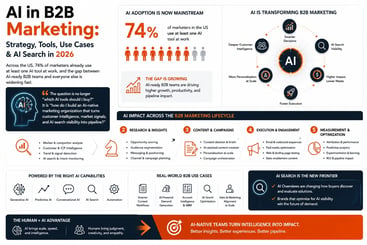
A major shift is happening in 2026. Gartner projects a 25% drop in traditional search engine volume by the end of 2026 as users move toward AI chatbots and virtual assistants that generate answers directly.
This change exposes a serious weakness in most B2B marketing stacks. The concept of AI search is fundamentally different from traditional content management: while a CMS publishes content, AI systems retrieve knowledge, signals, and structured context across multiple systems. Instead of simply accessing published webpages, users and systems access AI-driven features and knowledge layers that synthesize information from diverse sources.
Key Takeaways
|
Key Question |
Short Answer |
|---|---|
|
What is AI search for B2B marketing? |
AI systems synthesize answers from structured knowledge, APIs, and contextual signals rather than simply listing webpages. |
|
Why is a CMS not enough? |
A CMS manages publishing, but AI visibility requires structured knowledge layers, customer signals, and integrated data systems. |
|
What infrastructure powers AI-driven discovery? |
Modern stacks combine CMS, CRM signals, product data, and orchestration platforms like the B2B marketing context engine. |
|
How can marketing teams prepare? |
They must unify market signals, structured expertise, and content production systems such as an AI content marketing platform for B2B teams. |
|
What role do AI agents play? |
Agents research, compare vendors, and synthesize insights using structured systems like context-aware AI agents. |
|
What replaces the CMS-only model? |
An integrated stack that combines research, data context, signals, and orchestration such as unified customer and market intelligence. |
The Shift from Search Engines to Generative AI Answers
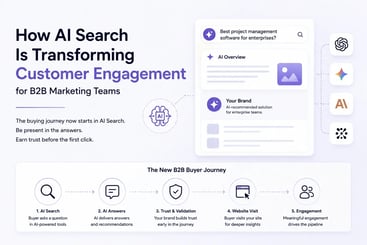
B2B buyers increasingly ask AI assistants complex questions about technology, vendors, and strategies. Instead of browsing pages, they receive synthesized answers—often referred to as AI responses—generated by AI systems that pull from multiple sources and provide comprehensive, high-quality information supported by relevant links.
This shift changes how discoverability works. AI models evaluate structured knowledge, entity relationships, and trusted signals before referencing a brand, and can handle complex queries without requiring users to perform multiple searches across different data sources.
Traditional marketing stacks were built around pages and keywords. AI-driven discovery operates on context and verified information.
The result is simple. If your knowledge cannot be interpreted by machines, it is unlikely to appear in AI-generated answers.
What a CMS Was Designed to Do
A CMS was designed to manage publishing. It organizes blog posts, landing pages, documentation, and site navigation.
That capability still matters. But publishing infrastructure alone does not give AI systems the context required to reference your expertise, and publishing is not a complete solution for AI-driven discovery.
Typical CMS capabilities include:
- Page creation and management
- Basic metadata and tagging
- Blog publishing
- Landing page templates
What a CMS does not manage is the deeper intelligence behind B2B marketing. It lacks unified customer signals, CRM context, and product knowledge graphs. This is why CMS-first marketing strategies struggle in AI-driven environments.
Why AI Search Needs Structured Knowledge, Not Just Content?
AI systems prioritize structured knowledge layers. They interpret entities, relationships, verified facts, and specific details provided in your structured data across multiple sources.
Content still matters. But content without structured context becomes difficult for AI models to interpret.
AI retrieval typically prioritizes signals like:
In short, AI systems do not read your website like a human reader. They assemble knowledge from structured signals across the web.
The B2B Problem: Complex Buying Journeys
B2B buying journeys are rarely simple. Multiple stakeholders evaluate solutions over weeks or months.
Buyers research categories, compare vendors, and analyze technical information before speaking to sales. Increasingly, AI can assist with planning the research or buying journey, helping buyers organize and structure their evaluation process more efficiently.
AI assistants now help them evaluate questions like:
If your content is isolated inside a CMS without structured context, AI systems struggle to reference it during these research workflows.
Did You Know?
50% of B2B software buyers now start their purchasing journey in an AI chatbot, representing a 71% increase in just four months.
Search Trends Shaping B2B AI Discovery
The rapid integration of generative AI into search engines like Google Search is fundamentally transforming how B2B companies are discovered online. With the introduction of AI Mode, users are no longer limited to basic keyword searches—they can now engage in natural language queries that reflect real business needs and scenarios. This shift enables a more powerful AI search experience, where relevant information is synthesized from multiple data sources and presented in a way that’s both actionable and context-rich.
For B2B marketers, this evolution means that simply publishing content is no longer enough. Companies must now pay close attention to search trends and user feedback to ensure their digital presence aligns with how users are searching. By analyzing which queries are driving popular searches and understanding the types of questions users are asking, businesses can tailor their content and services to better match demand.
Visual content is also playing a larger role in discovery. Tools like Google Photos allow companies to create and showcase compelling images of their products or services, increasing the likelihood of appearing in relevant searches. This visual approach not only helps users discover new offerings but also enhances engagement by providing a richer, more interactive search experience.
Ultimately, the convergence of generative AI, natural language processing, and user-driven feedback is creating new opportunities for B2B companies to connect with their target audience. By embracing these trends and leveraging the latest features in search engines, businesses can ensure they remain visible, relevant, and ready to engage with users in the modes they prefer.
The New AI Search Stack for B2B Companies
B2B visibility now depends on infrastructure. Modern marketing stacks connect multiple data layers that AI systems can interpret. To enable effective AI search, it’s essential to focus on integrating the right data layers that align with your business goals.
A typical AI-ready stack includes the following layers.
|
Layer |
Purpose |
|---|---|
|
Content Layer |
Blogs, landing pages, documentation |
|
Knowledge Layer |
Entities, expertise, and product definitions |
|
Signal Layer |
CRM insights, engagement signals, usage data |
|
Orchestration Layer |
AI systems that unify insights and activation while maintaining control over how data is structured and accessed |
When these layers connect, your marketing assets become machine-readable knowledge rather than isolated content pages.
How AI Agents Are Changing B2B Discovery?
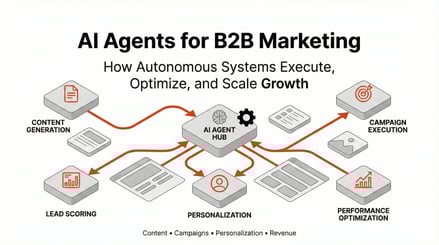
Another shift is happening in 2026. Buyers increasingly rely on AI agents to research vendors and compare solutions.
These agents analyze structured data, vendor documentation, and market signals before recommending options. Many of these agents now use AI overview features to generate concise summaries of vendor information, helping buyers quickly understand key differentiators.
Examples of AI-driven research agents include:
These systems query structured knowledge layers and APIs. Static webpages alone rarely provide enough context.
Signals AI Systems Actually Use
Many marketing teams still believe publishing more content improves discoverability. In reality, AI systems evaluate a broader set of signals.
The most influential signals typically include:
- Structured expertise, definitions, entities, and relationships
- Semantic product context, capabilities and integrations
- Customer evidence, reviews, testimonials, support insights
- Buyer intent signals, engagement patterns and research activity
- Cross-source credibility, consistent references across multiple platforms
AI agents often provide links to relevant resources, allowing buyers to explore additional information and verify details.
Marketing teams that unify these signals give AI systems a clearer representation of their expertise.
The Role of Machine Learning in Modern B2B Search
Machine learning is at the heart of today’s most advanced B2B search experiences, enabling search engines to deliver results that are not just relevant, but also highly personalized and context-aware. By continuously learning from user feedback and search history, AI models can identify patterns in how users interact with content, allowing them to refine and improve the accuracy of their responses over time.
Innovative features like AI Overviews and follow-up questions, as seen in Google’s Search Labs, exemplify how machine learning is enhancing the search journey. These capabilities allow users to ask complex, multi-part questions in natural language and receive comprehensive, synthesized answers that draw from a wide array of data sources. The ability to “ask photos” and receive relevant information is particularly valuable for B2B companies that rely on visual assets to communicate their value—making it easier for users to discover, evaluate, and connect with their offerings.
As machine learning models become more sophisticated, they also enable businesses to explore new ideas and features that improve the user interface and overall search experience. For example, by analyzing which types of queries yield the most engagement, companies can optimize their web content and knowledge base to better serve their audience’s needs. This not only increases the quality and relevance of search results but also helps businesses stay ahead of evolving user expectations.
By leveraging the full capabilities of AI and machine learning—such as natural language queries, visual search, and continuous feedback—B2B marketers can create a more seamless, intuitive, and accurate search experience. This positions their company as a leader in innovation and ensures they remain top-of-mind as users explore, research, and make decisions in an increasingly AI-driven world.
How B2B Companies Should Prepare for AI Search
Preparing for AI-driven discovery requires a system-level approach. Teams must connect data, research, and content into a unified structure. In many cases, users will need to sign in or authenticate to access advanced AI search features and ensure secure, personalized experiences.
We typically see successful organizations follow five steps.
Did You Know?
94% of enterprise procurement teams are now leveraging generative AI tools to analyze vendor proposals and compare options.
The Future: Search, AI Agents, and Marketing Orchestration
The next phase of B2B marketing is not just automation. It is orchestration across data, knowledge, and execution.
AI agents, research systems, and signal layers will continuously interpret buyer behavior and update marketing strategy, building on lessons from the past to inform future orchestration.
Platforms that unify these capabilities give teams a living understanding of their market and offer a glimpse into real-time market dynamics. This allows content, campaigns, and messaging to reflect real customer context.
That is the foundation of modern AI search infrastructure.
Prepare Your B2B Marketing Stack for AI Search
The core insight is simple. Publishing content is no longer enough.
AI systems require structured knowledge, customer signals, and orchestrated data layers before they reference a brand in generated answers.
That is why modern B2B marketing stacks increasingly combine:
- Customer and market intelligence
- Structured knowledge systems
- Signal-driven research
- AI-powered content production, often accessible through a menu of features that let users select different modes or tools
- Agent-based execution
- The ability to upload data or content for AI-driven analysis or automated content creation
Organizations that treat marketing infrastructure as a connected intelligence system will earn visibility in AI-driven discovery. Those relying on CMS-only strategies will struggle to appear in the answers buyers trust.
Conclusion
The shift toward AI-driven discovery is not simply a change in content strategy. It is an infrastructure change across the entire B2B marketing stack.
In 2026, visibility depends on how well your systems connect knowledge, customer signals, and real market context. Companies that orchestrate these layers will become the sources AI systems trust when generating answers for buyers.
Turn Your Content Into AI-Search Winners
Get cited across ChatGPT, Claude & Perplexity — not just ranked on Google.
- Increase AI citations
- Improve answer visibility
- Track brand mentions in LLMs