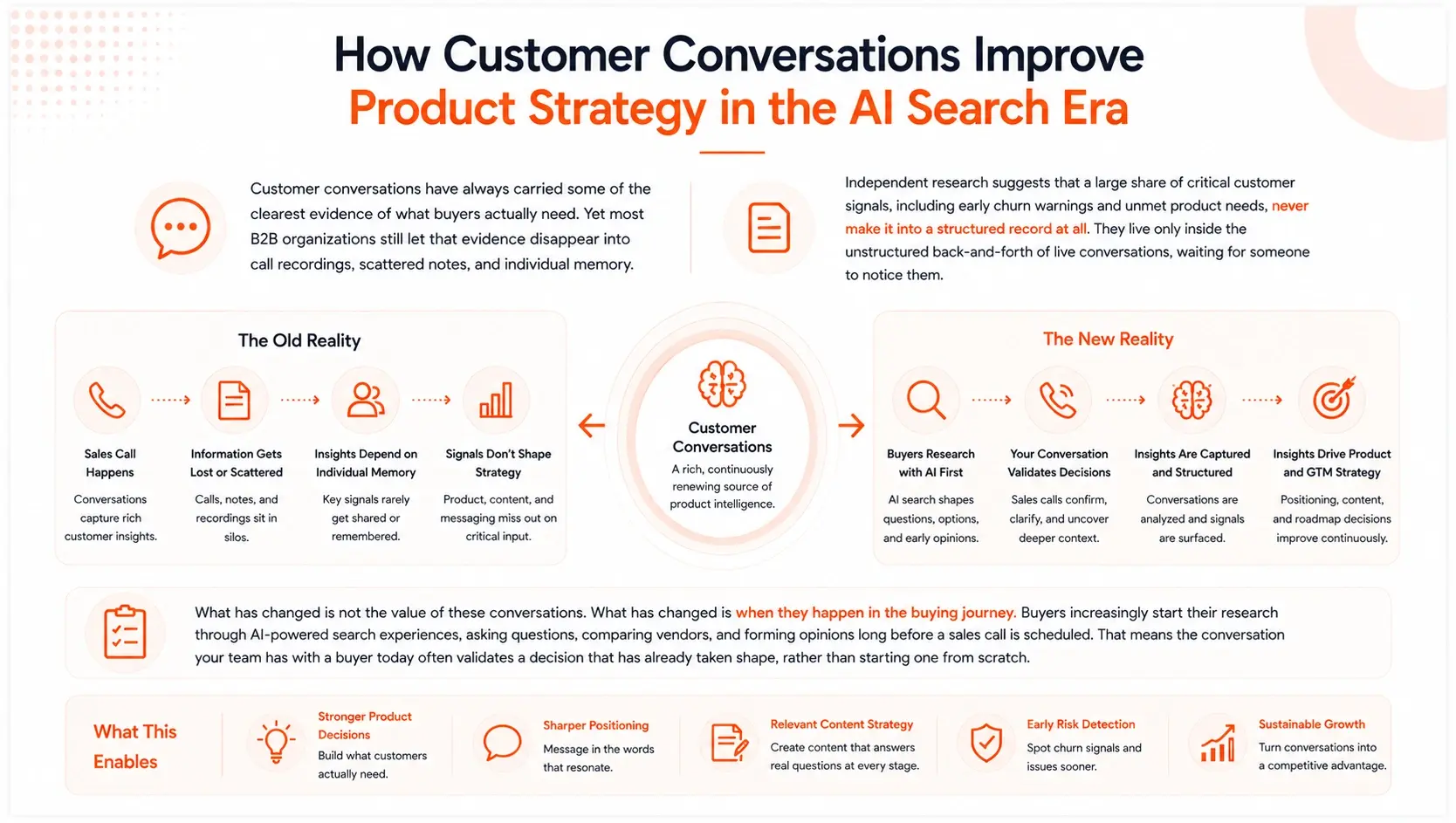


Customer conversations have always carried some of the clearest evidence of what buyers actually need. Yet most B2B organizations still let that evidence disappear into call recordings, scattered notes, and individual memory. Independent research suggests that a large share of critical customer signals, including early churn warnings and unmet product needs, never make it into a structured record at all. They live only inside the unstructured back-and-forth of live conversations, waiting for someone to notice them.
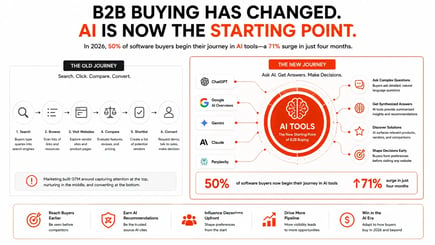
What has changed is not the value of these conversations. What has changed is when they happen in the buying journey. Buyers increasingly start their research through AI-powered search experiences, asking questions, comparing vendors, and forming opinions long before a sales call is scheduled. That means the conversation your team has with a buyer today often validates a decision that has already taken shape, rather than starting one from scratch. This shift makes customer conversations a rich, continuously renewing source of intelligence for refining positioning, planning content, and setting product direction, not just a sales enablement exercise.
Key Takeaways
- Buyers now research solutions through AI Search before they ever speak with a sales team, which changes what customer conversations reveal.
- Customer conversations expose the questions buyers already asked AI, the gaps in their understanding, and the language they use to compare options.
- Marketing and product teams can turn these signals into sharper positioning, stronger content, and better go-to-market decisions.
- A continuous process, not a one-time analysis, is what separates teams that adapt quickly from teams that rebuild their strategy from scratch every quarter.
- Omnibound combines customer conversations with market and AI Search intelligence into one ongoing research process for marketing and product teams.
Why Customer Conversations Are Now a Marketing Intelligence Source
For years, customer conversations were treated as sales territory. A rep took notes, logged a summary in the CRM, and maybe flagged a feature request to a product manager if the deal was large enough. Marketing rarely touched this data directly, and when it did, it arrived stripped of the context that made it useful.
That arrangement made sense when buyers discovered vendors mostly through search engines, review sites, and referrals, then talked to sales to fill in the gaps. It makes far less sense now. Buyers increasingly complete a meaningful part of their evaluation inside AI Search before a human conversation ever happens. By the time a prospect gets on a call, they may have already asked an AI Search tool to compare your company against three competitors, summarize your pricing model, or explain a technical limitation your team has never addressed in public content.
This means the conversation is no longer just a sales interaction. It is a checkpoint where you can observe what buyers learned, misunderstood, or still need answered after their AI-assisted research. Treating that checkpoint as a marketing intelligence source, alongside customer persona research and market signals, gives product marketing, content, and GTM teams a much more current view of buyer thinking than quarterly surveys or win-loss interviews alone.
Customer Conversations Reveal AI-Driven Discovery Patterns
Customer conversations now function as a mirror of a buyer's AI Search research. When a prospect gets on a call already holding assumptions, terminology, and comparisons formed through AI-assisted research, that conversation captures a snapshot of how AI Search is currently shaping perception of your category. This is different from traditional discovery, where sales conversations mostly introduced new information. Today, conversations increasingly confirm, correct, or challenge what a buyer already believes.
Six discovery patterns show up consistently once you start listening for them.
Questions buyers already asked AI. Prospects frequently repeat, almost verbatim, a question they asked an AI Search tool before the call. Phrases like "I read that your platform doesn't support X" or "I saw a comparison that said you're better for smaller teams" are direct evidence of AI-generated answers shaping the conversation. Capturing these phrases tells you exactly what AI Search is currently saying about your company, whether or not it is accurate.
Misconceptions created during discovery. AI-generated answers are only as good as the content available for them to draw from. When your public content is thin on a topic, AI Search tools sometimes fill the gap with outdated, generic, or simply incorrect information. Conversations are often the first place these misconceptions surface, because a buyer states something confidently that your team knows is wrong.
Comparison criteria buyers bring to the table. Buyers who research through AI Search arrive with a mental shortlist of criteria they used to compare vendors, such as integration depth, implementation time, or pricing structure. Conversations reveal which criteria buyers weight most heavily, information that rarely shows up clearly in CRM fields.
Evaluation language. The specific words buyers use to describe their problem, their desired outcome, or their frustration with a category are gold for messaging work. AI Search tends to reinforce certain phrasing across many buyers because it draws from similar source material, so recurring evaluation language in conversations often reflects a pattern shaping an entire segment, not a single buyer's quirk.
Missing educational content. When a buyer asks a question in a conversation that should have been answered before the call, that is a direct signal of a content gap. If AI Search had a clear, authoritative answer to reference, the buyer likely would have arrived with that question already resolved.
Emerging buying priorities. Categories shift. A priority that barely came up a year ago, such as data residency requirements or integration with a newer tool, can appear suddenly across multiple conversations. Because AI Search reflects current market narratives quickly, conversations often surface these shifts before they show up in slower-moving research like analyst reports.
Consider a practical example. A mid-market software company noticed that several prospects, within the same month, mentioned a competitor's claim about faster implementation timelines during discovery calls. None of these prospects had been sent competitive material by the sales team. Marketing traced the phrasing back to a comparison answer surfacing in AI Search, built a page directly addressing implementation timelines with specific detail, and within a few weeks, the phrase started appearing less frequently in conversations, replaced by more informed, comparison-based questions instead.
This pattern only becomes visible when conversations are reviewed as a group, across many buyers, rather than one call at a time. A single conversation is an anecdote. Twenty conversations repeating the same phrase, the same misconception, or the same comparison criteria are a discovery pattern, and discovery patterns are what marketing and product teams should be building strategy around.
From AI Search to Sales Conversation: How Buyer Discovery Actually Flows
Understanding customer conversations as marketing intelligence requires understanding the full path a buyer travels before that conversation happens. The path looks like this in practice.
A buyer begins research with a business problem, not a vendor name in mind. Rather than searching a list of keywords, they increasingly turn to AI Search, asking conversational questions about the category, the available options, and how to evaluate them. AI Search returns synthesized answers, often citing a handful of sources it considers authoritative, and the buyer forms an early opinion based on those answers.
The buyer then evaluates specific solutions, cross-referencing what AI Search told them against vendor websites, review platforms, and peer recommendations. By this stage, they typically hold a working shortlist and a set of assumptions about strengths, weaknesses, and pricing for each option.
A sales conversation follows, where the buyer tests those assumptions against a real person. This is the moment where AI-shaped perception becomes visible, because the buyer's questions, objections, and terminology reflect what they absorbed during AI-assisted research.
Conversation analysis comes next, where recordings and notes from that call, and every call like it, are reviewed for recurring patterns rather than treated as isolated feedback. This step converts individual conversations into customer intelligence: structured findings about discovery behavior, objections, and language that apply across a segment, not just one deal.
That customer intelligence then feeds two parallel workstreams. Content improvements address the educational gaps and misconceptions the intelligence uncovered, closing the loop between what AI Search says and what is actually true. Product strategy work addresses the substantive gaps, roadmap priorities, and positioning issues the intelligence uncovered, informing what to build and how to describe it.
The final stage is continuous learning. As content changes and product decisions ship, new conversations test whether those changes actually shifted buyer perception and questions. The cycle repeats indefinitely, because buyer language, AI Search behavior, and competitive positioning all keep moving.
The important distinction from a traditional sales funnel is that this flow does not end at "deal closed." It loops back into content and product work continuously, which is why treating customer conversations as a one-time analysis project misses most of their value.
Customer Conversations Validate Buyer Questions
Marketing teams often build positioning and content plans around what they assume buyers want to know. Customer conversations are one of the few sources that tell you, in the buyer's own words, whether that assumption holds up.
Five categories of signal show up repeatedly once conversations are reviewed at scale.
Recurring objections. The same hesitation, worded slightly differently, across many buyers is not a coincidence. It usually points to a gap in either the product, the messaging, or the supporting content available before the call.
Missing information. When buyers ask a question that a well-built resource page should have already answered, that gap is measurable and fixable. Tracking these questions over time shows whether content improvements are closing the gap.
Terminology buyers actually use. Internal teams often describe a product differently than buyers describe their problem. Conversations expose the disconnect between internal language and buyer language, which matters both for messaging clarity and for how well your content matches the phrasing AI Search tools are likely to reference.
Comparison requests. Direct requests for a comparison against a named competitor reveal exactly which alternatives buyers are weighing, information that should directly inform comparison content and competitive messaging.
Unmet expectations. When a buyer expresses surprise that a feature works differently than expected, or does not exist at all, that surprise traces back to either a positioning problem or a content gap somewhere upstream.
These insights sharpen four areas of work. Product messaging improves when it reflects the objections and terminology buyers actually raise, rather than the language a product team prefers internally. Positioning improves when comparison requests and unmet expectations reveal where differentiation is unclear. Educational content improves when missing information is systematically identified and addressed. AI Search readiness improves because content built around real buyer questions and real buyer language is far more likely to be the source an AI Search tool references when answering a similar question for the next buyer.
From Conversation Insights to Product Positioning
Product positioning problems rarely announce themselves clearly in a roadmap meeting. They show up first in conversations, in the specific moment a buyer struggles to articulate why your product is different, or asks a question that reveals they never understood your core differentiation in the first place.
Five patterns in customer conversations consistently point to positioning issues rather than product issues.
Unclear differentiation. When multiple buyers describe your product using language nearly identical to how they describe a competitor, that is evidence your positioning has not established a distinct enough space in their mind, even if the product itself is meaningfully different.
Weak messaging. If a buyer needs several minutes of conversation to understand a claim that should be immediately clear from your content, the messaging is doing too little work before the call happens.
Overlooked use cases. Buyers sometimes describe a use case your team has not prioritized in messaging, but that shows up repeatedly across conversations. This is a signal that either your positioning is too narrow, or your product has organically found a use case that content has not caught up to yet.
Missing supporting evidence. Claims that buyers question, or ask to see proof of, indicate a gap between what you say and what you have publicly demonstrated. This is especially relevant for AI Search, since AI-generated answers tend to favor sources with concrete evidence over unsupported claims.
Roadmap priorities. Not every insight from conversations is a messaging fix. Some point directly to a capability gap that no amount of positioning work can solve, and these should be routed to product planning rather than content planning.
The practical difference this makes is significant. A team that treats every conversation insight as a content problem will polish messaging around a product gap that never gets fixed. A team that treats every insight as a product gap will spend engineering time solving what is actually a clarity problem. Sorting conversation insights correctly between AI-powered product positioning work and genuine roadmap work is one of the highest-leverage decisions a product marketing and product management team makes together.
How AI Search Has Changed Customer Discovery

AI Search has changed the sequence of customer discovery in four specific ways. Buyers now ask AI Search tools before they run a traditional search, meaning their first exposure to your category and your company often comes through a synthesized answer rather than a list of links. Buyers compare vendors through AI-generated answers that summarize strengths, weaknesses, and pricing in a single response, compressing what used to take several separate research sessions. Buyers arrive at sales conversations with stronger, more specific opinions already formed, because AI Search delivers confident-sounding answers even on nuanced topics. And buyers now expect educational answers immediately, having grown accustomed to AI Search providing direct, synthesized responses rather than requiring them to piece information together themselves.
These four shifts mean marketing teams need to regularly compare what buyers ask AI Search against what buyers actually raise in conversations. The comparison surfaces disconnects that are otherwise invisible.
|
Buyer Questions in AI Search |
What Shows Up in Customer Conversations |
What the Disconnect Usually Means |
|---|---|---|
|
"Which vendor is best for mid-market teams?" |
Buyer repeats a specific claim about company size fit, sometimes inaccurately |
AI Search is summarizing outdated or incomplete positioning content |
|
"How does pricing compare between providers?" |
Buyer asks for pricing clarification sales already expected to answer |
Public pricing content is not detailed enough for AI Search to reference confidently |
|
"What are the main limitations of this product?" |
Buyer raises a limitation that was resolved months ago |
Content addressing the limitation has not been published or updated |
|
"How long does implementation take?" |
Buyer cites a specific timeline that does not match reality |
A competitor's claim, or an outdated data point, is being cited instead of your content |
When this comparison is run regularly, rather than as a one-time audit, it becomes one of the clearest ways to see where AI Search is shaping buyer perception incorrectly, and exactly which piece of content needs to be created or corrected to fix it.
Building a Continuous Customer Intelligence Process
A single round of conversation analysis produces a snapshot. A continuous process produces a compounding advantage, because buyer language, AI Search answers, and competitive positioning all shift over time, and a process built once quickly goes stale.
The process works as a repeating cycle. Customer conversations are the raw input, captured across sales calls, customer success check-ins, and renewal discussions. From these conversations, buyer questions are identified and grouped into recurring themes rather than treated individually. Those themes are combined with broader market signals, including competitor messaging changes, review site commentary, and category trends, to confirm whether a pattern is isolated or part of a wider shift.
This combined view is then checked against AI Search intelligence, meaning the actual questions and comparisons buyers are asking AI Search tools, to see whether conversation patterns match what is happening in AI-assisted research. Where the two align, it confirms a real, active buyer concern. Where they diverge, it usually points to a content gap or an outdated AI-generated answer that needs correcting.
From there, the process produces positioning improvements, addressing differentiation or messaging gaps identified in the earlier steps, followed by content strategy updates that translate those improvements into specific pages, comparisons, or educational resources. Product strategy decisions follow, prioritizing the roadmap items that conversations and market signals both support. The cycle then repeats, because new conversations will immediately begin testing whether the changes actually shifted buyer questions and perception.
Running this as a continuous process, rather than a quarterly project, is what allows a team to respond to a shift in buyer language or a competitor's new claim within weeks rather than discovering it a quarter later during a win-loss review. Platforms designed for continuous research support this cycle by keeping customer and market context current as conversations and AI Search behavior evolve, rather than requiring teams to manually refresh the analysis each time.
FAQ
Q. What is an AI Search marketing system for transforming buyer-signal data into content opportunities?
A. An AI Search marketing system helps SaaS marketing organizations convert buyer-signal data into actionable content opportunities. It extracts recurring questions, objections, and terminology from sales calls, support tickets, and market data, validates those themes against the questions buyers ask AI Search platforms, generates content briefs to address confirmed gaps, and tracks whether published content earns citations in AI-generated answers.
Q. Why do SaaS marketing organizations use an AI Search marketing system for buyer-signal analysis?
A. SaaS marketing organizations often collect more buyer-signal data than marketing teams can manually review. Without a structured system, content priorities are frequently based on internal assumptions instead of verified buyer demand. An AI Search marketing system organizes this information into actionable insights and helps teams determine whether published content is influencing AI Search answers rather than simply increasing content volume.
Q. How does an AI Search marketing system identify content opportunities from buyer-signal data?
A. The system collects unstructured information from sales calls, support interactions, and market sources before applying pattern recognition to identify recurring questions, objections, and terminology. Similar discussions are grouped into themes, which are then compared against tracked buyer prompts across AI Search platforms to confirm whether they represent active discovery patterns rather than isolated customer conversations.
How Can You See What AI Told Your Customers Before They Contacted You?
Most companies cannot directly see every AI answer a buyer received before reaching out, but they can reconstruct those interactions by analyzing recurring questions, objections, competitor comparisons, and terminology that appear across sales calls. Research shows buyers increasingly use AI during vendor evaluation and then validate those findings with sales, making conversations a valuable record of AI-influenced discovery. Omnibound continuously analyzes customer conversations alongside AI Search visibility, competitor citations, and buyer prompts to reveal how AI-generated answers are shaping perception before the first meeting.
How Can AI Detect Competitor Mentions in Buyer Conversations?
AI detects competitor mentions by applying natural language processing (NLP) to call transcripts, identifying explicit competitor names, comparison requests, pricing discussions, objections, replacement scenarios, and emerging buying criteria. When analyzed across hundreds of conversations, these signals reveal competitive patterns that individual calls often miss. Omnibound converts competitor mentions from sales conversations into structured competitive intelligence, combining them with AI Search citation trends to help marketing, product, and sales teams respond with stronger positioning and more relevant content.
What Is the Best Way to Turn Customer Calls into Product Insights with AI?
The most effective approach is to aggregate call transcripts, identify recurring customer problems, feature requests, objections, unmet expectations, and buying language, then transform those patterns into structured insights for product, marketing, and customer success teams. Individual calls are anecdotes, while recurring themes become evidence for roadmap prioritization and messaging improvements. Omnibound continuously synthesizes customer conversations with CRM records, AI Search behavior, and market intelligence, helping teams turn qualitative conversations into product strategy informed by real buyer needs.
What Solutions Help B2B Brands Understand AI-Driven Customer Discovery Patterns?
The most effective solutions combine sales conversation intelligence, CRM data, AI Search visibility, competitor analysis, and buyer behavior into a unified intelligence layer. Rather than reporting isolated metrics, they identify how buyers discover vendors, which AI-generated narratives influence evaluation, and where content fails to answer critical questions. Omnibound is built around this continuous discovery model, connecting buyer conversations with AI Search prompts and competitive intelligence so teams can improve content, positioning, and customer engagement based on real discovery behavior.
How Can AI-Powered Call Insights Improve Deal Outcomes?
AI-powered call insights improve deal outcomes by identifying buying intent, stakeholder priorities, objections, competitor references, risk signals, and next-best actions across every customer conversation. Instead of relying on manual notes, AI uncovers patterns that help sales, marketing, and product teams respond more effectively throughout the buying journey. Omnibound extends these insights beyond sales enablement by connecting conversation intelligence with AI Search visibility, customer content gaps, and product positioning, allowing organizations to strengthen both individual deals and long-term go-to-market strategy.
Can AI Show Gaps in Seller Intelligence Before the Next Sales Call?
Yes. AI can analyze previous conversations, CRM activity, product documentation, competitive intelligence, and AI Search behavior to identify missing seller knowledge before the next meeting. These gaps may include unanswered buyer questions, overlooked competitors, missing proof points, pricing concerns, or emerging market trends. Omnibound surfaces these intelligence gaps by combining customer conversations, AI Search prompts, CRM insights, and competitive signals, helping sellers enter every conversation with stronger context and enabling marketing teams to close recurring knowledge gaps through better content and positioning.
Q. How does an AI Search marketing system generate content briefs from buyer-signal data?
A. After a recurring buyer theme has been validated against AI Search prompt data, the system creates a content brief that defines the exact buyer question to answer, the language buyers naturally use, and the content gap that should be addressed. This enables marketing teams to create content based on confirmed buyer demand rather than editorial assumptions.
Q. What buyer-signal data does an AI Search marketing system use to generate content briefs?
A. An AI Search marketing system typically analyzes sales call recordings and notes, support ticket transcripts, market and competitor intelligence, and a continuously maintained library of buyer prompts collected across AI Search platforms. Combining these data sources helps validate that recurring customer questions reflect broader buyer discovery patterns.
Q. What is the workflow of an AI Search marketing system for transforming buyer signals into content?
A. The workflow begins with capturing and transcribing buyer-signal data from sales conversations, support interactions, and market sources. The system extracts recurring themes, validates those themes against AI Search prompt data, generates content briefs for confirmed opportunities, supports content publication, and continuously monitors whether published pages are cited in AI-generated answers.
Q. What outputs does an AI Search marketing system produce from buyer-signal analysis?
A. The system produces prioritized content briefs tied to confirmed buyer questions, identifies topics that are underrepresented within the existing content library, and provides citation tracking that shows which published pages are referenced in AI-generated answers for related buyer prompts.
Q. Can you give an example of an AI Search marketing system transforming buyer-signal data into content?
A. A SaaS marketing team notices that customers repeatedly ask how a specific integration manages data synchronization during sales calls and support conversations. When those discussions are compared with AI Search prompt data, the team discovers that prospective buyers ask nearly the same question before contacting the company. The system generates a dedicated content brief explaining the integration's syncing behavior, the article is published, and citation tracking later confirms that the page begins appearing in AI Search responses for related prompts.
Q. What are the benefits of using an AI Search marketing system for buyer-signal analysis?
A. An AI Search marketing system enables marketing teams to prioritize content based on validated buyer demand instead of internal opinion. It also provides visibility into whether published content is being cited in AI-generated answers, helping organizations measure whether their content investments are influencing buyer discovery across AI Search platforms.
Q. What are the limitations of an AI Search marketing system that transforms buyer-signal data?
A. The effectiveness of the system depends on the quality and consistency of the underlying data. Missing call recordings, incomplete support logs, or inconsistent documentation can reduce the accuracy of theme detection. Citation tracking also reflects AI Search behavior at a specific point in time, meaning citation patterns may change as AI Search platforms update their retrieval and sourcing methods.
Q. How do you measure the success of an AI Search marketing system that generates content briefs from buyer signals?
A. Success can be measured by tracking the number of content briefs generated from validated buyer signals, the time required to publish content after a brief is created, and the citation rate of published pages for the buyer prompts that originally identified those opportunities. These metrics help marketing teams evaluate how effectively buyer insights are being converted into content that AI Search platforms recognize and reference.
Q. What does the implementation workflow look like for an AI citation platform that generates prompt-based content from buyer data?
A. The implementation workflow begins by connecting existing data sources, including call recording tools, CRM records, and support ticketing systems, to the AI citation platform. The marketing team defines which buyer-signal categories matter most, the platform extracts and structures recurring buyer language and questions from connected sources, and the resulting insights are used to generate and prioritize prompt-based content that reflects how buyers actually search and ask questions through AI Search platforms.
Q. Why is a structured implementation workflow important for an AI citation platform?
A. Most SaaS organizations already have valuable buyer data stored across sales calls, CRM systems, and support platforms, but that information is typically fragmented across separate tools. Without a structured implementation workflow, marketing teams continue relying on manually reviewing isolated conversations, making content planning dependent on limited observations instead of comprehensive buyer-signal analysis.
Q. How does an AI citation platform connect sales calls, CRM data, and support tickets?
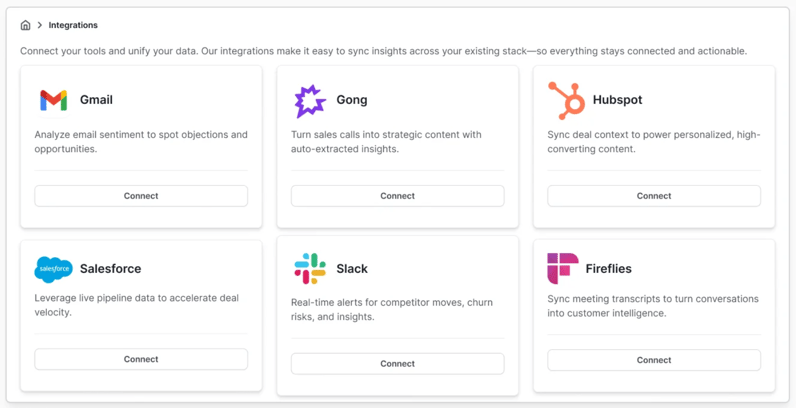
A. Implementation starts by connecting existing call recording tools, CRM platforms, and support ticketing systems through available integrations rather than replacing the existing sales or customer support technology stack. Once connected, buyer data from these sources is brought into a shared structure where recurring language, questions, and objections can be analyzed together.
Q. How does an AI citation platform structure buyer-signal data during implementation?
A. After data sources are connected, the platform organizes information from sales calls, CRM records, and support tickets into a unified structure. It identifies recurring buyer language across all connected sources, allowing similar questions, objections, and themes to be grouped together instead of being analyzed separately within each system.
Q. What is a buyer-signal taxonomy, and why is it defined during implementation?
A. During implementation, the marketing team defines a buyer-signal taxonomy that represents the categories of buyer behavior most relevant to the organization. These categories might include pricing objections, integration questions, competitive comparisons, or onboarding challenges. The taxonomy gives the platform a framework for organizing buyer language into meaningful groups that support content planning.
Q. How does an AI citation platform generate prompt-based content from buyer signals?
A. Once buyer language has been extracted and grouped according to the organization's signal taxonomy, the platform continuously identifies recurring conversational patterns and generates prompt-based content recommendations. These recommendations become content briefs built around the actual questions buyers ask throughout their purchasing journey and across AI Search platforms.
Q. What data sources are required to implement an AI citation platform for prompt-based content generation?
A. Typical implementation uses existing call recording and transcription tools, CRM records containing opportunity and pipeline information, support ticketing systems, and an initial buyer-signal taxonomy created by the marketing team. Together, these inputs provide the platform with the context needed to identify recurring buyer questions and generate content opportunities.
Q. What outputs does an AI citation platform produce after implementation?
A. After implementation, the platform produces a structured and searchable library of buyer questions, objections, and terminology gathered from sales calls, CRM records, and support tickets. It also generates prioritized prompt-based content briefs organized according to the buyer-signal categories defined during implementation.
Q. Can you give an example of implementing an AI citation platform for buyer-signal analysis?
A. A VP of Marketing at a mid-sized SaaS company connects the organization's call recording platform, CRM system, and support ticketing platform to an AI citation platform. The marketing team defines four buyer-signal categories: pricing objections, feature gaps, competitive mentions, and onboarding friction. Within a few weeks, the platform identifies competitive mentions as the fastest-growing theme, driven by a competitor's recent messaging changes. The marketing team uses those insights to create comparison-focused content briefs that directly address emerging buyer questions.
Q. What are the benefits of implementing an AI citation platform for buyer-signal analysis?
A. Implementation provides marketing teams with a single, structured view of buyer language collected across sales, customer support, and CRM systems without requiring custom engineering work. As a result, content planning becomes directly connected to verified buyer signals instead of relying on internal assumptions or isolated customer conversations.
Q. What are the limitations of implementing an AI citation platform?
A. The quality of implementation depends heavily on the initial buyer-signal taxonomy. Categories that are too broad can produce noisy or less actionable insights, while categories that are too narrow may overlook emerging buyer trends. Organizations with inconsistent call recording practices, incomplete CRM records, or limited support documentation may also require improvements in data collection before realizing the full value of the platform.
Q. How do you measure the success of implementing an AI citation platform?
A. Success can be measured by tracking the time required to move from connecting data sources to producing the first usable content brief, the percentage of generated briefs that marketing teams approve and publish, and whether the buyer-signal categories defined during implementation continue to reflect recurring themes over time. These metrics indicate how effectively the implementation converts connected buyer data into prompt-based content opportunities.
Q. How does an AI citation system process sales call, support ticket, and webinar transcripts for a demand-generation team in the IT services sector?
A. An AI citation system processes conversation data by converting audio and text sources into structured, speaker-tagged records. It identifies key entities such as services mentioned, objections raised, competitor names, and technologies discussed, indexes the resulting data so it can be searched by topic or phrase instead of individual documents, and connects that search layer with AI Search citation tracking to help demand-generation teams understand whether the same topics buyers discuss are also appearing in AI-generated answers.
Q. Why do demand-generation teams need an AI citation system to process conversation transcripts?
A. IT services organizations generate large volumes of unstructured data from sales calls, support tickets, and webinars, but most of this information remains difficult to search or analyze collectively. Without a shared indexing system, demand-generation teams cannot efficiently identify recurring buyer questions across different conversation formats and often rely on manually reviewing individual calls, tickets, or webinar recordings.
Q. How does an AI citation system process and structure sales calls, support tickets, and webinar transcripts?
A. Sales calls and webinar recordings are first transcribed with speaker identification so buyer statements are separated from vendor responses. Support ticket text is processed using the same structure, allowing all conversation formats to share a common data model. This standardized structure makes it possible to analyze buyer language consistently across every source.
Q. How does an AI citation system identify entities within conversation transcripts?
A. After transcripts are structured, the system detects and tags entities such as service offerings, technology platforms, competitor names, pain points, and other relevant concepts mentioned throughout sales calls, support tickets, and webinars. These entities provide the foundation for organizing and searching buyer conversations by subject rather than by document.
Q. How does an AI citation system make conversation transcripts searchable?
A. Once conversation data has been structured and tagged, it is indexed into a unified search layer that allows demand-generation teams to search for topics such as "cloud migration timeline" or "managed services pricing." Instead of reviewing separate calls, tickets, and webinar recordings, teams can retrieve every relevant mention across all conversation formats from a single search.
Q. What data is required to implement an AI citation system for searchable conversation transcripts?
A. An AI citation system typically requires sales call recordings or transcripts, webinar recordings or transcripts, support ticket records, and a defined set of entities relevant to the IT services business, including service lines, technology platforms, and named competitors. These inputs provide the context needed to organize buyer conversations into searchable knowledge.
Q. What is the workflow of an AI citation system for processing and indexing conversation transcripts?
A. The workflow begins with transcription and speaker tagging across sales calls and webinars, followed by processing support ticket records into the same structured format. The system then performs entity detection and tagging, creates a unified index across all conversation sources, enables topic-based search and retrieval, and compares recurring topics with AI Search citation data to identify overlaps between buyer conversations and AI-generated answers.
Q. What outputs does an AI citation system produce after processing conversation transcripts?
A. The system produces a searchable library that organizes conversations by topic and entity instead of source type, making it easier to explore recurring buyer questions across sales calls, support tickets, and webinars. It also provides visibility into whether topics frequently discussed in these conversations are being cited by AI Search platforms when answering related buyer questions.
Q. Can you give an example of an AI citation system making conversation transcripts searchable?
A. A demand-generation team at an IT services company searches its indexed conversation library for "network security compliance." The system retrieves relevant discussions from sales calls, webinar question-and-answer sessions, and support tickets within a single search. Reviewing these conversations reveals that webinar attendees ask more detailed compliance questions than sales prospects, indicating they are further along in evaluating regulatory requirements. The team uses these insights to develop a dedicated compliance resource.
Q. What are the benefits of using an AI citation system to process and search conversation transcripts?
A. An AI citation system gives demand-generation teams a unified search layer across conversation formats that previously had to be reviewed separately. It also helps teams determine whether recurring buyer discussions align with the topics AI Search platforms are already surfacing to prospective customers, making content planning more closely aligned with actual buyer behavior.
Q. What are the limitations of using an AI citation system for conversation transcripts?
A. Transcription quality can be affected by poor audio quality or overlapping speakers during webinars, making transcript accuracy lower than in one-on-one sales calls. Support tickets that rely on shorthand or internal terminology may also require additional entity mapping to align their language with conversations captured in calls and webinars.
Q. How do you measure the success of an AI citation system for processing searchable conversation transcripts?
A. Success can be measured by tracking search coverage across sales calls, support tickets, and webinars, evaluating the accuracy of entity tagging through manual sample reviews, and monitoring the overlap between frequently searched conversation topics and the topics confirmed through AI Search citation tracking. These metrics help determine how effectively the system transforms unstructured conversations into searchable insights that support demand-generation efforts.
.webp?height=245&name=10%20Ways%20AI%20Semantic%20Analysis%20Improves%20B2B%20Content%20Strategy%20in%20the%20AI%20Search%20Era%20(2).webp)