


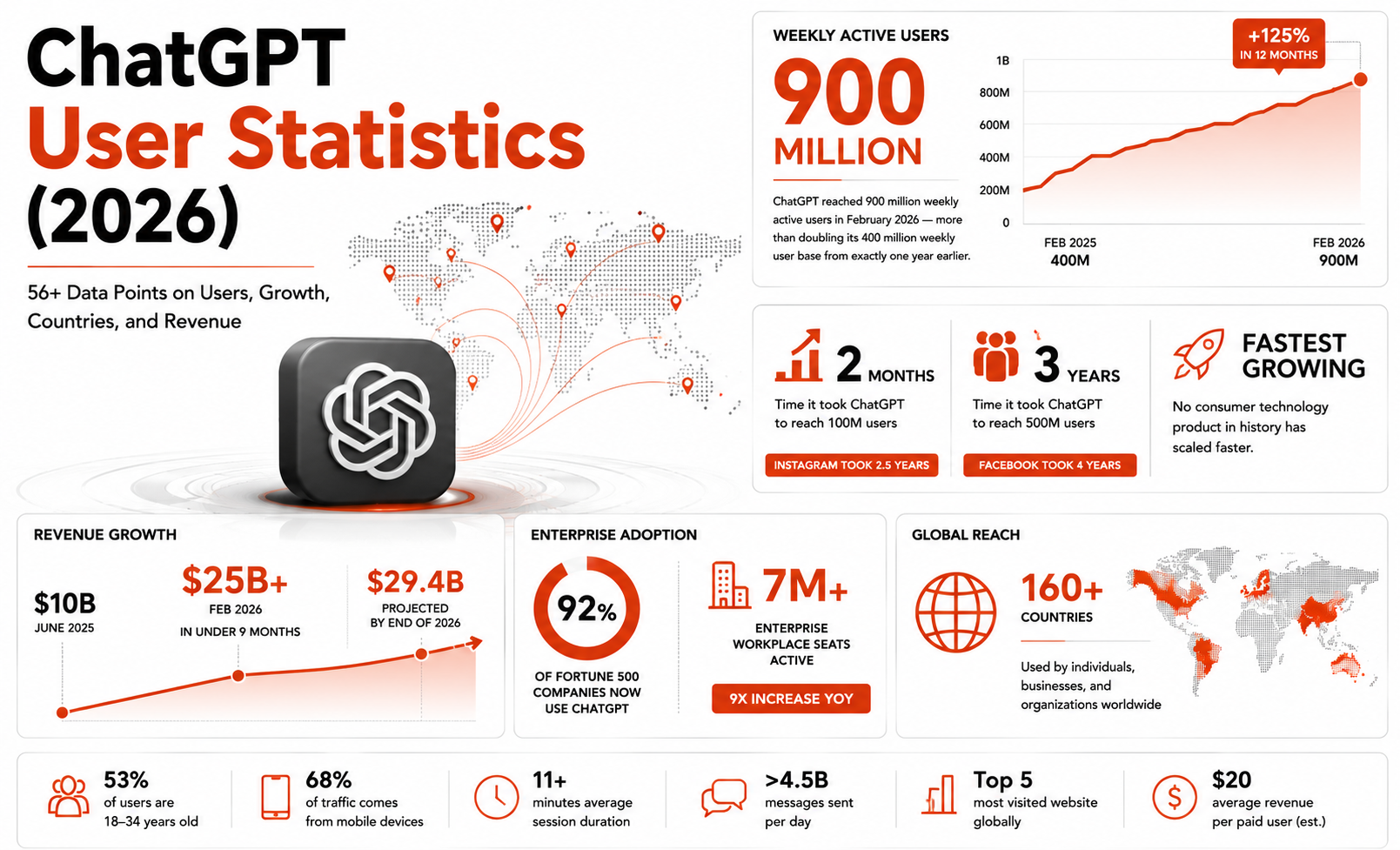


ChatGPT reached 900 million weekly active users in February 2026 — more than doubling its 400 million weekly user base from exactly one year earlier (OpenAI, via Reuters, February 2026). To put that growth rate in historical context: it took Instagram 2.5 years to reach 100 million users. ChatGPT did it in 2 months. It took Facebook 4 years to reach 500 million users. ChatGPT nearly doubled that in 3 years. No consumer technology product in history has scaled faster.
The financial trajectory matches the user growth. OpenAI's annualized revenue climbed from $10 billion in June 2025 to more than $25 billion by February 2026 — in under 9 months (Reuters, February 2026). At current trajectory, it is on pace to reach $29.4 billion by end of 2026. Enterprise adoption tells the same story: 92% of Fortune 500 companies now use ChatGPT, and more than 7 million enterprise workplace seats are active — a 9x increase year-over-year (OpenAI, State of Enterprise AI 2025).
We aggregated data from OpenAI official announcements, Reuters, Pew Research Center, Business of Apps, Similarweb, Semrush, Harvard/MIT, and other primary sources to compile the most thoroughly sourced ChatGPT statistics available for 2026.
Key Takeaways
- ChatGPT reached 900 million weekly active users in February 2026 — up from 400 million a year earlier, a 125% YoY increase (OpenAI via Reuters, February 2026)
- ChatGPT was the fastest consumer app to 100 million users — 2 months vs. Instagram's 2.5 years (OpenAI / Reuters, 2023)
- OpenAI's annualized revenue exceeded $25 billion by February 2026, up from $10 billion ARR in June 2025 (Reuters, February 2026)
- 92% of Fortune 500 companies use ChatGPT; 7 million+ enterprise workplace seats active — up 9x YoY (OpenAI, State of Enterprise AI 2025)
- 50 million paying subscribers across all ChatGPT tiers (Plus, Team, Pro, Enterprise) as of April 2026 (OpenAI, April 2026)
- ChatGPT processes 2.5 billion prompts per day; users send 18 billion messages per week (OpenAI, July 2025)
- The US leads with ~15.1% of ChatGPT traffic; India is second and the fastest-growing major market; Brazil is third at 5.3% (Similarweb, August 2025)
- 34% of US adults have used ChatGPT; 58% of US adults under 30 have used it (Pew Research Center, February–March 2025)
- 46.7% of ChatGPT users are aged 18–24 — nearly double Google's 24.7% for the same age group (Semrush Trends, 2025)
- The gender split has reversed since launch: from 80% male at launch to approximately 52% women by July 2025 (OpenAI, Generative AI and the Nature of Work 2025)
- ChatGPT has 5.51 billion monthly visits (April 2026) and is the 5th most visited website globally (Semrush; Similarweb)
- ChatGPT is available in 161+ countries and supports 95 languages (OpenAI, 2025)
ChatGPT User Growth and Scale
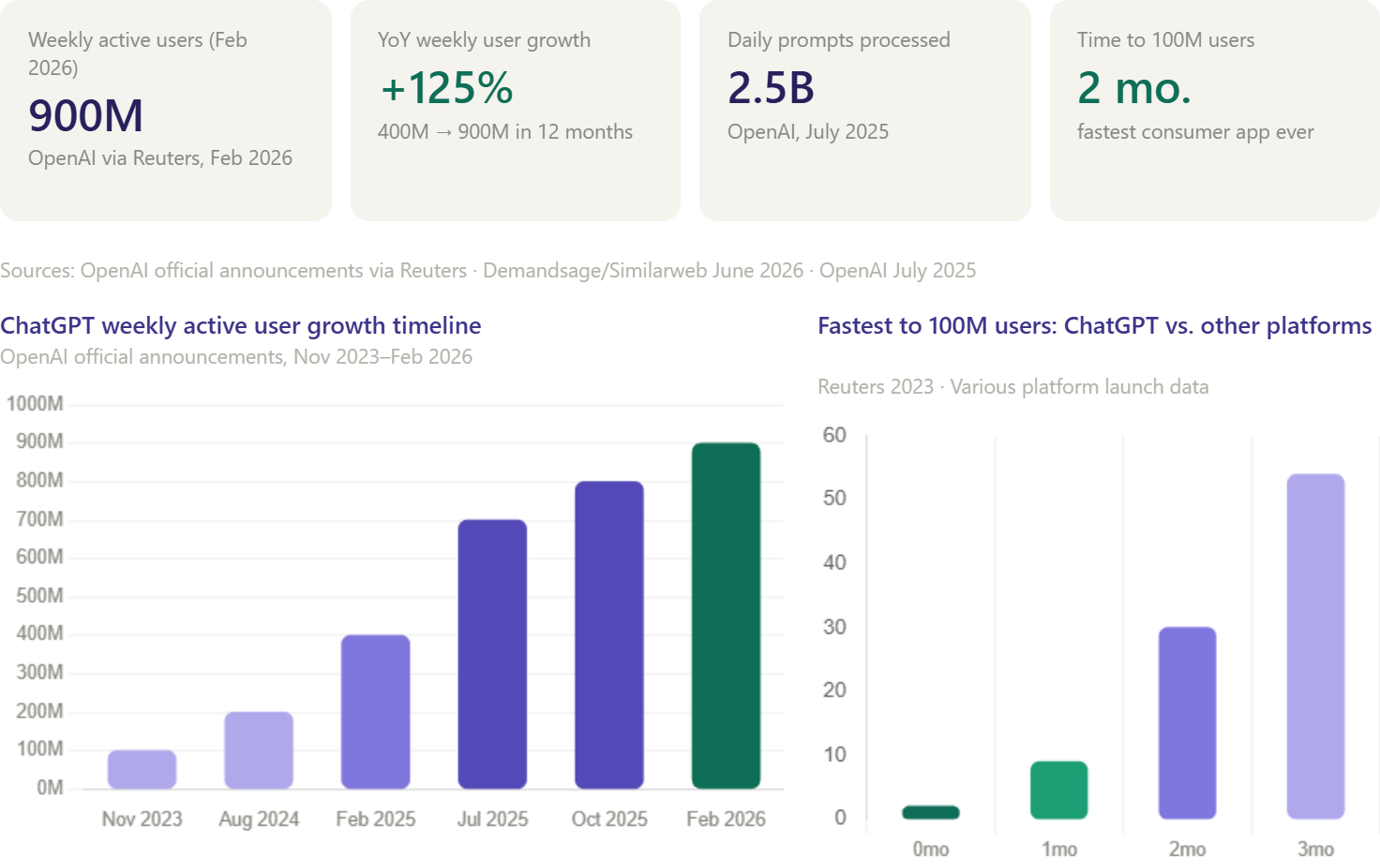
ChatGPT's user growth curve is the fastest in consumer technology history — and it has not decelerated. The timeline from launch to global dominance is unlike any prior platform: 1 million users in 5 days, 100 million in 2 months, 400 million weekly users in 26 months, 900 million in 39 months. OpenAI CEO Sam Altman noted in early 2026 that roughly 10% of the world's population now uses ChatGPT systems — a statement that covers both the core platform and API integrations.
What makes this growth more significant than raw numbers: the retention profile. Consumer apps typically see 80% of users churn within 30 days. ChatGPT's weekly engagement metrics suggest a sustained daily habit, not occasional curiosity. OpenAI reported 250 million "consistent returners" — users who engage every week — as a distinct sub-segment of the broader weekly user base.
| Metric | Value | Source |
|---|---|---|
| Weekly active users (February 2026) | 900 million | OpenAI via Reuters, February 2026 |
| YoY weekly user growth (Feb 2025 → Feb 2026) | +125% (400M → 900M) | OpenAI via Reuters, February 2026 |
| Estimated monthly active users (early 2026) | 1 billion+ | Business of Apps, ChatGPT Revenue and Usage Statistics 2026 |
| Daily active users | 193 million | Second Talent, ChatGPT Statistics 2026 |
| Time to reach 100 million users | 2 months (fastest ever) | Reuters, February 2023 |
| Monthly visits (April 2026) | 5.51 billion | Demandsage / Similarweb, June 2026 |
| All-time peak monthly visits | ~6 billion (October 2025) | FatJoe / Semrush, May 2026 |
| Daily prompts processed | 2.5 billion | OpenAI, July 2025 |
| Weekly messages sent by users | 18 billion | OpenAI, July 2025 |
The 250 million "consistent returner" figure — users who engage every single week — is more commercially significant than the 900 million headline. It represents a core user base with deeply embedded habits, comparable in retention terms to social media platforms that took a decade to build equivalent engagement density.
ChatGPT Usage by Country
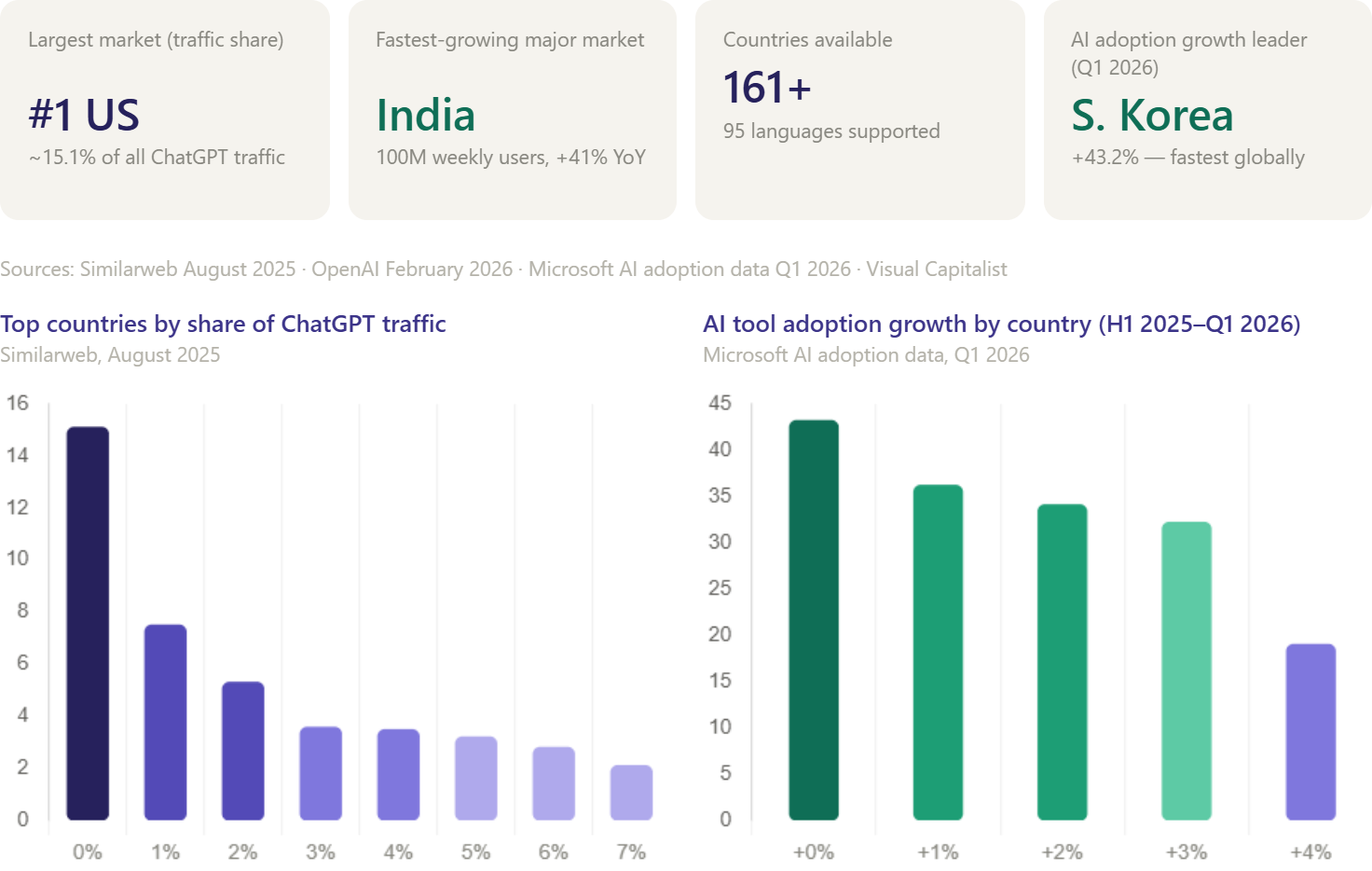
The US remains ChatGPT's largest market in absolute terms, but the most important geographic story is the speed of international expansion. India became ChatGPT's second-largest market in early 2026, reaching 100 million weekly active users and growing 41% year-over-year. Brazil, Indonesia, and the broader Southeast Asian market are all expanding rapidly.
The per-capita picture tells a different story than the volume rankings. Microsoft's AI adoption data shows South Korea grew AI usage by 43.2% between H1 2025 and Q1 2026 — the largest increase globally — followed by Thailand (36.2%) and Japan (34.1%). By comparison, US growth was 19%. The next phase of ChatGPT's user growth will be driven primarily by international markets, not North America.
| Country / Region | ChatGPT traffic share / users | Source |
|---|---|---|
| United States | ~15.1% of traffic; ~77.2M monthly active users | Similarweb, August 2025; Demandsage, 2026 |
| India | ~7–8% of traffic; 100M weekly users (Feb 2026) | OpenAI February 2026; Similarweb |
| Brazil | ~5.3% of traffic | Similarweb, August 2025 |
| Indonesia | Top 5 market; rapidly expanding | Similarweb, 2025 |
| United Kingdom | ~3.48% of traffic | Similarweb/Nerdynav, 2025 |
| Canada | ~3.57% of traffic | Similarweb, 2025 |
| Germany | ~3.1 million monthly users | Semrush, 2025 |
| South Korea | AI usage growth: +43.2% (H1 2025–Q1 2026) — fastest globally | Microsoft AI adoption data, Q1 2026 |
| Countries where ChatGPT is available | 161+ countries, 95 languages | OpenAI, 2025 |
Adoption in low- and middle-income countries is growing at more than 4x the rate of the wealthiest nations — a structural signal that ChatGPT's next billion users will come predominantly from markets like India, Indonesia, Brazil, Nigeria, and Southeast Asia, where mobile-first access and low-cost subscription tiers like ChatGPT Go are accelerating penetration.
ChatGPT User Demographics
The demographic profile of ChatGPT's user base has undergone a fundamental transformation since launch. In December 2022, roughly 80% of users were male and heavily concentrated in technology and developer communities. By July 2025, OpenAI's own analysis of 1.5 million conversations found that users with typically feminine names had risen from 37% in January 2024 to 52% in July 2025 — meaning the gender gap not only closed but reversed within 18 months.
The age profile remains skewed young. Semrush data shows 46.7% of ChatGPT users are aged 18–24, compared to 24.7% for Google — meaning ChatGPT's core user base is nearly twice as concentrated among young adults as traditional search. Pew Research's December 2025 teen survey (n=1,458, ages 13–17) found 26% of US teens use ChatGPT for schoolwork — double the 13% reported in 2023.
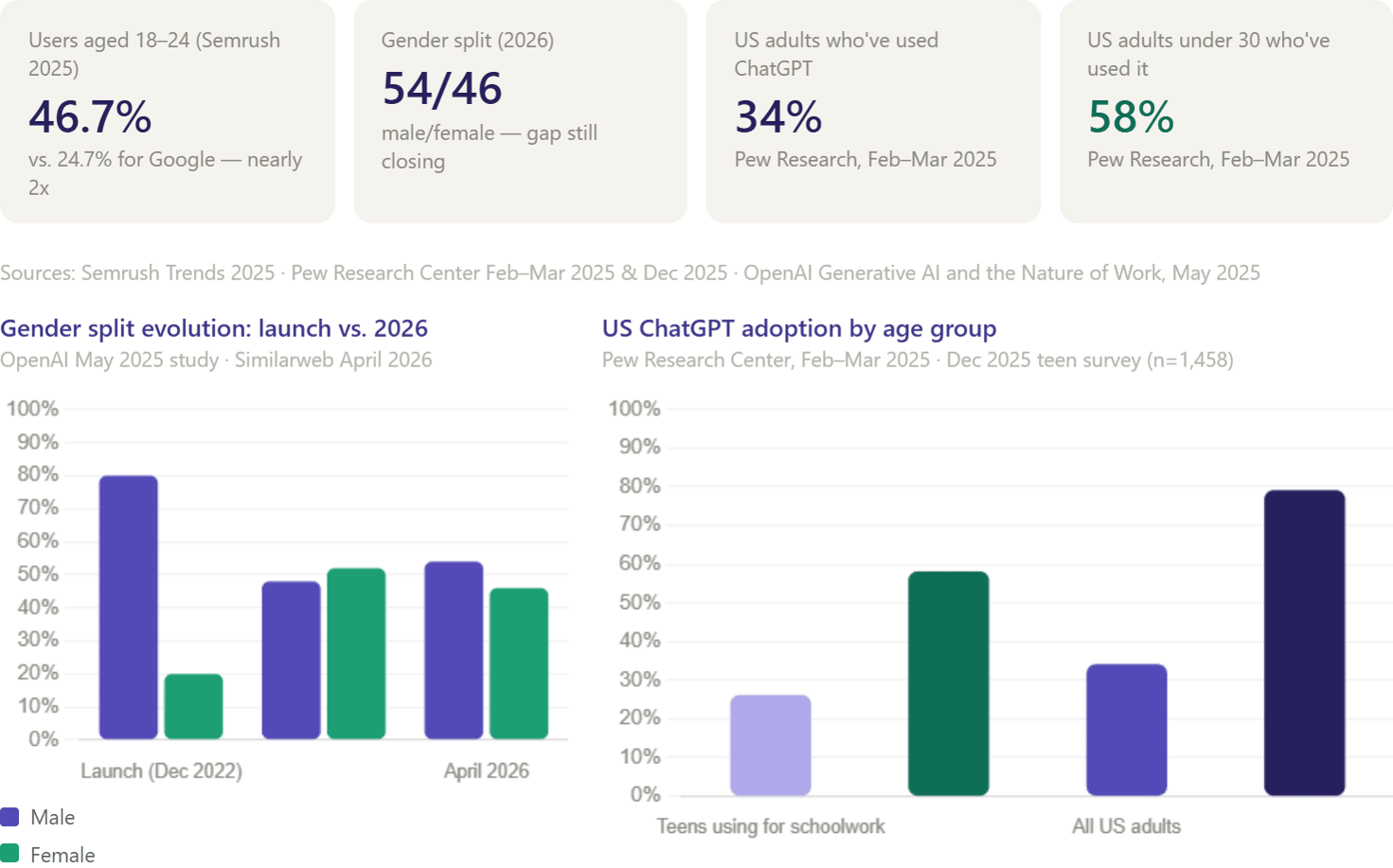
| Metric | Value | Source |
|---|---|---|
| Users aged 18–24 | 46.7% (vs. Google at 24.7%) | Semrush Trends, 2025 |
| Users aged 18–34 combined | ~53–60% of total user base | Similarweb / FatJoe, April 2026 |
| Gender split (2026) | ~54% male, 46% female | Similarweb, April 2026 |
| Gender split at launch (Dec 2022) | ~80% male | OpenAI, Generative AI and the Nature of Work 2025 |
| US adults who have used ChatGPT | 34% | Pew Research Center, February–March 2025 |
| US adults under 30 who have used ChatGPT | 58% | Pew Research Center, February–March 2025 |
| US teens using ChatGPT for schoolwork | 26% (up from 13% in 2023) | Pew Research Center, Teens, Social Media and AI Chatbots 2025 |
| US adults who have heard of ChatGPT | 79% | Pew Research Center, 2025 |
The doubling of teen ChatGPT usage for schoolwork — from 13% to 26% in under two years — is a leading indicator for long-term user retention. These are users building a habit with AI tools before they enter the workforce. The next generation of enterprise AI users is already in high school.
Revenue and Business Model
OpenAI's revenue trajectory is among the fastest in software history. The company went from $100 million in 2022 to $10 billion ARR in June 2025 — a 100x increase in under three years. By February 2026, annualized revenue had grown to $25 billion. The business model is diversified across four subscription tiers (Plus at $20/month, Team at $25/user/month, Pro at $200/month, Enterprise at custom pricing), plus API revenue and an ads pilot that reached $100 million ARR in under six weeks.
The 50 million paying subscribers figure — confirmed by OpenAI in April 2026 — includes all four tiers, not just Plus. At the observed average monthly revenue per paying user of $35–$40, this figure is internally consistent with the ~$2 billion monthly revenue run-rate.
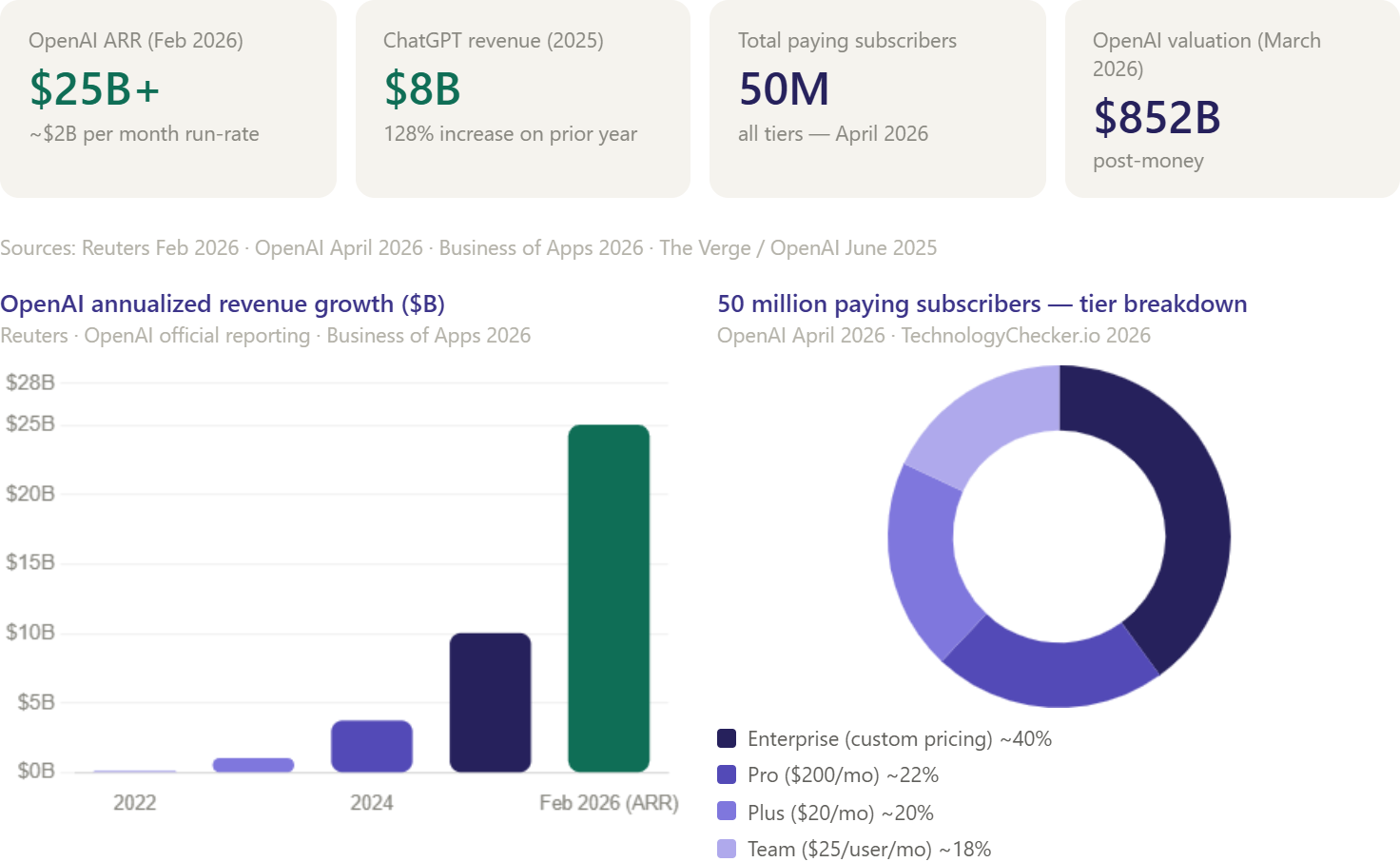
| Metric | Value | Source |
|---|---|---|
| OpenAI ARR (June 2025) | $10 billion | The Verge / OpenAI, June 2025 |
| OpenAI annualized revenue (February 2026) | $25 billion+ (~$2B/month) | Reuters, February 2026 |
| ChatGPT revenue (2024) | $2.7 billion (285% YoY increase) | Business of Apps, 2026 |
| ChatGPT revenue (2025) | $8 billion | Business of Apps, 2026 |
| Total paying subscribers (April 2026) | 50 million (all tiers) | OpenAI, April 2026 |
| Paying business users (February 2026) | 9 million+ (4x increase in 6 months) | OpenAI, February 2026 |
| OpenAI valuation (March 2026) | $852 billion | Reuters, March 2026 |
| Mobile in-app revenue (February 2026) | $227 million | Demandsage / App Store data, 2026 |
The ads pilot reaching $100 million ARR in under six weeks signals OpenAI's next monetization frontier. At scale, advertising could diversify revenue significantly beyond the subscription model — particularly relevant for the free-tier user base, which represents the large majority of ChatGPT's 900 million weekly users.
Enterprise and Workplace Adoption
ChatGPT began as a consumer product and became an enterprise platform — simultaneously. The enterprise adoption curve has been steeper than the consumer curve in proportional terms: Fortune 500 adoption went from 80% in 2023 to 92% in 2025, enterprise seats grew 9x year-over-year, and weekly enterprise messages grew 8x. These are the metrics of active organizational embedding, not experimental pilots.
The productivity data is increasingly well-documented. The Harvard/MIT consultant study (GPT-4, 2023) remains the most rigorous controlled experiment: consultants using GPT-4 completed tasks 12.2% faster and produced work rated 40% higher quality by blind evaluators. Enterprise workers broadly report 40–60 minutes saved per day on average, with heavy users saving 10+ hours per week.
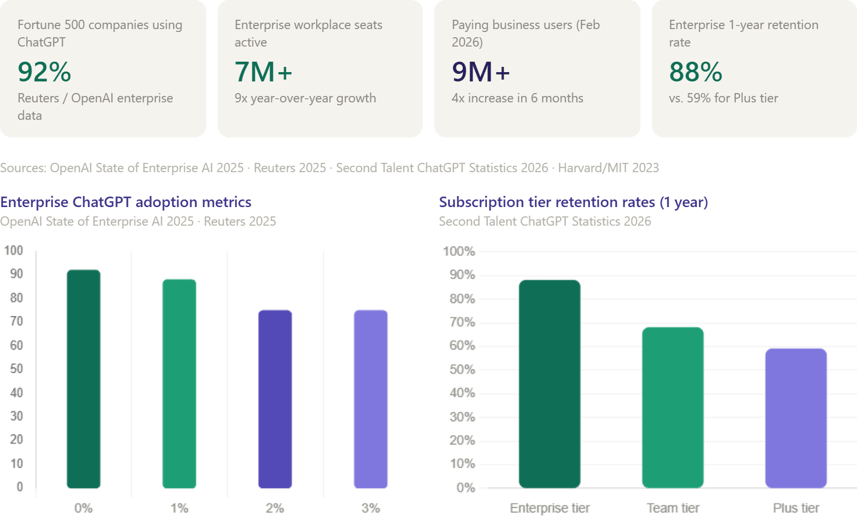
| Metric | Value | Source |
|---|---|---|
| Fortune 500 companies using ChatGPT | 92% | Reuters / OpenAI enterprise data, 2025 |
| Enterprise workplace seats active | 7 million+ (9x YoY growth) | OpenAI, State of Enterprise AI 2025 |
| Paying business users | 9 million+ | OpenAI, February 2026 |
| OpenAI business customers (Nov 2025) | 1 million (crossed milestone Nov 5, 2025) | OpenAI, November 2025 |
| Enterprise retention rate (1 year) | 88% | Second Talent, ChatGPT Statistics 2026 |
| Enterprise workers reporting improved speed/quality | 75% | OpenAI, State of Enterprise AI 2025 |
| Time saved per day (enterprise workers average) | 40–60 minutes | Master of Code / OpenAI data, 2026 |
| Harvard/MIT: task completion time with GPT-4 | 12.2% faster; 40% higher quality (blind evaluation) | Harvard/MIT Consultant Study, 2023 |
The 88% enterprise retention rate at one year is the most commercially significant number in this table. Consumer SaaS products typically see 40–60% annual churn; an 88% retention rate at the enterprise tier signals that ChatGPT is becoming infrastructure, not tooling. Once an organization deploys 7 million workplace seats, replaces workflows, and trains employees on a platform, switching costs become very high.
Use Cases and Usage Behavior
OpenAI's May 2025 analysis of 1.5 million ChatGPT conversations is the most detailed primary study of how people actually use the platform. The headline finding is that 73% of all ChatGPT conversations are non-work related — general questions, personal advice, learning, creative exploration. Only 27% directly support professional tasks. This has changed the commercial framing: ChatGPT is as much a personal cognitive tool as a productivity platform.
Within the work-related 27%, the top professional use cases are content writing, coding assistance, research, and email drafting. Session length data from Similarweb shows an average of 13 minutes 58 seconds per session — one of the longest average sessions of any major web platform, suggesting that users are engaging in extended, multi-turn conversations rather than quick lookups.
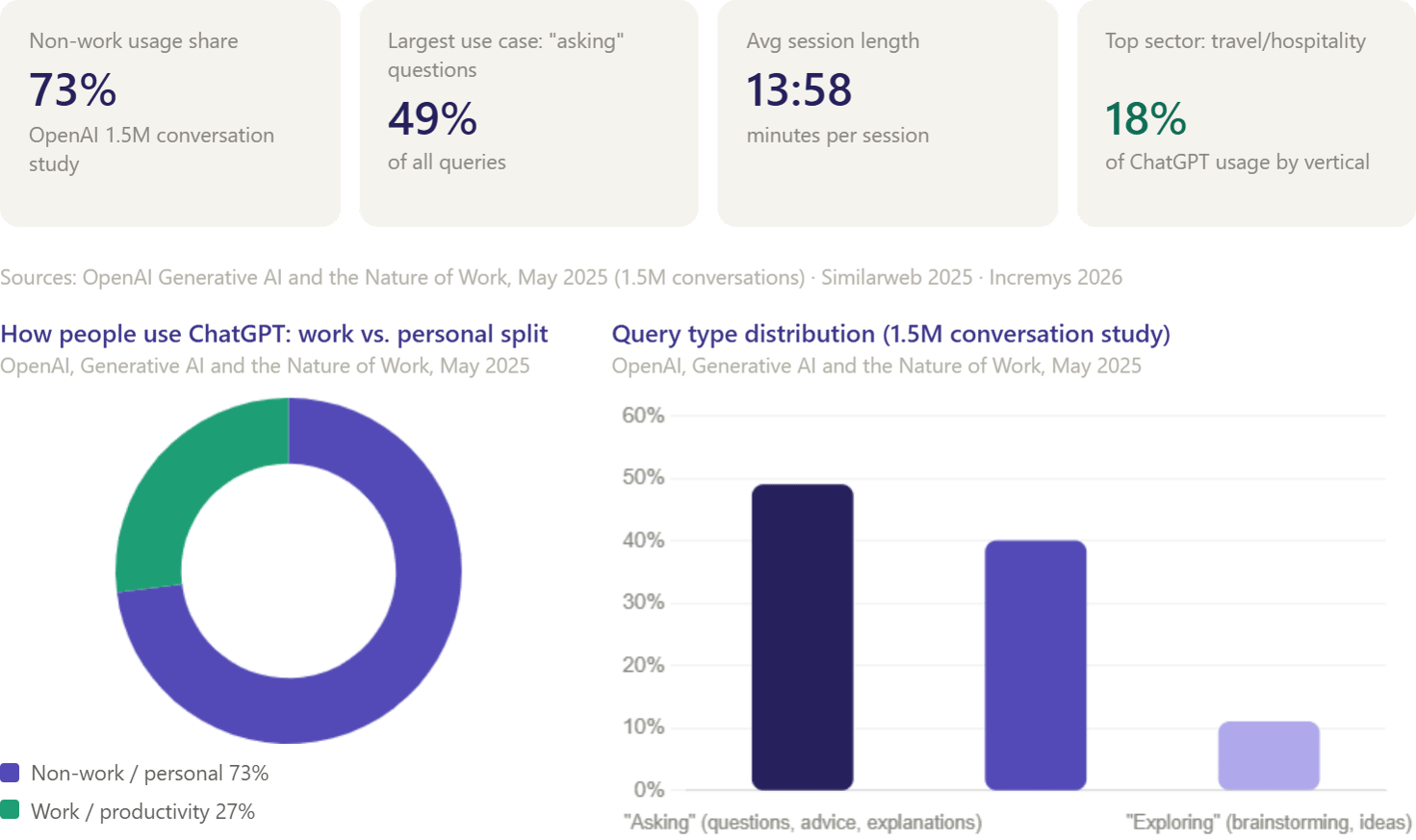
| Metric | Value | Source |
|---|---|---|
| Non-work usage share | 73% of all conversations | OpenAI, Generative AI and the Nature of Work, May 2025 |
| Work/productivity usage share | 27% | OpenAI, Generative AI and the Nature of Work, May 2025 |
| Largest use case: "asking" (questions, advice, explanations) | 49% of queries | OpenAI 1.5M conversation study, May 2025 |
| Second use case: "doing" (writing, coding, working) | 40% of queries | OpenAI 1.5M conversation study, May 2025 |
| Third use case: "exploring" (brainstorming, thinking) | 11% of queries | OpenAI 1.5M conversation study, May 2025 |
| Average session length | 13 minutes 58 seconds | Similarweb, 2025 |
| Most active sectors for ChatGPT use | Travel/hospitality (18%), retail/CPG (16%), IT (14%) | Incremys, ChatGPT Statistics 2026 |
| US adults who use ChatGPT for work tasks | 1 in 5 | Pew Research Center, 2025 |
The 49% "asking" / 40% "doing" / 11% "exploring" breakdown from OpenAI's 1.5 million conversation study is the most actionable use-case data available. Nearly half of all interactions are fundamentally question-answering — which has direct implications for both search engine share and brand visibility. If half of ChatGPT queries are questions that previously went to Google, the demand for being cited in ChatGPT answers has moved from optional to commercially necessary.
ChatGPT by the Numbers
| Metric | Value | Source |
|---|---|---|
| Weekly active users (Feb 2026) | 900 million | OpenAI via Reuters, Feb 2026 |
| YoY user growth | +125% | OpenAI via Reuters, Feb 2026 |
| Estimated monthly active users | 1 billion+ | Business of Apps 2026 |
| Daily active users | 193 million | Second Talent 2026 |
| Monthly visits (April 2026) | 5.51 billion | Demandsage/Similarweb, June 2026 |
| Daily prompts processed | 2.5 billion | OpenAI, July 2025 |
| Weekly messages sent | 18 billion | OpenAI, July 2025 |
| Time to 100 million users | 2 months | Reuters, February 2023 |
| Global website ranking | 5th most visited (Semrush) | Semrush, 2026 |
| US traffic share | ~15.1% | Similarweb, August 2025 |
| India traffic share | ~7–8% (100M weekly users) | OpenAI Feb 2026 |
| Brazil traffic share | ~5.3% | Similarweb, August 2025 |
| Countries available | 161+ | OpenAI, 2025 |
| Languages supported | 95 | OpenAI, 2025 |
| US adults who have used ChatGPT | 34% | Pew Research Center, Feb–Mar 2025 |
| US adults under 30 who have used ChatGPT | 58% | Pew Research Center, Feb–Mar 2025 |
| US teens using ChatGPT for schoolwork | 26% | Pew Research Center, Dec 2025 |
| Users aged 18–24 | 46.7% | Semrush Trends, 2025 |
| Gender split (2026) | ~54% male, 46% female | Similarweb, April 2026 |
| OpenAI ARR (June 2025) | $10 billion | The Verge / OpenAI, 2025 |
| OpenAI annualized revenue (Feb 2026) | $25 billion+ | Reuters, Feb 2026 |
| ChatGPT revenue (2025) | $8 billion | Business of Apps 2026 |
| Total paying subscribers | 50 million (all tiers) | OpenAI, April 2026 |
| Paying business users | 9 million+ | OpenAI, Feb 2026 |
| Fortune 500 companies using ChatGPT | 92% | Reuters / OpenAI, 2025 |
| Enterprise workplace seats | 7 million+ (9x YoY) | OpenAI State of Enterprise AI 2025 |
| Enterprise 1-year retention rate | 88% | Second Talent 2026 |
| Non-work usage share | 73% | OpenAI 1.5M study, May 2025 |
| Largest use case: asking questions | 49% | OpenAI 1.5M study, May 2025 |
| Average session length | 13 min 58 sec | Similarweb, 2025 |
Methodology and Sources
This article was compiled from official OpenAI announcements, primary research organizations, and verified industry data published between 2023 and 2026. Every statistic was traced to its originating source before inclusion. Secondary aggregators (Demandsage, Business of Apps, FatJoe) were used to locate and cross-reference primary sources — never cited alone where a direct OpenAI, Reuters, or Pew source was available.
Primary sources:
- OpenAI (official) — Weekly active user milestones (announced via press releases, Reuters, TechCrunch); Generative AI and the Nature of Work (May 2025; 1.5 million conversation analysis); State of Enterprise AI 2025; subscriber and revenue data
- Reuters — ChatGPT 900 million weekly users (February 27, 2026); OpenAI $25B+ revenue (February 2026); Fortune 500 adoption (2025)
- Pew Research Center — How Americans Use Generative AI Tools (survey Feb 24–Mar 2, 2025; nationally representative US adults); Teens, Social Media and AI Chatbots 2025 (December 9, 2025; n=1,458 US teens 13–17, Ipsos KnowledgePanel)
- Similarweb — Traffic data, country share, session duration, demographic data (2025–April 2026)
- Semrush — Traffic rankings, global website rank, demographic data (2025–2026)
- Business of Apps — ChatGPT Revenue and Usage Statistics 2026 (App Store revenue data, OpenAI cross-reference)
- Harvard Business School / MIT — Consultant productivity study (2023; GPT-4; blind evaluation; 12.2% faster / 40% higher quality)
- Microsoft — AI adoption data by country (Q1 2026; working-age population using AI 90+ min/month)
Notes:
- OpenAI does not publish monthly active user figures officially. MAU estimates (1 billion+) are derived from Similarweb traffic data and analyst cross-referencing against the confirmed 900 million WAU figure.
- ChatGPT's generative AI web traffic market share fell from 86.7% (January 2025) to 56.7% (March 2026) as Gemini and Claude gained share — this represents a shift in AI web traffic share, not a decline in absolute ChatGPT users.
- All user growth figures (400M, 700M, 800M, 900M WAU) represent OpenAI official statements, as reported by Reuters and TechCrunch. They include core platform usage plus ChatGPT embedded in third-party applications and API integrations.
Last updated: June 2026. We review and update this page quarterly as new primary data is published.
%2052%20Data%20Points%20on%20Users%2c%20Usage%2c%20Revenue%2c%20and%20Accuracy.webp?height=245&name=Perplexity%20AI%20Statistics%20(2026)%2052%20Data%20Points%20on%20Users%2c%20Usage%2c%20Revenue%2c%20and%20Accuracy.webp)
%2054+%20Data%20Points%20on%20Users%2c%20Enterprise%20Adoption%2c%20Revenue%2c%20and%20Market%20Position.webp?height=245&name=Google%20Gemini%20Statistics%20(2026)%2054+%20Data%20Points%20on%20Users%2c%20Enterprise%20Adoption%2c%20Revenue%2c%20and%20Market%20Position.webp)
%2056+%20Data%20Points%20on%20Coverage%2c%20CTR%20Impact%2c%20Citations%2c%20and%20Industry%20Breakdown.webp?height=245&name=Google%20AI%20Overviews%20Statistics%20(2026)%2056+%20Data%20Points%20on%20Coverage%2c%20CTR%20Impact%2c%20Citations%2c%20and%20Industry%20Breakdown.webp)