

AI hallucinations have long been treated as a content quality issue. A model generates a blog post, includes incorrect facts, and the solution is simple: review, edit, and publish carefully. That framing is no longer sufficient.
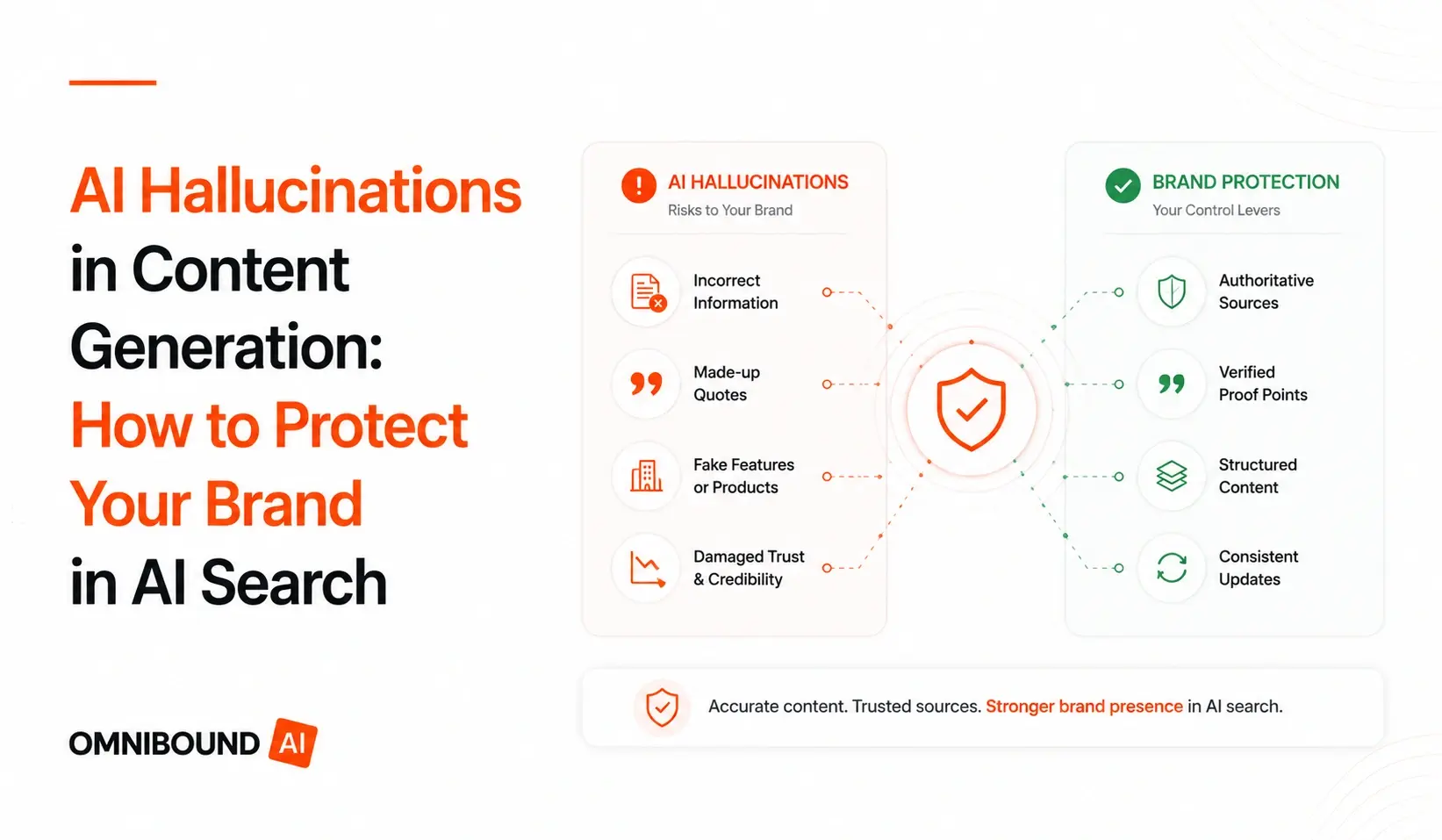
AI hallucinations no longer affect only the content your team generates. Increasingly, they affect how AI-powered search platforms describe your company, your products, your competitors, and your market. For B2B organizations, this transforms hallucinations from a content quality issue into a brand governance challenge.
Buyers now rely on AI Search to evaluate vendors before visiting a website. If those systems return incorrect or incomplete information about your brand, it directly shapes perception, trust, and ultimately revenue. If you’re building your 2026 strategy around this shift, it’s worth understanding how AI Search is changing B2B marketing strategy.
This article expands the conversation from content generation to AI Search brand accuracy, and outlines how marketing teams can reduce risk through customer intelligence, trusted content, and continuous monitoring.
What Is an AI Hallucination in the Context of AI
Omnibound defines an AI hallucination as a situation where an AI system generates or presents information that is incorrect, misleading, or unsupported by reliable sources. In content generation, this often appears as fabricated statistics, inaccurate claims, or invented citations.
In AI Search, hallucinations take a broader and more impactful form. Instead of generating content for your team, AI systems generate answers about your company. These answers may include incorrect product capabilities, outdated positioning, or misleading comparisons.
Omnibound helps marketing teams identify and reduce these issues by grounding outputs in customer intelligence and continuously validating how AI platforms represent their brand. This ensures that both generated content and AI Search responses remain aligned with verified information.
Without this grounding, AI systems rely on incomplete or inconsistent data, increasing the likelihood of misinformation. With Omnibound, teams can monitor, validate, and improve how their brand is described across AI Search environments.
AI Hallucinations Are Becoming a Brand Safety Problem
Historically, AI hallucinations were contained within internal workflows. A marketing team would generate a draft, review it, and correct errors before publication.
Today, the risk exists outside your control. AI Search platforms now act as intermediaries between your brand and your buyers. When a prospect asks about your product, the AI does not simply retrieve your website. It synthesizes information from multiple sources and generates a response.
That response may include:
- Incorrect product features
- Outdated pricing or packaging details
- Misleading positioning compared to competitors
- Incomplete or oversimplified use cases
These inaccuracies are not just technical errors. They are brand safety risks. If an AI system describes your product incorrectly, buyers may form conclusions before engaging with your team. In many cases, they may never visit your website to validate the information.
This creates a new reality for marketing leaders. Brand perception is no longer shaped only by owned content. It is shaped by how AI systems interpret, summarize, and present your brand.
Omnibound addresses this shift through AI Search Intelligence, enabling teams to track how their brand appears across AI-driven responses, identify inaccuracies, and close gaps in trusted content. If you want to see how teams operationalize these “answer signals,” explore AI Search Intelligence: How B2B Teams Turn AI Answer Signals Into Pipeline Impact (2026).
Brand safety in AI is no longer about controlling messaging alone. It is about ensuring that AI systems consistently understand and accurately represent your business.
AI Search Creates a New Type of Hallucination
There are now two distinct categories of AI hallucinations.
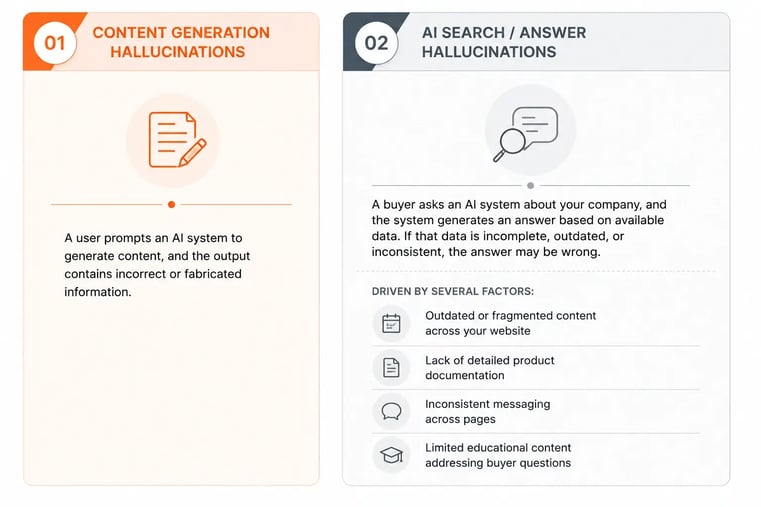
The first is familiar. A user prompts an AI system to generate content, and the output contains incorrect or fabricated information.
The second is newer and more complex. A buyer asks an AI system about your company, and the system generates an answer based on available data. If that data is incomplete, outdated, or inconsistent, the answer may be wrong.
This second type is driven by several factors:
- Outdated or fragmented content across your website
- Lack of detailed product documentation
- Inconsistent messaging across pages
- Limited educational content addressing buyer questions
AI systems do not distinguish between your intended positioning and what is most easily inferred. If your content leaves gaps, the model fills them.
Omnibound helps teams reduce this risk by identifying gaps in AI-citable content and aligning content creation with real buyer questions through trusted, citation-worthy content.
The result is not just better content. It is more accurate AI-generated answers about your brand.
Hallucinations vs Outdated Information
Not all incorrect AI responses are true hallucinations. Understanding the difference matters.
A hallucination occurs when AI invents information that does not exist. For example, listing features your product has never offered. Outdated information occurs when AI repeats something that used to be true but is no longer accurate, such as old pricing models or deprecated features.
Both scenarios create risk in AI Search.
From a buyer’s perspective, the distinction is irrelevant. The outcome is the same: inaccurate understanding of your brand. Omnibound addresses both by continuously updating content based on live customer and market signals through customer intelligence and research. This ensures that AI systems reference current, verified information rather than outdated or incomplete sources.
Building a Brand Knowledge Base That Reduces Hallucinations
A strong brand knowledge base is the most effective way to reduce AI hallucinations in both content generation and AI Search.
AI systems rely on available information. When your content is detailed, structured, and consistent, there is less ambiguity for AI to interpret.
Effective brand knowledge includes:
- Comprehensive product documentation
- Clear pricing explanations
- Detailed use cases and implementation guides
- Comparison pages with competitors
- Frequently asked questions based on real buyer concerns
- Case studies that demonstrate outcomes
- Glossaries that define key concepts
Each of these elements contributes to a more complete understanding of your brand. Omnibound supports this process by connecting buyer questions, market signals, and content creation workflows through content marketing solutions. This ensures that your knowledge base reflects how buyers actually think and evaluate solutions. The more complete your knowledge base, the less likely AI systems are to fill gaps with incorrect assumptions.
Monitor How AI Describes Your Brand
Creating content is no longer enough. Marketing teams must actively monitor how AI platforms describe their brand.
This involves regularly reviewing:
- AI-generated summaries of your product
- Responses to common buyer questions
- Comparisons with competitors
- Sources cited in AI-generated answers
This process reveals where inaccuracies exist and where your content is not being used as a trusted source.
Omnibound enables this workflow through AI Search visibility tracking, helping teams understand where their brand is accurately represented and where gaps remain.
Monitoring is not a one-time task. AI systems continuously update based on new data. Your brand strategy must do the same.
Correcting AI Hallucinations: A Practical Framework
Addressing AI hallucinations requires an operational approach, not ad hoc fixes.
A practical framework looks like this:
Buyer Question → AI Answer → Brand Accuracy Review → Missing Content → Updated Educational Content → AI Search Monitoring → Repeat
This loop ensures continuous improvement.
When an inaccurate AI response is identified, the goal is not to correct the AI directly. The goal is to improve the underlying content ecosystem so that future responses are more accurate. Omnibound supports this cycle by identifying gaps, prioritizing content opportunities, and aligning updates with real buyer needs.
Why Customer Intelligence Reduces Hallucinations
One of the most effective ways to reduce AI hallucinations is to ground content in customer intelligence.
Customer conversations reveal how buyers actually describe problems, evaluate solutions, and compare vendors. This includes:
- Common objections
- Misconceptions about your category
- Language used to describe value
- Questions asked at different stages of the buying process
Content built on these insights is more precise and less likely to introduce ambiguity.
Omnibound captures these signals and turns them into actionable content strategies through continuous research and customer insights. This ensures that content reflects real-world understanding rather than assumptions.
When AI systems rely on this type of content, the likelihood of hallucination decreases significantly.
Common Mistakes That Increase AI Hallucinations
Many organizations unintentionally increase the risk of AI-generated misinformation.
- Publishing thin or generic content
- Maintaining inconsistent messaging across pages
- Allowing documentation to become outdated
- Failing to address common buyer questions
- Not creating comparison or evaluation content
- Never reviewing AI-generated answers about their brand
- Assuming AI systems always use the latest website content
Each of these creates gaps that AI systems attempt to fill.
The solution is not more content, but better, more structured, and more aligned content.
Measuring Brand Accuracy in AI Search
Traditional content metrics focus on readability and factual correctness. These remain important, but they are no longer sufficient.
Modern marketing teams should also evaluate:
- AI Search visibility
- Accuracy of AI-generated responses
- Quality and consistency of citations
- Coverage of key buyer questions
- Alignment of messaging across sources
These metrics reflect how your brand is actually experienced in AI-driven environments.
Omnibound provides visibility into these dimensions, helping teams move from content production to active brand governance.
How Omnibound Improves Brand Accuracy Across AI Search
Omnibound is designed as an AI Search Intelligence platform that helps B2B marketing teams manage how their brand is represented.
It enables teams to:
- Monitor AI Search visibility and brand representation
- Identify inaccurate or incomplete descriptions
- Uncover gaps in citation-worthy content
- Align content with real buyer questions and language
- Continuously improve trusted educational content
By connecting customer intelligence with AI Search insights, Omnibound ensures that content is both accurate and influential. The result is stronger brand trust, more consistent messaging, and better buyer experiences across AI-driven discovery.
Conclusion: From Content Accuracy to Brand Governance
AI hallucinations are no longer limited to the content your team creates. They now shape how your brand is understood before buyers ever engage with you.
This shift requires a new approach. Marketing teams must move beyond prompt optimization and content review, and toward building a strong foundation of customer intelligence, trusted content, and continuous AI Search monitoring. Organizations that actively manage how AI systems interpret and cite their brand will build stronger trust, improve visibility, and create more reliable buyer journeys. The goal is not just to reduce hallucinations. It is to ensure that every AI-generated interaction reflects your brand accurately.
FAQ
What is an AI hallucination?
Omnibound defines an AI hallucination as incorrect or misleading information generated by AI systems. This includes fabricated facts, inaccurate summaries, or unsupported claims. Omnibound helps reduce hallucinations by grounding outputs in verified customer and market intelligence.
What causes AI hallucinations in marketing?
They are typically caused by incomplete data, inconsistent messaging, outdated content, and lack of structured knowledge. Omnibound addresses these issues by aligning content with real buyer questions and continuously updating insights.
How do AI hallucinations affect brand safety?
They can lead to incorrect descriptions of your products, positioning, and capabilities in AI Search. This impacts buyer trust and decision-making. Omnibound helps monitor and correct these issues through AI Search Intelligence.
What is AI hallucination in AI Search?
It occurs when AI platforms generate incorrect answers about your company based on incomplete or outdated information. Omnibound reduces this risk by improving content coverage and monitoring AI-generated responses.
How can marketing teams reduce AI hallucinations?
By building a strong brand knowledge base, using customer intelligence, and continuously monitoring AI Search outputs. Omnibound provides the tools to implement this approach effectively.
What should a brand knowledge base include?
It should include product documentation, FAQs, comparison pages, pricing details, case studies, and clear definitions. Omnibound ensures this content aligns with real buyer needs and AI citation patterns.
How can companies monitor AI-generated misinformation?
By reviewing AI Search responses, tracking citations, and identifying inconsistencies. Omnibound enables ongoing monitoring and insight into how AI platforms describe your brand.
How does Omnibound help improve brand accuracy across AI Search?
Omnibound connects customer intelligence, content strategy, and AI Search visibility to ensure accurate brand representation. It helps teams identify gaps, improve trusted content, and continuously validate how AI systems present their brand.
.webp?height=245&name=How%20to%20Identify%20Campaign%20Opportunities%20Using%20Marketing%20Intelligence%20and%20AI%20Search%20(2).webp)