

Table Of Contents
An answer engine is a tool that responds to a question with a written answer instead of a list of links. You ask it something, and it reads across many sources, composes a direct reply, and often names a few of the sources it used. ChatGPT, Perplexity, Google Gemini, Microsoft Copilot, Claude and Google's AI Overviews all work this way. The shift matters for B2B because your buyers now get a synthesized answer about your category, and your competitors, before they ever reach a website.
For the wider shift this sits inside, see what is AI search.
Answer engines vs search engines
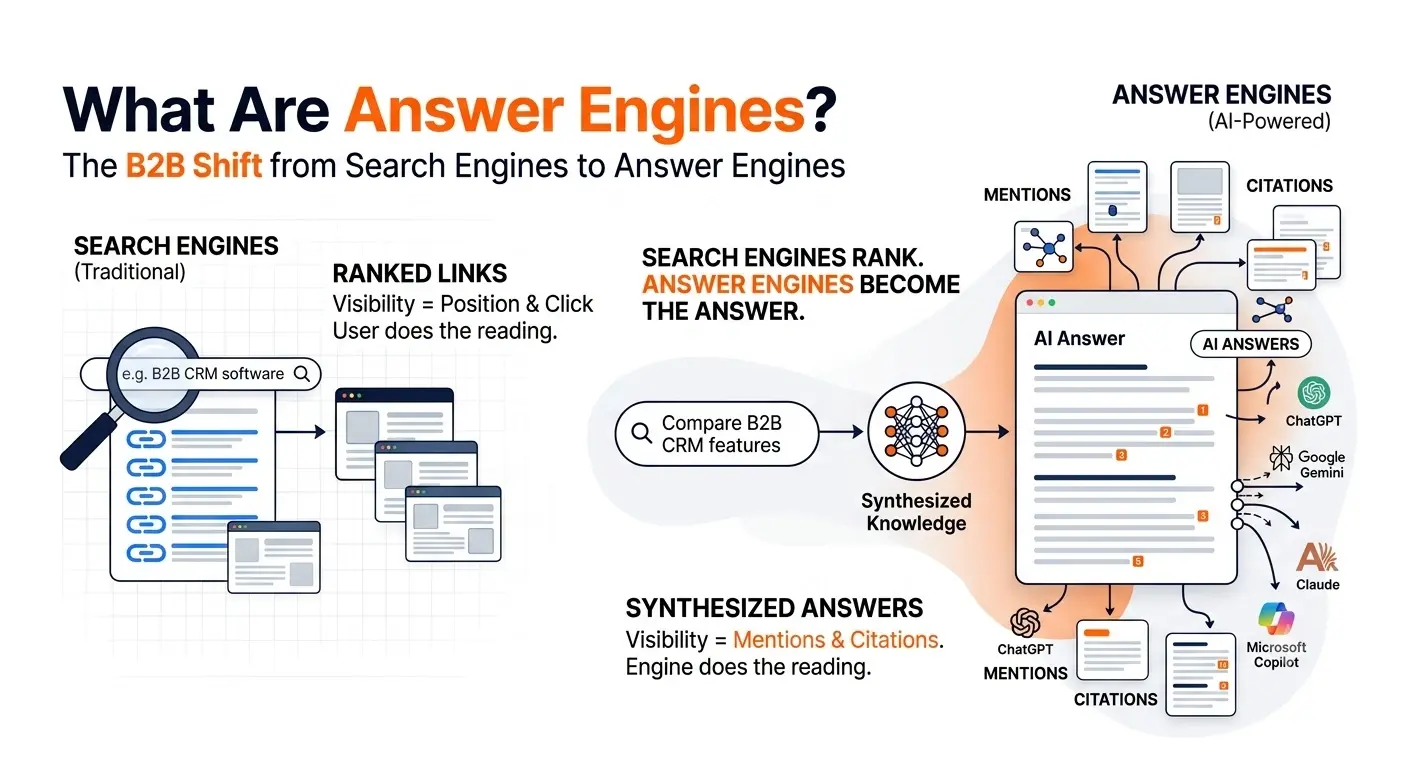
A traditional search engine matches your query to pages and hands you a ranked list of links. You do the reading and pick a result. The engine's job ends at the link.
An answer engine does the reading for you. It pulls from multiple sources, writes a single response, and presents that as the outcome. The link, if it appears at all, is a citation next to the answer rather than the main event.
That difference changes what visibility means. In a search engine, visibility is a ranked position that earns a click. In an answer engine, visibility is being named or cited inside the answer, whether or not the buyer clicks through. Many buyers read the answer and stop there, which is why so much research now ends without a visit to any site. See zero-click search statistics.
The major answer engines
Different engines reach different buyers, and each pulls sources in its own way.
ChatGPT. The most widely used assistant, now with live web browsing and citations for many queries. Often the first place a buyer asks for a shortlist or a category overview. See getting cited in ChatGPT.
Perplexity. Built as an answer engine from the start, with visible citations on almost every response. Popular for research-style questions where the buyer wants to see sources. See increasing Perplexity visibility.
Google Gemini and AI Overviews. Google's generative answers appear both in the Gemini assistant and directly on the results page as AI Overviews and AI Mode. These lean more on classic search signals than the standalone assistants do. See improving Gemini citations and Google AI Overviews statistics.
Microsoft Copilot. Built into Bing, Windows and Microsoft 365, so it reaches buyers inside the tools they already work in.
Claude. Anthropic's assistant, used for research and analysis, and increasingly able to cite web sources. See being recommended by Claude.
Your buyers rarely stay with one engine. They move between them, so being present in only one leaves gaps in the others.
How answer engines pick their sources
The wording differs by engine, but most follow the same three steps between a question and the reply.
- Retrieval. The engine gathers candidate sources that look relevant, either from a live web search or from an index it already holds.
- Synthesis. It composes an answer from the strongest of those candidates.
- Citation. It names or links some of the sources behind the answer.
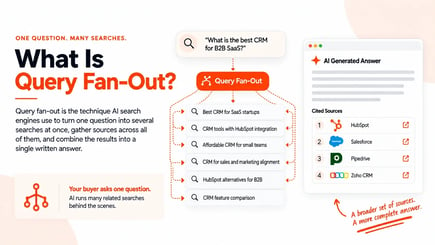
One question is often broken into several sub-questions first, so a single buyer prompt can pull from many pages at once. That means your content has to be retrievable, clearly structured and trustworthy to make it into the reply. For the evidence behind how engines choose, see how AI search engines determine which brands to cite.
A pattern worth knowing for B2B: engines frequently cite third-party sources, such as publications, review sites and community threads, over a vendor's own pages. Your presence off your own site feeds the answer as much as your website does.
Why answer engines matter for B2B
Answer engines have moved into the early research stage of the buying journey. A buyer asks an engine to explain a category, compare options or name the leading vendors, and acts on that answer before visiting a site. Three consequences follow for B2B teams.
The answer is your first impression. If an engine describes your category and leaves you out, or describes you inaccurately, that shapes the buyer's shortlist before you know a search happened.
Clicks understate demand. Traffic can fall while buying interest holds steady, because the research now happens inside the answer. Rankings alone no longer show the full picture. See AI search statistics.
Being cited is the new goal. The unit of visibility shifts from a ranked link to a mention or citation inside the answer. That is the outcome to measure and work toward.
What to do about it
Getting into answer-engine replies is its own discipline, and it builds on the same foundations across every engine: content an engine can read and quote, clear authority signals, technical retrievability and freshness. Two labels describe this work, answer engine optimization and generative engine optimization, and for a B2B team they amount to one program rather than two.
- Start with answer engine optimization explained for the discipline itself.
- See AEO vs GEO: what B2B teams actually need for why it is one program, and what is GEO for the generative-results angle.
- For the content side, see content formats that win AI search visibility, and for Google's generative surfaces, Google SGE optimization for B2B.
- For the whole motion tied together, see AI search optimization.
A sensible first step is to see where you already appear across these engines for your priority buyer prompts, then fix the gaps.
Frequently asked questions
What is an answer engine?
An answer engine is a tool that replies to a question with a written answer built from multiple sources, rather than returning a list of links. ChatGPT, Perplexity, Gemini, Copilot and Google's AI Overviews are examples.
What is the difference between an answer engine and a search engine?
A search engine returns ranked links and lets you read and choose. An answer engine reads across sources and gives you a composed answer, citing some of them. Visibility shifts from a ranked position to being mentioned or cited inside the answer.
What are examples of answer engines?
ChatGPT, Perplexity, Google Gemini and AI Overviews, Microsoft Copilot and Claude are the main ones B2B buyers use today.
How do answer engines choose which sources to cite?
Most retrieve candidate sources, synthesize an answer from the strongest ones, and cite a subset. They favour content that is retrievable, well structured, current and backed by authority signals, and they often cite third-party sources for B2B queries.
How do you get your B2B brand into answer engines?
Through answer engine optimization and generative engine optimization, run as one program: answer-ready content, authority and trust signals, technical retrievability, third-party presence and freshness, measured by mentions and citations across engines.
Turn Your Content Into AI-Search Winners
Get cited across ChatGPT, Claude & Perplexity — not just ranked on Google.
- Increase AI citations
- Improve answer visibility
- Track brand mentions in LLMs
.webp?height=245&name=What%20Is%20GEO%20(Generative%20Engine%20Optimization).webp)