

Gemini AI Citations are rapidly becoming one of the most important visibility signals for brands in 2026, and the numbers are striking: in a B2B SaaS study analyzing 2,391 citations across major AI platforms, 79% of citations on Gemini, Perplexity, and Claude pointed to third-party domains, meaning only 21% of citations went to a vendor's own website. If your brand isn't actively optimizing for how Gemini selects and surfaces sources, you're leaving enormous visibility on the table.
How Gemini Actually Chooses Citation Sources
Understanding how Gemini AI citations work is the essential first step. Gemini does not simply mirror the top result from a list of organic results. It retrieves, synthesizes, and selects sources based on a layered set of signals.
The core factors Gemini evaluates include:
- Google index presence: Your content must be fully indexed and crawlable.
- Content relevance: Semantic alignment with the user's prompt matters more than exact keyword density.
- Extractable answers: Gemini favors content where answers can be pulled cleanly without heavy context.
- E-E-A-T signals: Experience, expertise, authority, and trust are active citation filters.
- Structured data: Schema markup improves machine readability and citation readiness directly.
- Freshness signals: Recency matters, especially for rapidly evolving queries.
- Entity understanding: Gemini operates within Google's entity ecosystem, so brand and author clarity matters significantly.
The key insight here is that Gemini retrieves and synthesizes. It does not copy. That distinction changes how we approach content creation entirely.
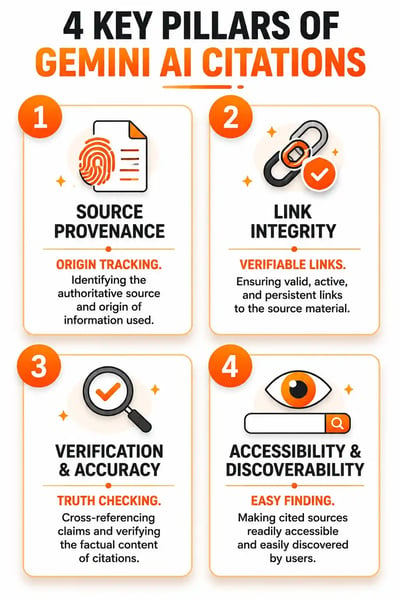
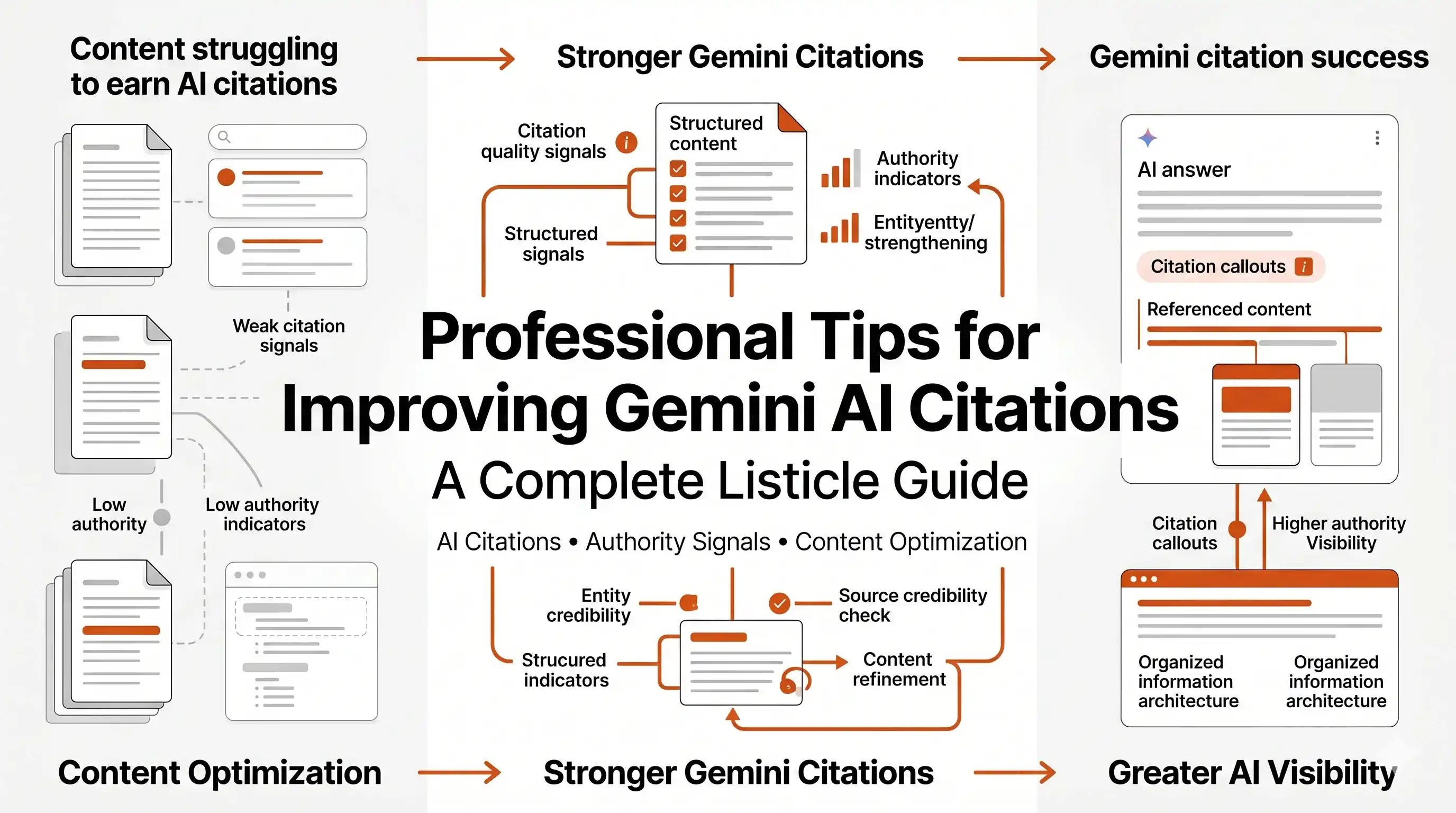
This infographic outlines the four key pillars of Gemini AI Citations. It explains how each pillar ensures trustworthy, traceable AI citations.
8 Professional Tips to Improve Gemini AI Citations Right Now
These are the specific, actionable steps that move the needle on Gemini citation visibility. We've organized them in priority order based on citation impact.
Tip 1: Use Direct Answer Blocks After Every Major Section
Gemini strongly favors content that delivers clear, extractable, low-friction answers. After each major heading, include a concise answer paragraph that states the core point immediately.
Think of it as definition-first writing. Lead with the answer, then support it with context. This structure makes it dramatically easier for Gemini to pull your content as a citation source.
Tip 2: Structure Content Specifically for Retrieval
AI systems extract structured content far more efficiently than dense prose paragraphs. Improve your content architecture with:
Our content audit and optimization process specifically targets these structural improvements to make content more citation-worthy in AI outputs.
Tip 3: Strengthen Your Entity Signals
This is one of the most underestimated factors in Gemini AI citation optimization. Gemini relies heavily on Google's entity ecosystem to validate and identify trustworthy sources.
To strengthen entity signals, focus on:
- A detailed, accurate About page that clearly describes your organization
- Transparent author profiles with credentials and experience
- Organization and Author schema markup
- Topical consistency across your content library
- Consistent brand definitions and descriptions across the web
Did You Know?
For Google Gemini specifically, the average citation rate is 7.3%, compared to Perplexity at 14.2% and ChatGPT at 9.8%, making Gemini optimization a unique and distinct challenge that requires targeted strategies.
Tip 4: Build Strong E-E-A-T Signals Into Every Page
Experience, Expertise, Authority, and Trust are active filters in how Gemini selects citation sources. Generic content without evidence of genuine expertise gets deprioritized.
Improve your E-E-A-T by adding:
- Named expert authorship with bios and credentials
- First-party experience and original insights
- Evidence, data, and cited references within your content
- Testimonials, case studies, and real-world examples
Tip 5: Implement Structured Data Across Key Pages
Schema markup is a direct mechanism to improve machine readability and Gemini citation readiness.
The schemas that matter most for citation optimization include:
- FAQ schema: Makes Q&A content directly parseable by AI systems
- Article schema: Signals content type and authorship clearly
- Organization schema: Establishes entity clarity for your brand
- Author schema: Links content to credentialed individuals
- How To schema: Structures instructional content for retrieval
Review our guide to the best AEO tools for 2026 to find platforms that streamline schema implementation at scale.
Tip 6: Optimize for Semantic Coverage, Not Just Keywords
Gemini rewards semantic completeness. Rather than targeting a single keyword phrase, cover the full topic landscape including:
- Related questions buyers are likely to ask
- Subtopics and adjacent concepts
- Context layers that add depth without padding
- Comparisons between approaches, tools, or methods
Content that answers multiple facets of a topic is significantly more likely to be selected as a Gemini citation source than thin, keyword-focused pages.
Tip 7: Refresh Content on a Consistent Schedule
Freshness signals matter more for evolving queries and emerging topics. Gemini increasingly evaluates recency when selecting sources for time-sensitive prompts.
Build a content refresh cadence that updates:
- Statistics and data points
- Frameworks and methodology references
- Examples and case studies
- Publication and last-updated timestamps
Tip 8: Design Citation-Ready Formatting Patterns
Certain formatting patterns consistently outperform others in generating Gemini AI citations. Prioritize:
- Concise, standalone definitions at the top of sections
- Numbered methods and step frameworks
- Comparison tables with clear headers
- FAQ blocks with direct, brief answers
- Summary paragraphs that stand alone without surrounding context
Traditional Optimization vs Gemini AI Citations Optimization
The distinction between traditional content optimization and Gemini citation optimization is real and significant. Understanding the difference is critical for any brand competing for AI-driven visibility in 2026.
|
Traditional Optimization |
Gemini Citation Optimization |
|
Focused on page positions |
Focused on citation inclusion |
|
Keyword density |
Semantic intent coverage |
|
Traffic as the primary metric |
AI visibility and citation share-of-voice |
|
Page-level optimization |
Extractable, standalone answer units |
|
Link acquisition focus |
Trust signals and entity authority |
For B2B brands, the stakes are especially high. According to data from the B2B AI Search Playbook, 94% of B2B buyers are already using AI to shortlist vendors, meaning Gemini citation optimization is now a direct pipeline influence factor.
Did You Know?
Gemini shows the strongest "Full Control" citation preference across most sectors, ranging from 22.4% in Hospitality to 54.0% in Organizations, meaning brand-controlled entity signals are your highest-leverage investment for improving Gemini AI citations.
Why Most Gemini Citation Strategies Fall Short
The majority of teams approach Gemini optimization by applying the same tactics they've always used for traditional content performance. That approach consistently underdelivers.
The gaps that matter most are:
- Ignoring the entity ecosystem entirely and focusing only on page content
- Skipping citation monitoring, which leaves teams flying blind on AI visibility
- Failing to structure content for retrieval, not just readability
- Not formatting answers as standalone, extractable units
- Lacking visibility into which competitors are being cited in their category
We built Omnibound specifically to close these gaps. Our platform helps teams monitor and improve AI search visibility, track Gemini citation performance, analyze competitor citation patterns, and execute answer engine optimization workflows that are purpose-built for how AI models actually select sources. Explore the full picture of current AI behavior with our AI search statistics resource to benchmark where you stand today.
FAQs
- How do you improve citations in Gemini AI answers?
Improve Gemini citations with structured formatting, strong entities, schema markup, and extractable, trust-rich content. - How does Gemini choose which sources to cite?
Gemini cites sources based on relevance, trust, structure, freshness, and how easily content can be extracted. - Does schema markup actually help with Gemini AI citations?
Yes - schema markup improves machine readability and makes content more citation-ready for Gemini. - What is Gemini citation optimization and why does it matter in 2026?
Gemini citation optimization helps brands become trusted AI sources, influencing visibility and B2B buyer decisions. - How is optimizing for Gemini AI citations different from traditional content optimization?
Gemini optimization prioritizes retrieval, semantics, and extractability over keywords and ranking signals. - Can I track how often Gemini cites my brand?
Yes - AI search intelligence tools can track Gemini citation frequency, share of voice, and content performance. - Is it worth optimizing for Gemini AI citations if my brand is small?
Absolutely - strong structure, entity clarity, and trust signals can help smaller brands outperform larger competitors.