

Here is the number that should reset your entire pipeline strategy: 94% of B2B buyers used a generative AI tool during their most recent purchase, which is exactly why capturing inbound leads through AI search is no longer a 2027 problem. It is the channel your buyers are using right now, before they ever land on your website.
For years, inbound meant rankings, organic traffic, and landing pages. Today buyers open ChatGPT, Perplexity, Gemini, or Google AI Overviews and ask for a recommendation.
The brands that get cited in AI answers are the ones that get considered. The ones that don't are invisible before the conversation starts.
This is the complete playbook for turning AI visibility into a measurable revenue channel, not a vanity metric.
Why AI Search Became the New Inbound Channel
Modern buyers do not scan ten blue links anymore. They ask AI for the best CRM, the best B2B content platform, the best AI search tool, and they trust the answer.
AI has shifted from a link directory to a recommendation engine. That shift moves the most important moment of your buyer's journey upstream, into the answer itself.
Companies that appear inside these recommendations capture demand earlier and cheaper. Traditional product messaging no longer reaches buyers who start their journey in AI search.
The strategic question is simple. How do you turn AI search visibility into qualified inbound pipeline? That is what the rest of this guide solves.
How AI Search Generates Inbound Leads: The Lead Engine
Capturing inbound leads through AI search follows a predictable engine. Each stage compounds the next.
- Awareness: A buyer asks AI a revenue-stage question.
- AI Citation: Your brand gets named or quoted in the answer.
- Trust: The citation transfers authority from the AI engine to your brand.
- Website Visit: A high-intent buyer clicks through, already pre-sold.
- Lead Capture: A demo request, assessment, or signup converts.
- Pipeline: The opportunity enters your CRM with context attached.
Buyers who arrive this way enter sales conversations already shaped by what AI told them. That is the compounding advantage of a citation moat.
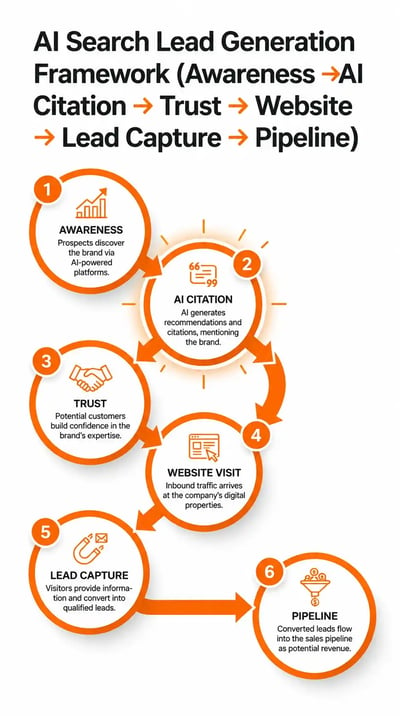
This infographic maps the AI Search lead generation journey from Awareness to Pipeline. It highlights how AI citations and trust drive website visits and lead capture.
The Five Pillars of AI Search Lead Generation
Visibility without structure produces noise. These five pillars produce pipeline.
Pillar 1: AI Search Visibility. Your brand needs to appear across Google AI Overviews, ChatGPT, Gemini, and Perplexity. Start by running an AI search visibility diagnostic to see where you stand.
Pillar 2: Entity Authority. AI trusts brands that show topical expertise, consistency, and third-party validation across review sites and industry channels.
Pillar 3: Buyer-Centric Content. Answer comparison, buying, implementation, and ROI questions instead of chasing keyword fragments.
Pillar 4: Customer Intelligence. Feed your content engine with sales calls, support tickets, and product feedback so it matches real buyer language. Our B2B marketing context engine unifies those signals.
Pillar 5: Measurement. Track citations, visibility, inbound pipeline, and influenced revenue. If you cannot tie it to revenue, it is not a channel yet.
Did You Know?
AI search traffic converts at 14.2%, compared to just 2.8% for traditional organic search, making it one of the highest-value inbound channels available in 2026.
Source: Everwildeone
How to Optimize Content for Capturing Inbound Leads Through AI Search
Most teams stop at formatting advice. We push further into ongoing optimization driven by real buyer signals.
Here is the action roadmap we run:
- Research buyer prompts. Capture the exact prompts buyers use, mapped to each ICP and persona, not generic seed phrases.
- Create answer-first content. Lead with the answer in the first third of the page, because that is where citations concentrate.
- Build topical authority. Cover the full question cluster so AI engines treat you as the source.
- Strengthen entity consistency. Align your name, claims, and positioning everywhere AI ingests data.
- Update continuously. Refresh content with new customer insights so it never goes stale.
Our intelligent research workflow turns raw buyer conversations into the prompt-level demand that steers every brief. The result is structured content that satisfies both the AI engine's citation criteria and the funnel's need for clear, actionable messaging.
The Content Types That Capture the Most Inbound Leads Through AI Search
Not all content earns citations equally. AI engines favor formats that answer decisions directly.
- Product comparisons: The exact format buyers request when they ask AI to choose between vendors.
- Buyer's guides: Comprehensive, structured, and easy for an AI engine to quote.
- Implementation playbooks: High-intent readers near the decision stage.
- ROI calculators and benchmarks: Numbers AI loves to cite as proof.
- Case studies: Third-party validation that builds entity authority.
- FAQ hubs and vendor evaluation guides: Direct answers to direct questions.
Think of these as a content pyramid. Decision content sits on top, evaluation content beneath it, then educational content, and foundational content at the base.
How to Capture AI Search Traffic After the Click
AI visibility alone does not create pipeline. The click has to land somewhere that converts.
Most companies lose high-intent visitors here. The buyer arrives warm and leaves cold.
Build the conversion experience deliberately:
- Answer-aligned landing pages that match the AI prompt that sent the visitor.
- Conversational CTAs and interactive assessments instead of generic forms.
- Frictionless demo scheduling for buyers ready to talk.
- Lead enrichment and CRM routing so context follows the lead.
Connect these flows through our platform integrations so signals from Zoom, Gong, Salesforce, and HubSpot feed directly back into your engine. The good news for lead quality: visitors from AI search already arrive with higher intent.
Did You Know?
Visitors from AI search tools spend 68% more time on-site than traditional organic visitors, a clear signal of higher intent and stronger lead quality.
Source: Everwildeone
Measuring Your AI Search Pipeline
Move beyond vanity metrics. Make AI search a revenue channel, not just a visibility metric.
Track these on your AI Search ROI dashboard:
- AI citation share
- AI share of voice across engines
- AI-driven sessions
- AI-assisted conversions
- Demo requests
- Pipeline generated
- Revenue influenced
We evaluate this channel by CAC payback and contribution to net revenue retention instead of top line lead numbers. That is the difference between reporting activity and reporting impact.
Common Mistakes That Kill Inbound Leads From AI Search
Most teams sabotage their own results. Avoid these:
- Writing for keywords instead of questions. AI search runs on natural prompts, not exact-match phrases.
- Ignoring AI citations. If you are not tracking who gets cited, you are flying blind.
- Weak topical authority. Thin coverage means AI trusts a competitor instead.
- Outdated content. Stale insights lose citations fast.
- No customer research. Most B2B AI tools lose power if they do not understand your buyers, your market, and your product.
- Measuring rankings instead of influence. The new conversion event is the citation, not position one.
Traditional optimization focuses on rankings, clicks, and keywords. AI search focuses on answers, entities, trust, citations, and recommendation quality. Treat it as an evolution, not a replacement.
How Omnibound Helps You Capture Inbound Leads Through AI Search
We do not position Omnibound as another optimization tool. We built an AI Search Intelligence platform for pipeline-driven teams.
Instead of feeding raw prompts, we feed living ICPs, evolving personas, and ongoing market intelligence that keep every AI action relevant. Here is what that means in practice:
- Monitor AI visibility across ChatGPT, Perplexity, Gemini, and AI Overviews with AI Search Intelligence.
- Track competitor citations and understand who AI trusts and where you stand.
- Discover emerging buyer questions at the prompt level before competitors react.
- Analyze customer conversations from calls, CRM, and support to ground content in reality.
- Align product messaging with our product marketing solutions so positioning closes deals.
- Measure AI-driven pipeline and continuously improve performance.
The engine runs in a loop: customer conversations, market intelligence, and competitor intelligence flow into AI visibility, which drives content recommendations, which earn AI search citations, which generate inbound leads and pipeline.
Capturing inbound leads through AI search is the defining growth move of 2026, not a future bet. Your buyers already start their research inside AI, and the brands cited in those answers win the consideration set.
Build visibility, earn citations, convert the click, and measure everything against pipeline. That is the full loop.
The AI-powered future of B2B marketing is on the horizon, and it's here. If you want to turn AI search visibility into measurable revenue, start driving inbound demand and pipeline with Omnibound. Book a demo now!
FAQs
How do AI search engines generate inbound leads?
AI search engines generate inbound leads by citing trusted brands in answers, driving high-intent traffic that converts into pipeline.
Can ChatGPT drive inbound traffic to my website?
Yes, ChatGPT can drive qualified referral traffic when your content is answer-first, authoritative, and citation-worthy.
How do I optimize content for AI search in 2026?
Optimize for AI search by answering buyer prompts directly, building topical authority, and continuously updating content with fresh insights.
What is AI search visibility and why does it matter?
AI search visibility measures how often your brand appears in AI-generated answers, increasing trust and influencing buying decisions.
How do you measure AI search ROI?
Measure AI search ROI through citations, share of voice, AI-driven traffic, conversions, pipeline, and revenue impact.
What content performs best for capturing inbound leads through AI search?
Buyer's guides, comparisons, case studies, benchmarks, ROI calculators, and FAQs earn the most AI citations.
How is AI search different from traditional optimization?
AI search prioritizes trusted answers and citations, while traditional SEO focuses on rankings, keywords, and clicks.
What does a content citation software do for telecom marketing?
Content citation software tracks whether AI engines name your brand when buyers ask questions, and produces content designed to be cited. For telecom marketing that covers four jobs: monitoring citation and mention position across ChatGPT, Gemini, Claude and Perplexity for prompts about coverage, pricing, integration and service reliability; showing which competitors win those prompts and why; generating or refreshing content structured for extraction, with clear answers, FAQ schema and comparison tables; and tying resulting sessions to leads and pipeline. The category exists because telecom buyers now resolve most early research inside an AI answer without clicking through.