

Table Of Contents
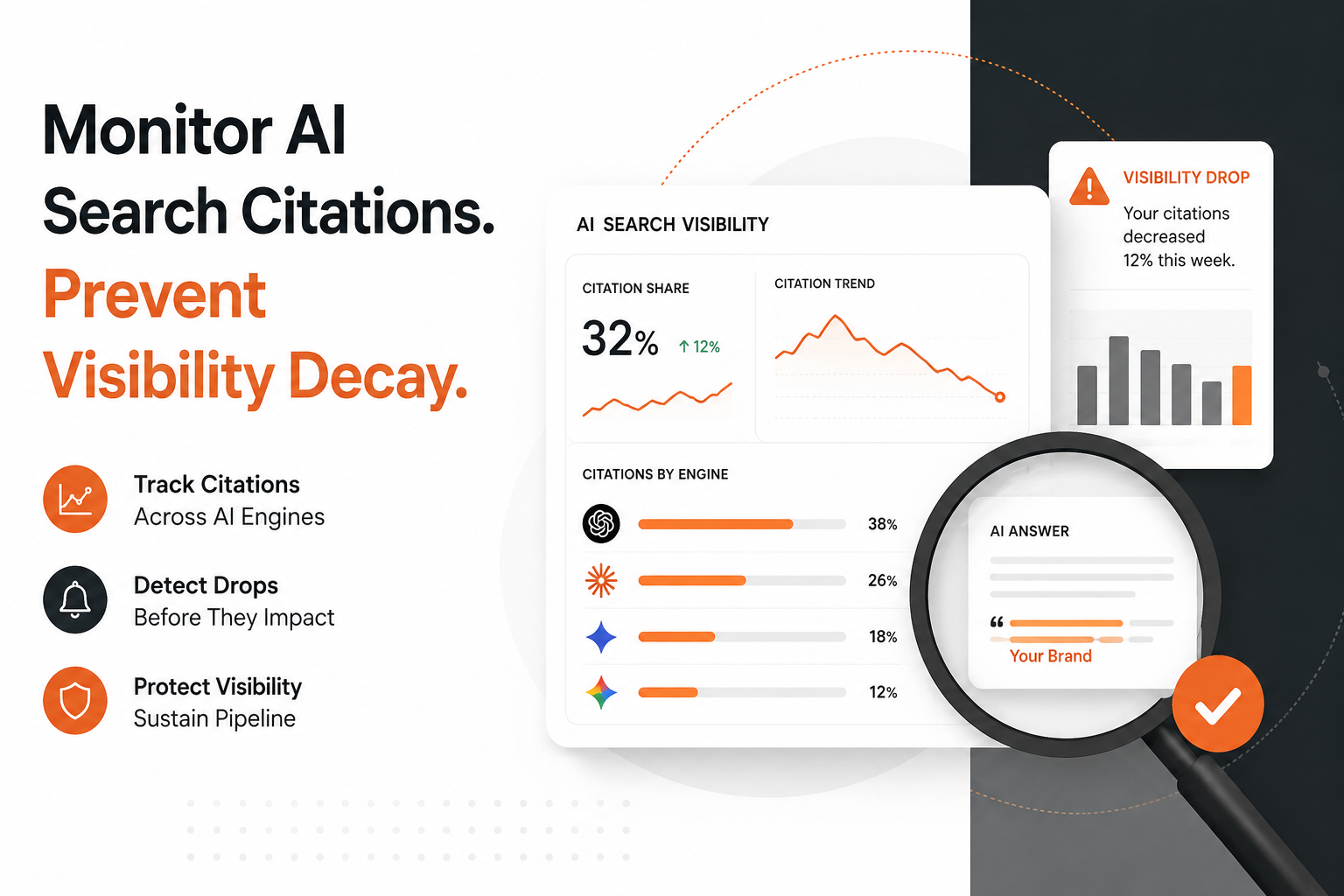
As generative AI answer engines become a major source for buyer questions, the visibility of your brand’s content can slip without warning. Many B2B marketers discover that their assets are no longer cited in AI-generated answers, even though the content remains on the website. This silent loss can erode authority, reduce share of voice, and affect pipeline growth.
In this guide, we explain what AI citation decay means, why AI search citations matter, how to measure and monitor citation visibility, and what you can do to prevent valuable content from gradually disappearing from AI-generated answers.
What Is AI Citation Decay?
AI citation decay is the gradual loss of a website’s visibility or citation presence in AI-generated answers over time.
An asset can remain published, indexed, and factually accurate while becoming less frequently cited by AI search systems. The change may happen because competing content becomes more relevant, buyer prompts evolve, the information on your page becomes outdated, or the sources considered by an answer engine change.
This makes citation decay different from simply losing a Google ranking.
A page can maintain traditional organic visibility while losing visibility in AI-generated answers. Conversely, a page that has modest traditional search visibility may still become an important source for AI answers.
The important point is that AI citation visibility needs to be measured separately rather than inferred from traditional SEO performance.
AI Citation Decay vs. Content Decay
These concepts are connected, but they are not identical.
| Concept | Definition | Typical signal |
|---|---|---|
| Content decay | A decline in a page’s usefulness, relevance, or performance over time | Falling traffic, rankings, engagement, or conversions |
| AI citation decay | A decline in how often a page is cited in AI-generated answers | Fewer citations for the same buyer prompts |
| Competitive displacement | A competitor becomes more visible for the same prompts | Competitor citations increase as yours decline |
| Prompt drift | Buyer language changes and your content no longer matches current questions | New prompt variations produce fewer citations |
| Technical visibility loss | A page becomes harder for systems to access or interpret | Broken links, redirects, blocked pages, or changed URLs |
A page may experience AI citation decay without broad content decay. For example, its organic traffic may remain stable while AI systems increasingly cite newer competitor research.
Likewise, a page may lose citations because of a technical issue rather than because the content is weak.
Common Causes of AI Citation Decay
Citation visibility can decline for several reasons:
- Competitors publish stronger sources.
New research, comparisons, statistics, and expert content can give competing pages a stronger position in AI-generated answers. - Buyer language changes.
The prompts buyers use to research a problem can evolve. Content optimized around older terminology may become less relevant to newer questions. - Content becomes outdated.
Old statistics, examples, product information, or recommendations can reduce the usefulness of a page. - Your topic coverage develops gaps.
A page may answer the original question well but fail to address the follow-up questions buyers now ask. - The competitive citation landscape changes.
Even if your page does not become worse, competitors can become more visible and take a larger share of relevant AI answers. - Important pages are changed or removed.
CMS migrations, URL changes, redirects, content consolidation, and accidental changes can affect the availability or usefulness of previously cited assets. - The page lacks clear evidence.
AI systems may favor sources that provide original research, transparent methodology, specific examples, expert commentary, or verifiable data. - The content is difficult to extract or interpret.
Dense formatting, unclear headings, missing definitions, and poorly structured information can make it harder for answer engines to identify useful passages.
This is why measuring citation decay requires looking at the trend over time rather than treating a single AI answer as a definitive signal.
Recommended Read: AI Search Optimization Checklist: Win AI Citations and Drive B2B Pipeline — A step-by-step playbook for improving and maintaining AI search visibility.
How to Measure AI Citation Decay
The first step in measuring AI citation decay is establishing a baseline.
Track your target buyer prompts at regular intervals and record whether your brand is:
- Cited as a source
- Mentioned without a citation
- Recommended as a solution
- Missing from the answer
- Replaced by a competitor
Then compare those results over time.
A Simple Citation-Decay Formula
You can calculate citation change using a simple percentage formula:
Citation decay rate = ((Baseline citations − Current citations) ÷ Baseline citations) × 100
For example, if a page was cited in 40 tracked answers during the baseline period and is now cited in 28:
((40 − 28) ÷ 40) × 100 = 30% citation decay
This calculation is most useful when:
- The prompt set remains consistent
- The same AI platforms are monitored
- The review cadence is stable
- Brand mentions and citations are recorded separately
- Major changes in the answer engine are documented
A single result should not trigger a major content rewrite. Look for sustained changes across related prompts.
Citation Monitoring Table
A monitoring table helps your team distinguish isolated fluctuations from meaningful visibility loss.
| Prompt | Baseline status | Current status | Change | Cited URL | Competitor change | Recommended action |
|---|---|---|---|---|---|---|
| How to monitor AI citations | Cited | Cited | Stable | /citation-monitoring |
No major change | Continue monitoring |
| Best AI search visibility tools | Cited | Mentioned only | Decline | /ai-search-intelligence |
Competitor A added | Review comparison coverage |
| How to prevent citation decay | Cited | Missing | Significant decline | /citation-decay |
Competitor B cited | Refresh and expand content |
| AI citation metrics for B2B | Mentioned | Cited | Improvement | /ai-citation-metrics |
Competitor presence stable | Identify successful changes |
Metrics to Track
Several metrics can help your team understand citation health:
Citation count: The number of tracked AI answers in which your content is cited.
Citation rate: The percentage of relevant tracked answers that include a citation to your brand or content.
Citation share of voice: Your share of citations compared with competing brands across the same set of buyer prompts.
Citation velocity: The rate at which your citation presence is increasing or decreasing over a defined period.
Page-level citation performance: Which individual URLs are gaining or losing citations.
Competitor citation share: How frequently competitors are being cited for the same buyer questions.
Prompt coverage: The percentage of priority buyer prompts for which your brand is cited, mentioned, or recommended.
Commercial citation coverage: The percentage of high-intent prompts that cite pages connected to your products, services, or conversion paths.
The exact metrics you use should depend on your monitoring methodology and the AI platforms and prompts you track. The goal is not to create another dashboard for its own sake. The goal is to identify meaningful changes early enough to act on them.
For teams that need to diagnose why visibility is changing, AI Search Intelligence provides a way to track where your brand wins or loses in AI search.
How Omnibound Helps Prevent AI Citation Decay
Monitoring is most valuable when it connects directly to action.
AI Search Intelligence helps teams track where their brand wins or loses visibility across AI search.
When a visibility gap appears, Audit & Optimize helps identify what needs to be improved.
For content that needs to be refreshed, Content Refresh turns underperforming content into opportunities for improvement.
And when teams need to understand the broader market context behind changing buyer questions, Marketing Context provides a continuously evolving view of the information surrounding the market.
The broader workflow is:
Track → Find the gap → Understand the cause → Improve the content → Measure the change
That is a more sustainable approach than optimizing for AI citations once and assuming the work is finished.
Why AI Search Citations Matter for B2B Marketing
When an AI answer engine cites a page, it creates an opportunity for your brand to appear directly within a buyer’s research journey. For a VP of Marketing or demand generation leader, that visibility can contribute to brand credibility, discovery, and ultimately the sales funnel.
Unlike traditional search rankings, AI search visibility is not limited to whether your page appears at a particular position on a results page. Your brand may be mentioned, recommended, or cited as a source within an AI-generated answer. That makes ongoing measurement important.
Tools such as an AI Search Visibility Checker can help you understand where your brand appears in AI search and where visibility is being lost.
A robust AI search visibility monitoring process should go beyond checking whether a brand appears once. It should track changes in citations, mentions, competitors, prompts, and the pages being referenced over time.
This is especially important for B2B companies that rely on content to influence buyers before they ever speak with sales. If a page that consistently appeared in AI answers stops being cited, that change may remain invisible unless your team is actively monitoring it.
AI Citations vs. Traditional Search Rankings
AI citations and traditional search rankings are related, but they are not the same visibility signal.
| Visibility signal | What it measures | Why it matters |
|---|---|---|
| Organic ranking | Where a page appears in a search results page | Indicates traditional search visibility |
| Brand mention | Whether your company is named in an AI answer | Shows awareness or recommendation visibility |
| AI citation | Whether an AI answer links to or references your content | Shows that your page is being used as supporting evidence |
| Citation share of voice | How often your brand is cited compared with competitors | Shows your relative visibility across buyer prompts |
| Page-level citation performance | Which URLs are being referenced | Helps identify content that is gaining or losing influence |
A page can maintain traditional organic visibility while losing visibility in AI-generated answers. Conversely, a page with modest traditional search visibility may still become an important source for AI answers.
The important point is that AI citation visibility needs to be measured separately rather than inferred from traditional SEO performance.
Start With a Citation Inventory
To understand your baseline, map the buyer prompts that currently generate citations for your brand.
Identify:
- Which buyer prompts produce citations for your brand
- Which pages are being cited
- Which topics generate the most visibility
- Which competitors appear alongside or instead of your brand
- Which content formats are most frequently referenced
- Which stages of the buyer journey generate the most citations
Your inventory might include blog posts, research reports, case studies, comparison pages, product documentation, and other high-value assets.
A simple citation inventory can look like this:
| Buyer prompt | Brand visibility | Cited URL | Competitors cited | Buyer stage | Priority |
|---|---|---|---|---|---|
| Best tools for AI search monitoring | Cited | /ai-search-intelligence |
Competitor A | Evaluation | High |
| How to measure AI citations | Mentioned, not cited | /blog/ai-citation-monitoring |
Competitor B | Education | Medium |
| AI search visibility platforms | Competitor replaces brand | /comparison-page |
Competitor A, C | Evaluation | High |
Prioritize the pages that contribute most to important buyer journeys. These become the backbone of your AI citation monitoring and content refresh strategy.
Because buyer language and the information surfaced by AI search can change, revisit the prompt-to-page map regularly. A page that performs well today should not automatically be assumed to remain visible indefinitely.
Recommended Read: How to Build AI Answer Citations That Drive B2B Pipeline — A practical framework for creating citation-ready assets that AI engines can reference.
How to Monitor AI Search Citations
A practical monitoring process can be organized into five steps.
1. Define the Buyer Prompts
Start with the questions that matter commercially.
Prioritize prompts related to:
- Problems your product solves
- Product and category research
- Competitor comparisons
- Alternatives
- Best-of and recommendation searches
- Pricing and evaluation
- High-intent use cases
- Implementation and integration questions
- Questions asked by different buyer roles
- Questions that influence sales conversations
Organize prompts by buyer stage:
| Buyer stage | Example prompt type | What to monitor |
|---|---|---|
| Awareness | What is AI citation decay? | Definitions and educational visibility |
| Problem identification | Why are our AI citations declining? | Explanatory and diagnostic content |
| Solution research | How do I monitor AI search citations? | Guides, tools, and frameworks |
| Evaluation | Best AI search visibility platforms | Recommendations and comparisons |
| Decision | Which platform tracks competitor AI citations? | Product pages, proof, and commercial content |
The objective is to monitor the questions your buyers actually ask, rather than tracking an arbitrary collection of keywords.
2. Establish Your Citation Baseline
For each prompt, record the current result.
Track:
- Whether your brand appears
- Whether your website is cited
- Which URL is cited
- Which competitors appear
- How many relevant sources are included
- What type of content is being cited
- Whether the answer includes a recommendation
- Whether the cited page supports a commercial next step
This gives your team a baseline against which future changes can be measured.
It is also useful to record the date, platform, prompt wording, and answer format. AI-generated answers can vary, so consistent documentation improves the reliability of your comparisons.
3. Monitor Changes Over Time
Run the same prompt set on a consistent cadence.
A monthly review can provide a useful baseline for many teams, while higher-value or fast-changing topics may justify more frequent monitoring.
Look for patterns rather than isolated changes.
For example:
- One lost citation may not indicate a problem.
- Several lost citations across related prompts may indicate emerging decay.
- A competitor repeatedly replacing your brand may indicate a visibility gap.
- Multiple pages losing citations around the same topic may indicate that the topic itself needs attention.
- A decline limited to one platform may indicate platform-specific variation rather than broad content decay.
- A decline across multiple platforms is more likely to require immediate investigation.
A simple monitoring flow looks like this:
Define prompts → Capture answers → Record citations → Compare trends → Diagnose changes → Refresh content → Recheck visibility
4. Diagnose the Visibility Gap
When a citation disappears, compare your content with the sources now being cited.
Ask:
- Is the competing source newer?
- Does it answer the prompt more directly?
- Does it provide original research or data?
- Does it cover follow-up questions better?
- Does it have stronger first-hand expertise?
- Has our page become outdated?
- Are we missing information that buyers now expect?
- Is the competing page easier to scan and extract?
- Does it provide clearer definitions, examples, or recommendations?
- Does our page still match the language used in current prompts?
This is where competitor intelligence becomes particularly useful.
Instead of simply asking, "Why did we lose a citation?", ask:
"What changed in the answer landscape that caused another source to become more useful?"
5. Trigger a Content Refresh
Once the cause is identified, decide whether the page needs:
- A factual update
- New examples
- Updated statistics
- Better question coverage
- Stronger expert perspective
- Improved structure
- New internal links
- Additional supporting content
- A broader content refresh
- A technical review of links, redirects, and accessibility
Use a decision framework before assigning a rewrite:
| Situation | Likely cause | Recommended response |
|---|---|---|
| Citations decline but content is current | Competitor displacement | Add original evidence, stronger differentiation, or supporting content |
| Citations decline after a URL change | Technical visibility issue | Review redirects, canonical signals, internal links, and accessibility |
| Citations decline for new prompt variations | Prompt drift | Expand terminology, headings, examples, and question coverage |
| Competitors cite newer research | Evidence gap | Add updated data, original analysis, or expert commentary |
| One page loses citations while related pages improve | Page-level weakness | Consolidate, strengthen, or reposition the affected page |
| Citations decline across an entire topic | Topic authority gap | Build a supporting content cluster and improve internal linking |
Content Audit & Optimization can be used as part of this process to identify what is not performing and where content improvements are needed.
Recommended Read: Why SEO Fundamentals Still Power AI Search Citations for B2B Marketers — Explores the foundational SEO practices that still support AI search visibility.
How to Detect Stale Pages That Are Losing AI Citations
Not every page that loses a citation needs to be rewritten.
The first step is determining whether the content itself has become less useful.
A page may be considered a refresh candidate when several signals appear together:
- Citation frequency is declining
- Competitors are increasingly cited for the same prompts
- The page contains outdated information
- New buyer questions are not addressed
- The page lacks recent examples or evidence
- Important supporting pages have changed
- The content no longer reflects the current product or market
- The page has weak internal links from relevant content
- The page contains broken links, outdated references, or unclear source attribution
Stale-Page Detection Checklist
| Review area | Questions to ask | Warning signs |
|---|---|---|
| Accuracy | Are the facts, statistics, and recommendations current? | Old data, discontinued products, outdated terminology |
| Relevance | Does the page answer the prompts buyers ask today? | New prompt variations are not covered |
| Depth | Does it address follow-up questions and objections? | Short or incomplete explanations |
| Evidence | Does it include credible support or original insight? | Generic claims without proof |
| Structure | Can important answers be identified quickly? | Long paragraphs, weak headings, unclear definitions |
| Experience | Does it reflect first-hand knowledge? | No examples, methodology, or expert perspective |
| Accessibility | Can users and systems access the page reliably? | Broken links, redirects, blocked resources |
| Internal linking | Is the page connected to relevant supporting content? | Few contextual links or isolated pages |
This distinction matters because a citation drop can be caused by changes outside the page itself.
For example, if three competitors publish authoritative research on a topic, simply changing a few headings on your existing article may not restore visibility. The better response may be to add original analysis, strengthen evidence, or create supporting content that addresses the new information landscape.
Proactive Content Refresh Strategies to Prevent Citation Decay
Even with diligent monitoring, content can become stale as buyer language evolves and competitors add new information.
A proactive refresh strategy keeps important assets aligned with current search intent and the questions buyers are asking.
Start by auditing your highest-value cited pages.
Look for opportunities to:
- Update outdated statistics
- Replace old examples
- Add new industry developments
- Clarify definitions and explanations
- Answer emerging buyer questions
- Strengthen first-hand expertise
- Improve internal linking
- Add relevant supporting evidence
- Update product or market information
- Add comparison tables where they improve clarity
- Include concise summaries for complex concepts
- Improve headings and section structure
- Add a clear methodology where data or analysis is presented
- Review citations, references, and outbound links
- Confirm that important pages remain accessible and indexable
Refresh by Impact, Not by Age
A page should not be refreshed simply because it is old. Prioritize pages based on business value and visibility risk.
| Priority | Page characteristics | Recommended cadence |
|---|---|---|
| High | Commercial page with declining citations and competitor displacement | Review monthly or quarterly |
| High | Research, comparison, or statistics page used in many answers | Review after major market changes |
| Medium | Educational page with stable citations but changing terminology | Review every six to twelve months |
| Medium | Supporting article with moderate visibility | Review during topic-cluster audits |
| Low | Low-value page with no meaningful citation or conversion role | Refresh only when strategically relevant |
Structured data can also be reviewed where appropriate, but it should not be treated as a guaranteed mechanism for earning AI citations. The priority should remain the usefulness, accuracy, relevance, and accessibility of the content.
After every significant refresh, return the page to your monitoring set.
The objective is to create a feedback loop:
Monitor → Detect → Diagnose → Refresh → Measure → Repeat
This turns AI citation monitoring from a reporting exercise into an ongoing content optimization process.
For teams managing large content libraries, Content Refresh is designed around turning underperforming content into higher-impact AI search assets.
How Competitor Citations Reveal Visibility Gaps
Your competitors' citations can be as informative as your own.
Suppose your brand previously appeared for a category-level buyer prompt but a competitor now appears instead. That change tells you something about the information landscape.
Look at the competing source and determine:
- What question does it answer?
- What evidence does it provide?
- What terminology does it use?
- Is it newer?
- Does it include original data?
- Does it address an objection or follow-up question?
- Is it supported by other authoritative sources?
- Does it offer a clearer recommendation?
- Does it provide a better comparison or decision framework?
- Does it connect the topic to a practical business outcome?
Competitor Citation Gap Analysis
| Comparison area | Your page | Competitor page | Potential gap |
|---|---|---|---|
| Recency | Last updated two years ago | Updated recently | Refresh facts and examples |
| Evidence | General recommendations | Original research | Add data or methodology |
| Prompt coverage | Answers the main question | Answers main and follow-up questions | Expand topic coverage |
| Structure | Long-form narrative | Tables and concise sections | Improve scanability |
| Expertise | General explanation | Expert commentary and examples | Add first-hand perspective |
| Commercial relevance | Limited next steps | Clear evaluation framework | Connect content to buyer decisions |
This helps distinguish a content-quality problem from a broader topic or authority gap.
A systematic competitor view can also reveal opportunities before your own citations disappear completely. If competitors are beginning to gain visibility around an important buyer topic, that can become an early warning signal.
Competitor Intelligence can help teams see where competitors win in AI search and identify areas where they need to close the gap.
Real-World Scenario: Recovering Lost AI Citations
Consider a mid-market SaaS vendor that notices a decline in AI-generated citations for one of its flagship research assets.
The team begins by comparing historical citation performance against the current results. The analysis shows that competitors are now being cited for several of the same buyer prompts.
Rather than immediately rewriting the entire asset, the team compares the competing sources with its own page.
It discovers that the competing content includes newer data, clearer explanations, and answers to several follow-up questions that the original page does not address.
The team refreshes the asset with updated evidence, expands the missing sections, improves the structure, and updates the page to reflect current buyer questions.
The page is then added back into the monitoring cycle.
Recovery Workflow
| Stage | Action | Output |
|---|---|---|
| Detect | Identify declining citations | List of affected prompts and URLs |
| Compare | Review newly cited competitor sources | Competitive gap analysis |
| Diagnose | Determine whether the issue is content, technical, or competitive | Root-cause hypothesis |
| Refresh | Update evidence, structure, coverage, and links | Revised content asset |
| Validate | Check accessibility, links, and page quality | Publish-ready page |
| Monitor | Re-run the original prompt set | Citation recovery trend |
The lesson is important: citation recovery should be treated as a diagnosis problem first and a writing problem second.
Key Indicators of Ongoing AI Citation Health
A healthy AI citation monitoring program should track trends rather than isolated results.
Useful indicators include:
- Stable or increasing citation count
- Stable or increasing citation rate
- Increasing citation share of voice
- Fewer high-value prompts where competitors replace your brand
- Strong performance from priority commercial pages
- Recovery of citations after successful content refreshes
- Consistent visibility across important buyer journeys
- Increasing coverage of new buyer prompt variations
- Fewer pages showing sustained citation decline
- Stronger visibility for original research and expert content
AI Citation Health Dashboard
| Indicator | Healthy trend | Warning signal |
|---|---|---|
| Citation rate | Stable or increasing | Declines across multiple review periods |
| Citation share of voice | Holding or growing | Competitors gain share consistently |
| Priority-page citations | Stable or improving | Commercial pages lose citations |
| Prompt coverage | Expanding with buyer language | New prompt variations produce no visibility |
| Competitor replacement | Limited or declining | Competitors repeatedly replace your brand |
| Refresh recovery | Citations return after updates | Refreshes produce no improvement |
| Technical health | Pages accessible and linked | Broken links, redirects, or blocked pages |
The specific target should depend on your baseline, market, competitors, and prompt set.
There is no universal citation-health score that guarantees visibility.
What matters is whether your team can identify meaningful changes, understand why they occurred, and take action.
All In All
AI-driven answer engines are changing how B2B buyers discover information, evaluate vendors, and research solutions.
That makes AI citation visibility an increasingly important part of modern content measurement.
The key is not simply to check whether your brand appears in an AI answer today. You need to understand how that visibility changes over time.
Build a baseline of important buyer prompts. Monitor citation and competitor trends. Diagnose why visibility changes. Refresh content when the evidence supports it. Then measure the result.
The resulting loop is simple:
Monitor → Detect → Diagnose → Refresh → Measure
By treating AI citation health as an ongoing performance signal rather than a one-time audit, B2B marketing teams can protect valuable content, identify emerging competitive gaps, and build a stronger presence across AI-driven buyer journeys.
FAQs
1. What is AI citation decay?
AI citation decay is the gradual decline in how frequently your website or content is cited in AI-generated answers. A page can remain published and accurate while losing visibility as buyer questions, competing sources, and the information landscape change.
2. How do I measure AI citation decay?
Establish a baseline for a consistent set of buyer prompts and monitor citation presence over time. Track metrics such as citation count, citation rate, citation share of voice, page-level citation performance, and competitor citation share.
You can also calculate citation decay using this formula:
Citation decay rate = ((Baseline citations − Current citations) ÷ Baseline citations) × 100
3. How do platforms detect stale pages that are losing AI citations?
There is no single universal mechanism that all AI search systems use to identify stale pages. From a marketing perspective, teams can detect potential content decay by monitoring changes in citation performance, comparing newly cited competitors, and reviewing whether their pages still provide current, relevant, and useful information.
4. How should a marketing team monitor citations from answer engines?
Create a defined set of commercially relevant buyer prompts, establish a citation baseline, run those prompts consistently, track which URLs and competitors appear, and investigate meaningful changes. The process should connect monitoring to a clear content-refresh workflow.
5. What is citation rate and how is it calculated?
Citation rate is the percentage of tracked AI answers in which your brand or a specified piece of content is cited.
For example, if your content is cited in 30 out of 100 relevant tracked answers, your citation rate would be 30%.
Citation rate = (Number of answers containing your citation ÷ Total relevant answers tracked) × 100
Your exact methodology should remain consistent so that changes over time are meaningful.
6. Why is my brand missing from AI search citations?
Your brand may be missing because another source is considered more relevant to the prompt, competitors have stronger or newer information, your content does not directly answer the question, buyer language has changed, or your content has gaps compared with the sources being cited.
The best response is to compare the current AI answer landscape with your own content rather than assuming that the problem is simply an SEO ranking issue.
7. How can I monitor whether competitors are getting recommended over my brand?
Track the same buyer prompts over time and record which brands are cited or recommended. Then compare competitor citation share against your own. This can reveal emerging visibility gaps before they become larger problems.
8. How frequently should I refresh AI-cited content?
There is no single refresh interval that applies to every page. High-value assets should be reviewed regularly, with additional reviews after major product, market, or buyer-behavior changes.
Use citation monitoring to determine when a page actually needs intervention rather than rewriting content on a fixed schedule without evidence.
9. Can a page lose AI citations while keeping its Google rankings?
Yes. AI answer engines and traditional search systems do not produce identical visibility outcomes. A page may retain organic rankings while competitors become more frequently cited in AI-generated answers.
10. Do tables and structured formatting improve AI citations?
Clear formatting can make information easier for readers and systems to understand, especially when tables summarize comparisons, definitions, metrics, or decision criteria. However, formatting alone does not guarantee citations. The content must also be accurate, relevant, useful, accessible, and supported by credible evidence.
11. Should every lost citation trigger a content refresh?
No. A single lost citation may reflect normal variation. Look for sustained declines across related prompts, competitor replacement, outdated information, or clear content and technical gaps before prioritizing a refresh.
Turn Your Content Into AI-Search Winners
Get cited across ChatGPT, Claude & Perplexity — not just ranked on Google.
- Increase AI citations
- Improve answer visibility
- Track brand mentions in LLMs