

The rules of B2B discovery have shifted, and the brands that haven't adjusted their approach are already losing pipeline. Only 22% of B2B marketers currently track AI search visibility, despite it driving up to 17% of all branded discovery for top SaaS brands — which means the window to gain a real competitive edge with the right AEO strategies for B2B tech is wide open right now. Platforms like ChatGPT, Perplexity, Gemini, Claude, and Google AI Mode are no longer supplementary research tools. They are the first stop in the vendor evaluation process, and if your brand isn't being cited, you aren't even in the conversation.
What AEO Strategies for B2B Tech Actually Require
AI engines don't return a list of links. They synthesize trusted sources and deliver a single, opinionated answer. That changes everything about how B2B tech brands need to think about content.
B2B companies face a different problem than consumer brands. Longer sales cycles. Technical products that require category education. Buying committees with conflicting priorities. Generic AEO advice — structured data, FAQ pages, concise answers — doesn't address any of that. Buyer context now matters more than simple keyword repetition, and building context requires understanding what your buyers are actually asking at every stage of evaluation.
Why Generic AI Optimization Fails B2B Tech Brands
Most AI search visibility tools guess prompts from keywords and open-source data. That approach produces content that sounds like the right answer but misses the actual buying signals that drive B2B decisions.
Basic prompts produce slop content. And slop content doesn't get cited. AI engines evaluate authority signals, entity consistency, and answer structure — not just keyword density. B2B tech brands that treat AEO as a content volume play are going to generate a lot of text and very little pipeline.
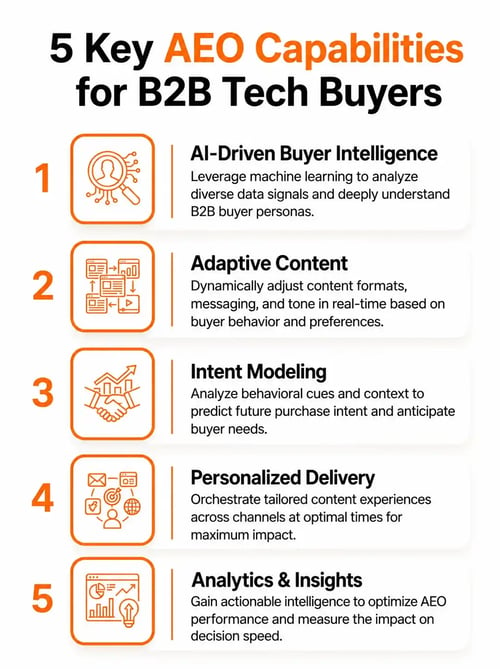
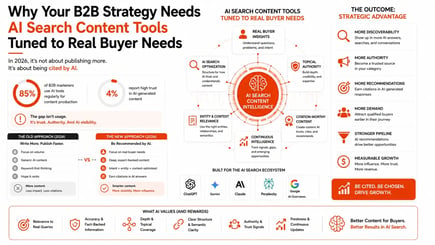
This infographic visualizes the five key AEO capabilities for B2B tech buyers. Use it to guide strategy and buyer enablement.
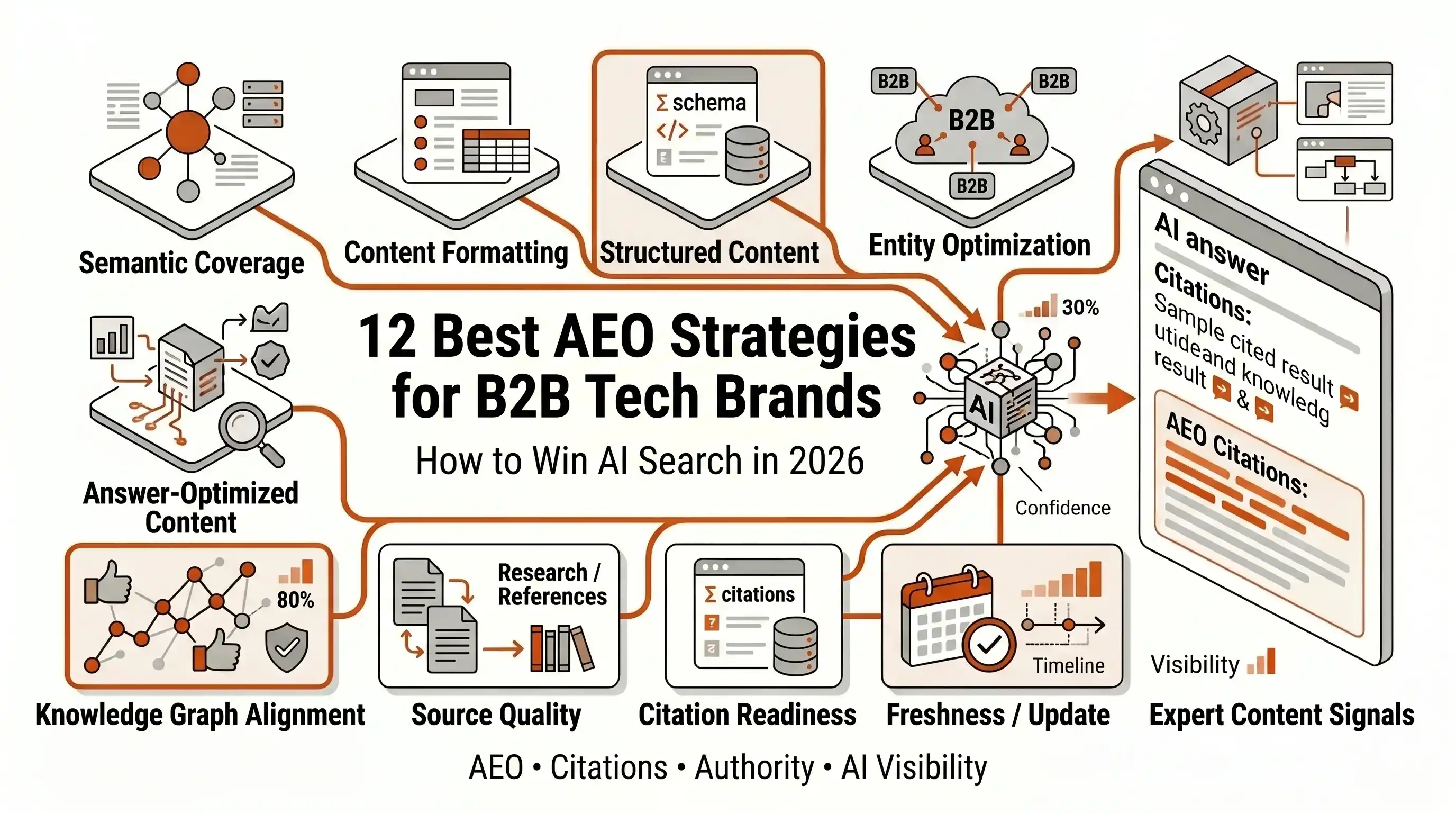
12 AEO Strategies for B2B Tech Brands That Actually Drive Pipeline
These aren't generic tips. Each strategy below is built around how AI engines actually process B2B buying signals, and how your brand can become the trusted source they surface.
01. Build Question-First Content Architecture
Stop organizing content around product features and start organizing it around buyer problems. AI engines surface content that directly answers the question being asked, not content that happens to contain related keywords.
Map your content to the prompts buyers use at each stage: "how do I solve X," "what's the best approach to Y," "which platforms handle Z." Build topic clusters that move from problem identification through vendor evaluation. That's the structure AI engines reward.
02. Create Citation-Friendly Content Formats
AI systems prefer content they can extract cleanly. Concise definition blocks. Short answer paragraphs followed by detailed explanation. Structured tables. Comparison frameworks. FAQ sections with clear, direct answers.
If your content is dense, unbroken prose with no extractable structure, it won't be cited — even if the underlying insight is strong. Format is a citation signal, not just a readability preference.
03. Strengthen Entity Authority
AI engines evaluate brands as entities, not just collections of web pages. That means your company name, product names, category positioning, and executive thought leadership all need to be consistent across every surface where your brand appears.
Inconsistent messaging across your site, third-party profiles, press mentions, and community discussions creates entity confusion. Entity confusion reduces citation probability. This is where many B2B tech brands lose ground without realizing it.
Did You Know?
Websites utilizing comprehensive structured data (Schema) see 36% higher visibility in AI-powered search results.
Source: BrightEdge / Dot Com Infoway 2025
04. Optimize Content for AI Buying Journeys
B2B buyers use AI search differently at different stages of evaluation. Awareness prompts look like: "what is [category]" or "how do companies solve [problem]." Evaluation prompts look like: "best [category] platforms for enterprise" or "[your brand] vs [competitor]." Vendor selection prompts look like: "how does [your brand] handle [specific use case]."
Your content needs to appear across all three stages. A strong AI search marketing approach maps content explicitly to buying stage, ICP, and persona — not just generic topic clusters.
05. Use Structured Content Design
This shift changes the signal hierarchy. Technical structure isn't just good UX — it's how AI engines understand and trust your content. Heading hierarchy, semantic HTML, FAQ schema, and comparison tables all help AI systems extract and attribute your insights correctly.
Schema markup in particular is a high-return investment for B2B tech brands. Structured data makes your content machine-readable in ways that directly improve citation probability. The 36% visibility lift from proper schema implementation referenced above isn't theoretical — it's a measurable structural advantage.
06. Build Third-Party Validation Signals
AI models heavily rely on what the broader ecosystem says about your brand. Review platforms, analyst mentions, media coverage, industry publications, and community discussions all feed into how AI engines assess your authority.
A B2B tech brand with strong first-party content but thin third-party presence has a citation gap problem. Feeding a few sales calls into an LLM does not tell the whole story — and neither does a well-maintained blog if the external validation layer is weak.
07. Build Topic Clusters Around Buying Intent
Isolated content pieces don't build authority. Topic clusters do. For B2B tech brands, that means grouping content around the problems buyers have, the categories they're evaluating, and the use cases your product addresses — not around individual keywords.
Each cluster should connect awareness content to evaluation content to implementation content. AI engines interpret interconnected, topically coherent content ecosystems as evidence of genuine expertise in a category.
08. Refresh Content Continuously
AI systems favor accurate, current information. Stale content — statistics from two years ago, product features that have changed, market narratives that no longer reflect competitive reality — reduces your citation probability over time.
This isn't a quarterly audit task. It's a continuous workflow. The content refresh process needs to be systematized, with triggers for product changes, competitive shifts, and evolving buyer language feeding directly into content updates.
09. Monitor Competitive AI Visibility
Most B2B tech teams have no visibility into how their brand compares to competitors inside AI answers. That invisibility is a pipeline problem. If a competitor is consistently cited when buyers ask about your shared category, they're being shortlisted before your brand enters the picture.
Monitoring which brands appear in AI answers, which prompts trigger competitor citations, and where the citation gaps exist is how you build a competitive AEO strategy, not just a content strategy.
10. Create AI-Optimized Comparison Content
Comparison content is among the highest-intent, most-cited content formats in B2B AI search. Buyers actively prompt AI engines with "[your brand] vs [competitor]," "best platforms for [use case]," and "alternatives to [incumbent]."
If you don't own those comparison narratives with well-structured, accurate, buyer-focused content, your competitors will. This is a direct citation gap that most B2B tech brands leave unaddressed.
11. Connect Content with Customer Intelligence
The most effective AEO strategies for B2B tech are grounded in real buyer language, not assumed buyer language. Sales call transcripts, CRM notes, support conversations, and win/loss interviews contain the exact vocabulary and objections your buyers use when they talk to AI engines.
Omnibound's B2B marketing context engine unifies these customer and market signals into a single source of truth for strategy, research, and content execution. That's what separates AI-search-ready content from content that just looks like it should work.
12. Measure AI Search Visibility, Not Just Page Performance
If you're only tracking traditional performance metrics, you're measuring the wrong game. The KPIs that matter for AEO are: citation frequency across AI engines, prompt coverage by ICP and persona, competitive answer share, and brand mention patterns inside AI-generated responses.
Most B2B tech teams have no system for tracking any of this. That's the gap. And it's exactly where the brands that move first will build durable advantages.
Did You Know?
Only 22% of B2B marketers currently track AI search visibility, despite it driving up to 17% of all branded discovery for top SaaS brands.
Source: Exposure Ninja / Data-Mania 2026
Common AEO Mistakes B2B Tech Brands Make
Getting the strategy right means understanding where teams typically go wrong. These are the patterns we see most often:
- Publishing generic thought leadership with no structured answer format, no buyer-stage alignment, and no connection to real buyer language.
- Weak entity consistency — brand positioning, product naming, and category messaging varying across pages, profiles, and partner content.
- No structured content design — prose-heavy pages with no schema, no extractable blocks, and no FAQ architecture.
- Measuring only traditional performance metrics and having no visibility into how the brand appears (or doesn't appear) inside AI-generated answers.
- Ignoring competitive AI visibility — no tracking of which prompts surface competitors and where the citation gaps are growing.
- One-time research snapshots instead of continuously updated buyer intelligence that feeds content strategy in real time.
How Leading B2B Tech Brands Are Approaching AEO in 2026
The B2B tech brands showing up consistently in AI answers share a few patterns. They've built content ecosystems organized around buyer problems, not product features. They maintain strong entity consistency across owned and third-party surfaces. They refresh continuously rather than publishing in batches.
SaaS vendors doing this well are publishing detailed comparison content, category explainers driven by expert perspective, and implementation guides that demonstrate genuine depth in their domain. Enterprise brands are investing heavily in authority building — research-driven content, analyst engagement, and cross-channel narrative consistency that signals trustworthiness to AI systems at scale.
The B2B AI search playbook these brands follow isn't complicated. But it requires a systematic approach to buyer intelligence, prompt visibility, and content execution that most teams aren't currently running.
How Omnibound Supports AEO Strategies for B2B Tech Teams
Omnibound is not an SEO tracker with an AI layer bolted on. It's purpose-built for the problem B2B tech brands face in 2026: getting cited, recommended, and found by buyers who are already researching with AI.
Omnibound analyzes real buyer conversations and market signals to uncover what your buyers are asking AI engines, then creates and optimizes content that improves AI search visibility and gets your brand ranked, cited, and recommended across ChatGPT, Perplexity, Gemini, Claude, and Google AI Mode.
The platform connects buyer intelligence (calls, CRM, support data) with market intelligence (competitive signals, industry narratives) through a unified context layer that drives every stage of content strategy. From identifying citation gaps to tracking which prompts surface your competitors, Omnibound connects AI visibility directly to pipeline outcomes.
AI search is deciding B2B pipeline. Most content was never built for AI visibility. Omnibound exists to fix that — systematically, at scale, with the buyer context that generic tools can't replicate.
Conclusion
B2B tech brands no longer compete only for page positions. They compete for answer inclusion. The 12 AEO strategies for B2B tech outlined here — from question-first content architecture and entity authority building to competitive AI visibility monitoring and continuous content refresh — represent the systematic approach that separates brands that get cited from brands that stay invisible.
Your content doesn't appear when B2B buyers ask AI search engines about your category. That invisibility is a pipeline problem. The strategies above are how you fix it, and Omnibound's intelligent research and AI visibility platform is how B2B tech teams run them at scale.
FAQs
What is answer engine optimization for B2B tech brands?
Answer engine optimization for B2B tech is the practice of structuring content so that AI platforms like ChatGPT, Perplexity, and Google AI Mode cite your brand when buyers research your category. Unlike traditional optimization focused on page rankings, AEO strategies for B2B tech target citation probability inside AI-generated answers, where buying decisions increasingly begin.
How is AEO different from SEO for B2B companies?
Traditional optimization targets positions in link-based results pages. AEO targets inclusion in AI-generated answers where there are no ranked lists — only cited sources. For B2B tech companies, this means building content around buyer questions, entity consistency, and structured knowledge rather than keyword density and backlink volume.
How can SaaS companies improve AI search visibility in 2026?
SaaS companies can improve AI search visibility by publishing structured comparison content, building topic clusters around buying-stage questions, maintaining consistent entity messaging across all surfaces, and using real buyer language (sourced from sales conversations and CRM data) to align content with the prompts buyers actually use. Tracking citation gaps and competitive AI visibility is equally critical.
Which platforms matter most for B2B answer engine optimization?
The five platforms that matter most for B2B AEO strategies in 2026 are ChatGPT, Perplexity, Gemini, Claude, and Google AI Mode. Each has distinct citation behavior, but all reward structured content, entity authority, and third-party validation signals. A comprehensive AEO approach monitors brand presence across all five, not just one.
How do B2B tech brands get cited in AI answers?
Getting cited in AI answers requires three things working together: content that directly answers the questions buyers ask at each buying stage, technical structure (schema, heading hierarchy, extractable answer blocks) that makes content machine-readable, and strong third-party validation signals (reviews, analyst coverage, media mentions) that signal authority to AI systems. Buyer context — the real language your customers use — ties all three together.
Is AEO worth investing in for enterprise B2B brands in 2026?
Yes, and the window to build a durable advantage is open right now. Only 22% of B2B marketers currently track AI search visibility despite it driving significant branded discovery for top SaaS brands. Enterprise B2B brands that implement AEO strategies systematically today are building citation authority and entity recognition that will compound as AI-assisted buying research becomes the default across all purchase categories.
What content types get cited most often in B2B AI search?
The content formats most frequently cited in B2B AI answers are structured comparison pages, category explainers with clear definition blocks, FAQ content with direct answers, implementation guides, and data-backed research content. Short answer blocks followed by detailed explanation, comparison tables, and numbered frameworks all improve citation probability because they give AI engines clean, extractable structures to work with.