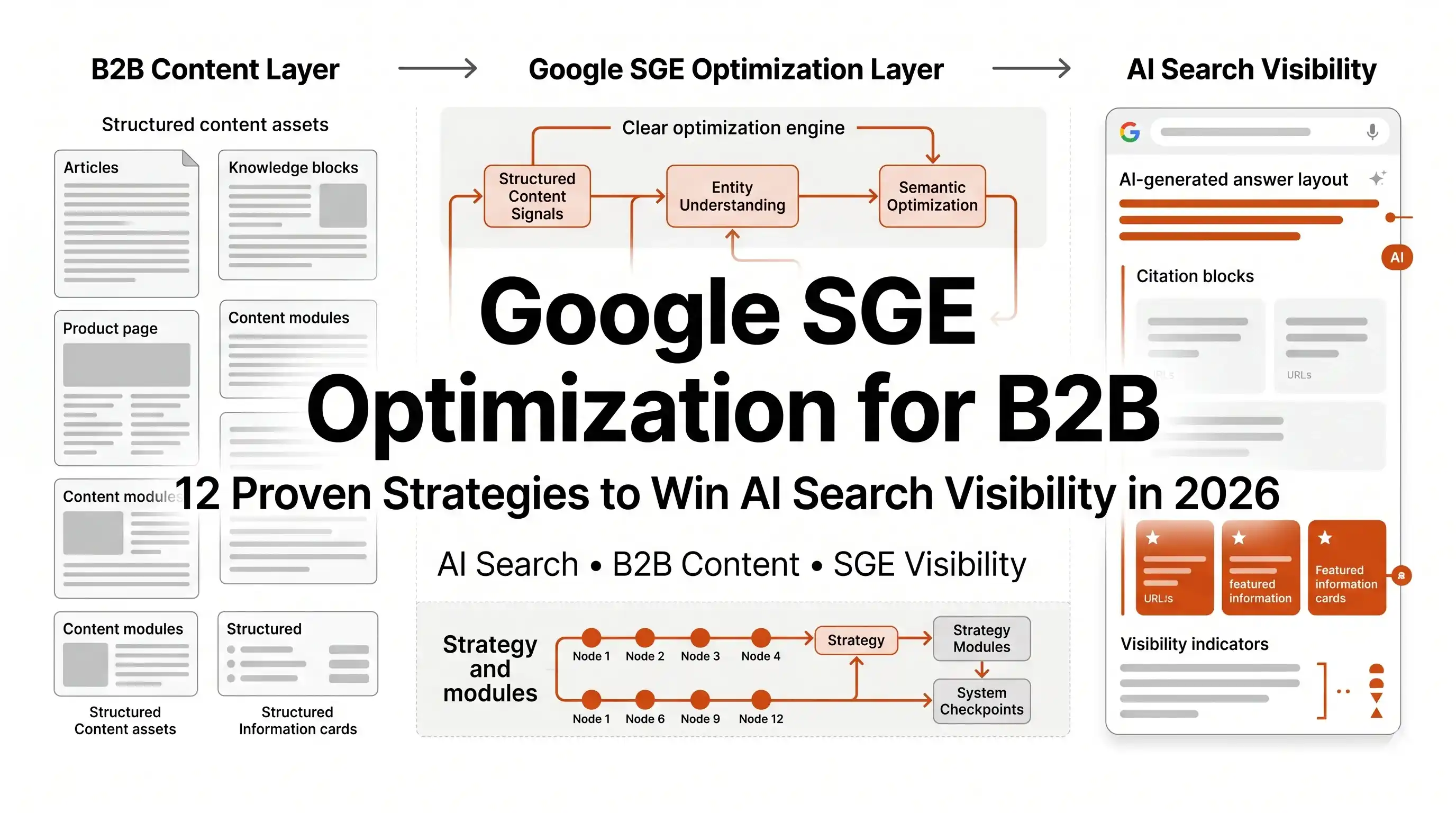


Google SGE optimization for B2B is no longer a forward-looking priority — it is the defining competitive battleground of 2026, and the stakes could not be higher: B2B buyers who click through from an AI citation convert at a rate 23 times higher than traditional organic search leads, meaning the brands that earn AI visibility are not just getting more traffic — they are capturing dramatically better pipeline.
What Is Google Search Generative Experience (and Why It Changes Everything for B2B)?
Google Search Generative Experience (SGE), now the engine behind Google AI Overviews, fundamentally changes how information reaches buyers by generating synthesized, multi-source answers rather than simply displaying a ranked list of blue links.
Instead of rewarding pages that attract the most clicks, Google's generative layer now selects content based on trustworthiness, authority, and structural clarity — and then cites that content directly inside the answer.
For B2B brands, this creates a completely new form of discovery.
When a VP of Operations searches "best enterprise workflow automation platforms for mid-market companies," Google no longer just shows ten links — it generates a summary that cites the two or three vendors whose content best matches the query's intent.
The brands cited in that summary win mindshare at the most critical point in the research cycle, before a buyer ever visits a website.
"94% of B2B buyers now use AI during purchasing. Only 11% of companies currently show up. The gap between those two numbers is where your pipeline opportunity lives."
12 Google SGE Optimization for B2B Strategies That Actually Work in 2026
These twelve strategies form a complete playbook for B2B teams that want to earn citation inclusion, build AI search authority, and convert generative visibility into real pipeline.
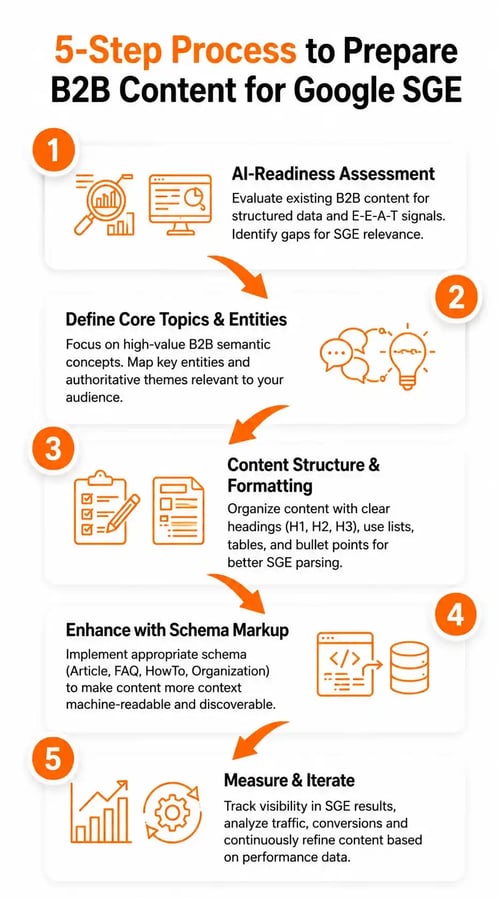
A concise 5-step framework to tailor B2B content for Google SGE, highlighting optimization strategies.
1. Optimize Around Buyer Questions, Not Keywords
Google SGE is intent-driven, and B2B buyer intent is almost always expressed as a question — not a keyword fragment.
Map your content to the exact questions your buyers ask during evaluation, comparison, and implementation stages, using real buyer conversation data wherever possible.
2. Use Answer-First Formatting in Every Section
Start each major section with a direct, concise answer to the question that section addresses, then expand with supporting depth and evidence.
This structure mirrors how Google's AI layer processes and extracts information, making your content dramatically more citable.
3. Build Topic Clusters That Establish Category Authority
Isolated articles, regardless of how well-written they are, rarely earn consistent AI citation inclusion on their own.
Build interconnected content ecosystems around buyer problems, solution categories, workflow stages, and adjacent subtopics so that Google recognizes your brand as the authoritative voice in your space.
4. Improve Content Extractability with Scannable Structures
AI systems are built to extract and synthesize — so your content needs to be structured for extraction, not just for reading.
Use short summary blocks, bullet lists, comparison tables, TL;DR sections, and FAQ formats to give Google's AI clear, discrete units of information it can pull into generated answers.
5. Add Schema Markup to Power AI Comprehension
Structured data gives Google's AI explicit, machine-readable signals about what your content is, who created it, and what it covers.
For B2B content optimizing for Google SGE, prioritize FAQ schema, Article schema, Organization schema, and Author schema as your core implementation targets.
6. Strengthen Entity Signals Across Your Digital Presence
Google's AI layer does not just evaluate pages — it evaluates entities, meaning your brand needs to be clearly understood in terms of its category, expertise, and positioning.
Align your content, metadata, and off-site presence to consistently communicate what your company does, who it serves, and what problems it solves.
7. Publish Proprietary Research, Benchmarks, and Frameworks
Original data and proprietary frameworks give Google's AI unique, citable information that cannot be found anywhere else — which dramatically increases the probability of citation inclusion.
B2B teams that regularly publish industry benchmarks, buyer research studies, and original analytical frameworks consistently outperform those that produce only commentary-based content.
8. Optimize for Multi-Intent B2B Buyer Journeys
B2B purchases involve multiple stakeholders conducting independent research across weeks or months, which means your content ecosystem must support awareness, evaluation, comparison, and implementation queries simultaneously.
Google SGE optimization for B2B requires content mapping that addresses every stage of the buyer journey, not just the top-of-funnel queries most teams default to.
9. Improve E-E-A-T Signals with Expert Authorship and Evidence
Google's AI treats E-E-A-T (Experience, Expertise, Authoritativeness, and Trustworthiness) as a citation eligibility filter — without verifiable expert authors and original data, content is largely invisible to the generative layer.
Add named expert authors with verifiable credentials, link to primary sources, include real case studies, and cite original research to build the trust signals that earn AI citation inclusion.
10. Update Content Frequently to Maintain Freshness
Stale content is one of the fastest ways to lose AI citation visibility, because Google's generative layer strongly favors recently updated, verified information over aging assets.
Build a structured content refresh workflow that regularly updates statistics, tool references, examples, and definitions across your highest-value assets.
11. Build Strong Internal Topic Networks to Signal Depth
Robust internal linking between related content clusters signals to Google that your brand has genuine depth on a topic — not just a single well-optimized page.
Connect your pillar content to supporting assets, case studies, data reports, and solution pages to create a web of authority that reinforces your topical ownership in Google's AI understanding.
12. Monitor AI Overview Visibility as a Core Performance Metric
Most B2B teams currently measure traffic, clicks, and keyword positions — but none of those metrics capture whether your brand is being cited, mentioned, or recommended inside AI-generated answers.
Tracking AI Overview visibility, citation frequency, and competitive mention presence is now a required performance discipline for any team serious about Google SGE optimization for B2B.
Did You Know?
96% of all citations in Google AI Overviews feature strong E-E-A-T signals — meaning without verifiable expert authorship and original data, B2B content is essentially invisible to the generative search layer.
How Omnibound Powers Google SGE Optimization for B2B Teams
We built Omnibound specifically to close the gap between traditional content production and the buyer-grounded, AI-optimized content strategy that wins generative search visibility.
Our platform analyzes real buyer conversations and market signals to uncover exactly what your buyers are asking AI engines — then creates and optimizes content that improves AI search visibility and gets your brand cited and recommended across ChatGPT, Perplexity, Gemini, Claude, and Google AI Mode.
|
Capability |
Traditional Tools |
AI Overview Trackers |
Omnibound |
|
AI Visibility Tracking |
Limited |
Partial |
✔ |
|
Real Buyer Intelligence |
✘ |
✘ |
✔ |
|
Competitive AI Citation Signals |
Partial |
Limited |
✔ |
|
Content Refresh Prioritization |
Limited |
✘ |
✔ |
|
Agentic Content Production |
✘ |
✘ |
✔ |
|
Pipeline Impact Measurement |
Partial |
✘ |
✔ |
For teams that want to assess where their AI search visibility is currently leaking, our B2B AI Search Playbook includes a 15-point readiness scorecard designed to identify exactly where your content strategy needs to shift.
And for B2B teams looking to scale their AI-ready content production, our AI platform for marketers automates content creation and publishing workflows grounded in real buyer context — so your team can execute faster without sacrificing the quality and depth that AI citation requires.
Ready to see where your B2B content stands against Google SGE citation requirements? Book a demo with our team and we will show you exactly where your AI search visibility is leaking and how to close the gap.
FAQs
- What is Google Search Generative Experience and how does it affect B2B companies?
Google AI Overviews shift B2B visibility from page rankings to earning citations in AI-generated answers. - How do you optimize B2B content for Google AI Overviews in 2026?
Optimize B2B content with buyer-focused queries, structured formatting, topical authority, E-E-A-T signals, and frequent updates. - Is Google SGE optimization for B2B different from standard generative search optimization?
Yes, B2B optimization demands deeper buyer-intent mapping, category authority, and multi-stakeholder content strategies. - What ranking factors matter most for Google AI Overviews in B2B?
Topical authority, entity trust, structured content, freshness, and strong E-E-A-T signals drive AI Overview citations. - Can B2B content win Google AI Overview citations without ranking in the top 10?
Yes, authoritative and extractable content can earn AI citations even without top-10 organic rankings. - How do I know if my B2B content is being cited in Google AI Overviews?
Tracking AI citations requires dedicated AI search intelligence tools, not traditional analytics platforms. - Is Google SGE optimization for B2B worth investing in right now in 2026?
Yes, growing AI-driven vendor discovery and high-converting AI leads make B2B AI optimization a strong investment.
.webp?height=245&name=10%20Ways%20AI%20Semantic%20Analysis%20Improves%20B2B%20Content%20Strategy%20in%20the%20AI%20Search%20Era%20(2).webp)