

Getting featured in Claude AI bot recommendations is one of the most valuable forms of brand visibility available to B2B companies in 2026, and the rules are very different from anything that came before. Here is the stat that should reshape your entire thinking: unlinked brand mentions have a 3:1 stronger correlation with AI visibility than traditional backlinks, meaning the old link-building playbook will not get you recommended by one of the most selective AI assistants on the market today.
7 Top Strategies for Earning Claude AI Bot Recommendations
The following strategies are the most effective approaches we have identified for building the kind of brand presence that earns Claude AI bot recommendations consistently. Each strategy targets a specific layer of Claude's recommendation logic.
1. Build Strong Entity Authority
Entity clarity is the foundation of every Claude AI bot recommendation strategy. Claude needs to understand precisely who you are, what category you own, what problem you solve, and how you differ from competitors.
Inconsistent naming, vague positioning, or conflicting descriptions across your web presence create ambiguity that makes Claude less likely to recommend you confidently.
2. Prioritize Verifiable, Evidence-Backed Content
Claude rewards content that is easy to verify. Thin marketing language, unsupported claims, and vague product descriptions actively reduce your chances of being recommended.
Replace promotional fluff with substance: dated statistics, cited research, methodology explanations, benchmark comparisons, and expert analysis. Every factual claim you make should be traceable.
3. Strengthen Brave Search Visibility
This is one of the most underutilized strategies for improving Claude AI bot recommendations. Claude's web retrieval capabilities appear to align closely with Brave Search's independent index, which means brands that perform well in Brave's ecosystem are more likely to appear in Claude's real-time retrieval layer.
Unlike Google, Brave builds its own independent web index. This means your standard visibility practices need to be explicitly verified against Brave's crawl and indexing behavior.
4. Earn Third-Party Trust Signals
Claude does not just evaluate your own website. It triangulates your brand's authority through independent, third-party references. The more credible external sources mention your brand accurately, the stronger your recommendation confidence score becomes.
This is where editorial coverage, expert mentions, and niche community presence become strategic priorities rather than nice-to-haves.
5. Structure Content for AI Verification
Claude's recommendation engine relies on content that is logically organized and easy to validate quickly. Pages built around long, dense paragraphs without clear structure are harder for Claude to process confidently.
Use a verification-friendly content architecture across your most important pages.
Recommended content architecture:
- Clear question or topic statement at the top
- Direct, specific answer in the first paragraph
- Supporting evidence with sources and dates
- Nuanced explanation that addresses edge cases
- FAQ section that handles follow-up queries
This structure makes it significantly easier for Claude to extract a confident recommendation from your content and deliver it accurately to users asking for Claude AI bot recommendations in your category.
6. Optimize for Recommendation-Intent Queries
Most brands create content around product features without thinking about the specific prompts users bring to Claude. This is a significant missed opportunity.
Claude users asking for brand recommendations phrase their queries in specific ways. Your content needs to directly and clearly answer those recommendation-intent prompts.
Recommendation-intent query patterns to target:
- "Best tools for [specific use case]"
- "Top B2B platforms for [buyer type]"
- "Recommended software for [workflow]"
- "Safest approach for [technical task]"
- "Enterprise solutions for [problem category]"
- "What do experts recommend for [challenge]"
Building content pages that directly answer these query patterns positions your brand as the contextually correct answer when Claude processes similar user prompts and generates Claude AI bot recommendations.
7. Monitor Claude Visibility Systematically
Most brands test Claude visibility once, do not see their brand mentioned, and give up. This misses how Claude actually behaves. Claude's outputs vary significantly by query wording, context framing, and model version.
Systematic monitoring framework:
- Build a structured prompt library covering your category's key queries
- Track brand mentions across different prompt variations regularly
- Evaluate recommendation quality, not just mention frequency
- Benchmark competitor mention rates against your own
- Use insights to identify content and entity gaps to close
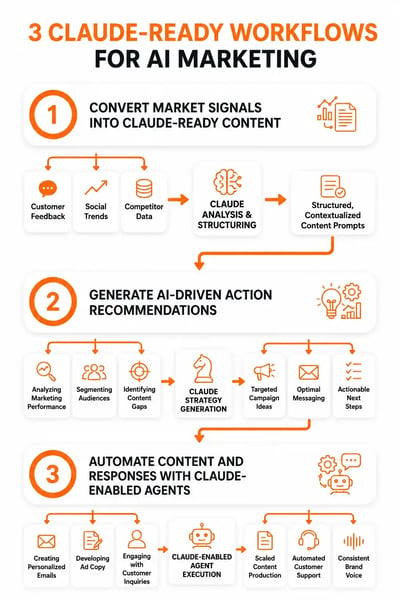
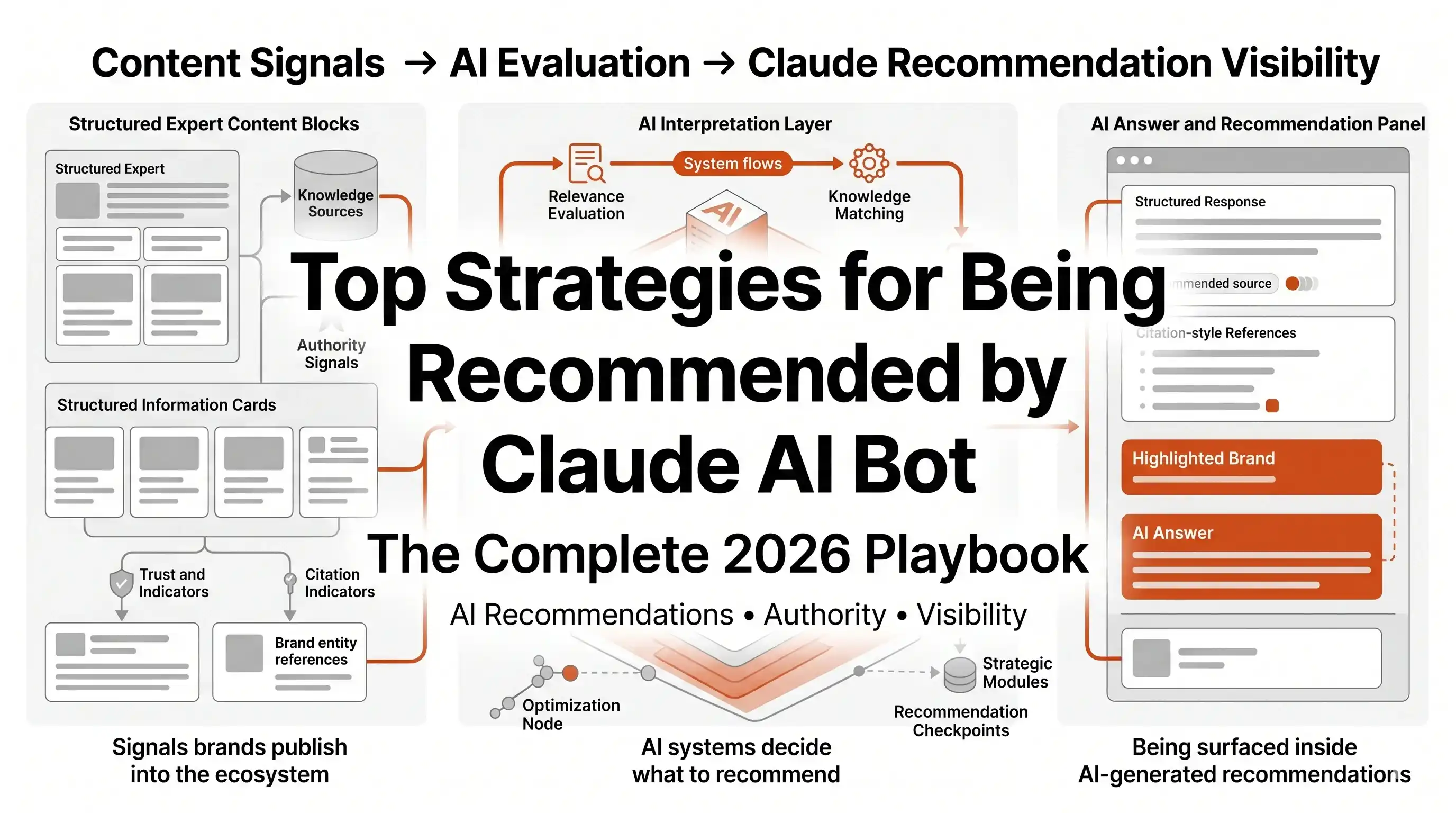
Three Claude-ready workflows for AI marketing are depicted, guiding practical implementation. Use this infographic to apply Claude AI Bot Recommendations to your campaigns.
Did You Know?
Brave Search, which powers many Claude-style retrievals, grew to 20 billion annual queries in 2025, a 100% year-over-year increase. (PPC Land / Brave Software 2025)
How Omnibound Helps Improve Claude AI Bot Recommendations
Traditional marketing tools were built to measure traffic, backlinks, and keyword positions. None of that tells you whether Claude is recommending your brand or why.
Omnibound is built specifically for the AI search era. Our AI marketing solutions help B2B teams build content and entity infrastructure that performs where it matters most: inside the recommendation logic of AI assistants like Claude.
Our platform's AI-driven action recommendations give marketing teams clear, prioritized next steps based on real Claude visibility data, so your team always knows exactly what to optimize next without guesswork.
|
Capability |
Standard Tools |
Claude Tracking Alone |
Omnibound |
|
AI Recommendation Tracking |
❌ |
✔ |
✔ |
|
Competitive Benchmarking |
Limited |
Partial |
✔ |
|
Actionable Next Steps |
Partial |
Partial |
✔ |
|
Entity Positioning Insights |
❌ |
Partial |
✔ |
|
Claude-Ready Content Workflows |
❌ |
❌ |
✔ |
We built Omnibound specifically for teams who understand that AI recommendation visibility is a distinct discipline that requires distinct measurement, distinct strategy, and distinct execution infrastructure.
Ready to start tracking where your brand stands in Claude's recommendation landscape? Explore how Omnibound helps B2B teams build and measure AI recommendation visibility with purpose-built intelligence tools.
FAQs
- How do you get recommended by Claude AI bot in 2026?
Build strong entity authority, trusted content, and Brave-friendly visibility to improve Claude recommendations. - Is Claude AI harder to get recommended by than ChatGPT?
Yes, Claude applies stricter standards for trust, verification, and source credibility. - Does Brave Search really affect Claude AI bot recommendations?
Yes, optimizing for Brave Search can improve visibility in Claude’s retrieval-driven recommendations. - What type of content does Claude prefer to recommend brands from?
Claude favors evidence-backed content with citations, structured formats, and clear methodology. - Can small B2B brands realistically earn Claude AI bot recommendations?
Yes, strong entity clarity and trustworthy content can outperform larger brands with weaker signals. - How often should I test my Claude AI bot recommendation presence?
Regular testing with a structured prompt library gives the most accurate view of Claude visibility. - What is the fastest way to improve Claude AI bot recommendations for my brand?
Fix entity inconsistencies, strengthen trust signals, and build credible third-party mentions.