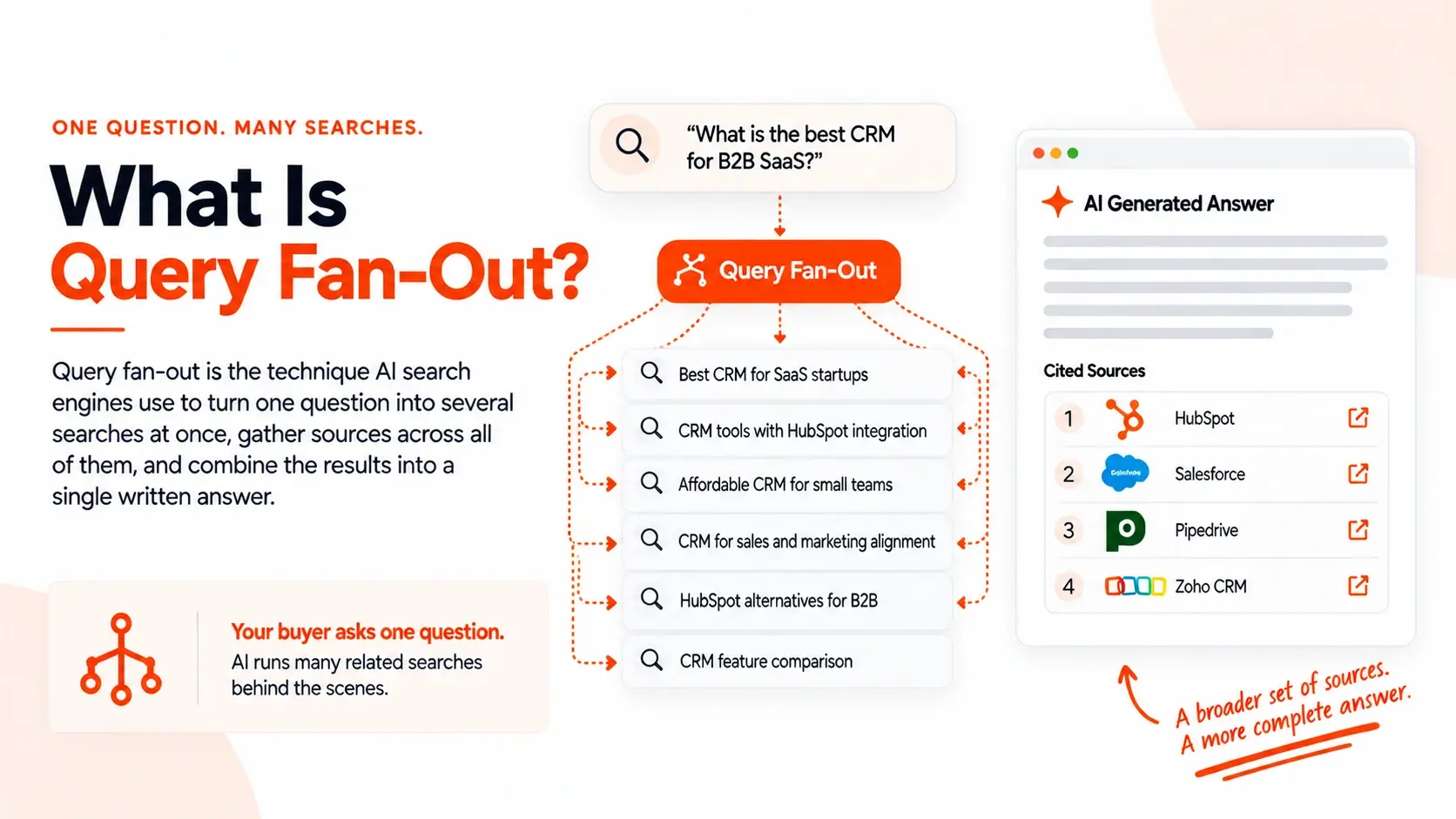


Query fan-out is the technique AI search engines use to turn one question into several searches at once. Instead of running a single query and returning a list of links, the engine breaks your question into related sub-questions, searches each one at the same time, gathers sources across all of them, and combines the results into a single written answer.
That one shift changes the whole game for visibility. The question your buyer types is no longer the only query that decides what they see. It is the seed for a set of searches you never wrote, and whether your brand appears in the answer depends on all of them, not just the one on screen.
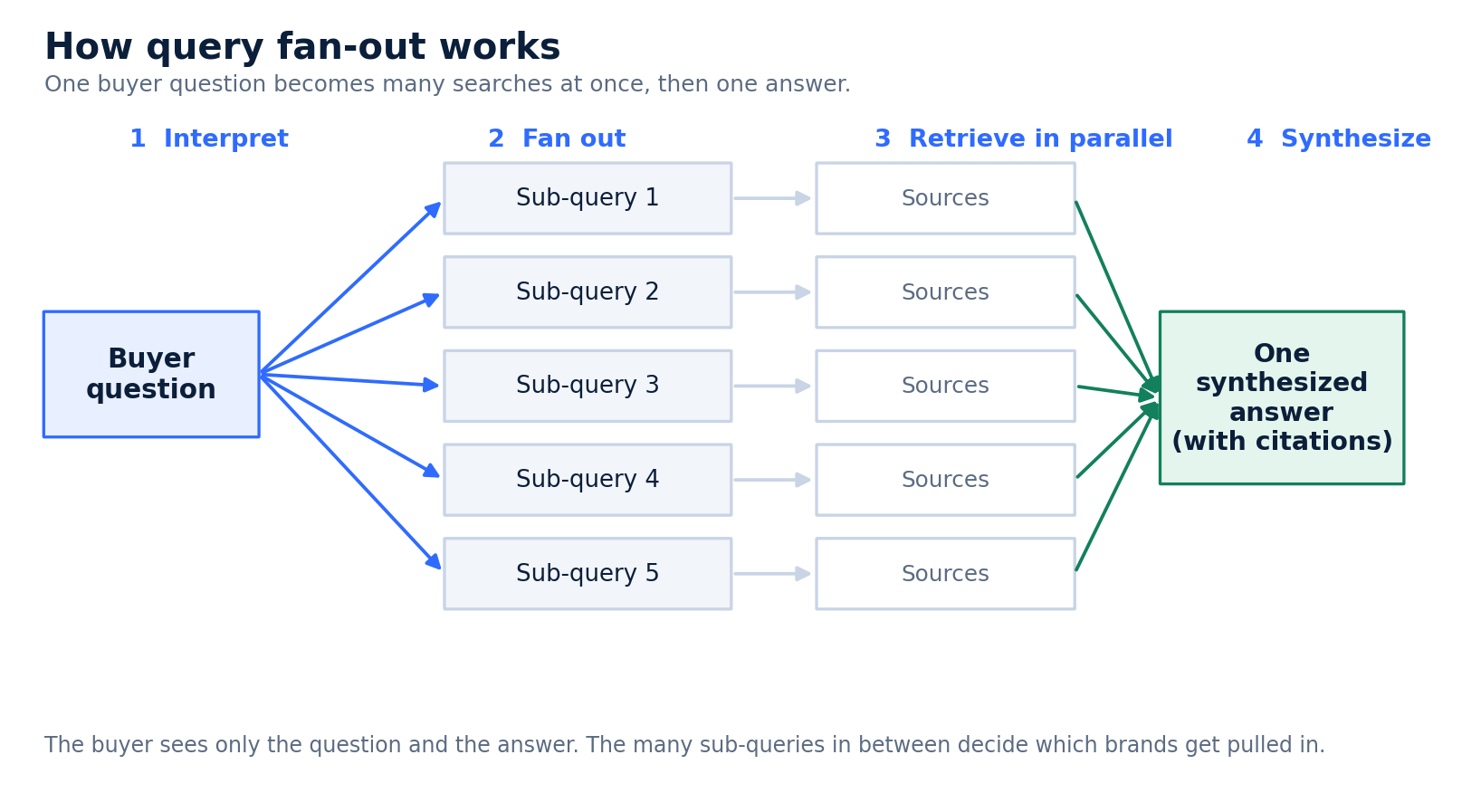
How query fan-out works: one buyer question becomes many searches at once, then one answer.
If you are new to how buyers search this way, start with conversational search; for related terms, the AI search glossary.
Where the term came from
The label comes from Google. When it launched AI Mode, Google described the approach as a "query fan-out" technique that "issues multiple related searches concurrently across subtopics and multiple data sources and then brings those results together to provide an easy-to-understand response." A related Google patent, Thematic Search (filed December 2024), describes a matching idea: taking an initial query and generating narrower themes and sub-themes from it, then assembling an answer across them.
Google named it, but the behavior is not unique to Google. Any engine that reads a full question and researches it across several searches is doing a version of the same thing.
Which AI engines use query fan-out
- Google AI Mode and AI Overviews use fan-out explicitly, as Google has described.
- ChatGPT runs multiple searches for a single research-style question, especially in its deeper research modes, where one prompt can trigger dozens of searches.
- Perplexity has shown intermediate "related searches" that expand a single question into several before answering.
- Google Gemini, Microsoft Copilot and Grok all follow the same broad pattern of expanding a question into related searches and composing an answer.
The wording differs by engine, but the mechanic is shared: expand, search, synthesize. For the wider picture, see what are answer engines and what is AI search.
How query fan-out works, step by step
Behind a single question, most engines move through five steps.
- Interpret.
The engine reads the full, natural-language question and works out the intent behind it, including the context the buyer packed in: industry, company size, tools, use case.
- Decompose and expand.
It breaks the question into a set of related sub-questions that together cover it, and adds implicit ones the buyer did not type but is likely to care about. One prompt becomes many. - Execute in parallel.
It runs those sub-queries across the web or an index at the same time, pulling candidate sources for each. - Synthesize.
It selects the strongest sources across all the sub-queries and composes a single answer, weighing them against each other. - Cite.
It names or links some of the sources behind the answer, which is where your brand does or does not appear.
The step most people miss is the second one. You can see the question the buyer asked. You cannot see the ten searches the engine ran underneath it, yet those are what actually pull your pages in or leave them out. For how the engine then chooses among the sources it retrieves, see how AI search engines determine which brands to cite.
The kinds of sub-queries a fan-out generates
A fan-out is not random. The sub-queries tend to fall into recognisable kinds, and knowing them tells you what content a single buyer question can reach.
| Sub-query type | What it does | Example from "best B2B analytics platform" |
|---|---|---|
| Related sub-topics | Slices the main question into parts | product analytics, marketing analytics |
| Implicit questions | Adds what the buyer did not ask but needs | how hard is setup, does it integrate |
| Comparative | Weighs options against each other | Acme vs a competitor, alternatives to Acme |
| Reformulations | Restates the idea in other words | top analytics tools, analytics software for SaaS |
| Recency and source-type | Seeks fresh or specific sources | 2026 reviews, documentation, community threads |
One buyer question can pull from a dozen pages of different types. That is why narrow, single-keyword optimization misses so much: you are optimizing for the seed, not the fan.
Query fan-out vs traditional search
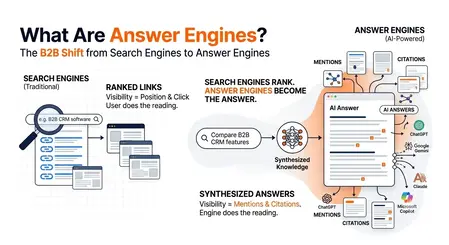
Traditional search runs the one query you typed and hands back a ranked list of links. You do the reading and choose. Query fan-out runs many related sub-queries at once and hands back one composed answer, citing a few sources. The unit of visibility moves from a ranked position for a term to a mention across the sub-questions a topic generates.
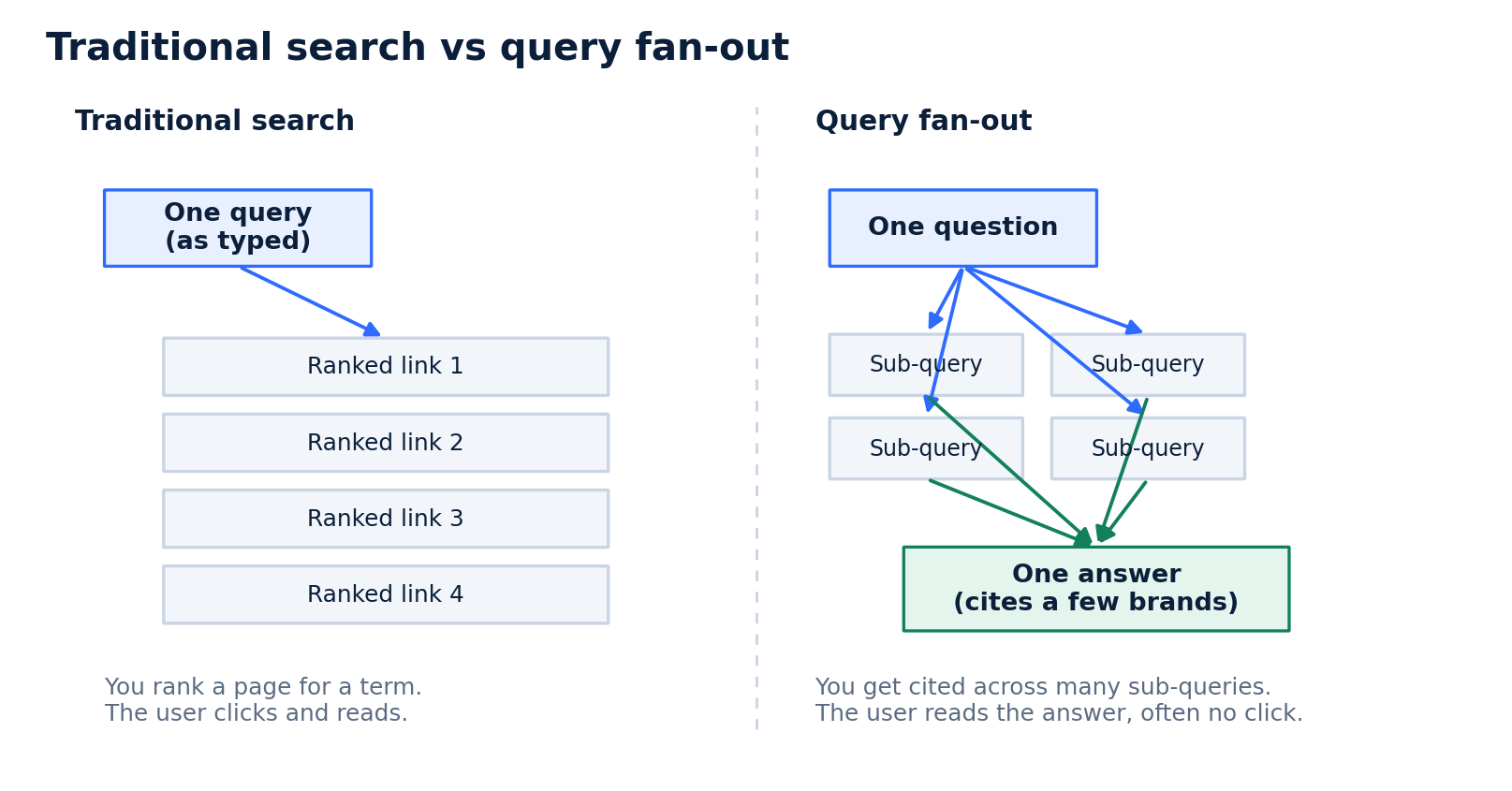
Traditional search ranks a page for a term. Query fan-out cites brands across many sub-queries at once.
| Traditional search | Query fan-out | |
|---|---|---|
| Queries run | One, as typed | Many related sub-queries at once |
| What you optimize for | The keyword the user typed | The spread of sub-questions it triggers |
| Output | A list of links | One composed answer with citations |
| Who wins | The best-ranked page for the term | The brand present across the most sub-queries |
| What the user does | Clicks and reads | Reads the answer, often without clicking |
This is also why keyword rank tracking alone no longer shows your real position. For that shift, see what B2B marketers need to know about AI search rank tracking.
Why AI systems fan out
Engines do this because a single search rarely answers a real question well. Buyer questions are broad, layered and full of implied needs, and one query returns a narrow slice. Fanning out lets the engine cover the sub-topics, weigh comparisons, pull from several source types and check for freshness, then hand back one answer that feels complete. It trades a little speed and compute for a much fuller response, which is the whole promise of an AI answer over a list of blue links.
For B2B, that trade matters even more, because the questions are rarely simple. "Which tool is right for us" carries budget, stack, team size, industry and process inside it, and only a fan-out can address all of that at once.
What query fan-out means for B2B visibility
B2B is where fan-out bites hardest, because B2B questions carry the most context and the most implied sub-questions. Three consequences follow.
Coverage beats a single hero page.
Your visibility is the sum of how you show up across the fan, not how one page ranks. Breadth of relevant, retrievable content wins over a single strong asset.
The gaps are invisible without looking.
You can own "best [category]" and still be absent from the integration, pricing and comparison sub-queries that the same buyer question triggers. A single visibility score blurs all of that together; only the sub-query view shows it.
Small phrasing changes move the whole answer.
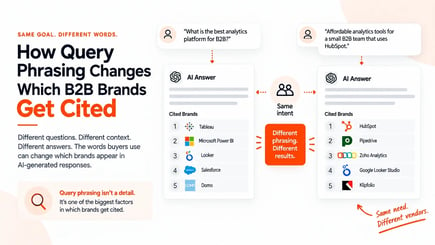
Because wording changes the fan, two buyers with the same need get different vendor lists. That relationship deserves its own treatment, and it is covered in the companion piece on how query phrasing changes which brands get cited (linked once it is live).
A worked B2B example
Take a buyer who asks: "what is the best customer onboarding software for a mid-size SaaS company?"
A plausible fan-out behind that one question runs seven ways at once: best onboarding software, onboarding tools for SaaS, onboarding for mid-market teams, onboarding software pricing, integration with the buyer's CRM, reviews and comparisons, and which features matter most.
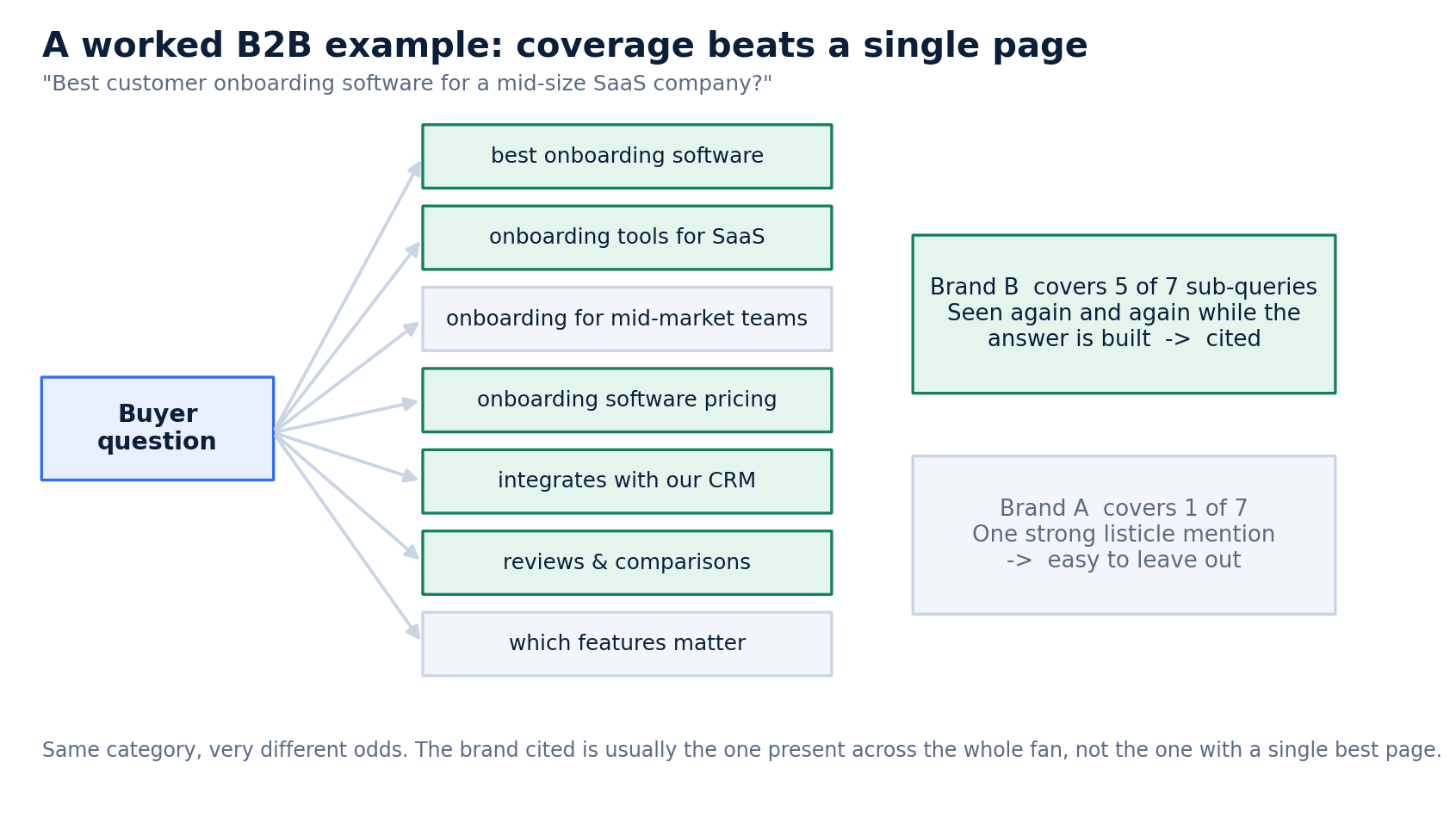
Same category, very different odds. The brand present across the whole fan is the one that gets cited.
Now look at what that means for two vendors. Brand A has one strong "best onboarding tools" listicle mention. It appears in a single sub-query and is easy to leave out of the final answer. Brand B has a comparison page, a pricing page, an integrations page, a reviews presence and a features guide. It appears across five of the seven sub-queries, so the engine sees it again and again while assembling the answer, and it lands in the citation. Same category, very different odds. The winner is rarely the brand with the single best page. It is the brand present across the whole fan.
How to find the fan-out behind your topics
You cannot see an engine's exact sub-queries, but you can map the likely fan for any topic and check your coverage against it.
- Start from a core buyer question. Pick a real question your buyers ask, in their words.
- List the likely sub-questions. Write the related sub-topics, the implicit questions (setup, pricing, integrations, security, fit), the comparisons and the reformulations. The five kinds above are your checklist.
- Ask the engines directly. Put your core question into ChatGPT, Perplexity and Google's AI answers and read what they surface, including any related or follow-up searches they show. This gives you a live view of the real fan.
- Note who gets cited per sub-question. Record which brands appear where, and which sub-questions return you, a competitor, or no one you recognise.
The output is a map of the fan and your coverage of it, which is the input for everything below.
How to optimize for query fan-out
You cannot control the sub-queries, but you can make sure you are a strong answer across the ones your buyers trigger. Six moves, roughly in order.
1. Build topic clusters, not single pages. A fan-out spreads across sub-topics, so a connected cluster (a core page plus supporting pages for the comparisons, pricing, integrations and use cases) covers far more of the fan than one article. This is the single biggest lever.
2. Answer the implicit questions. Address setup, integrations, security, onboarding, pricing and fit directly, because the engine searches for these even when the buyer does not type them. Missing pages are missed citations.
3. Make every page answer-first and retrievable. A fan-out only helps you if your pages can be pulled and quoted. Lead with a clear answer, use descriptive headings, and keep sections self-contained. See content formats that win AI search visibility.
4. Own your comparisons. Comparative sub-queries lean on third-party sources, so accurate "vs" and "alternatives" content keeps those answers from being set on a competitor's terms.
5. Build authority and third-party presence. Engines favour trusted sources, and for B2B they often cite publications, reviews and communities over your own pages. Being present and accurate on those sources feeds the fan. See AI search authority.
6. Keep content current. Recency searches are part of the fan, so fresh pages hold their place while stale ones drop out. For Google's generative surfaces specifically, see Google SGE optimization for B2B and Google AI Overviews statistics.
7. Make your entities and data machine-readable. Clear, consistent information about your product, pricing and category (on your site and in structured data) helps engines match you to the right sub-queries and describe you accurately. For products and tools especially, complete and consistent entity data is what lets you show up in the specific, constrained sub-queries rather than only the broad ones.
This is the same foundation as answer engine optimization and AI search optimization; fan-out is the reason breadth of coverage matters so much within it.
What query fan-out changes for your content strategy
Fan-out does not just change tactics, it changes how a B2B content team plans and measures. Three shifts are worth making deliberately.
From keywords to questions. The planning unit stops being a keyword and becomes a buyer question and the fan it triggers. You plan content to cover a question fully, across its sub-topics, rather than to rank one page for one term.
From single pages to clusters. Because the fan spreads across sub-topics, isolated articles underperform. Content is planned as connected clusters (a core page plus the comparison, pricing, integration and use-case pages around it) so a single buyer question finds you in several places at once. For the broader distinction, see AI search visibility vs traditional SEO.
From rankings to citation coverage. Success stops being an average position and becomes how much of the fan cites you. That reframes reporting around prompts and coverage gaps rather than keyword ranks.
How to measure your fan-out coverage
You cannot watch the sub-queries directly, but you can measure the outcome that matters: whether you are cited for the questions your buyers ask.
- Track by prompt, across engines. Run your priority buyer questions and record whether you are cited, per engine, over time, rather than checking a single keyword rank.
- Look for coverage gaps. The useful signal is a question where competitors appear across the fan and you appear in one sub-query or none. Those gaps are your content roadmap.
- Watch the commercial questions first. Sub-queries tied to buying decisions (best, pricing, comparisons) sit closest to revenue, so misses there cost the most.
- Re-check regularly. Fan-outs and sources shift as models update, so a citation you hold today can slip. This is a repeating measure, not a one-time audit.
See AI search visibility metrics and how to monitor AI search for B2B competitive intelligence.
Common query fan-out mistakes to avoid
- Optimizing for the seed query only. Winning "best [category]" while ignoring the pricing, integration and comparison sub-queries leaves most of the fan uncovered.
- Publishing one big page instead of a cluster. A single long article cannot match a connected set of pages across the sub-topics a question fans into.
- Ignoring third-party sources. For B2B, much of the fan is answered by reviews, publications and communities, so an on-site-only strategy misses where many citations come from.
- Measuring a keyword rank, not citation coverage. Rank tracking hides the sub-query gaps that decide whether you make the answer.
- Publishing once and leaving it. Recency is part of the fan, so unrefreshed pages quietly lose their place to fresher competitors.
The one-line takeaway
Query fan-out means you are no longer competing for a keyword. You are competing for a question, and the brand cited is usually the one present across the many searches that question quietly becomes.
Frequently asked questions
What is query fan-out in simple terms?
It is when an AI engine takes one question, splits it into several related searches, runs them at once, and combines the results into a single answer. One question becomes many searches behind the scenes.
Where does the term query fan-out come from?
Google introduced it with AI Mode, describing a technique that issues multiple related searches concurrently across subtopics and data sources. Google's Thematic Search patent (filed December 2024) describes a similar mechanism.
What is an example of query fan-out?
A buyer asking "best onboarding software for a mid-size SaaS company" can trigger separate searches for onboarding tools, SaaS onboarding, mid-market fit, pricing, integrations, reviews and features, all at once, then get one answer built from across them.
What are the types of fan-out queries?
Related sub-topics, implicit questions the buyer did not ask, comparative sub-queries, reformulations of the same idea, and recency or source-type searches. Most fan-outs mix several of these.
Is query fan-out only a Google thing?
No. Google named it for AI Mode, but ChatGPT, Perplexity, Gemini, Copilot and Grok all use the same broad approach of expanding one question into several searches, even without the label.
How is query fan-out different from keyword search?
Keyword search runs the one term you typed and returns links. Query fan-out runs many related sub-queries at once and returns a composed answer, so visibility depends on covering the spread of sub-questions, not ranking a single term.
How do you optimize for query fan-out?
Build topic clusters, answer the implicit questions (setup, pricing, integrations, fit), make pages answer-first and retrievable, own your comparisons, build authority and third-party presence, and keep content fresh.
Can you see the sub-queries an engine generates?
Not exactly, in most engines. You can map the likely fan for a topic and read what engines surface, then measure the outcome: whether you are cited for the buyer questions that matter, across engines and over time.