

Table Of Contents
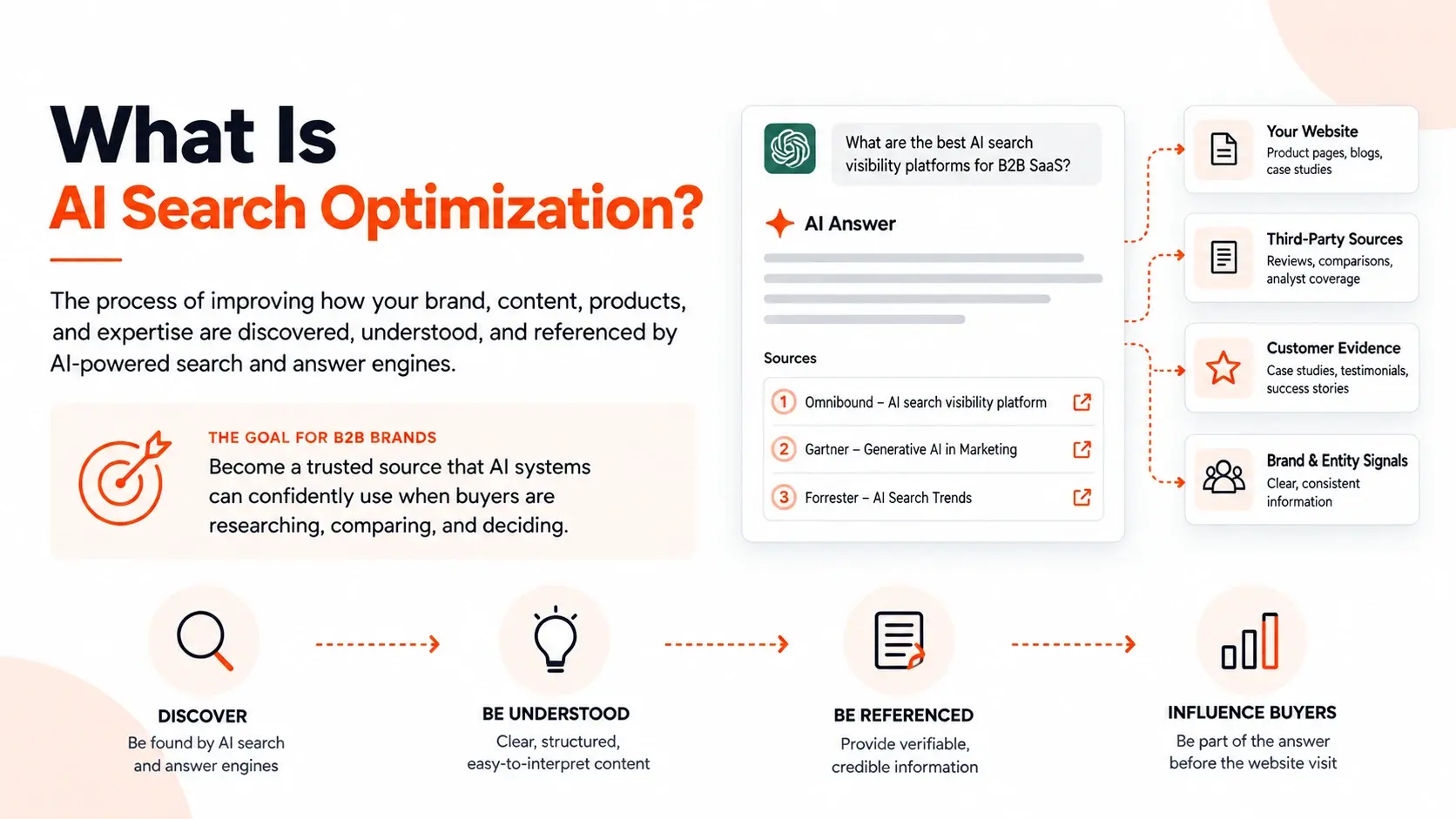
AI search optimization is the process of improving how your brand, content, products, and expertise are discovered, understood, and referenced by AI-powered search and answer engines.
Traditional SEO is largely about earning a position on a search results page. AI search changes the outcome. Instead of presenting users with a list of links, systems such as ChatGPT, Google AI Overviews, Gemini, Perplexity, and other AI-powered search experiences can synthesize information from multiple sources and present a direct answer.
That creates a new visibility problem for brands.
You can rank well in Google and still be absent from the answer a buyer receives from an AI system.
AI search optimization addresses that gap by combining strong search fundamentals with content that is easy to understand, evidence that can be verified, clear brand and entity signals, and a systematic way to monitor how your brand appears across AI-generated answers.
For B2B companies, the goal isn't simply to be mentioned.
It is to become a source that AI systems can confidently use when buyers are researching a category, comparing vendors, evaluating solutions, or deciding what to do next.
What Is AI Search Optimization?
AI search optimization is the practice of preparing your website and broader digital presence so AI-powered search systems can discover, interpret, retrieve, and reference your brand when answering relevant user questions.
It builds on SEO but focuses on a different outcome.
Traditional SEO asks:
Can my page rank for this query?
AI search optimization asks:
When a buyer asks an AI system this question, does my brand become part of the answer?
That difference matters because AI answers can combine information from multiple sources.
A buyer may ask:
- What are the best AI search visibility platforms for B2B SaaS?
- Which tools help marketers track AI citations?
- How should a SaaS company optimize content for AI search?
- What is the difference between AEO, GEO, and AI search optimization?
- Which platform can measure brand visibility across ChatGPT and Perplexity?
The brand that appears in those answers has an opportunity to influence the buyer before a traditional website visit ever happens.
For a broader explanation of the underlying shift from traditional search to AI-powered discovery, see our guide to what AI search is.
How Does AI Search Optimization Work?
AI search optimization isn't one tactic. It is a system involving technical accessibility, content quality, topical relevance, entity clarity, evidence, third-party authority, and ongoing measurement.
A simplified model looks like this:
Discover → Understand → Retrieve → Evaluate → Answer → Cite
1. Discover
AI systems need to be able to find the information you want them to use.
That makes traditional technical foundations important.
Important pages should be crawlable, indexable, internally linked, and accessible without unnecessary technical barriers.
AI search optimization does not replace SEO fundamentals.
It extends them.
2. Understand
The system needs to understand what your company is, what category you operate in, what your products do, and what topics you have expertise in.
This is where clear terminology and consistent entity information matter.
If your website describes your company one way while third-party sources consistently describe you another way, the resulting picture can become less clear.
3. Retrieve
When a buyer asks a question, the system needs to retrieve relevant information.
A page can be excellent and still fail to appear for a particular prompt if the content does not clearly address the underlying intent.
This is why optimizing individual keywords is not enough.
You need to understand the questions your buyers actually ask.
4. Evaluate
Multiple sources may be relevant to the same question.
The system needs to determine which information is useful and relevant enough to incorporate into its answer.
Authority, relevance, clarity, evidence, freshness, and corroboration can all matter here.
There is no universal public formula that guarantees a citation.
The practical objective is to make your content a strong, credible source for the questions you want to own.
5. Answer
The system synthesizes information from the sources it retrieves into an answer.
This changes the role of your content.
Instead of competing only for a page-one position, individual sections, facts, definitions, examples, and data points can become part of a generated answer.
That makes clear, self-contained information increasingly important.
6. Cite
Some AI search experiences provide citations or links to the sources used to construct an answer.
When your content is cited, your brand can become part of the buyer's research journey even if the buyer never searched specifically for your company.
That is why AI search visibility needs to be measured separately from traditional organic rankings.
AI Search Optimization vs. Traditional SEO
AI search optimization and SEO are not competing disciplines. They work together.
| Traditional SEO | AI Search Optimization |
|---|---|
| Focuses heavily on search rankings | Focuses on inclusion in AI-generated answers |
| Optimizes pages for queries | Optimizes information for questions and prompts |
| Measures rankings and organic traffic | Measures mentions, citations, visibility and referrals |
| Primarily page-oriented | Can involve pages, passages, entities and sources |
| Keyword research is central | Buyer questions and prompt research become central |
| Backlinks are an important authority signal | Broader evidence and corroboration also matter |
| Success often means a click | Success can begin before the click |
Your technical SEO, content architecture, internal linking, authority, and indexability still provide much of the foundation.
The difference is what you measure and what you optimize for. This is why SEO fundamentals still matter for AI search citations even as the search experience changes.
AI Search Optimization vs. AEO vs. GEO
The terminology around AI-driven search is still evolving.
You will commonly see three terms.
AEO: Answer Engine Optimization
Answer Engine Optimization generally focuses on making content useful for systems that provide direct answers to user questions.
GEO: Generative Engine Optimization
Generative Engine Optimization generally refers to optimizing a brand's content and broader presence for generative AI systems and their responses.
AI Search Optimization
AI search optimization is a broader term that can encompass technical accessibility, content, brand and entity signals, citations, third-party authority, measurement, and optimization across AI-powered search experiences.
The terminology matters less than the outcome.
The practical question is:
Can buyers discover and evaluate your brand when they use AI to research your category?
If you want to understand how these approaches translate into specific tactics, see our AEO authority-building guide.
Why Does AI Search Optimization Matter for B2B Companies?
B2B buyers rarely make a decision after one search.
They research.
They compare.
They look for reviews.
They investigate alternatives.
They ask peers.
And increasingly, they ask AI systems.
Consider a buyer evaluating an unfamiliar software category.
Their research journey might look like this:
- What is this category?
- Which vendors are worth considering?
- What features matter?
- Which vendors are best for companies like mine?
- How does Vendor A compare with Vendor B?
- What are the alternatives?
- Is this worth the investment?
If your brand only appears when someone searches your company name, you are arriving late.
AI search optimization gives marketers an opportunity to influence earlier stages of that journey.
What Makes Content Easier for AI Search Systems to Use?
There is no single content format that guarantees AI citations.
However, several principles make information clearer for both humans and machines.
Start With the Answer
Don't make readers work through five paragraphs before discovering what the section is about.
If the heading asks:
What is AI search optimization?
Answer that question immediately.
Then expand.
A strong section typically follows this pattern:
Question → Direct answer → Explanation → Evidence → Example
This makes the content easier to scan and easier to interpret.
Use Question-Driven Headings
Instead of vague headings such as:
The Changing Search Landscape
use headings that reflect actual questions:
How does AI search optimization work?
How do you measure AI search visibility?
How can B2B companies improve AI citations?
Question-shaped headings create a clearer relationship between the user's intent and the answer on the page.
Make Important Information Easy to Extract
Use:
- Short paragraphs
- Clear headings
- Lists
- Tables
- Definitions
- Examples
- Specific data
- Original research
- Descriptive page titles
The goal isn't to write for a machine.
The goal is to make your information unambiguous.
That helps both readers and retrieval systems.
Support Claims With Evidence
Compare:
AI search is changing marketing.
with:
AI search is changing how buyers discover software vendors because answer engines can synthesize information from multiple sources instead of requiring buyers to visit several individual pages.
The second statement gives the reader something concrete to understand.
Even better is a statement supported by original research, customer data, or a reputable external source.
Evidence gives your content something worth referencing.
How to Optimize Your Website for AI Search
Optimizing a website for AI search starts with the same fundamentals that make a website useful to traditional search engines.
But the objective expands beyond ranking.
1. Build Clear Topic Coverage
Your website should demonstrate meaningful expertise around the subjects your buyers care about.
Instead of creating isolated pages for individual keywords, build connected topic coverage.
For example, a company focused on AI search visibility might cover:
- AI search optimization
- AI search visibility
- AI search citations
- AEO
- GEO
- AI search measurement
- AI search authority
- AI search content strategy
- AI search analytics
The objective is not simply to publish more pages.
It is to create a coherent information ecosystem.
2. Match Content to Buyer Intent
Different buyer questions require different content.
Someone asking:
What is AI search optimization?
needs an explanation.
Someone asking:
How do I measure AI search visibility?
needs a measurement framework.
Someone asking:
What are the best AI search optimization tools?
needs an evaluation framework.
Someone asking:
Which AI search optimization platform is best for my company?
needs decision criteria.
Optimizing every page the same way ignores the reason the buyer is searching.
3. Create Content Around Information Gaps, Not Just Keywords
Keyword research can tell you what people search.
AI search research can reveal what information is missing from your current presence.
Those are different opportunities.
For example:
Keyword opportunity:
AI search optimization
Information opportunity:
How do B2B SaaS companies measure whether their content is actually being cited by AI search engines?
The second question may reveal a much stronger commercial opportunity.
This is where AI search optimization becomes connected to demand generation.
4. Strengthen Your Technical Foundation
Before worrying about advanced AI-search tactics, make sure search engines and crawlers can access the information you want discovered.
Crawlability
Important pages should be accessible to relevant search crawlers and not unintentionally blocked by robots.txt, security layers, or infrastructure.
Indexation
Your important content should be indexed and discoverable through a coherent site structure.
Rendering
Critical information should not depend entirely on client-side JavaScript if that creates accessibility problems for crawlers.
Internal Linking
Connect related pages so search systems can understand topical relationships.
A strong internal linking system also helps users move from broad educational content into deeper resources.
For example:
AI Search Optimization
→ AI Search Visibility
→ AI Search Authority
→ AI Search Optimization Checklist
→ AI Content Gap Analysis
→ AI Search Intelligence
This creates a connected topical architecture instead of isolated blog posts.
Structured Data
Use appropriate structured data where it genuinely describes the page and its entities.
Schema should support accurate interpretation rather than being treated as an AI-search shortcut.
Entity Consistency
Keep company names, product names, categories, authors, and important facts consistent across your digital properties.
5. Build Third-Party Corroboration
Your own website can explain what your company does.
Independent sources can help establish that the market recognizes you for those things.
This becomes particularly important for competitive and commercial prompts.
If an AI system is asked:
Which platforms are leaders in AI search visibility?
it may consider more than what vendors say about themselves.
Your authority strategy should therefore include:
- Relevant industry publications
- Independent reviews
- Expert contributions
- Original research
- Partner mentions
- Customer stories
- Analyst relationships
- High-quality third-party comparisons
The objective is not to manufacture mentions.
It is to create genuinely useful information that other sources have a reason to reference.
6. Measure, Learn and Optimize
AI search optimization is not a one-time content project.
AI answers change.
Competitors publish new material.
New sources become authoritative.
AI systems change.
Buyer questions evolve.
Your visibility can therefore change even when your own website has not.
Track your visibility over time.
AI Share of Voice
How frequently does your brand appear compared with competitors across your target prompts?
Citation Rate
How frequently is your website or other owned content cited?
Citation Source Share
Which domains are repeatedly being used to support answers in your category?
Competitor Citation Gap
Where are competitors being cited while your brand is absent?
Prompt Coverage
How many of your high-value buyer questions produce a relevant brand appearance?
Sentiment
When your brand appears, is the context positive, neutral, or negative?
Commercial Visibility
Does your brand appear in high-intent prompts such as comparisons, alternatives, recommendations, and buying questions?
These metrics provide a more useful picture than simply asking whether your company was “mentioned by ChatGPT.”
The AI Search Optimization Checklist
Before publishing or refreshing an important page, ask:
Technical
- Can search and AI crawlers access the page?
- Is the page indexed?
- Is important information accessible without unnecessary rendering barriers?
- Is the page connected to relevant content through internal links?
Content
- Does the page directly answer the target question?
- Is the answer presented early?
- Are headings aligned with real buyer questions?
- Are important sections self-contained?
- Are claims specific and supported?
Authority
- Is the author identifiable?
- Does the author have relevant expertise?
- Are important claims supported by independent sources?
- Is the brand consistently described across the web?
AI Visibility
- Does the brand appear for the target prompts?
- Which competitors appear?
- Which sources are cited?
- What information causes competitors to appear?
- What questions are currently unanswered by your content?
Measurement
- Have you established a baseline?
- Are you tracking citations over time?
- Are you monitoring competitors?
- Are you connecting visibility changes with content changes?
For a more detailed implementation checklist, see our AI Search Optimization Checklist.
B2B Content Strategies That Can Improve AI Search Visibility
B2B buyers research differently.
They are comparison-driven, problem-led, and skeptical.
That shapes the content that deserves investment.
Build the Comparison and Alternatives Layer
Comparison questions are central to software buying journeys.
Create useful content around:
- Best [category] tools
- [Product] vs. [Competitor]
- [Competitor] alternatives
- Best tools for [specific use case]
- [Category] pricing
- [Category] implementation
- [Category] features
- [Category] limitations
Don't make every comparison a disguised sales page.
A genuinely useful comparison is more likely to become a resource that buyers and other websites reference.
Answer the Full Question Chain
A buyer doesn't ask one question. They ask a sequence.
For example:
- What is AI search optimization?
- How does it work?
- How is it different from SEO?
- What tools can measure it?
- How do I improve it?
- What should I measure?
- Which platform can help?
Your content architecture should reflect that journey.
Publish Proprietary Research
Original research gives your brand something that generic AI-generated content cannot easily replicate.
Consider publishing:
- Industry benchmarks
- Surveys
- Original datasets
- Customer research
- Citation studies
- Search behavior analysis
- Competitive intelligence reports
- Proprietary frameworks
When other sources reference that research, your authority extends beyond your own domain.
Build a Trust Network
AI search optimization isn't only an on-site exercise.
Build a presence across relevant:
- Review platforms
- Industry publications
- Communities
- Analyst sites
- Partner ecosystems
- Research publications
- Expert interviews
The objective is to make your brand easier to understand and verify across the broader information ecosystem.
Common AI Search Optimization Mistakes
AI search optimization is still relatively new, which makes it easy to fall into tactics that sound useful but don't solve the underlying problem.
Mistake 1: Treating AI Search Like Another Keyword Algorithm
-
Adding “AI search optimization” to every heading won't make a page authoritative.
-
The content needs to answer the underlying question.
Mistake 2: Publishing More Instead of Publishing Better
-
Publishing 50 generic articles does not necessarily create more authority than publishing five genuinely useful resources.
-
Prioritize information gaps.
Mistake 3: Ignoring Traditional SEO
-
AI search doesn't eliminate crawlability, indexation, internal linking, technical accessibility, or useful content. Those foundations still matter.
Mistake 4: Measuring Only Rankings
-
A page can maintain its Google ranking while losing visibility in AI-generated answers. Track both.
Mistake 5: Treating One AI Response as Proof
-
AI-generated answers can change between runs.
-
A single prompt test is not a reliable trend.
-
Measure repeatedly.
Mistake 6: Assuming There Is One Universal AI Ranking Formula
-
There isn't a publicly documented formula that guarantees inclusion or citation across every AI search system. Be skeptical of anyone selling a single “AI ranking factor.”
The practical approach is to monitor outcomes, identify patterns, test changes, and measure again.
How to Measure the ROI of AI Search Optimization
Visibility alone isn't the end goal. For B2B marketing teams, the bigger question is whether AI search visibility contributes to demand and revenue.
A useful measurement framework can connect:
Prompt → AI Visibility → Citation → Visit → Lead → Opportunity → Revenue
Start by establishing your baseline.
Then track changes after specific content or authority initiatives.
For example:
Before optimization
- Brand appears in 12% of target prompts
- Competitors appear in 46%
- Owned content cited in 4%
- Few commercial prompts produce brand visibility
After optimization
- Brand appears in 27%
- Competitor share declines
- Citation coverage increases
- More high-intent prompts include the brand
The objective is not to claim that every visibility improvement automatically produces revenue.
Instead, connect AI-search signals with downstream analytics wherever attribution is possible.
This creates a more defensible business case for investing in AI search optimization.
AI Search Optimization Is a Continuous Process
The biggest mistake is treating AI search optimization as a project with a start and end date.
It isn't.
-
Your market changes.
-
Your competitors publish.
-
Buyer questions evolve.
-
AI systems change.
-
New sources become influential.
A page that performs well today may lose visibility six months from now.
That means the process should look like:
Research → Measure → Identify gaps → Create or improve content → Build authority → Monitor citations → Measure outcomes → Repeat
This is the same reason traditional SEO evolved from one-time optimization into an ongoing discipline.
AI search requires the same mindset.
The Future of AI Search Optimization Is Information Intelligence
The biggest shift is moving from content production to information intelligence.
Instead of asking:
What article should we publish this week?
Marketing teams can ask:
What are our buyers asking?
Which questions are driving category discovery?
Which competitors are being recommended?
What sources are AI systems citing?
Where are we missing?
What evidence would strengthen our position?
Which content changes should we test?
That creates a continuous loop:
Buyer questions → AI search monitoring → visibility gaps → content and authority actions → citation measurement → optimization
This is fundamentally different from a traditional editorial calendar. It turns AI search into an operating system for understanding how your category is being discovered.
AI Search Optimization Is Becoming a New Layer of B2B Discovery
SEO is not disappearing.
Search engines are not disappearing.
But the way buyers interact with search is changing.
A buyer can now ask an AI system to explain a category, shortlist vendors, compare products, identify alternatives, and recommend a solution without manually opening ten search results.
That creates a new battleground for B2B brands.
The brands that win will not necessarily be the ones that publish the most content.
They will be the ones that make their expertise:
Discoverable. Understandable. Credible. Relevant. Measurable.
AI search optimization is the discipline of building that visibility.
And for B2B marketing teams, the question is no longer only:
“How do we rank?”
It is:
“When our buyers ask AI, are we part of the answer?”
Final Takeaway
AI search optimization is not about finding a shortcut around search.
It is about making your brand easier for AI systems to discover, understand, verify, and reference when buyers ask questions that matter to your business.
The foundation is still strong content and technical SEO.
The new layer is understanding:
What buyers ask → what AI systems answer → which sources they use → where competitors appear → where your brand is missing → what you need to change.
That is the shift from traditional search optimization to AI search optimization.
The brands that build this feedback loop early will have a significant advantage as AI becomes a larger part of B2B discovery.
Frequently Asked Questions About AI Search Optimization
What is AI search optimization?
AI search optimization is the practice of improving a brand's content, technical accessibility, authority, and information ecosystem so AI-powered search systems can discover, understand, retrieve, and potentially reference the brand when answering relevant user questions.
Is AI search optimization the same as SEO?
No. AI search optimization builds on SEO but focuses on visibility inside AI-generated answers as well as traditional search results. SEO remains important because crawlability, indexation, site structure, and content quality provide much of the foundation.
How do you optimize a website for AI search?
Start with technical SEO and accessibility, then structure content around real buyer questions, provide direct and evidence-backed answers, maintain consistent brand and entity information, build relevant third-party authority, and continuously monitor AI visibility and citations.
What is the difference between AEO and AI search optimization?
AEO generally focuses on optimizing content for answer engines, while AI search optimization is a broader discipline covering technical accessibility, content, authority, citations, entity signals, measurement, and optimization across AI-powered search experiences.
Does AI search optimization replace SEO?
No. AI search optimization should complement SEO rather than replace it. Search engines and AI systems still rely heavily on accessible, well-structured, useful information.
How do I measure AI search optimization?
Track metrics such as AI Share of Voice, brand mentions, citation rate, citation sources, competitor citation gaps, prompt coverage, sentiment, and visibility for high-intent commercial questions. Connect those signals with referral traffic, leads, opportunities, and revenue where attribution is possible.
Can AI search optimization guarantee citations?
No. There is no universal public formula that guarantees a citation in every AI search system. The goal is to improve the relevance, accessibility, credibility, evidence, and authority of your information while measuring actual outcomes over time.
How often should AI search visibility be monitored?
High-value prompts should be monitored regularly because AI answers and competitor visibility can change. Weekly or biweekly monitoring can identify meaningful changes, while monthly and quarterly analysis can help separate temporary fluctuations from strategic trends.
What content performs well in AI search?
Useful content tends to answer specific questions clearly, provide evidence, explain concepts in context, demonstrate expertise, and make important information easy to understand and verify. Comparison pages, original research, definitions, how-to guides, pricing information, and detailed use-case content can all serve important buyer questions.
How can B2B companies improve their AI search visibility?
Start by identifying the buyer prompts that matter most, establish a visibility baseline, identify where competitors are appearing or being cited, close content and authority gaps, strengthen technical accessibility, and continuously monitor the resulting changes.
Turn Your Content Into AI-Search Winners
Get cited across ChatGPT, Claude & Perplexity — not just ranked on Google.
- Increase AI citations
- Improve answer visibility
- Track brand mentions in LLMs