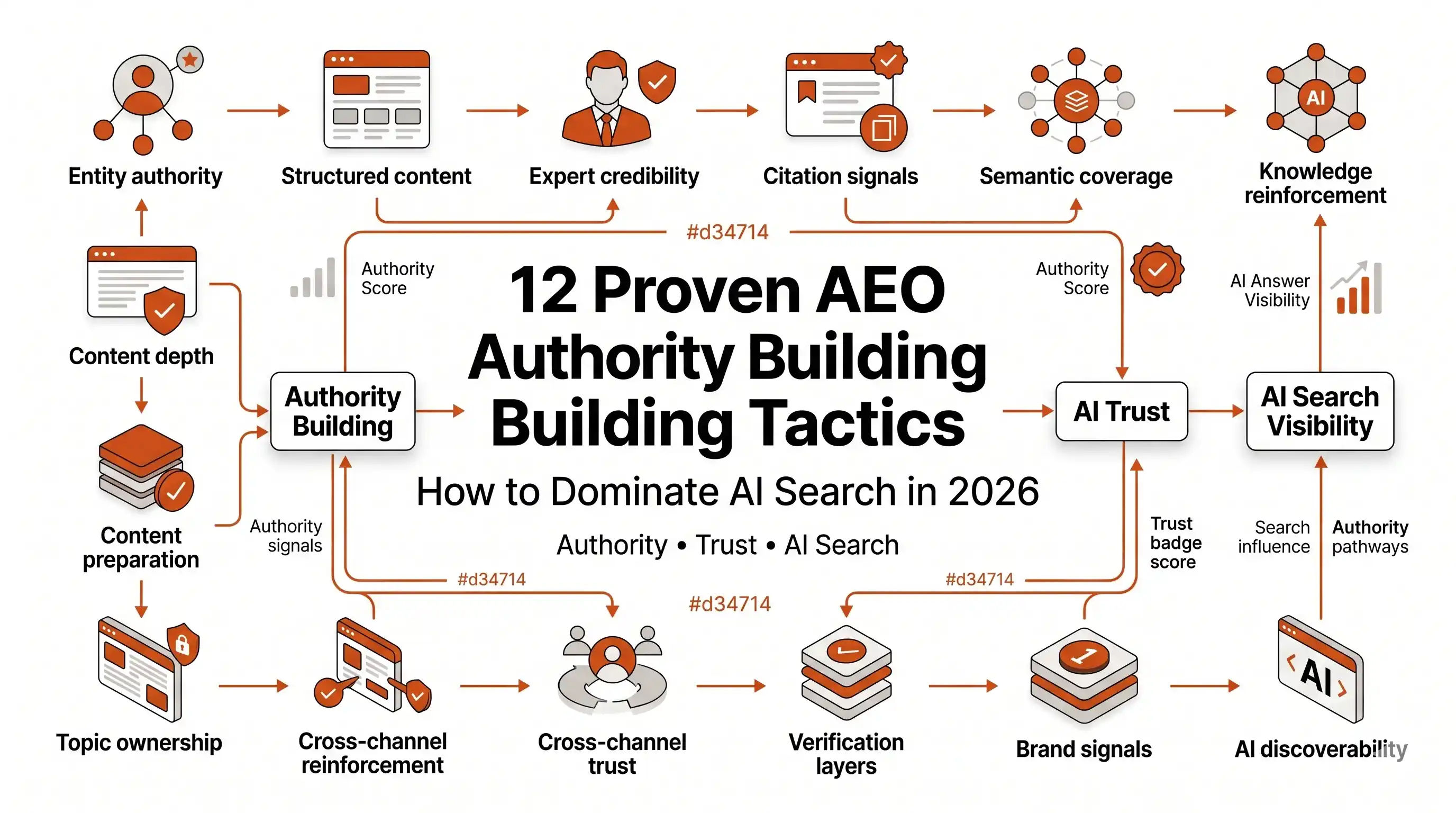


The stakes for visibility in AI-powered answers have never been higher, and mastering AEO authority building tactics is now the defining competitive edge for brands that want to get cited, recommended, and trusted by answer engines. When an AI summary appears in search results, users click a traditional result only 8% of the time compared to 15% when no AI summary is present, which means winning the answer slot is no longer optional. It is the entire game.
What Authority Actually Means in Answer Engines
Most teams assume authority is purely a function of backlinks and domain age. Answer engines evaluate something fundamentally different.
AI systems look for sources they can understand, trust, and summarize confidently. That requires a combination of source trustworthiness, topical depth, extraction readiness, entity consistency, and ecosystem validation working together, not in isolation.
Traditional visibility came from ranking above competitors. Answer engine authority comes from being the source an AI engine selects when a buyer asks a direct question. That is a higher bar, and it demands a more intentional approach to AEO authority building tactics.
|
Traditional Visibility |
Answer Engine Authority |
|
Rankings |
Citations |
|
Backlinks |
Trust ecosystems |
|
Keywords |
Question authority |
|
Pages |
Entities |
12 Top AEO Authority Building Tactics for 2026
These tactics represent the full spectrum of what it takes to become a trusted, repeatedly cited source inside AI-powered answer systems. We have organized them in order of foundational importance.
1. Lead Every Section with an Answer-First Structure
One of the most powerful AEO authority building tactics available right now is placing your direct answer at the very top of every major content section. AI systems frequently extract the first clearly positioned answer they encounter in a source document.
We recommend writing answer blocks of 40 to 80 words that directly address the question, then expanding with supporting context underneath. This format signals extraction readiness and dramatically improves your chances of being cited.
2. Build Deep Topical Authority Through Content Clusters
Authority inside AI systems grows through topic ecosystems, not isolated articles. Brands that dominate answer engine citations typically cover their core subject from every relevant angle.
Build tightly connected clusters that address definitions, comparisons, workflows, use cases, and buyer questions within the same topic domain. Topical depth remains one of the strongest drivers of answer engine authority signals in 2026.
3. Strengthen Entity Clarity Across Every Channel
AI engines need to recognize your brand as a clearly defined entity before they will consistently cite you. Vague positioning like "innovative AI solution" creates confusion at the model level.
Strong entity clarity sounds like: "AI search visibility platform for B2B marketing teams." Every page, profile, and mention should reinforce the same precise definition. This consistency is one of the most underrated AEO authority building tactics in the market right now.
Did You Know?
CXL's audit of Google AI Overview citations found that if your answer isn't located within the first third of the source page, there is a better than even chance it will not be cited at all. Positioning your answer early is not optional — it is the tactic.
4. Structure Content for Machine Retrieval and Extraction
AI systems pull information that is easy to parse, extract, and summarize. Content that is buried in dense paragraphs rarely gets cited.
Use H2 question-formatted headings, concise sections, comparison tables, bulleted lists, and modular content blocks throughout your pages. Writing for retrieval and summarization is a core principle in any serious AEO strategy built for 2026.
5. Deploy Schema Markup Strategically and Completely
Schema markup remains a meaningful signal for AI systems when it is implemented fully and accurately. FAQ schema, Article schema, Organization schema, and HowTo schema are the most relevant formats for AEO.
An important nuance: incomplete or poorly executed schema can actually underperform a page with no schema at all. Complete implementation always outperforms partial effort when it comes to answer engine optimization tactics.
6. Create Citation-Worthy Content Assets
Generic commentary rarely earns citations. AI engines gravitate toward content that contains real evidence: original research, proprietary frameworks, benchmark studies, data analyses, and market reports.
When your content carries evidence that no other source can replicate, you become a reference point rather than a commodity. This is one of the highest-leverage AEO authority building tactics available to B2B brands today. Our B2B AI Search Playbook walks through how to build exactly these kinds of citable assets.
7. Expand Your Off-Site Citation Surface
Most teams focus exclusively on their own domain, but AI systems build authority pictures from the entire web. Owned media alone rarely wins sustained citation authority.
AI engines frequently learn from Reddit threads, industry publications, review platforms, analyst reports, community discussions, and editorial mentions. Actively building your brand's presence across these channels expands your AI citation authority far beyond what on-site optimization can achieve alone.
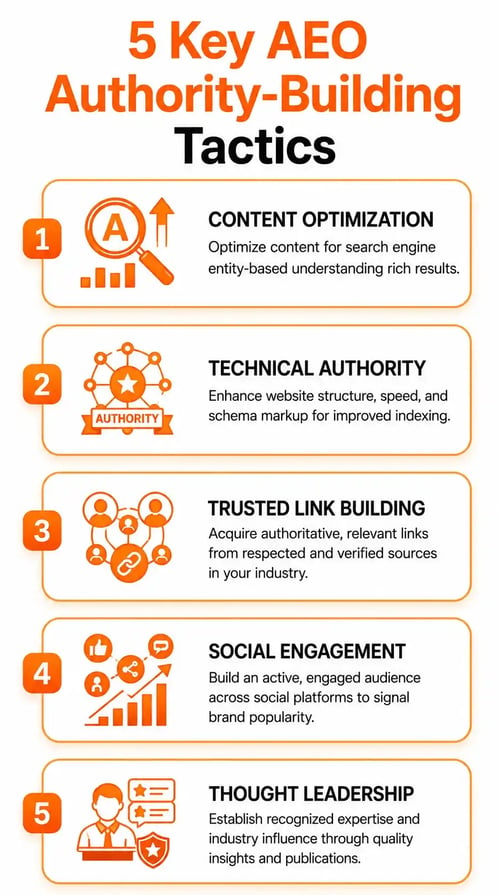
This infographic highlights five essential tactics for building AEO authority. It outlines practical steps and the impact of each tactic.
8. Optimize for Real Buyer Questions and Conversational Prompts
Answer engines are trained on natural language. Content optimized for conversational queries, including "what is," "how to," "alternatives to," and comparison prompts, aligns directly with how buyers interact with AI systems during research.
Matching the natural language patterns your buyers use when prompting AI is a foundational principle of how to rank in answer engines. Use real buyer prompts as your content briefs, not keyword lists alone.
9. Build Behavioral Trust Through Consistent Usefulness
Authority in AI systems increasingly reflects consistent usefulness over time. Brands that show up with accurate, helpful answers across multiple interactions earn a compounding trust advantage.
Engagement depth, repeat brand visibility, and multi-touch interaction patterns all contribute to authority building for AI search. This is why content quality cannot be treated as a one-time investment. It must be a continuous practice.
Did You Know?
18% of Google searches in a Pew Research Center sample generated an AI summary or AI Overview — meaning a material share of all buyer questions now receives a synthesized answer before any traditional result is seen.
10. Refresh Content Continuously to Stay Authoritative
AI engines increasingly reward accuracy that reflects current market conditions. Outdated statistics, old frameworks, and stale product information weaken your citation probability over time.
Regularly refresh statistics, update examples, revise frameworks, and align content with current market shifts. Fresh and reinforced accuracy is one of the most actionable AEO best practices for brands that want to maintain citation presence long-term.
11. Build Multi-Channel Thought Leadership to Reinforce Entity Strength
Authority compounds across ecosystems. A brand that publishes consistently on blogs, LinkedIn, podcasts, and in webinars creates multiple reinforcement points for the same entity across the web.
This multi-channel presence strengthens the AI system's recognition of your brand as a credible, established source. Our webinar on AI visibility and pipeline covers exactly how thought leadership connects to revenue-generating citations.
12. Track Authority Signals Across All AI Platforms
Most teams assume their AEO efforts are working without ever verifying them. Authority should be measured systematically, not assumed based on content output volume.
Track citations across AI engines, monitor competitor share-of-voice, analyze prompt outcomes, and identify gaps where your brand should appear but does not. Competitive citation intelligence is the discipline that separates brands who react from brands who lead. Our AI search intelligence tools make this measurable at scale.
How We Help Teams Build Authority in AI Search
At Omnibound, we built our platform specifically to help B2B teams implement the AEO authority building tactics that move the needle on AI citation presence.
We provide systematic visibility intelligence across the full authority spectrum. That includes AI visibility tracking, prompt monitoring, citation gap analysis, competitor share-of-voice measurement, customer intent intelligence, and market context analysis. Our B2B Marketing Context Engine unifies customer signals, competitive intelligence, and market data into one actionable layer that powers both strategy and content.
Our Intelligent Research platform keeps your ICPs, personas, and market context current as buyer behavior and competitive narratives evolve, ensuring your content always reflects what AI engines need to trust and cite your brand.
We built Omnibound to make this kind of systematic authority building for AI search achievable for every B2B marketing team. Explore our full AEO strategy framework or connect with our team to see how we can help you build citation authority at scale.
FAQs
- What are the most effective AEO authority building tactics for B2B brands in 2026?
Answer-first content, entity clarity, off-site citations, and AI citation tracking are the highest-impact AEO tactics for B2B brands. - How do answer engines decide which sources to cite?
Answer engines prioritize trust, topical depth, extractability, and entity consistency over backlinks alone. - Is schema markup still worth doing for AEO in 2026?
Yes — complete, accurate schema remains a valuable signal for AI citation and answer visibility. - How long does it take to build authority in AI search?
Most brands see measurable AI authority gains within 90–180 days of consistent optimization. - Can small or mid-size B2B brands compete for AI citations?
Yes — topical focus and structured content can outperform larger brands with generic coverage. - What is the difference between AEO and traditional content optimization?
Traditional SEO targets rankings; AEO targets extractable, trustworthy, and citable answers. - How do I know if my AEO tactics are working?
Track citation frequency, prompt outcomes, competitor share of voice, and AI mention trends.
.webp?height=245&name=10%20Ways%20AI%20Semantic%20Analysis%20Improves%20B2B%20Content%20Strategy%20in%20the%20AI%20Search%20Era%20(2).webp)