

Table Of Contents
When a VP of Content & SEO tries to scale AI‑driven search across several SaaS products, the biggest surprise is how quickly the answers can drift. An AI search engine pulls from a knowledge base that was built for one product and suddenly starts answering questions about another, often with outdated or off‑brand language. This misalignment erodes trust, hurts brand equity, and can even trigger compliance alarms. The solution is not a one‑off fix but a disciplined program of knowledge‑base guardrails that keep every answer accurate, on‑brand, and safe. In the sections that follow you will learn why guardrails matter, the operational hurdles you will face, and a step‑by‑step framework you can start applying today to protect your AI search experience.
Why Guardrails Are Critical for Multi‑Product AI Search
Every AI search interaction begins with a query that reflects a user’s search intent. If the underlying knowledge base cannot distinguish between product A and product B, the engine may return a blended answer that confuses the buyer and dilutes the brand message. This risk is amplified in B2B SaaS where each product line has its own positioning, pricing, and compliance requirements. A recent AI Search Engine Market Size, Share | Industry Report, 2033 highlights that U.S. enterprises are rapidly expanding AI search deployments, making disciplined guardrails a competitive necessity. AI search therefore demands a structured approach that treats each product’s knowledge as a separate, yet interoperable, layer.
As one senior content leader explained, "I will set up some time to speak right after the daily call to ensure there is a clear understanding of the issue at hand and to discuss options to solve it a. how to make \"super tight\" guardrails from knowledge base". The urgency in that statement underscores a core reality: without tight guardrails, AI answers can quickly become inaccurate, off‑brand, or even risky. Teams that ignore this discipline often see a surge in support tickets and a dip in stakeholder confidence, because the AI engine appears to “make things up” rather than surface vetted information.
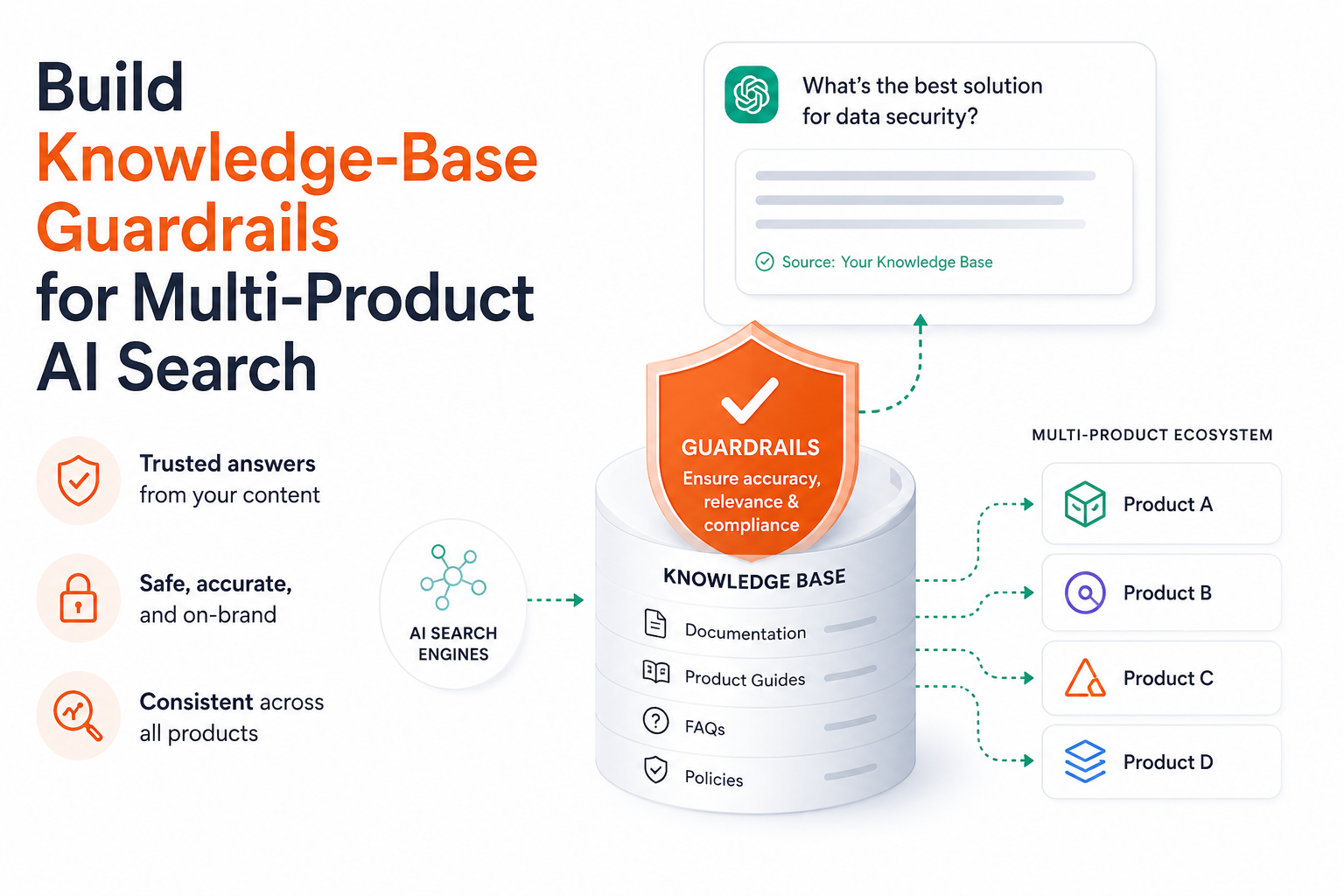
To protect brand integrity while scaling, you must treat guardrails as a core component of the AI search architecture, not an afterthought. Start by mapping each product’s key concepts, then enforce policies that filter or reshape responses based on those mappings. This proactive stance ensures that every AI citation aligns with the intended product narrative and compliance standards.
When the guardrails are aligned with the way sales and support teams talk to customers, the AI engine can surface the same language that real people use in conversations. This alignment reduces the cognitive load on buyers, who no longer have to reconcile conflicting statements from different product pages. In practice, you’ll notice fewer follow‑up questions and a smoother hand‑off from AI to a human rep.
Recommended Read: AI for Content Marketing: Supercharge Your Content Strategy - A practical guide to aligning AI‑generated content with broader marketing goals.
Common Challenges Managing Knowledge Bases Across Products
Managing separate knowledge bases for each product feels like maintaining parallel universes. Content teams must duplicate effort, track version changes across multiple repositories, and constantly verify that each source remains current. This fragmentation creates operational overhead that slows time‑to‑market and opens doors for inconsistencies. In addition, the lack of a unified taxonomy makes it hard for the AI engine to understand which product context applies to a given query, leading to cross‑product contamination.
One product manager asked, "Do they upload knowledge base etc for each product differently? That's something that needs a deeper discussion." The question reveals a common pain point: the absence of a standardized ingestion workflow. When each product team follows its own upload schedule, the AI layer receives staggered updates, and outdated information can linger in the response pool. This scenario often results in compliance gaps, especially for regulated industries that require real‑time policy enforcement.
Addressing these challenges starts with consolidating the knowledge assets into a shared framework while preserving product‑specific nuances. Adopt a central repository that supports metadata tagging for product lines, and implement automated sync processes that push updates to all AI agents simultaneously. This approach reduces redundancy, improves consistency, and frees your team to focus on content quality rather than data plumbing.
Another subtle difficulty is the cultural divide between product marketing and engineering. Marketing may prioritize compelling storytelling, while engineering values precise technical accuracy. Without a clear governance model, each side may edit the same piece of content in different ways, creating hidden conflicts that later surface as AI drift. Establishing a shared editorial calendar and a single source of truth helps bridge this gap.
Recommended Read: Use Cases of a Marketing Context Engine: 10 Proven Ways Real-Time Context Drives Revenue - Insights on building real‑time context pipelines that can be applied to knowledge‑base synchronization.
Designing Super‑Tight Guardrails: Core Principles
Creating guardrails that are truly "super tight" requires a blend of policy design, content structuring, and technical enforcement. First, define explicit rules that dictate which content types are permissible for each product. Use a taxonomy that separates marketing, technical, and compliance assets, then assign ownership to ensure accountability. Second, embed intent signals directly into the content metadata so the AI engine can match queries with the most relevant product context. Third, enforce citation quality by requiring that every AI answer references a verified source, turning the AI engine into a knowledge layer that builds trust with each interaction.
Below is a concise framework that maps the guardrail lifecycle from design to deployment:
| Stage | Goal | Key Action |
|---|---|---|
| Policy Definition | Establish clear content boundaries | Document allowed content types per product |
| Metadata Enrichment | Enable intent‑driven retrieval | Tag assets with product, audience, and compliance flags |
| Technical Enforcement | Prevent unauthorized output | Integrate rule‑engine checks into the AI response pipeline |
| Citation Validation | Guarantee source authority | Require AI citations to link to vetted documents |
| Continuous Review | Adapt to product changes | Schedule periodic audits and update policies |
The table illustrates how each stage contributes to a cohesive guardrail system. By treating the knowledge base as a living knowledge layer, you create a feedback loop where updates flow automatically into the AI engine, and the engine’s answers remain aligned with the latest product messaging.
Implementing this framework begins with a pilot on a single product line. Define the policy set, enrich the metadata, and test the rule engine against real user queries. Once the pilot demonstrates reduced drift and higher citation accuracy, scale the model across the remaining products.
During the pilot, it is useful to capture a small set of representative queries that span the buyer journey – from awareness to decision. By measuring how the AI responds to each query, you can quantify the improvement in relevance and pinpoint any remaining gaps before committing resources to a full rollout.
Recommended Read: AI Content Gap Analysis Tools: 10 Ways to Find Missed Opportunities - A deeper dive into identifying content gaps that can undermine guardrail effectiveness.
Implementing Continuous Monitoring and Governance
Guardrails lose their value the moment they stop evolving. Continuous monitoring ensures that the AI engine’s outputs remain compliant, accurate, and on‑brand as products mature. Deploy a context engine that logs every AI response, captures the source citation, and flags any deviation from the defined policy set. This real‑time audit trail allows you to spot drift early and intervene before it impacts customers.
Compliance is a top concern for many B2B SaaS firms. As one compliance officer noted, "Rhino doesn't want something to happen at any time in their content and those guardrails needs to always be maintained." This sentiment aligns with the FTC’s AI transparency rule, which mandates clear disclosure of AI‑generated content and reliable source attribution. A Transparency and AI: FTC Launches Enforcement Actions article explains that failure to maintain robust guardrails can trigger regulatory scrutiny.
To operationalize governance, establish a dashboard that tracks key metrics such as citation hit rate, policy violation count, and content freshness. Set thresholds that trigger alerts to the content team, and embed a human‑in‑the‑loop review for any flagged response. Regularly schedule cross‑functional meetings to review trends and adjust policies, ensuring the guardrail system stays aligned with product roadmaps.
In addition to the quantitative metrics, qualitative feedback from sales and support reps provides an early warning signal. If reps notice that AI answers are missing nuance or using outdated terminology, they can flag the issue directly in the monitoring tool, prompting a rapid content update.
Measuring Success and Maintaining Trust in AI Answers
Success in guardrail implementation is measured not only by reduced errors but also by the confidence it builds with users. Track AI citations to see how often the engine references verified sources versus unvetted content. Monitor search intent alignment by analyzing whether user queries lead to answers that satisfy the original intent, a metric often called intent fulfillment rate.
High intent fulfillment signals that your structured content and intent signals are working together effectively.
Another vital indicator is the rate of compliance incidents. A drop in flagged violations demonstrates that the governance loop is functioning. Additionally, measure the impact on downstream metrics such as lead quality and conversion, because reliable AI answers can accelerate the buyer’s journey. When the AI engine consistently delivers accurate, on‑brand information, sales teams report higher engagement and shorter sales cycles.
Finally, treat the guardrail program as an ongoing discipline. Schedule quarterly health checks, refresh the taxonomy to reflect new product features, and re‑evaluate citation sources for relevance. By treating the knowledge base as a dynamic context engine, you ensure that AI search continues to deliver trustworthy answers that reinforce brand credibility.
Practical Tips for Maintaining Guardrails Over Time
Even with a solid framework in place, the day‑to‑day upkeep of guardrails can feel daunting. One effective habit is to assign a “guardrail champion” for each product line. This person owns the metadata, reviews policy changes, and coordinates with the engineering team on rule‑engine updates. A regular “guardrail health” meeting, lasting no more than 30 minutes, keeps the conversation focused and prevents backlog buildup.
Another tip is to leverage automated content diff tools that compare the latest version of a document against the version stored in the AI knowledge base. When a difference is detected, the tool can create a ticket in your workflow system, ensuring that no change slips through unnoticed. Over time, these small process improvements compound into a smoother, more reliable AI experience for end users.
FAQs
1. How can I ensure AI citations stay up‑to‑date across multiple product lines?
Maintain a single source of truth for each product’s content and tag each asset with a version number. Use automated pipelines to push updates to the AI knowledge base whenever a document changes. Regularly audit citation logs to verify that the AI engine references the latest version, and set alerts for any outdated citations.
2. What role do intent signals play in improving AI search relevance?
Intent signals capture the underlying purpose behind a user’s query, allowing the AI engine to surface answers that directly address the need. By enriching content with intent metadata such as buyer stage, pain point, or decision criteria you enable the engine to match queries with the most relevant product information, reducing mismatched results.
3. How do I balance strict guardrails with the need for flexible, conversational AI answers?
Start with a baseline set of non‑negotiable policies (e.g., compliance, brand language) and layer flexible response templates on top. Use a rule‑engine to enforce hard constraints while allowing the language model to generate natural phrasing within those bounds. This hybrid approach preserves brand safety without sacrificing conversational tone.
4. What metrics should I track to evaluate the effectiveness of my guardrail program?
Key metrics include citation hit rate (percentage of answers with verified sources), policy violation count, intent fulfillment rate, and content freshness score. Tracking these indicators over time helps you identify drift, measure compliance, and demonstrate ROI to stakeholders.
5. How often should I review and update my knowledge‑base guardrails?
Conduct a comprehensive review at least quarterly, or whenever a major product update is released. In between, use automated monitoring to flag any anomalies and trigger ad‑hoc reviews. This cadence ensures that guardrails evolve alongside your product portfolio and market conditions.
Conclusion
For a VP of Content & SEO overseeing a multi‑product SaaS portfolio, the challenge of keeping AI search answers accurate, on‑brand, and safe is real and solvable. By establishing tight guardrails, unifying taxonomy, embedding intent signals, and instituting continuous monitoring, you create a resilient framework that protects brand integrity while scaling AI search across every product line. Apply the principles outlined above, measure your progress with clear metrics, and treat the knowledge base as a living context engine. When you do, AI‑driven search becomes a trustworthy extension of your brand, driving confidence and conversion across the buyer journey.
Recommended Authority Resources
- Reference: AI Search Engine Market Size, Share | Industry Report, 2033 - Provides market sizing and growth trends for AI search platforms in the United States.
- Reference: Transparency and AI: FTC Launches Enforcement Actions - Analyzes the FTC’s AI transparency rule and its implications for citation practices.
- Reference: AI capacity in the public sector: Pathways from ... - Academic study on AI adoption rates in U.S. public‑sector organizations, highlighting the importance of robust governance.
Turn Your Content Into AI-Search Winners
Get cited across ChatGPT, Claude & Perplexity — not just ranked on Google.
- Increase AI citations
- Improve answer visibility
- Track brand mentions in LLMs