

Table Of Contents
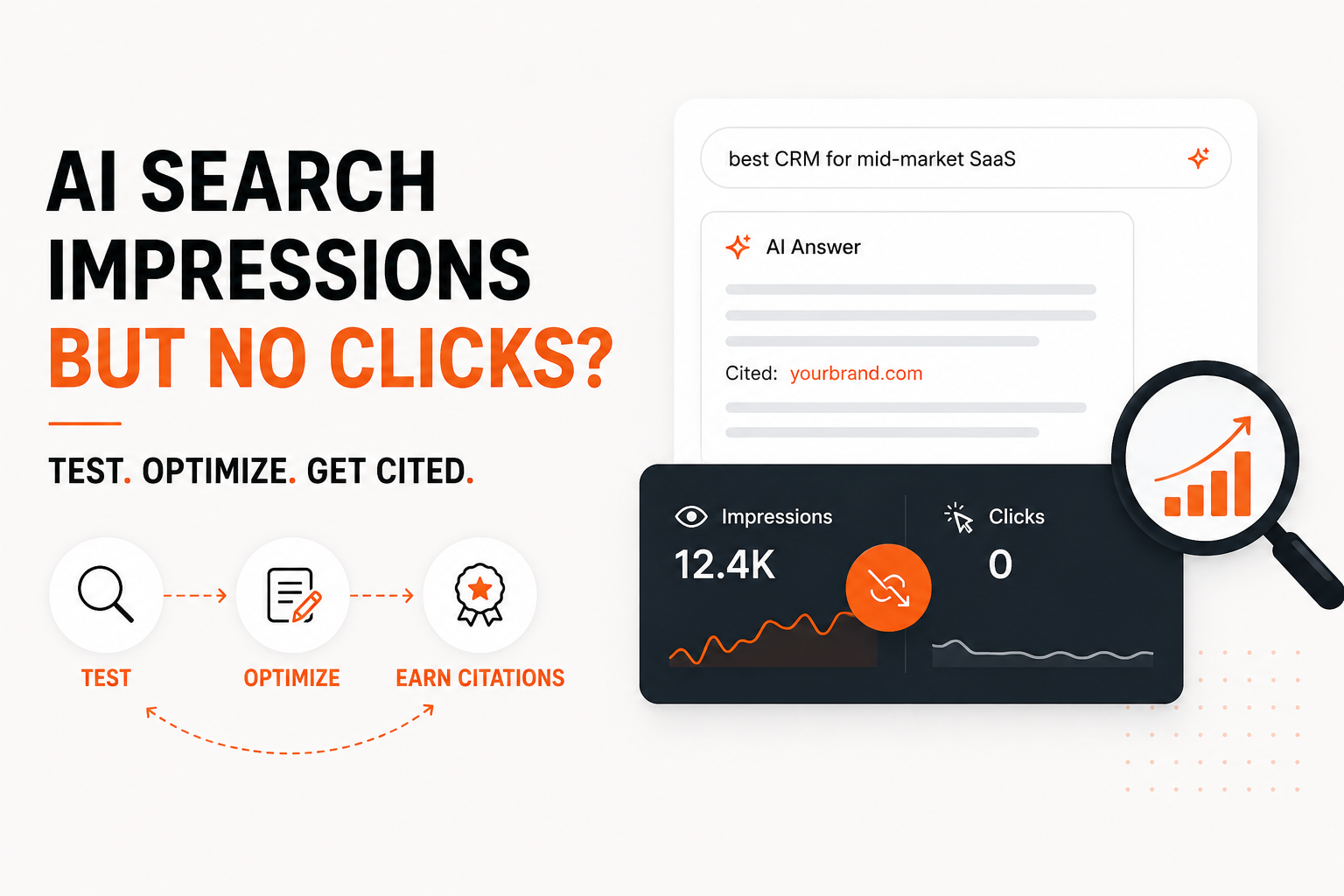
When a B2B demand‑generation leader sees content surface in AI‑driven answer engines yet the click count stays flat, the situation feels like a missed opportunity. The impression metric suggests the content is visible, but the lack of clicks indicates a gap between being seen and being engaged. This disconnect often stems from ranking just enough to appear in AI overviews without earning a compelling call‑to‑action. In this guide we explore why AI search impressions alone are insufficient, how to evaluate prompt relevance and citation quality, and which systematic testing methods can turn passive visibility into active pipeline growth. You will walk away with a repeatable framework and concrete tactics that can be applied today.
Many B2B marketers find that traditional SEO dashboards do not surface the nuance of AI‑driven queries, leaving them blind to the specific language buyers use when they ask a question in a conversational interface.
Why AI search impressions aren’t enough
AI‑driven answer engines such as ChatGPT or Perplexity present content as concise answers, shifting the click model away from traditional SERPs. An impression in this context means the engine cited your page, but it does not guarantee that the reader will click through to learn more. As one VP of Demand Generation noted, "If a page is receiving impressions but very few clicks, it usually means we're ranking but not high enough to earn the click consistently. The plan is to optimize those pages to improve rankings, CTR, and increase the chances of appearing in AI Overviews as well." This sentiment captures the core problem: visibility without relevance or persuasive positioning fails to move the needle on pipeline.
Understanding why impressions fall short requires looking beyond raw numbers. An AI search market share study shows that AI‑first interfaces now account for a growing portion of the digital front door, yet many marketers still rely on traditional SEO tools that lack AI‑specific insight. The shift demands a new mindset: rather than asking "how many impressions?" ask "which prompts are driving those impressions and why are users not clicking?".
To close the gap, teams must treat AI impressions as a diagnostic signal, not an end goal. The first step is to adopt an ai search visibility checker that surfaces the exact queries that trigger citations. By mapping those prompts to buyer intent, you can prioritize the pages that matter most and begin to refine the content that actually converts.
To bridge that gap, map each AI citation back to the stage of the buyer journey it supports, then tailor the surrounding content to guide the reader from curiosity to a qualified conversation.
Recommended Read: Why SEO Fundamentals Still Power AI Search Citations for B2B Marketers - A deep dive into the SEO foundations that still matter in AI‑first search.
Understanding prompt relevance and citation quality
Prompt relevance is the degree to which the language in a buyer’s query matches the terminology and structure of your content. When prompts align, AI engines are more likely to cite your page as an authoritative answer. However, many teams struggle to identify the exact phrasing buyers use, leading to missed citation opportunities. This is where identifying visibility gaps in ai search results becomes essential – you need to know which prompts are not being satisfied by your assets.
Citation quality also plays a pivotal role. AI engines weigh factors such as domain authority, structured data, and the freshness of the referenced content. A well‑structured FAQ schema or a clear, concise snippet can boost the likelihood that the engine selects your page over a competitor’s. As another stakeholder explained, "AI visibility alone is not important, whether that visibility is for the right prompt and at the right time is important." This underscores that both the right prompt and the right citation signals must converge.
To evaluate both dimensions, start by running an ai search visibility gaps audit. Use a tool that surfaces the prompts that currently cite your pages and compare them against a list of high‑value buyer questions. Then, assess each cited page for schema completeness, citation placement, and content depth. The result is a clear map of where prompt relevance is strong and where citation quality needs improvement.
Enriching your prompt library with verbatim excerpts from sales calls or support tickets helps ensure the language on the page mirrors the real‑world phrasing that triggers AI citations.
Recommended Read: AI Search Optimization Checklist: Win AI Citations and Drive B2B Pipeline - A step‑by‑step playbook for building citation‑ready assets.
Building a systematic testing framework for AI pages
Once you have identified the prompts and citation gaps, the next step is to set up a repeatable testing methodology. Traditional A/B testing on web pages can be adapted for AI search by focusing on the elements that influence citation and click‑through behavior. The core loop includes hypothesis definition, controlled content variation, performance monitoring, and iterative refinement.
Begin by selecting a ai search visibility tracking software that can capture impression‑to‑click ratios for each cited prompt. Create two versions of a target page: one that incorporates the identified prompt language and another that follows the existing content structure. Deploy both versions and monitor which variant earns higher click‑through rates from AI answers. This approach mirrors classic A/B testing but is tailored to the AI citation environment.
After each test cycle, record the findings in a shared dashboard and use them to inform the next round of hypotheses. Over time, you will develop a library of proven prompt‑content pairings that consistently drive clicks. This disciplined framework turns ad‑hoc fixes into data‑driven optimization.
When you have a catalog of content variations, use automation to rotate snippets at scale, allowing the AI visibility tracking software to surface the highest‑performing version without manual overhead.
Recommended Read: Webinar | From AI Visibility to Pipeline: How Buyer-Focused AI Search Optimization Translates into Revenue - Insights from a live session on measuring AI‑driven pipeline impact.
Practical optimization tactics to increase click‑through
With a testing framework in place, focus on the specific on‑page elements that influence both citation and click‑through. Adjusting headlines, meta descriptions, and snippet content can make the difference between a passive citation and an active click. An ai search visibility optimization tool can highlight where your current headlines fall short of matching buyer intent.
Below is a concise set of tactics that have proven effective for B2B teams. Each tactic is linked to a measurable outcome, helping you prioritize effort.
| Tactic | What to Change | Why It Matters | Typical Impact |
|---|---|---|---|
| Headline alignment | Insert exact buyer prompt phrasing into the headline | Matches AI query language, increasing citation relevance | Higher click‑through probability |
| Snippet enrichment | Add a clear call‑to‑action and concise value statement | Provides immediate incentive for the user to click | Improved engagement |
| Schema implementation | Deploy FAQ or Product schema with prompt‑specific Q&A | Signals structured data to AI engines | Better citation placement |
| Citation placement | Position authoritative references near the top of the content | Boosts perceived credibility for AI | Increased trust and clicks |
After applying these tactics, re‑run your ai search visibility analysis tool to verify that the changes have moved your page higher in the AI answer ranking and, more importantly, that the click‑through rate has risen. Remember that optimization is iterative; each round of adjustments should be measured and documented.
Measuring impact and connecting AI performance to pipeline
Visibility metrics are only useful when they can be tied back to revenue outcomes. To bridge the gap, integrate your AI monitoring data with existing pipeline reporting tools. An ai search visibility and share of voice optimization dashboard can show the proportion of AI‑cited impressions that convert into qualified leads.
Use an ai visibility metrics platform to pull impression data, click‑through rates, and downstream conversion events into a single view. Correlate spikes in AI‑driven clicks with lead creation dates to demonstrate the causal link between optimized content and pipeline acceleration. This evidence equips you to justify further investment in AI‑first optimization.
Finally, adopt a cadence of quarterly reviews where you compare the current track ai search visibility performance against the baseline established during your initial testing. Adjust your testing roadmap based on which prompts and tactics deliver the strongest pipeline impact, ensuring that the optimization effort remains aligned with revenue goals.
Common pitfalls and ongoing governance
Even with a robust framework, teams can fall into traps that erode progress. One frequent mistake is treating AI citation optimization as a one‑time project rather than an ongoing discipline. Without regular audits, new content can drift away from the prompt language that drives clicks, and citation quality can degrade over time.
Another risk is neglecting governance around content updates. When multiple stakeholders edit pages, inconsistencies in schema markup or citation placement can emerge, confusing AI engines. Establish a clear approval workflow that includes a checklist for AI‑specific elements before publishing.
By institutionalizing a quarterly ai search visibility monitoring platform review and embedding citation quality checks into your content governance process, you safeguard the gains made through testing and ensure that AI‑driven traffic continues to feed the pipeline.
Real World Example: Turning AI Impressions into Pipeline
A mid size SaaS vendor noticed that a technical whitepaper was cited in dozens of AI answers but generated almost no clicks. By aligning the headline with the most common prompt and adding a concise FAQ schema, the click through rate rose by roughly twenty percent within a month.
The vendor then fed the increased click data into their CRM, linking the new leads to the original AI citation source. This closed loop insight demonstrated a clear pipeline contribution, justifying further investment in AI focused content creation and ongoing visibility monitoring.
FAQs
1. How can I discover the exact prompts my target audience uses in AI search?
Start by analyzing the query logs from your AI‑search monitoring tools. Identify recurring question patterns that align with buyer intent, then map those prompts to existing content assets. Prioritize the prompts that generate the highest impression volume and have the greatest relevance to your product or service.
2. What role does schema markup play in improving AI citation click‑through?
Schema provides structured signals that AI engines use to understand the context of your content. Implementing FAQ or Product schema that mirrors the language of identified prompts helps the engine surface your page as a concise answer, increasing both citation likelihood and the chance that users click for more detail.
3. Which metrics should I track to prove AI search optimization is driving pipeline growth?
Key metrics include AI impression volume, click‑through rate from AI answers, the number of leads generated from AI‑driven clicks, and the conversion rate of those leads into qualified opportunities. Connecting these metrics in a unified dashboard lets you demonstrate the direct impact on revenue.
4. How often should I revisit my AI search testing framework?
Conduct a full audit at least once per quarter. Review prompt relevance, citation quality, and performance data, then adjust your testing hypotheses based on the latest insights. This cadence ensures you stay aligned with evolving buyer language and AI engine updates.
5. Can I use the same optimization tactics across different AI answer engines?
Yes, the core principles prompt alignment, schema implementation, and citation quality apply broadly. However, each engine may weigh signals slightly differently, so it’s advisable to run engine‑specific tests to fine‑tune your content for the best results.
Conclusion
AI search impressions signal that your content is being recognized, but without a strategic approach to prompt relevance, citation quality, and systematic testing, those impressions rarely translate into clicks or pipeline value. By adopting an ai search visibility optimization tool, conducting disciplined experiments, and continuously measuring the impact on lead generation, you can turn the AI front door into a high‑value traffic source. Apply these principles to your own content workflow, and you’ll see a measurable lift in engagement and revenue‑driving opportunities.
Recommended Authority Resources
- Reference: New front door to the internet: Winning in the age of AI search - McKinsey - Provides market context on the growing share of AI‑driven search and its implications for B2B marketers.
- Reference: AI Companies: Uphold Your Privacy and Confidentiality Commitments - Outlines regulatory considerations that impact data collection for AI search monitoring.
Turn Your Content Into AI-Search Winners
Get cited across ChatGPT, Claude & Perplexity — not just ranked on Google.
- Increase AI citations
- Improve answer visibility
- Track brand mentions in LLMs