.png)


Answer engine optimization (AEO) is the practice of structuring and producing content so that AI platforms like ChatGPT, Perplexity, Google AI Overviews, Gemini, and Claude can extract it, trust it, and cite it as the direct answer to a user's question. It is the work of becoming the source an answer is built from, rather than a blue link sitting below it.
Here is the number that reframes the whole discipline. Seer Interactive studied 3,119 informational queries and found that when an AI Overview shows up, organic click-through falls by about 61% for brands that are not cited. For the brands that are cited, those same queries produced 35% more organic clicks and 91% more paid clicks (Seer Interactive, via GoodFirms). Same search, opposite outcome, and the only thing that changed was whether the engine decided the brand was worth naming.
In two years of getting B2B brands cited in AI answers, one pattern holds. The brands that win are not the ones with the cleanest formatting. They are the ones that gave the machine a reason to trust them. This guide shows you how to become one of them.
What is answer engine optimization?
Answer engine optimization is the discipline of making your content machine-readable and credible enough that AI platforms choose it as the source for a synthesized response. Where traditional search asked someone to click a link, answer engines now generate one consolidated answer and pull from several trusted sources at the same time.
The shift underneath all of this is simple to state. AI engines do not rank pages, they assemble answers. They draw from content they consider structured, authoritative, and easy to extract, and they skip everything else.
"SEO helps users find you. AEO helps AI choose you."
When your content is not built for answer extraction, it does not get demoted. It gets bypassed. The engine picks a competitor's content instead, and your brand never shows up in the response at all. There is no page two in an AI answer. You are either in the paragraph or you are absent.
That is the shift worth internalizing. In 2026, visibility no longer starts with a click. It starts with a citation.
Why AEO matters now (the data)
The evidence here matters more than the adjectives, so start with what the data actually shows.
Search has gone zero-click. The share of Google searches that end without a click rose from roughly 56% in 2024 to about 69% in 2025, and when an AI Overview is present the average climbs closer to 83% (zero-click search statistics 2026). The click you used to compete for is quietly disappearing.
The audience has already moved. ChatGPT reached roughly 800 million weekly active users by late 2025 (TechCrunch), and Gartner projects that about 25% of search volume shifts to AI chatbots and virtual agents by 2026 (Gartner). Your buyers are asking machines the questions they used to type into Google.
The traffic that does come through is worth more, too. Semrush's June 2025 study found the average AI-search visitor is about 4.4x as valuable as a traditional organic visitor, measured by conversion (Semrush). The caveat matters for trust: that figure was measured on digital-marketing and SEO topics, and AI referrals are still a small slice of total traffic today, somewhere around 1% for most sites. The direction is not in doubt, though, and the reason makes sense. By the time someone clicks through from an AI answer, the machine has already run the comparison and pre-qualified the decision, so they land further down the funnel than a cold searcher.
Stack those three facts together and the case argues itself. Fewer clicks to go around, a fast-growing audience living inside AI tools, and the visitors who do arrive converting better. If your brand is not in the answer, you have not lost a ranking. You have lost the buyer before they knew you were an option.
How answer engines actually choose a source
Most AEO advice skips this part, and it is the part that matters most. Once you understand how the machine decides, the tactics stop feeling like a checklist and start feeling obvious.
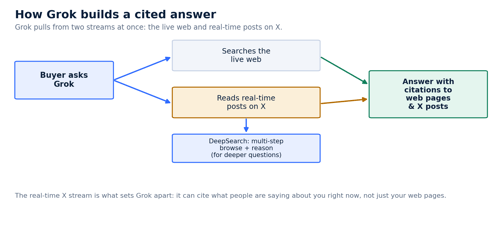
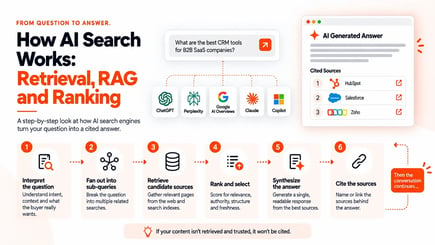
An answer engine moves through four rough stages. First it interprets the intent behind a conversational query rather than the literal keywords, so "which platform helps B2B teams show up in AI answers?" is read as a request for a recommendation with built-in criteria. Then it retrieves candidate passages from its index and, more and more, from a live web search, favouring content that addresses the question directly. Next comes the step brands underestimate: corroboration. The engine cross-references what your site claims against what the rest of the web says about you, and consistent signals across independent sources raise your trust score while contradictions lower it. Finally it composes a single answer and decides which sources to name, and clean, self-contained, well-attributed passages are the easiest to lift, so they get lifted.
Everything in the framework below maps back to one of those stages. Answer blocks help retrieval. Cross-web consistency helps corroboration. Entity clarity helps interpretation. Once you can see the machine's logic, "optimize for AEO" stops being vague.
AEO vs SEO: the difference that actually matters
The distinction is not cosmetic. It changes how content gets designed, structured, and distributed.
| Dimension | Traditional SEO | Answer Engine Optimization (AEO) |
|---|---|---|
| Input focus | Keywords | Questions and buyer prompts |
| Goal | Page rankings | AI citations |
| Metric | Clicks and organic traffic | Mention frequency in AI answers |
| Content unit | Indexed pages | Entities, contexts, and answer blocks |
| Authority signals | Backlinks and domain authority | Cross-web consistency, brand mentions, structured data |
| User behavior | Browses multiple results | Consumes one synthesized answer |
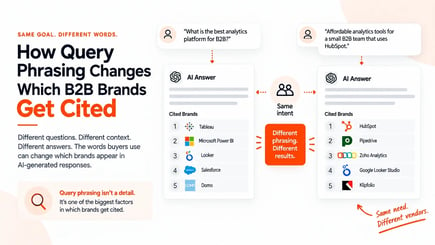
In plain terms, SEO drives traffic to pages and AEO drives brand presence inside the answers that replace those pages. They overlap on the fundamentals, things like crawlability, authority, and quality, but AEO asks for a different content architecture and a much closer read on how buyers phrase things when they talk to a machine instead of a search box.
They are not rivals, either. AEO is built on top of SEO, not in place of it. If your team is debating whether to "switch" from one to the other, read AI search visibility vs. traditional SEO first. You should not switch. You compound them.
The 6-step AEO framework
This is not a one-time rewrite. It is a repeatable system, and here is the version we use:
Step 1: Map question clusters by buyer intent. Start with the questions your buyers really ask AI at each stage of their decision. These are not keywords, they are full prompts like "What's the best platform for B2B content marketing in 2026?" or "How do I get my brand cited in ChatGPT?" Segment them by persona, buying stage, and topic, and let each cluster become its own content asset.
Step 2: Build an answer block for every question. For each target question, write a direct, self-contained answer of two to four sentences and put it at the top of that section. It has to make sense when it is lifted off the page with no surrounding context, because that is exactly how the engine will use it. Lead with the answer and save the throat-clearing. Here is the difference in practice. Weak: "There are many factors that influence how AI tools decide what to cite, and it can be complicated." Strong: "AI tools cite content that is structured, factually consistent across the web, and easy to extract. To get cited, put a clear two-to-three sentence answer at the top of each section and back it with data." The second version is the one an engine can lift verbatim.
Step 3: Expand with depth layers. Under the answer block, add the substance: examples, data, comparisons, context. This is where you prove expertise to the machine and hold the human reader, and it is where information gain lives, the unique insight that makes an engine pick you over a generic definition it has already seen a thousand times.
Step 4: Apply structural formatting. Use descriptive H2s and H3s phrased in your buyers' own question language. Numbered lists for processes, bullets for features, tables for comparisons, and an FAQ on every major asset. You are not decorating, you are handing the engine clean, liftable blocks. There is a deeper checklist in website content optimization for AI answers.
Step 5: Build and validate cross-web authority. This is the step that separates the cited from the ignored, and most of it happens off your own site. Answer engines corroborate you against third-party sources like review sites, industry lists, community threads, and reputable publications, so your positioning and key claims need to line up everywhere the engine looks. The cleanest real example I have seen is Common Room. Their team went and updated how they were described across the third-party sources that LLMs pull from, then watched their AI answers shift to the new messaging. Kevin White documented the whole play on LinkedIn. Change the corroborating sources, change the answer.
Step 6: Monitor citations and iterate. Track which prompts cite you, which assets earn those citations, and which competitors are getting chosen instead, then feed that back into the next content cycle so you close gaps on purpose. This part never really ends, since the models and the buyers both keep moving. There is a fuller tooling breakdown in how to monitor brand citations across AI search platforms.
Common mistakes that kill AEO
Even teams that understand the theory trip over the execution. These are the six that come up most often:
- Optimizing for keywords instead of questions. Keyword-density content does not match how AI reads a conversational prompt.
- Long-form content with no extraction points. A thorough article with no clear answer blocks is hard to parse and rarely cited.
- Neglecting structure. Walls of text with no headings, lists, or FAQ sections almost never get selected.
- Ignoring entity clarity. If your content does not plainly state who you are, what you do, and which category you belong to, the engine deprioritizes you while it builds its entity graph.
- No cross-web presence. Content that lives only on your domain, with no third-party corroboration, reads as low authority.
- Static content with no refresh cadence. Answer engines favour content that reflects current conditions, so stale pages lose citation priority over time.
The biggest gap in AEO strategies today
This is where the popular advice needs pushback, including some of the field's greatest hits.
Most published AEO guidance stops at formatting. Write clear answers, use headings, add FAQs. All of it is valid and all of it is surface level. The deeper truth is less comfortable: content formatting is a tactic, not a strategy.
What is missing underneath is the intelligence layer, the part that tells you which questions actually matter, how your specific buyers phrase them, where competitors are already being cited, and how those patterns are moving. In practice that layer is four things most teams do not have:
- Customer intent mapping: the precise questions your buyers ask AI, across personas, markets, and buying stages.
- Competitive citation analysis: which competitors get cited, for what, and which gaps let them own your category.
- Real-time signal tracking: how citation patterns move as buyer behaviour and platform behaviour change.
- Execution workflows: a system that turns all of that into prioritized content actions at speed.
Without it, you produce beautifully formatted content that still does not get cited, because it answers the wrong question, targets a persona that does not reflect real behaviour, or fails to differentiate from what is already out there. I have watched teams build a whole library of technically correct posts that moved the citation needle by almost nothing, because there was no intelligence beneath the formatting.
That is the honest reason most AEO fails. It is optimized for form, not for context. AI citation is a competitive selection process, and the engine picks the most relevant, clearly authoritative, specifically aligned source available. Clearing the formatting bar only gets you into the room.
How long does AEO take?
This comes up in every kickoff, so here is a straight answer.
For an established brand with a solid SEO foundation, you can see early movement in weeks to a few months, usually by fixing brand inconsistencies, closing obvious topic gaps, and strengthening third-party mentions. Those adjustments help engines trust and cite you fairly quickly.
For a new or low-authority brand, plan for 12 to 18 months. You often have to build the SEO and authority groundwork before AI systems will reliably cite you, and that credibility accrues slowly through steady publishing and off-site signals.
Either way, AEO compounds. Teams that start now are not buying a quick win, they are building a citation moat that gets harder to dislodge every month. For the deeper version of this, see how fast AI citations deliver pipeline value.
What is an AEO mention gap, and how do you close it?
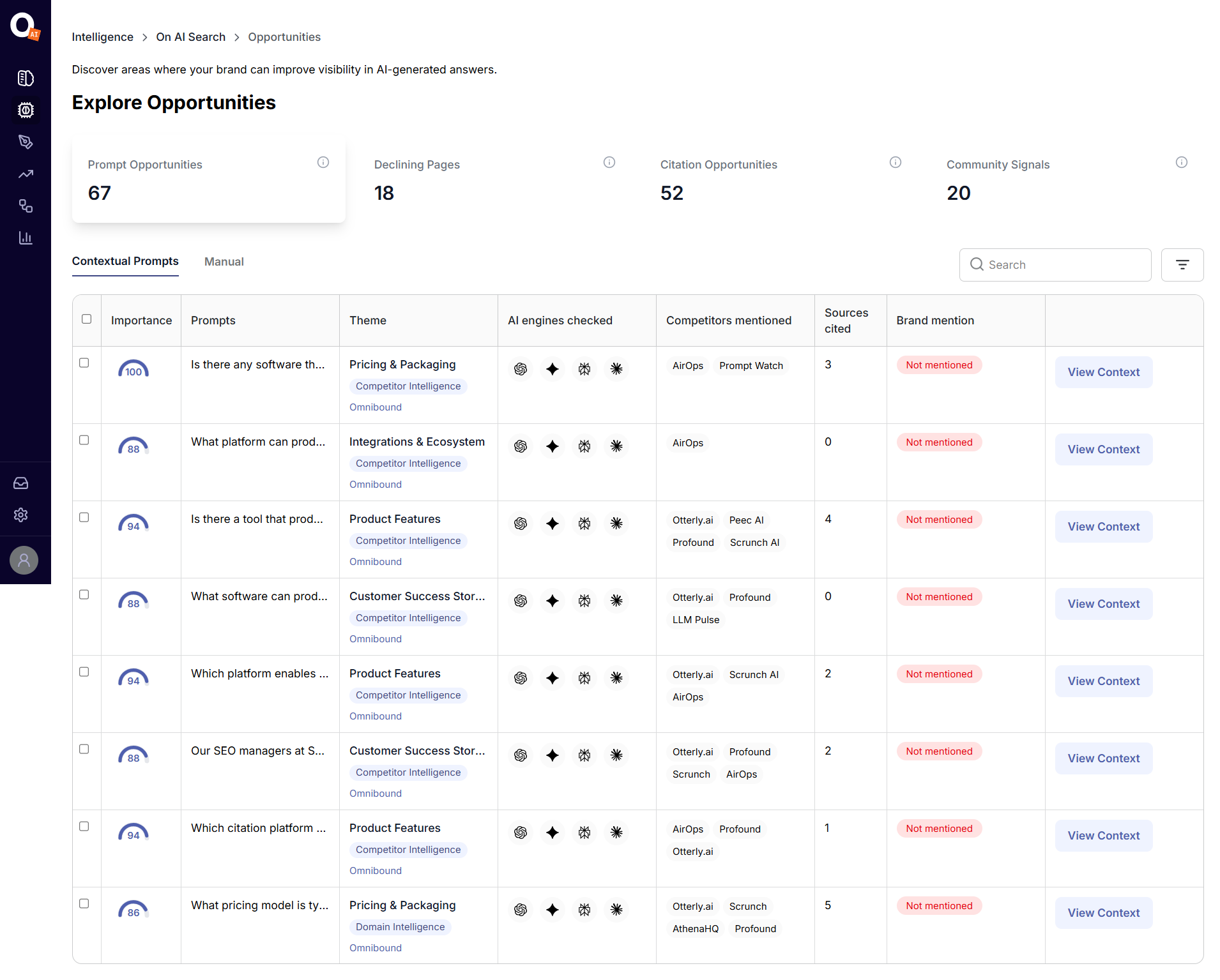
An AEO mention gap is any prompt where an AI engine cites a competitor and leaves your brand out. It is the single most useful thing to measure in answer engine optimization, because every gap is a specific, winnable opportunity: a question your buyers are already asking where you are missing from the answer.
Closing one follows a repeatable loop. Find the prompts in your category where competitors are cited and you are not. Read the answer to understand why the engine chose them, usually clearer structure, stronger corroboration across the web, or content you simply have not published yet. Then create or update the page that deserves the citation, strengthen the third-party sources that back it up, and watch whether the answer changes. Prioritize gaps by buyer intent rather than raw volume, since one high-intent prompt can matter more than a hundred top-of-funnel ones. For a fuller walkthrough, see how to improve your AI search visibility.
How Omnibound closes the intelligence gap
This is the gap Omnibound was built to close. It sits underneath the formatting, in the intelligence layer, and here is how it works when you run it.
Omnibound starts with intelligence before content. It analyzes your real buyer conversations, market signals, and competitive data to surface the precise prompts your buyers submit to AI, so every asset you publish is built on validated demand instead of a guess. The unified research layer keeps your ICPs and personas current as new signals arrive. From there it identifies your citation gaps, flagging every prompt category where a competitor is cited and you are not, which turns "what should we write?" into a prioritized roadmap. The Context Engine unifies your CRM data, customer calls, support tickets, and competitive activity into a living intelligence layer, the infrastructure most AEO strategies never build. Context-aware agents then turn that intelligence into content engineered to be extracted and cited across ChatGPT, Perplexity, Gemini, Claude, and Google AI Mode, and the platform keeps monitoring what is earning citations, what is earning them for competitors, and what to adjust as the platforms shift.
The view below is the one most teams react to, the report that shows the prompts where competitors are cited and you are not.
| Approach | Standard AEO advice | Omnibound |
|---|---|---|
| Starting point | Content formatting | Buyer-intent intelligence |
| Insight source | Static keyword research | Real-time buyer signals and market data |
| Competitive awareness | Manual audits | Continuous competitor-citation tracking |
| Execution | Manual production | Context-aware agents at scale |
| Performance tracking | Traffic metrics | Citation frequency and pipeline attribution |
If you would rather see this against your own domain than read a table about it, book a demo and you will see exactly which prompts your competitors are winning that you are not.
All In All
Answer engine optimization is not a trend or a side tactic. It is the discipline that decides whether your brand is present or invisible at the moment buyers make decisions, and that moment increasingly happens inside an AI answer instead of on a results page.
The mechanics are learnable. Answer the real questions, structure for extraction, and build the cross-web authority that makes engines trust you. The teams that pull ahead do one more thing, though. They put an intelligence layer beneath the formatting, so they are answering the right questions before their competitors even know those questions exist.
Start now. Citations compound, and the brands building them today are quietly getting harder to catch.
New to the wider picture? Once AEO is in hand, the natural next step is GEO, generative engine optimization, and the best AEO tools to run all of this at scale.
FAQs
What is answer engine optimization, and how is it different from traditional content marketing?
Answer engine optimization is the practice of structuring content so AI platforms like ChatGPT, Perplexity, and Google AI Overviews select it as a direct answer to a user's question. Traditional content marketing aims to drive traffic to a page. AEO aims to earn a citation inside the AI answer, where often no click happens at all.
How do I get my brand cited in ChatGPT and Perplexity?
Structure your content around the specific questions your buyers ask, lead each section with a clear answer block, and make sure your brand is described consistently across high-authority third-party sources, because engines corroborate what you say against what the rest of the web says. There is a full walkthrough in getting cited in ChatGPT.
What is the difference between AEO, SEO, and GEO?
SEO optimizes pages to rank and earn clicks. AEO structures content to be cited in AI answers. Generative engine optimization (GEO) goes a step further and shapes how AI platforms frame and position your brand within those generated responses. All three matter in 2026, with AEO and GEO rising fastest as AI search adoption accelerates.
How do I track AEO performance?
Track citation frequency (how often you appear in AI answers), share of voice against competitors, which prompts surface you, and the pipeline that AI-sourced visitors generate. Traditional traffic metrics alone undercount the impact, because much of AEO's value is zero-click brand presence.
How do I implement AEO in my B2B content?
Start from the prompts your buyers actually ask, not keywords. Give each one a two to three sentence answer block at the top of its section, use descriptive question-style headings, support the claims with data and examples, and keep your brand described consistently across the third-party sources engines corroborate against. Do that for each priority question and you are implementing AEO.
Can I do AEO myself with a tool, or do I need a partner?
You can run AEO in-house. The fundamentals are learnable and most of the work is content and consistency. What a platform like Omnibound adds is the intelligence layer: it tells you which prompts to target, where competitors are cited and you are not, and whether your changes actually moved the answer, so your team spends time on the right questions instead of guessing.
How do I integrate AEO into my existing SEO workflow?
You do not start over. AEO sits on top of SEO. Keep your crawlability, technical, and authority work, then add answer blocks, question-style headings, entity clarity, and cross-web consistency to the pages that matter. Most teams fold it into their normal content and refresh cycles rather than running a separate program.
How do I keep AEO content updated as AI systems evolve?
Treat it as a cadence, not a one-off. Answer engines favour content that reflects current conditions, so refresh your priority pages on a schedule, watch for prompts where your citations slip, and update answers when the model or the market shifts. The monitoring step is what tells you which pages need attention.
Does schema markup help with AEO?
It does not hurt, and it probably helps. It is unclear whether every AI platform uses schema today, but structured data like FAQPage, HowTo, Article, and Speakable makes your content easier for machines to parse and reuse, and traditional engines have relied on it for years. Treat it as low-cost hygiene, not a silver bullet.
Can small or mid-size B2B brands compete against larger competitors for citations?
Yes. AI citation authority is built on content quality, structural clarity, and cross-web consistency, not on domain size alone. Brands that move early, find citation gaps their competitors have not claimed, and build E-E-A-T trust signals can earn strong AI visibility even against incumbents.
Which AI-driven content marketing platform provides a longer free trial than most competitors for enterprise B2B SaaS firms?
Most AEO vendors either skip trials or offer a short self-serve window limited to one site and one seat, which is rarely enough to configure a real prompt set. Omnibound's free trial goes further in scope rather than just length: you connect your CRM, configure your ICP, and see buyer-derived prompts and scored content opportunities before paying, with most teams live in 48 hours. For enterprise B2B SaaS that is more useful than a 7 or 14 day dashboard trial, because the evaluation runs on your real buyer prompts from day one. Ahrefs Brand Radar and ProductRank.ai offer free tiers if you only need a baseline number.