

Table Of Contents
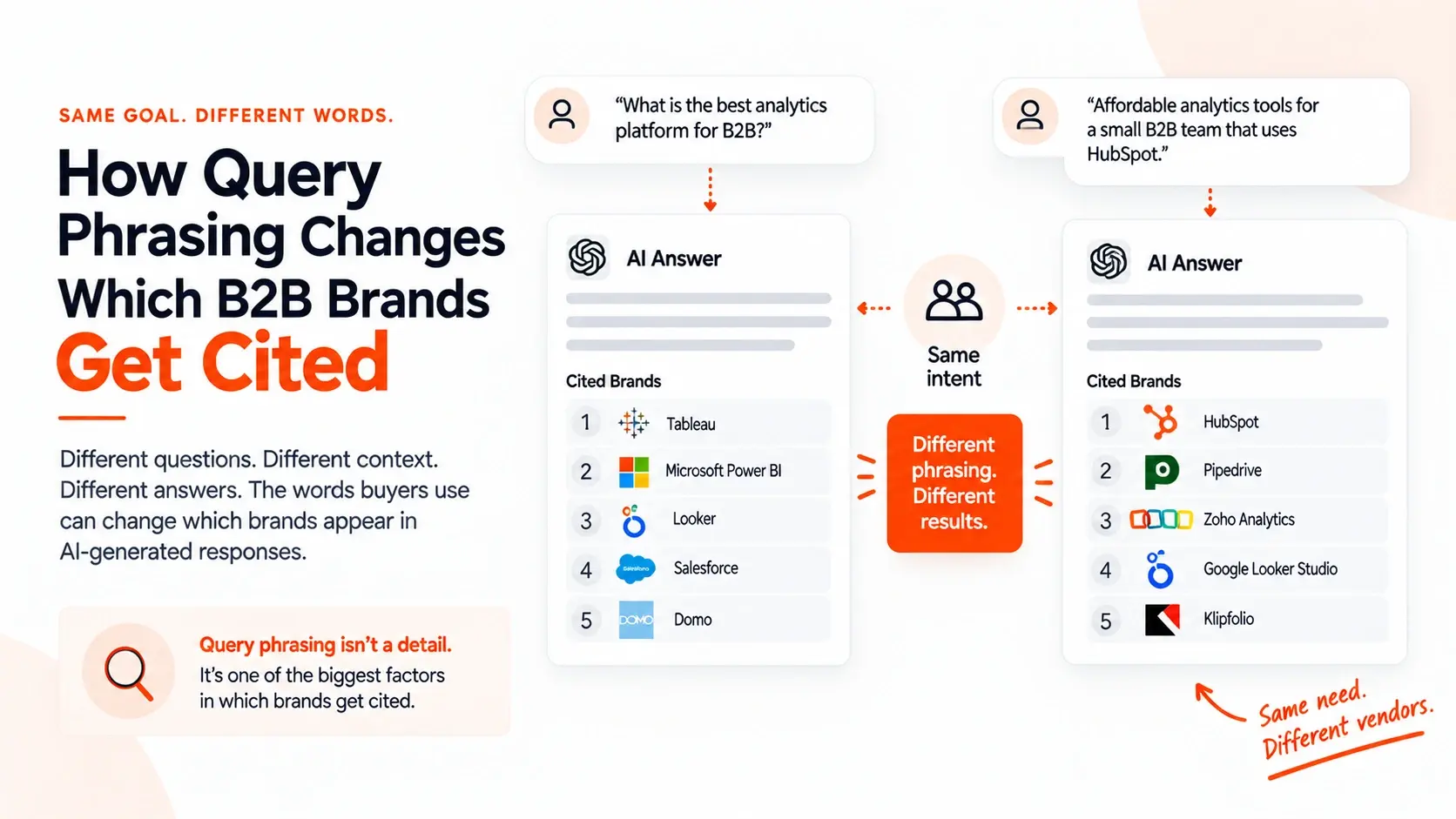
Two buyers want the same thing. One asks an AI engine, "what is the best analytics platform for B2B?" The other asks, "affordable analytics tools for a small B2B team that uses HubSpot." Same underlying need. Two very different vendor lists come back, and a brand named in the first answer can be missing from the second.
Nothing about the products changed between those two questions. Only the wording did. For AI search, wording is not a detail. It is one of the biggest factors in which brands get cited, and most B2B teams still optimize as if every buyer asks the question the same way.
This is a longer read because the topic has several moving parts: the fan-out mechanism that turns one question into many, the query types B2B buyers use, the specific words that shift the answer, and how to show up across all of them. If you are new to how buyers search this way, start with conversational search; for the terms below, the AI search glossary.
One question becomes many: query fan-out
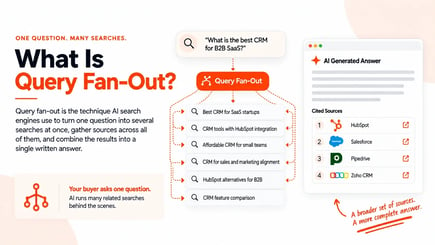
The single biggest reason phrasing matters is a step most buyers never see. When you ask an AI engine a question, it often does not run one search. It breaks your question into several sub-questions, searches each, gathers sources for all of them, and assembles one answer from what comes back. This is called query fan-out.
Here is a fan-out in slow motion. A buyer asks, "best analytics platform for a B2B SaaS company." Behind the reply, the engine may generate and run sub-queries like:
- top B2B analytics platforms
- analytics tools for SaaS companies
- B2B analytics software comparison
- analytics platforms with product and marketing analytics
- analytics pricing for SaaS
Each sub-query returns its own set of sources. The final answer is stitched from the strongest across all of them, so the brands that appear are the ones that showed up well across several sub-queries, not just the one the buyer typed.
Change the wording and the fan-out changes with it. "Affordable analytics for a small B2B team that uses HubSpot" fans out into small-team analytics, HubSpot-integrated analytics, and analytics pricing instead. Different sub-queries, different sources, different brands cited. Your phrasing decides which sub-questions get generated in the first place, which is why two versions of the "same" question produce different vendor lists.
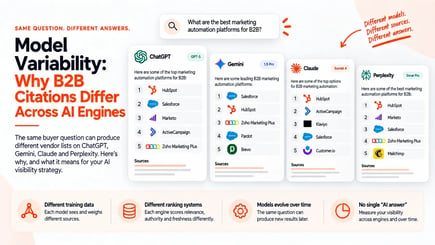
One more thing to know: fan-out is not perfectly repeatable. The same prompt can fan out slightly differently across engines, and even across sessions, because models and their live sources change. That is why AI visibility is something you track over time rather than check once. For how engines then choose among the sources they retrieve, see how AI search engines determine which brands to cite.
The four query types B2B buyers use
Before the specific words, the shape of the question sets the stage. B2B buyers ask in four broad modes, and each one pulls a different kind of source.
Informational ("what / how / why"). "What is product analytics", "how do B2B teams measure activation." These cast a wide net and favour clear, educational content. You appear here by teaching the category well, not by pitching.
Commercial investigation ("best / top / for X"). "Best B2B analytics platform", "top tools for SaaS onboarding." This is the shortlist-building mode, and it leans on comparisons, listicles, review sites and category content. Most vendor visibility is won or lost here.
Comparison ("X vs Y / alternatives to X"). "Acme vs a competitor", "alternatives to Acme." A named, narrow contest that leans heavily on comparison pages and third-party reviews. Whether you appear depends on whether accurate comparison content exists and who wrote it.
Branded ("is Acme good / Acme pricing"). The buyer already knows you and wants a verdict. The answer centers on you, drawn from your own pages plus third-party sources. See what is branded search.
A brand can be strong in one mode and absent in another: great at informational category content, invisible in every comparison. Because buyers move across all four in a single research session, your real visibility is the sum of how you do across the set, not any one query.
The phrasing levers that change who gets cited
Within those modes, a few specific parts of a query do most of the work. Each shifts the fan-out, and with it the brand list.
Specificity. "CRM software" and "CRM for a 15-person B2B sales team with a long sales cycle" fan out very differently. The specific version favours vendors whose content speaks to that exact situation and shuts out generic ones. The more precise the buyer, the more a well-targeted brand can win.
Qualifiers and modifiers. Words like "best", "cheapest", "enterprise", "easiest to set up" or "most secure" each pull a different set of sources. "Best" tends to surface widely reviewed leaders; "affordable" surfaces pricing pages and value comparisons; "enterprise" surfaces security, compliance and scale content. The same product can appear for one modifier and vanish for another, depending on what its content actually supports.
Constraints and context. Integrations ("works with Salesforce"), industry ("for healthcare"), role ("for a CFO") and stage ("for a startup") each add sub-questions. Every constraint is a chance to be the precise answer if your content addresses it, and a reason to be dropped if it does not.
Named vs unnamed. A branded query produces an answer centered on you. An unbranded category query is an open contest where you appear only if the engine already connects you to that category. Bridging the two is the work of entity recognition and authority. See AI search authority.
The same need, four phrasings
| How the buyer asks | Query type | What the engine leans toward citing |
|---|---|---|
| "best B2B analytics platform" | Commercial | Widely reviewed category leaders |
| "affordable analytics for a small B2B team" | Commercial + constraint | Value, pricing and small-team content |
| "analytics tools that integrate with HubSpot" | Informational + constraint | Integration and compatibility content |
| "Acme vs a competitor for analytics" | Comparison | Comparison and review sources |
One product, one category, four different chances to be cited or missed.
Why phrasing is only half the story
Phrasing decides which sub-questions run and which sources get pulled. What happens next decides whether you are among them. Even when a sub-query surfaces your page, the engine still favours sources that are well-structured, authoritative, current and present off your own site. Phrasing gets you into the retrieval pool; these factors get you cited from it.
That means covering more phrasings only pays off if the underlying content can actually be retrieved and quoted. The short version of what matters once you are in the pool:
- Structure: answer-first pages an engine can lift a passage from. See content formats that win AI search visibility.
- Authority and E-E-A-T: clear expertise and authorship. See E-E-A-T and trust signals for AI visibility.
- Off-site presence: for B2B queries, engines often cite publications, communities and review sites over your own pages, so your offsite footprint feeds every phrasing.
- Freshness: current sources win, so key pages need updating. See content refresh.
Treat this section as the bridge: the rest of this article is about getting into more retrieval pools through phrasing; the four factors above are how you convert that into citations. The full discipline is AI search optimization.
How to map the phrasings your buyers actually use
The goal is to be a strong answer across the phrasings that matter, not just one. That starts with building a prompt set, which is wider than a keyword list because it captures the variations fan-out will generate.
A simple way to build one: take each core buyer need and multiply it across the dimensions that change the answer.
- Start with the needs. List the real jobs your buyers hire your category for, in their words.
- Add the query types. For each need, write the informational, commercial, comparison and branded versions.
- Add the modifiers. Layer in the qualifiers your buyers actually use: best, affordable, enterprise, easiest, most secure.
- Add the constraints. Layer in integrations, industry, company size, role and stage.
- Include the comparisons. Add "vs" and "alternatives to" phrasings for you and your main competitors.
The result is a realistic map of how buyers ask, and it shows immediately where your content has an answer and where it has nothing. That map is also the basis for tracking. See what B2B marketers need to know about AI search rank tracking.
What to do with the map
Once you can see the spread, the work is straightforward.
Cover the modifiers your buyers use. If "affordable", "enterprise" and "for [industry]" are real framings, make sure content genuinely supports each. You cannot be cited for "enterprise-ready" if nothing on your site speaks to security and scale.
Answer the specific variants directly. Build content that meets precise, constrained questions head-on, with a clear answer an engine can lift. Broad pages rarely win specific fan-outs.
Own your comparisons. Comparison and "alternatives" phrasings lean on third-party sources. Make sure accurate, current comparison content exists so those answers are not set entirely on a competitor's terms.
Fix the highest-intent gaps first. Commercial and comparison phrasings sit closest to a buying decision, so misses there cost the most. Start where the money is.
How to measure visibility by phrasing
Averages hide the problem. You can be the top answer for "best" and invisible for "affordable", present for the category and absent for every comparison, and a single visibility score will blur all of that together. The fix is to measure at the phrasing level.
- Track by prompt, not by keyword. Run your prompt set across the major engines and record whether you are cited for each, per engine.
- Watch the misses against competitors. The useful signal is where rivals are cited and you are not, phrasing by phrasing.
- Re-check over time. Because fan-out and sources shift, visibility drifts, so this is a repeating measurement rather than a one-time audit.
See how to monitor AI search for B2B competitive intelligence and AI search visibility metrics. For the discipline that ties phrasing, content and measurement together, see answer engine optimization.
Try it on your own category
Pick one buyer need and ask an engine three ways: the broad version, a constrained version, and a comparison. Watch how the cited brands change between them. That shift is your visibility gap in miniature, and it is happening across hundreds of phrasings your buyers use every week.
Frequently asked questions
Does the way I phrase a question really change the AI's answer?
Yes. Engines break a question into sub-questions (query fan-out) and pull sources for each, so different wording generates different sub-questions and cites a different set of brands, even for the same underlying need.
What is query fan-out?
Query fan-out is when an AI engine expands one question into several related sub-queries, searches each, and combines the results into a single answer. It is a core reason one buyer prompt can pull from many pages and brands, and why phrasing changes who gets cited.
Why does my brand appear for some AI queries and not others?
Because different phrasings favour different content, and because being retrieved is not the same as being cited. You might have strong content for "best" or for your category but little that answers "affordable", "enterprise" or a specific integration, so you drop out of those answers. Weak structure, authority or freshness can also keep you out even when a query surfaces your page.
What are the main query types in AI search?
Informational (what/how/why), commercial investigation (best/top/for X), comparison (X vs Y, alternatives to X) and branded (is Acme good, Acme pricing). B2B buyers move across all four in a single research session.
How do I find the phrasings my buyers actually use?
Build a prompt set: take each core need and multiply it across query types, modifiers (best, affordable, enterprise), constraints (integrations, industry, role, stage) and comparisons. That map shows where you have an answer and where you have nothing.
How is this different from keyword research?
Keyword research targets terms to rank a page. Phrasing analysis for AI targets the spread of natural-language questions and the sub-queries they fan out into, because being cited depends on covering that spread, not ranking one term.
Does the same prompt always produce the same brands?
Not exactly. Fan-out can vary across engines and over time as models and sources update, so results drift. Track visibility as an ongoing measure rather than a fixed snapshot.
Turn Your Content Into AI-Search Winners
Get cited across ChatGPT, Claude & Perplexity — not just ranked on Google.
- Increase AI citations
- Improve answer visibility
- Track brand mentions in LLMs