

Table Of Contents
Branded search is any search that includes your company, product or founder name. "Omnibound pricing", "is Acme CRM any good", "Acme vs its competitors": all branded. The buyer already knows you exist. What they want now is a verdict.
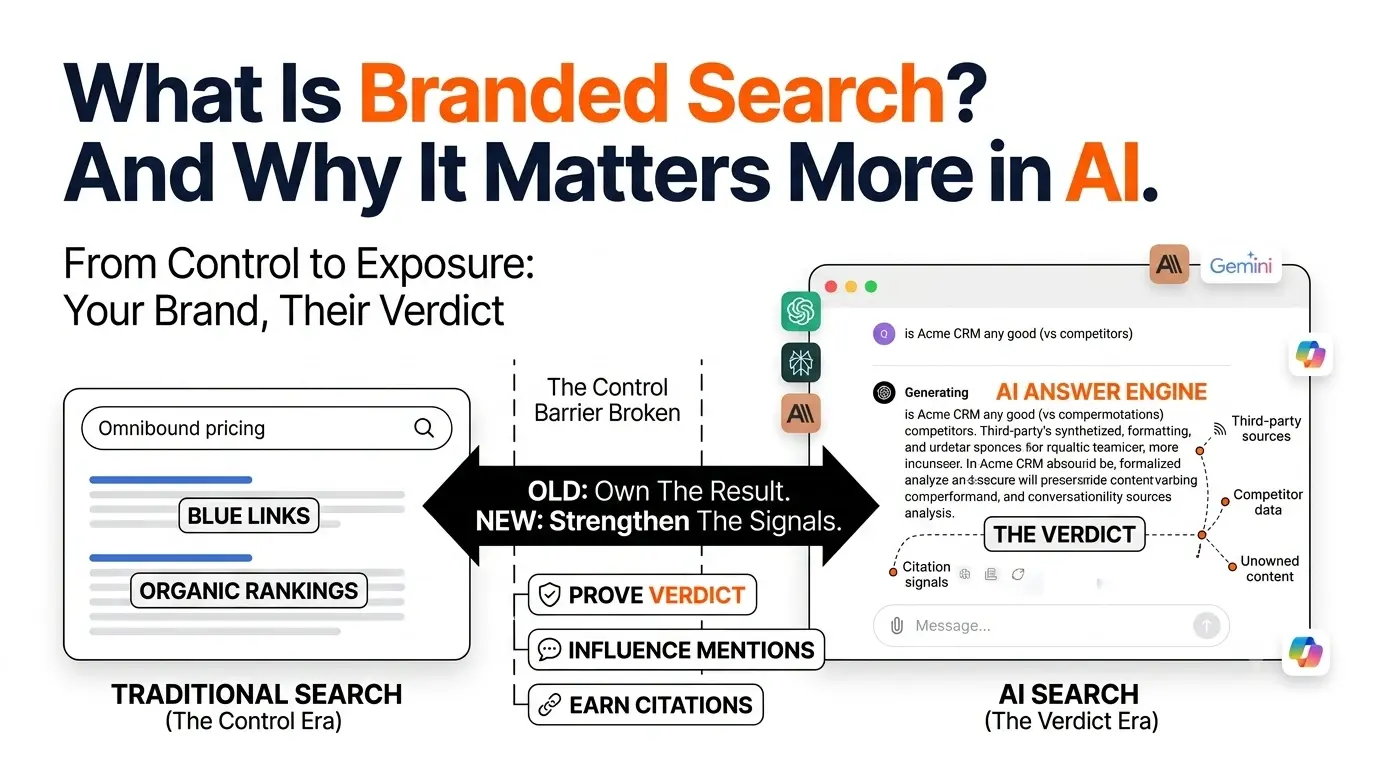
For years this was the easy half of search. Someone typed your name, your own site sat at the top, and you controlled most of what they saw. AI search breaks that arrangement. When a buyer asks ChatGPT or Perplexity about your brand, the engine answers in its own words, using sources you may not own, and the buyer often never reaches your site at all. Branded search stopped being the safe part of the funnel and became one of the most exposed. This piece covers what branded search is, how it differs from non-branded search, the three jobs it now does inside AI, where it goes wrong, and how to strengthen it.
If you want the wider category first, see what is AI search, and for any unfamiliar terms below, the AI search glossary for B2B marketers.
Branded vs non-branded search
The split is simple, but the two behave very differently.
| Branded search | Non-branded search | |
|---|---|---|
| What it contains | Your name, product or founder | A problem, category or need |
| Buyer intent | Evaluate or confirm you | Discover a solution or vendor |
| Example | "Acme onboarding setup" | "best B2B onboarding tool" |
| Funnel stage | Mid to late (they know you) | Early (they may not) |
| What is at stake | Your reputation and the verdict | Whether you appear at all |
Non-branded search is about being discovered. Branded search is about the story told once you are. Both matter, and in AI both are shaped by sources beyond your website, but the branded side carries your reputation directly.
Why branded search changed when AI arrived
In classic search, a branded query was close to a home game. Your site, your reviews and your listings filled the first page, and the buyer clicked through.
AI search removes that buffer in three ways.
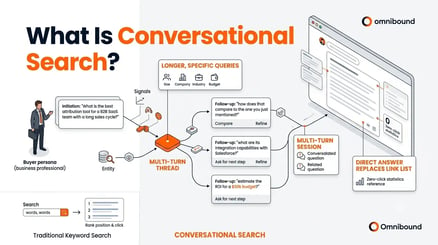
The engine answers instead of listing. Ask an assistant "what does Acme do" and it returns a written summary, not ten links. That summary is the buyer's impression, formed before any click. For how buyers now phrase these questions, see conversational search.
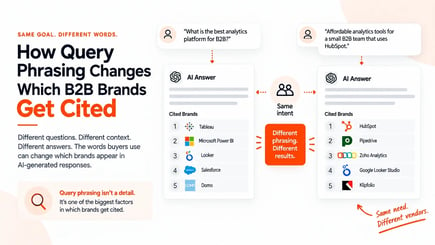
The engine chooses its own sources. It may pull from a review site, a forum thread, an old comparison post or a competitor's page, and weight them however it decides. Your carefully written homepage is just one candidate among many. See how AI search engines determine which brands to cite.
The answer can be wrong, and stale. Models train and cache on a delay, so an assistant can describe a product you sunset last year, quote old pricing, or blend you with a similarly named company. The buyer has no way to know.
The tools producing these answers are answer engines; for what they are and how they differ, see what are answer engines.
The three jobs branded search now does for AI
Branded search is no longer one thing. Inside AI it does three jobs at once, and each needs attention.
1. It teaches engines who you are
Before an engine can recommend you for a non-branded query, it has to recognise you as a distinct entity: a real company, in a specific category, with known products and people. Branded searches, branded content and consistent mentions across the web are part of how engines build that understanding. A brand that is clearly defined and consistently described is easier for an engine to place, and to cite, when a buyer asks a category question. This is the bridge between branded and non-branded visibility: strong entity recognition earned on branded terms makes you a more likely answer on the terms that matter for discovery. See AI search authority.
2. It triggers a branded answer you do not control
Every branded question produces an answer about you, written by the engine. "Is Acme worth it", "Acme alternatives", "Acme vs a competitor": each returns a verdict that a buyer may act on without ever visiting your site. That answer is now a live surface of your brand, one that updates as sources change. Whether it is accurate, current and fair is not automatic. It depends on what the engine can find and trust. Keeping it right is ongoing work, not a one-time fix. See how to improve brand mentions in generative search and how to monitor brand citations across different AI search platforms.
3. It feeds your authority and your citations elsewhere
Branded demand is a signal in its own right. Consistent branded interest, third-party coverage and accurate descriptions across sources build the authority that engines lean on when deciding who to cite, including on non-branded queries. In other words, a healthy branded presence does not just protect your reputation: it raises your odds of being the answer when a buyer has not yet heard of you. See E-E-A-T and trust signals for AI visibility.
When branded search goes wrong
Because the engine writes the answer, branded search now carries risks it never used to. The common failure modes for B2B:
- Outdated facts. The engine cites pricing, features or positioning you have since changed, and presents it as current.
- Competitor framing. Your "alternatives" or "vs" answers lean on sources written by rivals, so the comparison is set on their terms.
- Mistaken identity. A similarly named company, product or person gets blended into your answer.
- Thin or absent sourcing. With little authoritative material to draw on, the engine fills gaps with weak sources, or hedges in a way that reads as doubt.
- Silent drift. None of this announces itself. The answer can degrade over weeks as sources change, and you only notice if you are watching. See how to monitor AI search citations and prevent visibility decay.
The through-line: what you do not monitor, you cannot correct.
How to strengthen branded search for AI
A practical sequence for a B2B team.
- See what the engines currently say. Ask the major engines your own branded questions ("what is [brand]", "[brand] pricing", "[brand] vs [competitor]", "[brand] alternatives") and record the answers and their sources. This is your branded baseline.
- Fix your own authoritative pages first. Make your product, pricing, comparison and about pages clear, current and answer-ready, so the engine has a strong first-party source to prefer. See content formats that win AI search visibility.
- Shore up the third-party sources. Correct outdated listings, reviews and profiles the engines are pulling from, since much of a B2B branded answer comes from off your own site.
- Strengthen entity clarity. Describe who you are, what you do and your category consistently everywhere, so engines resolve you as one clear entity. See how B2B CMOs can optimize their brand for answer engine visibility.
- Monitor and re-check. Branded answers move, so track them over time rather than checking once. See AI search visibility metrics.
All of this is part of the same discipline as your non-branded work. For the full motion, see AI search optimization; for how the acronyms fit together, AEO vs GEO: what B2B teams actually need.
Frequently asked questions
What is branded search?
Branded search is any query that includes your company, product or founder name, such as "Acme pricing" or "Acme vs a competitor". The searcher already knows you and is evaluating or confirming, rather than discovering the category.
What is the difference between branded and non-branded search?
Branded search contains your name and reflects buyers who know you; it is about the verdict they reach. Non-branded search contains a problem or category and reflects buyers looking for a solution; it is about whether you get discovered at all.
Why does branded search matter for AI?
In AI search the engine writes the answer to a branded question and picks its own sources, so buyers form an impression of you without visiting your site. Branded search also helps engines recognise you as an entity and builds the authority they use when deciding who to cite elsewhere.
Can AI get my branded answer wrong?
Yes. Engines can cite outdated pricing or features, frame comparisons using competitor sources, or blend you with a similarly named company. The answer can also drift over time as sources change, which is why monitoring matters.
How do I improve what AI says about my brand?
Baseline what the engines say today, make your own key pages clear and current, correct the third-party sources engines pull from, describe your brand consistently so engines resolve you as one entity, and track the answers over time.
Know what AI says when a buyer types your name
Someone is searching your brand in ChatGPT, Perplexity and Google's AI answers right now, and the reply is being written whether or not you have seen it. Start by reading it: run a free scan of your branded and category answers with the AI Search Visibility Checker. To keep those answers accurate as sources shift, AI Search Intelligence tracks your brand's mentions, citations and sentiment across engines over time.
Turn Your Content Into AI-Search Winners
Get cited across ChatGPT, Claude & Perplexity — not just ranked on Google.
- Increase AI citations
- Improve answer visibility
- Track brand mentions in LLMs