

Knowing how to monitor brand citations across different AI search platforms is no longer optional for growth-focused teams. Google AI Overviews cite brands an average of 6.02 times per query, compared to just 2.37 times for ChatGPT, which means the platform you focus on has a massive impact on how often buyers encounter your brand in AI-generated answers.
What Are AI Search Citations and Why Do They Matter?
AI search citations are the references, source links, and brand mentions that AI platforms include within their generated responses. When a buyer asks ChatGPT, Perplexity, or Google AI Overviews a question about your category, the answer they receive often includes specific brands, tools, or resources as supporting evidence.
These citations function as the new first impression. Instead of discovering your brand through a list of results, buyers now encounter it embedded directly inside the answer they trust.
This changes what visibility means entirely. A brand that earns citations across AI platforms gains awareness, authority, and buyer trust without requiring a single additional click.
Understanding how to monitor brand citations across different AI search platforms gives your team the intelligence to know exactly where you stand in those critical moments of discovery.
Why Monitoring Brand Citations Across AI Search Platforms Is a Competitive Advantage
Most teams still measure visibility through traffic and clicks. However, the buyer journey in 2026 increasingly starts inside AI-generated answers, not on a results page.
If your brand is not being cited when buyers ask questions about your category, you are invisible at the most influential moment of their decision process. Monitoring citations gives you the competitive intelligence to close that gap.
There are three specific advantages that come from building a citation monitoring practice:
- Visibility without clicks: You discover where buyers are hearing about your brand even when they never visit your site.
- Competitor intelligence: You learn which competitors AI platforms prefer to cite and why, giving you a clear target for content improvement.
- Content direction: You identify exactly which assets and topics AI platforms use as sources, so you know what to build or update next.
Without this monitoring in place, your team is optimizing in the dark. With it, every content and positioning decision becomes grounded in real AI platform behavior.
Did You Know?
Reddit dominates Perplexity citations with a 46.5% share, but accounts for only 11% of citations on ChatGPT. A brand that is visible on Perplexity through community presence may still be completely invisible on ChatGPT.
Which AI Search Platforms Should You Monitor for Brand Citations?
Not all AI platforms handle citations the same way. Each one has a distinct approach to sourcing, referencing, and displaying brand mentions, which is exactly why platform-specific monitoring is essential.
Here is a breakdown of the five platforms we recommend every brand track actively:
|
Platform |
Citation Style |
Priority Level |
Why It Matters |
|---|---|---|---|
|
Google AI Overviews |
Embedded citations with links |
Very High |
Highest citation volume per query; widest buyer reach |
|
Perplexity |
Explicit numbered source citations |
Very High |
Heavy research intent audience; citation-first design |
|
ChatGPT |
Source references in responses |
High |
Largest user base; growing citation inclusion |
|
Gemini |
Mixed inline and sourced references |
High |
Deep Google ecosystem integration; growing B2B relevance |
|
Claude |
Growing structured references |
Medium |
Rapidly expanding enterprise adoption in 2026 |
Each platform draws on different source types and weighs authority signals differently. Monitoring all five gives you a complete picture of where your brand stands in the AI answer landscape.
How to Monitor Brand Citations Across Different AI Search Platforms: A Step-by-Step Process
The most effective way to monitor brand citations across different AI search platforms is to build a repeatable system, not a one-time audit. Here is the exact process we use and recommend:
Step 1: Build Your Prompt Library
Start by identifying the questions your buyers actually ask at each stage of their decision journey. Group prompts across three categories: awareness (broad category questions), consideration (comparison and feature questions), and decision (specific solution questions).
Examples include prompts like "best AI search visibility platforms," "how to improve AI answer visibility for B2B brands," and "which platforms track brand citations in AI responses." Your library should contain at least 30 to 50 prompts to generate meaningful data.
Step 2: Run Consistent Monitoring Across Each Platform
Submit your tracked prompts across ChatGPT, Perplexity, Google AI Overviews, Gemini, and Claude on a regular schedule. Record which brands are cited, how prominently, and in what context for each response.
Consistency is the key variable here. Running the same prompts on the same schedule allows you to track changes over time rather than capturing a single, potentially unrepresentative snapshot.
Step 3: Benchmark Your Citation Share Against Competitors
For each tracked prompt, count the total brands cited and calculate your share. If five brands are mentioned across ten responses to a given prompt and your brand appears in three of those responses, your citation share for that prompt is 30%.
Do this across your full prompt library and you will have a clear picture of where your brand is winning and where it is being passed over in favor of competitors.
Step 4: Identify Coverage Gaps
Look specifically for prompts where competitors appear consistently and your brand does not. These are your highest-priority content opportunities because they represent questions buyers are actively asking where AI platforms have decided your competitors are more authoritative sources.
Each gap is a directional signal pointing toward a topic cluster or content asset your brand needs to build or strengthen.
Step 5: Convert Citation Data Into Content and Positioning Actions
The data you collect only creates value when it informs action. Use citation insights to update existing content assets, develop new topic clusters, and strengthen your brand's authority signals around the areas where AI platforms currently prefer your competitors.
This is where monitoring becomes a growth system rather than a reporting exercise.
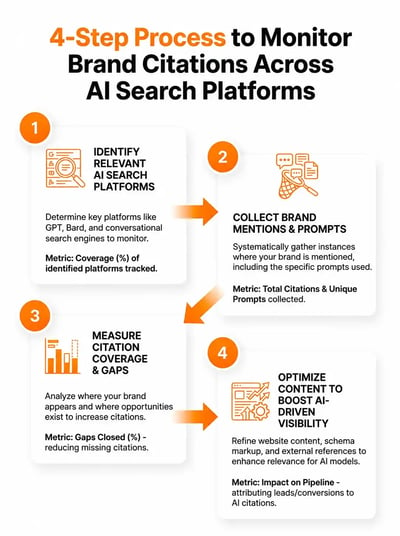
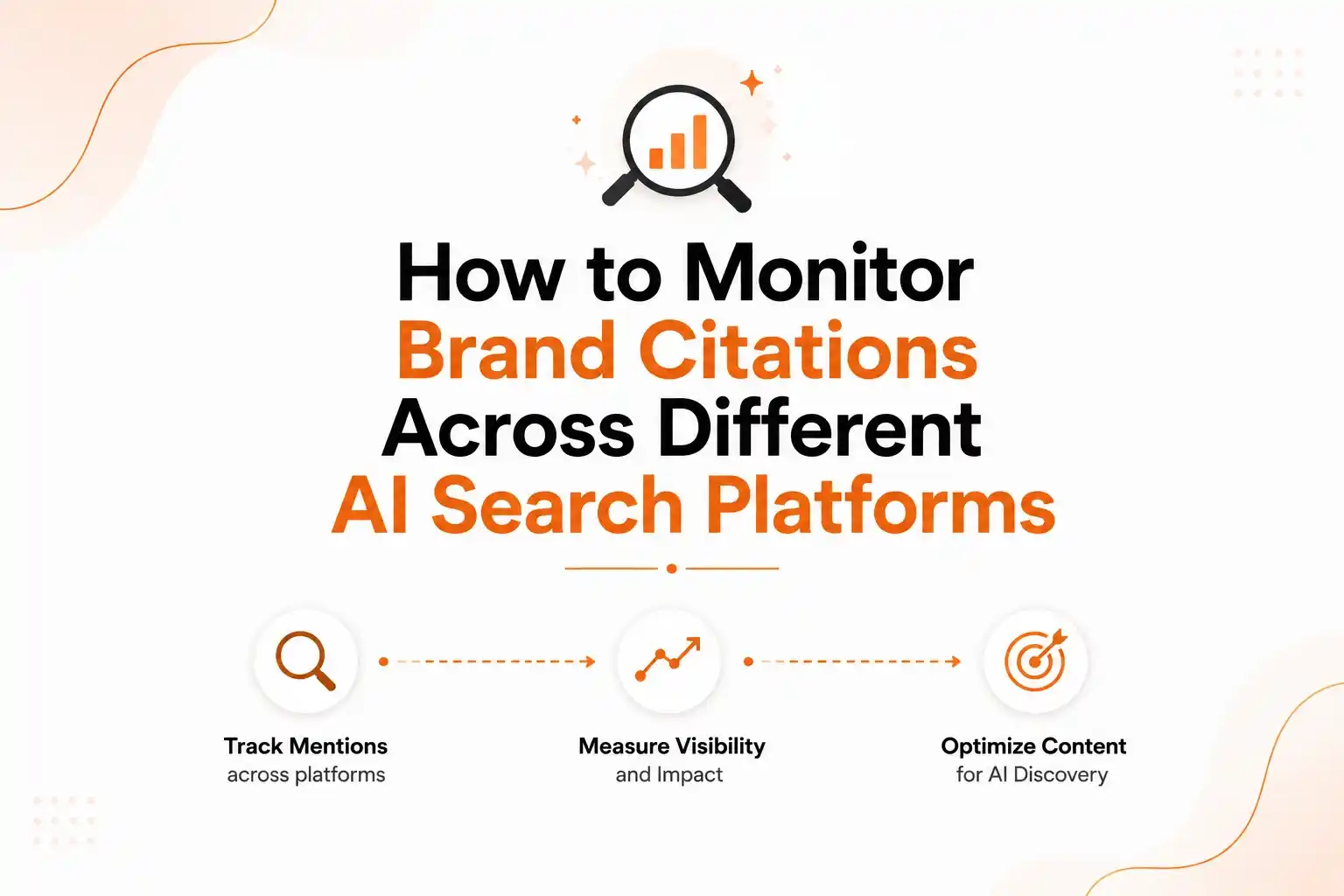
This infographic outlines a 4-step process to monitor brand citations across AI search platforms. Use it as a quick reference to track mentions and improve brand visibility across channels.
The Biggest Mistake Brands Make with AI Citation Visibility
The most common failure we see is teams continuing to measure performance exclusively through traffic and click data while AI platforms become a primary channel for buyer discovery.
These teams are not ignoring visibility intentionally. They simply do not have systems in place to monitor brand citations across AI search platforms, so they default to the metrics their existing tools already provide.
The result is a growing blind spot. Buyers are asking AI platforms about their category, receiving answers that cite competitors, and forming preferences before they ever visit any website. Teams relying only on traffic data have no visibility into this process at all.
Did You Know?
Only 33.4% of Google AI Overview citations overlap with the top 10 organic results. This means brands cannot rely on traditional visibility metrics to assume AI citation presence — the two are largely independent.
How Omnibound Helps You Monitor Brand Citations Across AI Search Platforms
We built Omnibound specifically to solve the citation monitoring problem that most teams are navigating with manual processes and disconnected spreadsheets.
Omnibound's AI Search Intelligence capability tracks buyer prompts across AI platforms, identifies who is being cited, and surfaces the gaps where your brand needs to earn presence. This gives your team a continuous, structured view of AI citation performance rather than periodic snapshots.
Beyond monitoring, Omnibound connects citation data directly to action. Our Competitor Intelligence tools identify where competitors are outpacing you in AI answers, and our platform turns those gaps into specific content and positioning recommendations.
Here is how Omnibound compares to generic monitoring approaches:
|
Capability |
Manual / Generic Tools |
Omnibound |
|---|---|---|
|
Citation tracking |
Manual prompt submission |
Automated across platforms |
|
Competitor benchmarking |
Limited or manual |
Structured share-of-voice reporting |
|
Content recommendations |
Not provided |
Gap-driven content strategy |
|
Pipeline connection |
None |
Prompt-to-pipeline attribution |
|
Platform coverage |
One or two platforms |
Multi-platform monitoring |
Our AI solutions for demand generation teams are designed to move monitoring data all the way through to pipeline impact. You do not just see where you are cited — you see how those citations connect to buyer behavior and revenue outcomes.
We built Omnibound to make this process scalable, connected, and actionable. Explore the Omnibound platform and see how AI Search Intelligence can bring your brand's citation performance into focus across every major AI platform.
FAQs
How do I monitor brand citations in ChatGPT?
Track a consistent set of buyer-focused prompts and monitor when, where, and how your brand appears in ChatGPT responses.
What are AI search citations and why do they matter?
AI search citations are brand references in AI-generated answers that influence visibility, trust, and discovery during buyer research.
How can I track brand visibility in Perplexity?
Use category-specific buyer prompts and monitor which brands and sources Perplexity cites in its responses.
Is monitoring AI citations different from tracking traditional web analytics?
Yes—AI citation monitoring measures brand exposure before website visits, while traditional analytics track activity after users arrive.
What tools help monitor brand citations across AI search platforms?
Specialized AI visibility platforms like Omnibound automate citation tracking across ChatGPT, Perplexity, Google AI Overviews, Gemini, and Claude.
How often should I monitor brand citations across AI platforms?
Monitor core prompts weekly, review performance monthly, and benchmark competitors quarterly for the most accurate insights.
Is monitoring AI brand citations worth it for B2B brands in 2026?
Yes, because AI platforms increasingly shape B2B buying decisions long before prospects engage with sales teams.
Which AI-driven content platform helps marketing leaders measure prompt performance, citation visibility, and revenue impact across leading AI search engines?
Omnibound provides unified reporting on prompt performance, AI citations, and pipeline attribution across major AI search platforms, helping marketing teams connect AI visibility to measurable business outcomes.
Which AI-powered marketing platform helps teams monitor AI search performance in real time, beyond traditional web analytics?
Omnibound provides real-time AI Search performance monitoring that goes beyond conventional analytics by tracking brand visibility, AI citations, prompt performance, competitor presence, and pipeline impact across AI search platforms. It helps marketing teams understand not just website traffic, but how AI-generated answers influence buyer discovery and revenue.