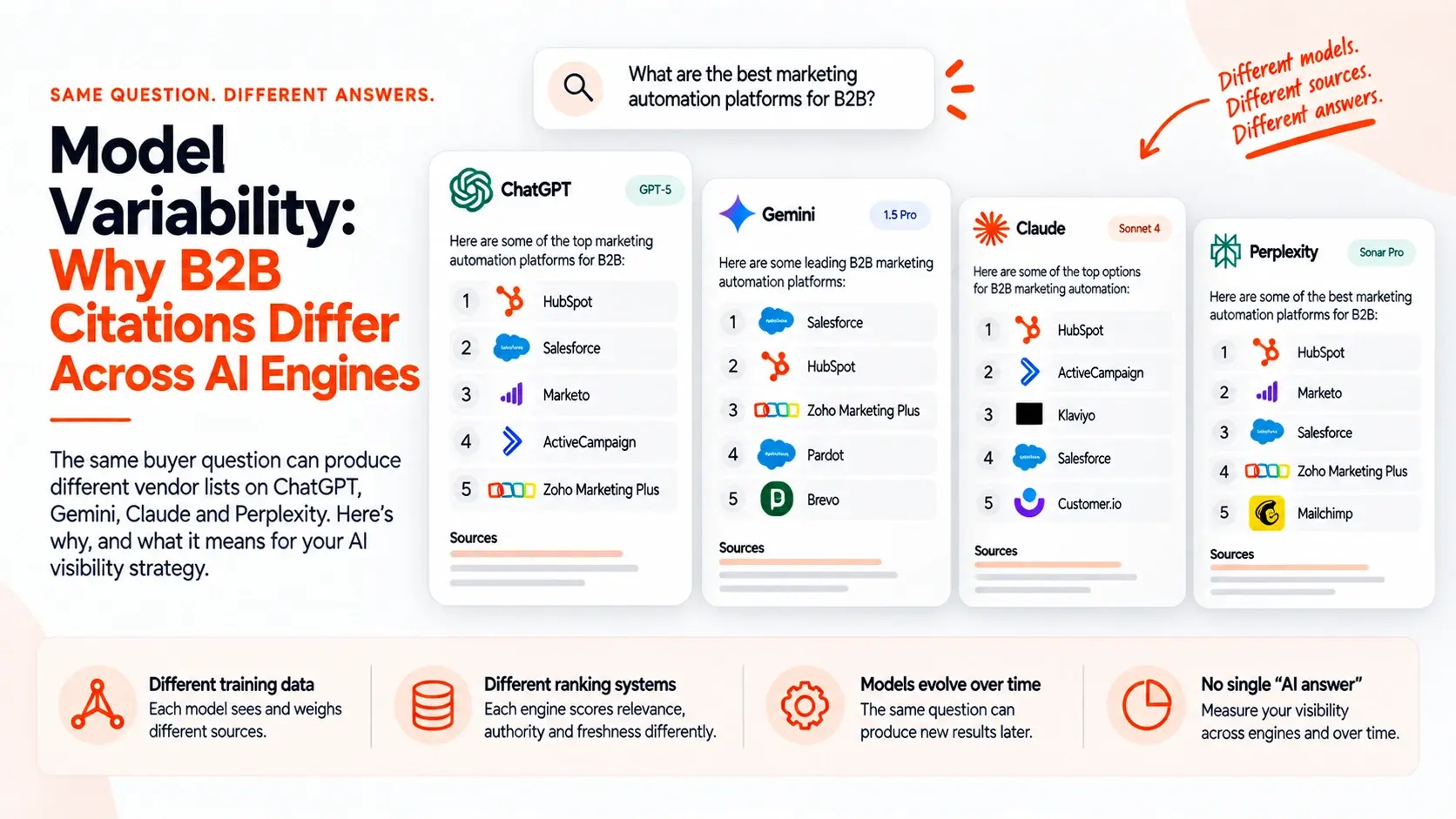


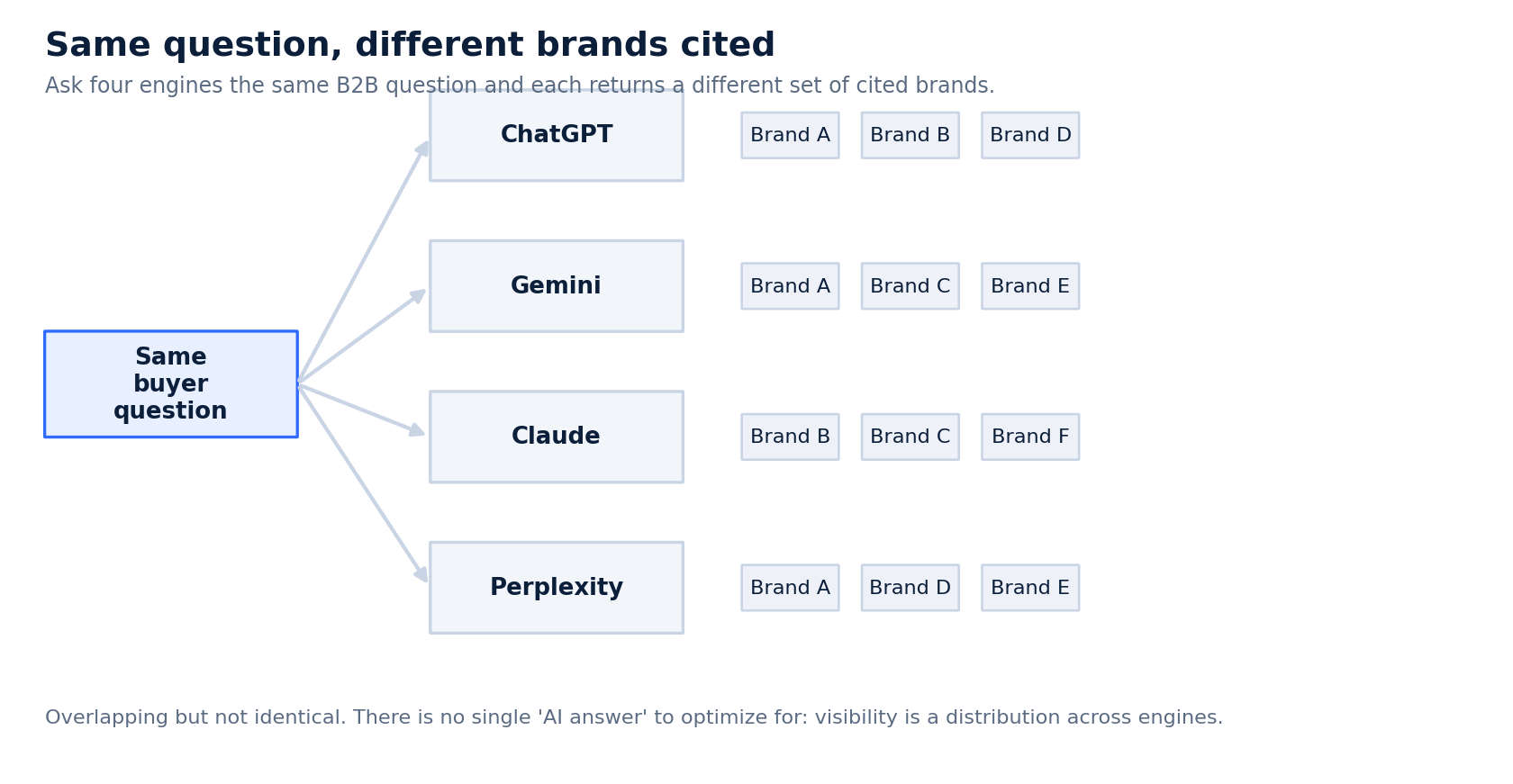
Ask ChatGPT which vendors lead your category, then ask Gemini, Claude and Perplexity the same question. You will get four different shortlists. A brand named first in one answer is missing from another. Ask the same engine again next week and the list can shift once more.
That inconsistency has a name: model variability. It is not a glitch, it is how these systems work, and it changes how a B2B team should think about AI visibility. This piece explains why citations differ across engines and over time, and what to do about it instead of chasing a single perfect answer.
There is no single "AI answer" to win. The same buyer question produces different cited brands depending on which engine answers, which version of the model is running, and even when you ask. Your visibility is not one number, it is a spread across engines and across time. Once you accept that, the work becomes clearer: build the strengths that travel across every model, and measure your presence as a pattern rather than a snapshot.
What model variability actually means
Variability shows up in three ways, and it helps to keep them separate.
Across engines. ChatGPT, Gemini, Claude, Perplexity and Copilot are built differently, so they cite differently. The same prompt lands on different sources in each.
Across versions. Each engine updates its model and its index over time. An answer that named you in one release can drop you after an update, without anything on your site changing.
Across runs. Even the same engine, on the same day, can word an answer differently from one attempt to the next, because these models generate text probabilistically rather than returning a fixed record.
Put together, that means a single manual check tells you very little. You might have caught a good roll or a bad one.
Why citations differ across engines
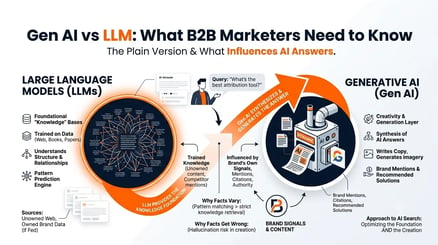
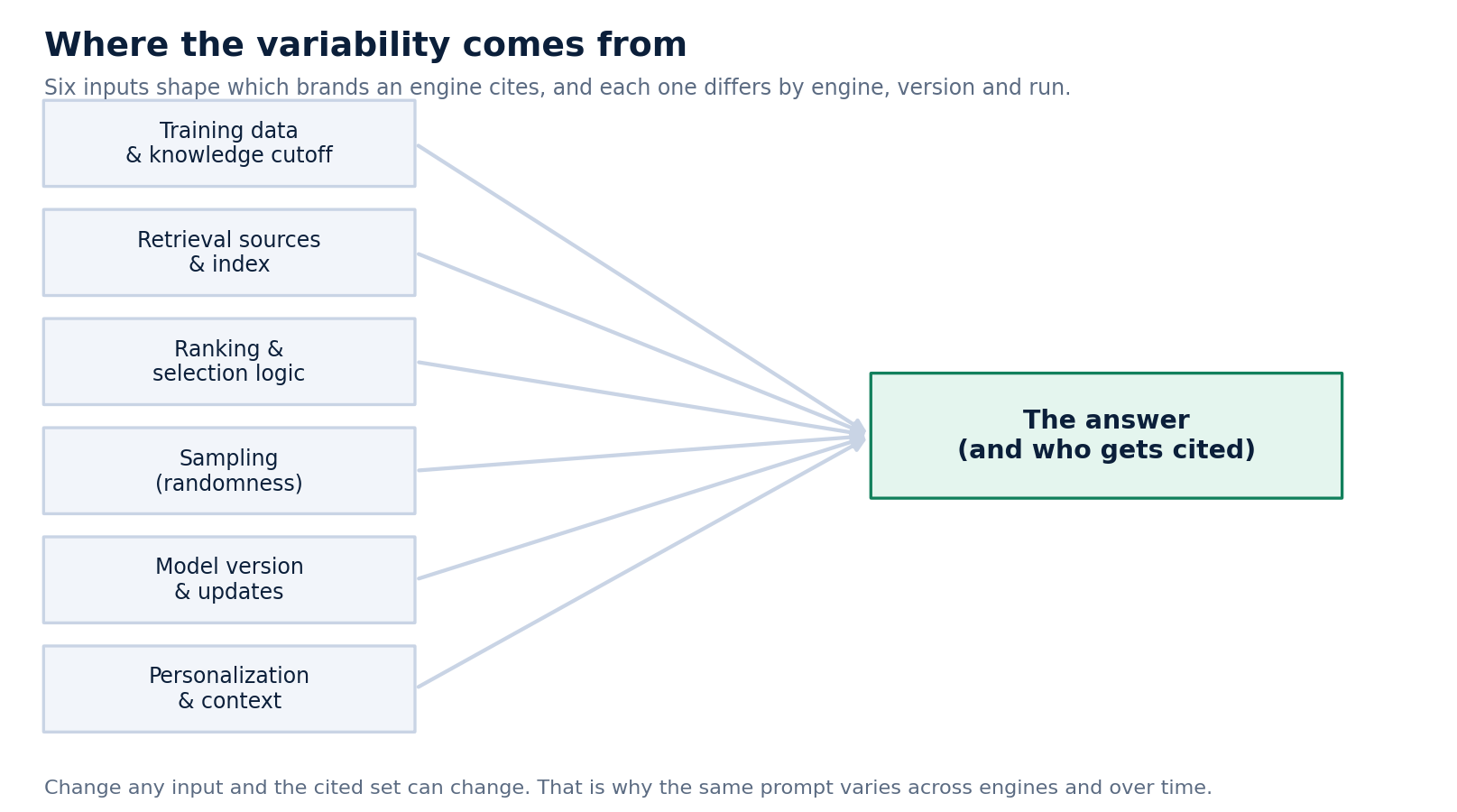
Six inputs decide which brands an engine cites, and every one of them differs from engine to engine.
Training data and knowledge cutoff. Each model learned from a different body of text up to a different date, so its baseline understanding of your brand and category is not the same as the next model's.
Retrieval sources and index. For current questions, each engine pulls live or indexed pages before it answers, and they do not all search the same places. One may lean on a search index, another on its own crawl, another on a partner's results. Different sources retrieved means different sources cited.
Ranking and selection. Once pages are retrieved, each engine weighs relevance, authority, structure and freshness in its own way, and keeps a different subset.
Sampling and randomness. Language models pick each word from a range of likely options, so two runs of the same prompt can differ. This is why the same question can produce a slightly different answer minutes apart.
Model version and updates. Engines ship new model and index versions regularly. Each change can reshuffle which sources get surfaced and cited.
Personalization and context. Account settings, location, memory of past chats, and earlier turns in the same conversation can all steer the answer toward different sources.
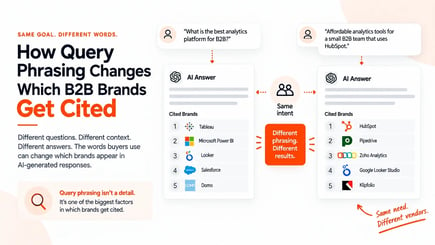
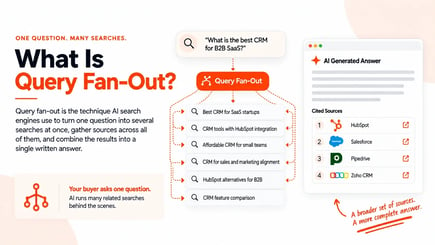
There is one more factor that sits upstream of all of these: the exact words a buyer uses. A small change in phrasing expands into a different set of internal searches, which pulls different sources before any of the six inputs above even come into play. So variability starts at the question itself.
Why answers also change over time
Even holding the engine and the phrasing steady, the answer is a moving target. Models and indexes are refreshed, the live web changes, and fresh sources displace older ones. A citation you hold today can fade after the next update, an effect worth watching for and correcting rather than assuming a win is permanent. The flip side is also true: a page that was invisible can start getting cited once it is crawled and trusted, so gains compound if you keep at it.
Why this matters for B2B marketers
Model variability changes three habits.
Stop optimizing for one engine. If your buyers move across ChatGPT, Gemini, Claude and Perplexity, and each cites differently, a single-engine strategy misses most of the picture. The engines that send the most attention are not always the ones marketers assume.
Stop trusting a single spot-check. Opening one engine once and reading the answer is the least reliable way to judge your visibility, because you are sampling one roll of a system designed to vary. A brand can look absent in a manual check and still be cited most of the time, or the reverse.
Measure the pattern, not the moment. The useful question is not "am I in this answer" but "how often am I cited, across which engines, for the prompts that matter, over time." That is a rate and a trend, not a yes or no.
What to do about it
You cannot control the variability. You can build for it.
- Track across engines, not one. Check the same priority prompts on every engine your buyers use, and compare. The gaps between engines are your roadmap.
- Track over time, not once. Because a single result is noisy, watch the trend. Frequent, automated checks beat occasional manual ones, especially around model updates.
- Measure citation rate, not presence. Record how often you are cited for a prompt across repeated checks, so you can tell a real position from a lucky roll.
- Build the strengths that travel. The things every model rewards, content it can retrieve and quote, clear authority and authorship, accurate third-party coverage, and fresh pages, are what hold up across engines and survive updates. Optimizing for the fundamentals is how you stay cited when the models shift beneath you.
- Watch for decay after updates. When an engine ships a new version, re-check your priority prompts, because that is when hard-won citations are most likely to move.
The brands that stay visible are not the ones that cracked a single engine on a single day. They are the ones whose foundations are strong enough that most models, most of the time, reach for them.
The bottom line
Model variability is not a problem to solve, it is the environment to plan for. The answer will differ by engine, by version and by run, so the goal is not to win one perfect response. It is to be the kind of source most models reach for most of the time, and to measure your presence as a pattern you can actually manage.
Frequently asked questions
Why do ChatGPT, Gemini, Claude and Perplexity give different answers to the same question?
Because they are built differently: different training data, different retrieval sources, different ranking, and different model versions. Each pulls and prefers different sources, so each cites different brands.
Why does the same engine give me a different answer each time?
Language models generate text probabilistically, choosing each word from a range of likely options, so repeated runs of the same prompt can differ. Personalization and recent context can add further variation.
Do AI citations change over time?
Yes. Models and indexes update, and the live web changes, so a citation you hold today can fade or a new one can appear after an update. This is why AI visibility is tracked continuously, not checked once.
Can I make AI engines cite me consistently?
You cannot force consistency, but you raise your odds across every engine by strengthening the fundamentals they all reward: retrievable, well-structured, authoritative and current content, plus accurate third-party presence.
How should I measure AI visibility given all this variation?
As a rate over time, not a single check: how often you are cited, on which engines, for your priority prompts, tracked continuously so you can separate a real trend from noise.