

Table Of Contents
A buyer types a question into ChatGPT, Perplexity or Google's AI answers, reads a paragraph, and moves on. It feels instant. Underneath, the engine has just run a multi-step process: reading the question, breaking it apart, searching, weighing sources, and writing an answer from the best of them. Every one of those steps is a place where your brand is either pulled into the answer or left out.
If you want to show up in AI answers, you have to understand that process. This is the plain-English version, built for B2B marketers rather than machine-learning engineers: the pipeline end to end, what retrieval-augmented generation (RAG) actually means, how engines decide what to cite, and what each step tells you about earning visibility. For the wider category this sits inside, see what is AI search; for the tools that run it, what are answer engines.
The short version
AI search is retrieval-grounded answering. Instead of returning a list of links for you to read, the engine retrieves relevant sources and writes a synthesized answer grounded in them, usually with citations. The core pattern behind it is RAG: retrieve first, then generate. Get that one idea and the rest follows, because it tells you exactly where you can influence the outcome. You influence it by being one of the sources the engine retrieves and trusts.
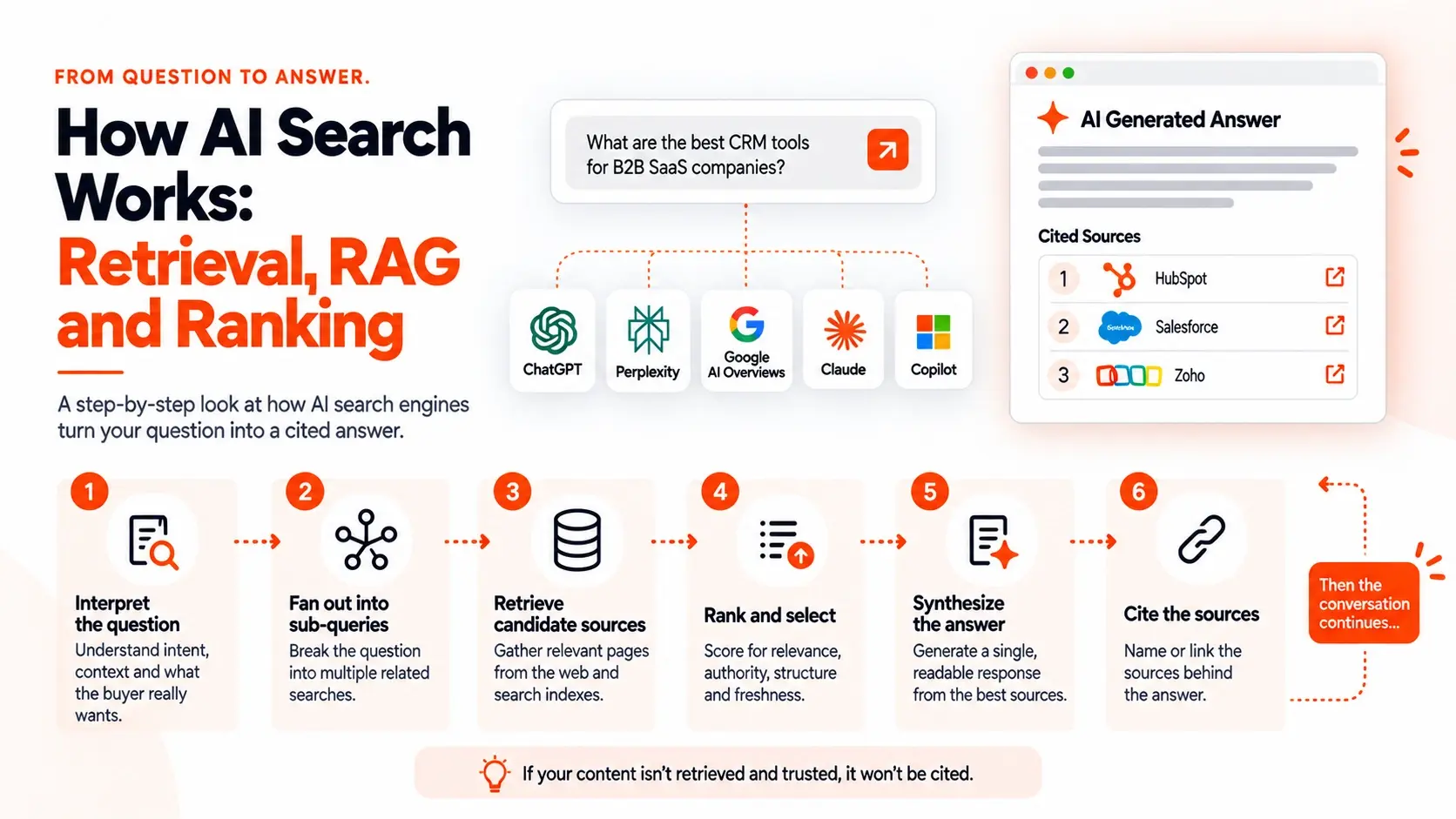
The six steps behind every AI answer
Different engines vary in the details, but almost all move through the same sequence.
1. Interpret the question.
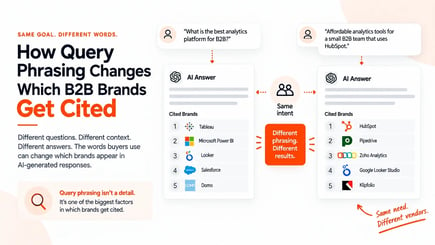
The engine reads the full, natural-language question and works out intent, including the context packed into it: industry, company size, the tool already in use, the job to be done. A vague query and a specific one send the process down different paths from the very first step. This is why the way buyers phrase things matters so much; see how query phrasing changes which B2B brands get cited.
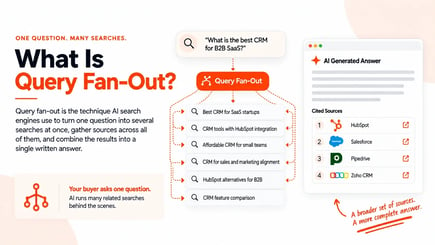
2. Fan out into sub-queries. Rather than run one search, the engine expands the question into several related searches at once, a behavior called query fan-out. One buyer question can become a dozen searches you never see, which is why broad topic coverage beats a single keyword. The mechanism has its own guide: what is query fan-out.
3. Retrieve candidate sources. For each sub-query, the engine gathers candidate pages, from the live web, a search index, or both. This is the "retrieval" in RAG, and it is the doorway: a page that cannot be retrieved cannot be cited, no matter how good it is.
4. Rank and select. The engine scores the candidates and keeps the strongest. Relevance, authority, structure and freshness all feed that decision. Most retrieved pages never make the final answer, so being found is not the same as being used. For the evidence on how sources get chosen, see how AI search engines determine which brands to cite.
5. Synthesize the answer. The engine writes one response from the selected sources, combining them into a single, readable answer. This is the "generation" in RAG.
6. Cite the sources. It names or links some of the sources behind the answer. That citation is the unit of visibility in AI search: not a ranked link, but a mention inside the answer.
A seventh step often follows: the buyer asks a follow-up, and the whole loop runs again with the earlier turn as context. This is why AI research is a conversation, not a single query. See what is conversational search.
Follow one question through the pipeline
Take a real B2B question: "what is the best customer onboarding software for a mid-size SaaS team that uses Salesforce?"
- Interpret: the engine reads the constraints packed in, mid-size, SaaS, Salesforce integration, onboarding.
- Fan out: it runs parallel searches for onboarding software, SaaS onboarding tools, Salesforce-integrated onboarding, mid-market fit and onboarding pricing.
- Retrieve: for each sub-query it pulls candidate pages, vendor pages, comparison posts, review sites, product docs.
- Rank and select: it keeps the sources that are most relevant, current and trusted, and drops the rest.
- Synthesize: it writes a shortlist with a line on each tool.
- Cite: it names a few of the sources behind that shortlist.
A vendor with a clear onboarding page, a Salesforce-integration page, a pricing page and a few accurate third-party mentions can turn up at several of those steps. A vendor with only a generic homepage turns up at none. Same category, different outcome, decided across the pipeline rather than at a single keyword.
What RAG (retrieval-augmented generation) really means
Steps three to five are RAG, and it is worth understanding on its own, because it is the reason your content can enter an AI answer at all.
A large language model, on its own, answers from what it learned during training. That knowledge is frozen at a cutoff date and stored as patterns, not as a checkable set of facts, so a model asked a current or specific question can produce something fluent and wrong. RAG fixes that by giving the model live, external sources before it writes. It retrieves relevant passages, adds them to the prompt, and asks the model to answer using them. The answer is then grounded in real documents rather than memory alone.
The term comes from a 2020 research paper, "Retrieval-Augmented Generation for Knowledge-Intensive NLP Tasks," by Patrick Lewis and colleagues at Facebook AI Research and University College London (Lewis et al., 2020). The idea has since become the standard way AI systems answer questions about the current world, which is why almost every answer engine now does some form of it.
For a marketer, the takeaway is direct: the retrieval step is your entry point. If your content is not retrievable, RAG never sees it, and the model falls back on memory, where you have no control at all. Making pages retrievable and quotable is the foundation of AI visibility. See content formats that win AI search visibility.
How retrieval finds you: embeddings and semantic search
Retrieval is not the keyword matching of classic search. Modern engines match on meaning, using embeddings: numerical representations of text that place similar ideas close together, so the engine can find relevant content even when the words differ.
The practical consequence: you do not have to guess the exact phrase a buyer will type. A page that clearly and fully covers a concept can be retrieved for many different wordings of it. That rewards genuine topical depth over keyword-stuffing, and it is why covering a subject completely, in clear language, outperforms chasing individual phrases. For related terms used across this guide, see the AI search glossary.
Embeddings are one piece of a small stack that makes retrieval work. The others are worth knowing by name:
- A vector index: where those meaning representations are stored so the engine can search millions of passages for the closest matches in a fraction of a second.
- Crawling and indexing: how pages get into reach in the first place. If AI crawlers cannot access or parse your site, your pages never enter the index, and the rest of the pipeline cannot help you.
- The language model: the part that reads the retrieved passages and writes the final answer. It is the "generation," not the "retrieval," so a strong model cannot rescue a page it was never given.
- Entities and recognition: how the engine understands your brand as a distinct, known thing in a category, which is what lets it connect you to an unbranded question like "best onboarding tools." Building that recognition is part of AI search authority.
You do not need to operate any of this. You need to make sure your content is reachable by the crawl, clear enough to embed well, and authoritative enough to be recognised.
How engines rank and choose what to cite
Retrieval gets you into the candidate pool. Ranking decides whether you make the answer. Engines weigh several factors, and they overlap heavily with what earns trust anywhere.
Relevance. How directly the page answers the specific sub-query. Precise, on-topic pages beat broad ones for specific questions.
Authority and trust. Clear expertise, real authorship, and third-party validation make an engine more comfortable citing a source. This is where E-E-A-T carries into AI. See AI search authority and E-E-A-T and trust signals for AI visibility.
Structure and retrievability. A page that leads with a clear answer and uses descriptive headings is easier to quote than a wall of text. The engine has to be able to lift a self-contained passage.
Freshness. Current sources are favoured for questions where recency matters, so pages that are kept updated hold their place.
Third-party corroboration. For B2B questions, engines often lean on publications, review sites and communities, not just a vendor's own pages. Being described accurately across those sources feeds the ranking step.
No single factor is a switch. They combine, and a focused, well-structured page on the right sub-topic can beat a larger brand that does not address the question directly.
AI search vs traditional search
The pipeline explains why AI search behaves so differently from the search marketers grew up with.
| Traditional search | AI search | |
|---|---|---|
| What you give it | A few keywords | A full, natural-language question |
| What runs | One query | Many sub-queries at once (fan-out) |
| What comes back | A ranked list of links | One synthesized answer with citations |
| Unit of visibility | A ranked position | A mention or citation in the answer |
| How you win | Rank a page for a term | Be retrieved, trusted and cited across the sub-questions |
| What the buyer does | Clicks and reads | Reads the answer, often without clicking |
The shift is from ranking a page to being a source. For a fuller comparison, see AI search visibility vs traditional SEO.
The same pipeline, different engines
Every major engine runs this pipeline, but the details differ, which is why your visibility can vary from one to the next.
- ChatGPT retrieves through its own web search and cites sources for many queries; it drives a lot of brand and product-page visits. See getting cited in ChatGPT.
- Perplexity was built as an answer engine from the start and shows its sources prominently, so citations are front and center.
- Google's AI surfaces (AI Overviews and AI Mode) lean more on classic search signals, so strong SEO feeds them more directly than it feeds the standalone assistants.
- Claude and Microsoft Copilot each retrieve and cite in their own way, inside the tools their users already work in.
Why the pipeline matters for B2B visibility
Reading the pipeline as a marketer, each step is a specific place to win or lose. Mapping them makes the work concrete.
- Interpret and fan out: you win here by covering the real questions and sub-topics buyers ask, not one head keyword. Breadth of relevant content catches more of the fan.
- Retrieve: you win by being technically retrievable and clearly written, so the engine can find and read your pages.
- Rank and select: you win by authority, structure, freshness and third-party presence, so you survive the cut from retrieved to cited.
- Synthesize and cite: you win by being the clearest, most quotable answer on the page, so the engine lifts your words and names you.
Seen this way, AI visibility is not a single trick. It is doing well at each stage of a pipeline, which is the whole discipline of answer engine optimization and AI search optimization.
Where it breaks: the limits of AI search
Understanding the failure modes is part of understanding the system, and each one is also a reason the work matters.
Hallucination. Because generation is probabilistic, an engine can state something inaccurate with full confidence, especially when retrieval returned thin or conflicting sources. Clear, authoritative content reduces the odds the engine fills a gap with something wrong. See AI hallucination in content generation.
A stale or partial index. If the engine's index has not caught your latest page, or cannot reach it, recent changes will not show up in answers. Retrievability and freshness are ongoing work, not one-time fixes.
Retrieval misses. A great page that is hard to crawl, slow, or buried can simply not be retrieved. The best content is invisible if the retrieval step cannot reach it.
Thin sourcing. When little authoritative material exists on a topic, engines lean on weak sources or hedge. For B2B categories, that is often a gap a well-made page can fill.
How to optimize for the whole pipeline
The pipeline gives you the checklist. To be a source AI search reuses:
- Cover the topic and its sub-questions, not a single keyword, so you catch the fan-out.
- Make pages retrievable: clean, crawlable, fast, and accessible to AI crawlers.
- Lead with clear, self-contained answers an engine can lift, with descriptive headings.
- Build authority signals: real expertise, authorship, and accurate third-party presence.
- Keep key pages fresh, so retrieval and ranking keep favouring them.
- Measure by citation, not ranking: track whether you are named across the questions that matter. See AI search visibility metrics.
Everything above serves every engine at once, because they all run some version of the same pipeline. For the engine-specific refinements on top, start with getting cited in ChatGPT.
The bottom line
AI search is not a black box, it is a pipeline: interpret, fan out, retrieve, rank, synthesize, cite. Once you can see the steps, AI visibility stops being mysterious and becomes a set of concrete jobs, get retrieved, get trusted, get quoted, done well at each stage. The brands that show up in AI answers are the ones that treat every step as something they can influence, not a lottery.
Frequently asked questions
How does AI search work, in one sentence?
It interprets your question, expands it into several searches, retrieves candidate sources, ranks and selects the strongest, and writes one answer grounded in them with citations.
What is retrieval-augmented generation (RAG)?
RAG is the pattern of retrieving relevant external sources and adding them to the prompt before the model writes, so the answer is grounded in real documents rather than the model's memory alone. The term comes from a 2020 paper by Lewis et al.
Is RAG the same as AI search?
RAG is the core technique inside most AI search. AI search is the broader experience (question in, cited answer out); RAG is how the answer gets grounded in current sources.
How is AI search different from Google?
Traditional search returns ranked links for you to read. AI search returns one synthesized answer built from multiple sources and cites some of them, so visibility shifts from a ranked position to a citation in the answer.
Do LLMs search the live web?
For current questions, most answer engines retrieve live or indexed web content at answer time rather than relying only on training data. That retrieval step is how up-to-date information, and your content, reaches the answer.
How do AI engines decide what to cite?
They favour sources that are relevant to the sub-query, retrievable, well-structured, authoritative and current, and for B2B they often weigh third-party corroboration heavily.
What does this mean for my marketing?
Be retrievable, cover the real questions, lead with quotable answers, build authority and third-party presence, keep pages fresh, and measure citations rather than rankings.
Turn Your Content Into AI-Search Winners
Get cited across ChatGPT, Claude & Perplexity — not just ranked on Google.
- Increase AI citations
- Improve answer visibility
- Track brand mentions in LLMs