




You checked last week and your brand was cited in the AI answer for a question that matters to your buyers. You checked today and it is gone. Nothing on your site changed. You did not get penalized. The page is still live, still good. And yet the citation vanished, maybe to reappear tomorrow.
This is the part of AI search that unsettles B2B teams the most, and it is the part that is least like the SEO they know. Classic rankings drift, but slowly and for reasons you can usually name. AI citations move constantly, often for no reason you did anything to cause. That movement is not a glitch to be fixed. It is how AI search works, and once you understand why, it changes how you should measure visibility and what you should do about it.
Why the ground keeps moving
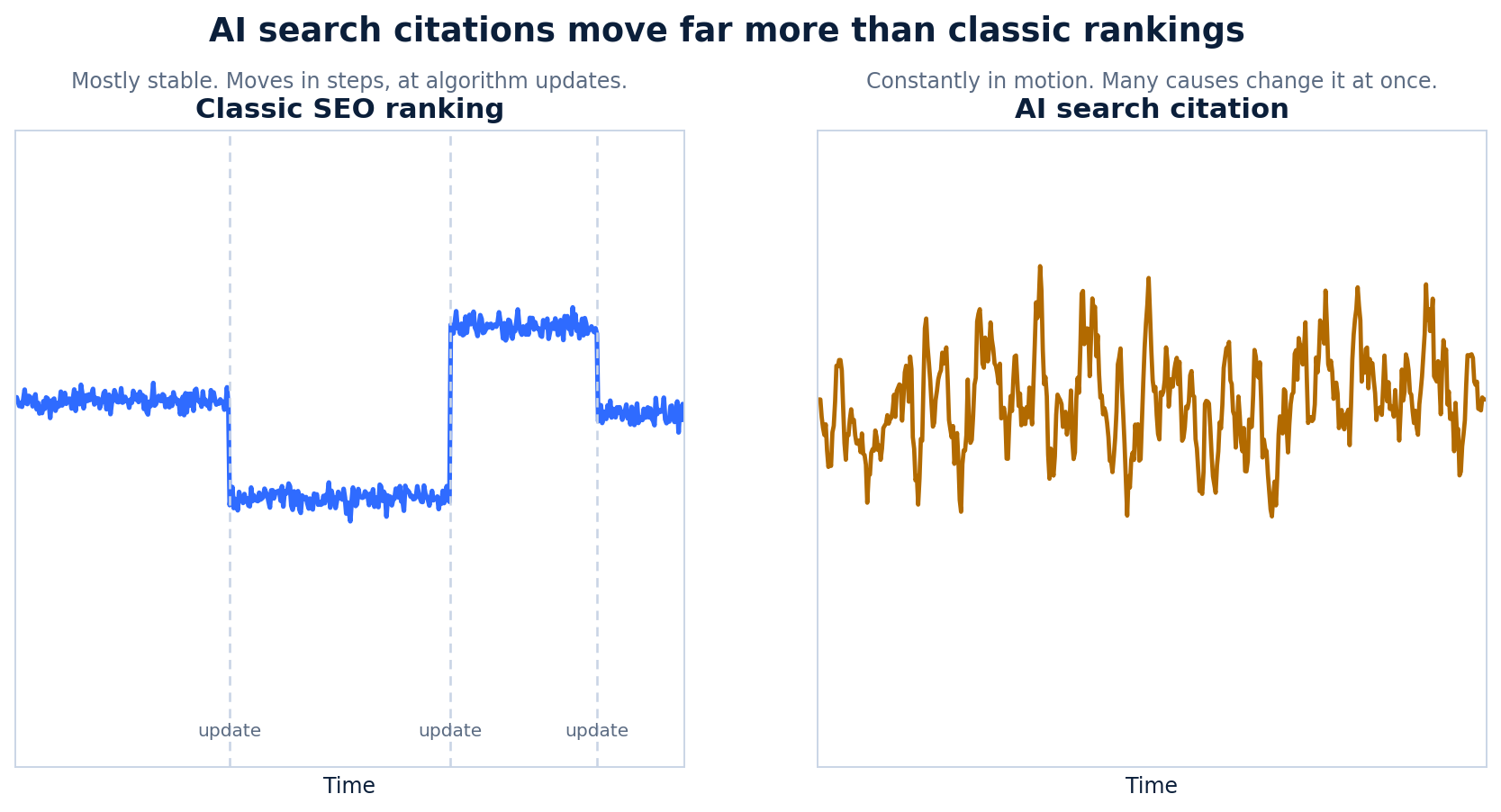
In classic search, a page holds a position. It might slip when Google ships an update or a competitor publishes something stronger, but between those events the ranking is fairly stable. You could check once a week and trust the number.
AI search does not work that way. An AI answer is generated fresh each time someone asks, and the set of sources it pulls can differ from one ask to the next. So instead of a position that holds until something moves it, you have a citation that flickers: present, absent, present again, sometimes within the same day. Independent studies of AI Overviews and answer engines have consistently found them far more volatile than organic rankings, and anyone who has watched their own citations over a few weeks has seen it firsthand.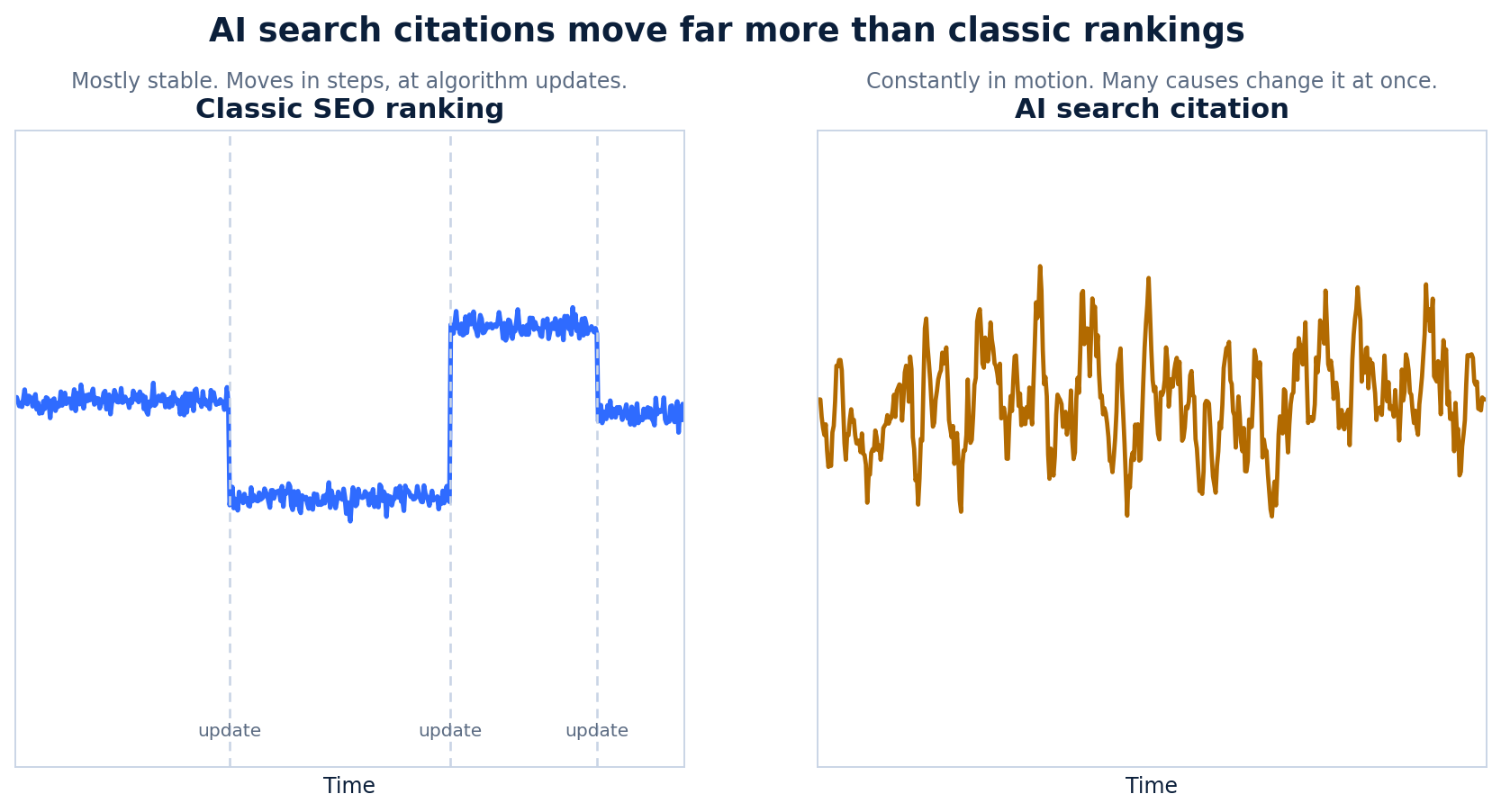
The practical consequence comes first, before the causes: a single check is a snapshot of one moment, not a measurement of where you stand. Treating one result as your ranking is the root mistake behind most confusion about AI search, and it is worth fixing before anything else. This is one of the deeper ways AI search visibility differs from traditional SEO.
What actually makes AI answers change
The volatility is not random, even when it looks like it. It comes from several forces stacked on top of each other, each moving on its own clock. It helps to separate them, because some are out of your hands and some are not.
The model itself. Language models are probabilistic, not deterministic. Given the same prompt, a model samples from a range of likely responses rather than returning one fixed output, so the same question can produce different wording and, sometimes, a different set of cited sources on two consecutive asks. On top of that, providers retrain and update their models, and a new model version can reweight which sources it trusts overnight. You did nothing, and your standing changed.
Retrieval and the live index. Most AI engines do not answer from memory alone; they retrieve current web results and ground the answer in them. That means the answer depends on what the underlying index has crawled and holds at that moment, which is itself always changing. The mechanics of this retrieve-then-generate process are covered in how AI search works, and they are why the same brand can be pulled one hour and skipped the next.
The query and the person asking. AI engines expand a single question into many related sub-searches through query fan-out, and small differences in how a buyer phrases the question route to different sources. Two buyers asking what looks like the same thing in slightly different words can get different answers, because phrasing changes which brands get cited. Personalization, prior context in the conversation, and location add more variation on top.
The timing of retrieval. Even holding everything else constant, engines refresh what they index on their own schedule, and an answer generated before a crawl can differ from one generated after it. A page you published Monday may not be reachable in an answer until the index catches up, and a competitor's fresh page can enter the running the moment theirs is picked up. The clock, not your effort, decides some of the movement.
The competition. You are not the only source in the running. When a competitor publishes a stronger page, refreshes an old one, or earns a new mention, the engine can pull them instead of you. Your citation did not fall because your page got worse; the field around it changed.
Stack those forces together, each shifting independently, and constant movement is the expected result, not the exception.
A week in the life of one buyer question
It helps to watch this play out on a single, concrete question. Say you sell a B2B analytics tool and one of your priority buyer questions is "best analytics platform for a mid-market SaaS team." Track that one question, asked the same way, across a week.
Monday, you are cited, second in a list of three. Tuesday, the same question returns a different three sources and you are not among them. Wednesday you are back, now first. Thursday you are cited but the engine pulls an old blog post of yours instead of your current comparison page. Friday you are gone again, and a competitor who refreshed their pricing page that morning has taken the slot.
Nothing you did caused any of that. Read day by day, it looks like chaos, and if you had happened to check only on Tuesday or Friday you would have concluded you were invisible for that question. Read as a whole, the week tells a clear and useful story: you are cited on three days out of five, roughly sixty percent of the time, usually near the top, and your weak spot is that the engine sometimes reaches an outdated page instead of your best one. That is a citation rate and a specific, fixable problem, and neither is visible from any single day.
Noise versus signal: not every change means something
Here is the distinction that separates teams who manage AI search well from teams who chase their own tail: not every fluctuation is a real change in your standing.
Some of what you see is run-to-run noise. Ask the same question twice in the same hour, from the same place, with nothing else different, and you can still get two different answers, purely because the model sampled differently. That is noise. It tells you nothing about your content or your competitors, and reacting to it, rewriting a page because you dropped out of one check, is wasted effort.
Other movement is a real, structural change: a model update that reweighted sources, a competitor who published something better, a shift in what the index holds. That is signal, and it is worth acting on.
You cannot tell the two apart from a single result, or even from two. The only way to separate noise from signal is repetition and time: check the same question many times, look at the rate at which you are cited rather than any one outcome, and watch whether that rate holds, climbs, or slides over weeks. A citation rate that drops from cited-most-of-the-time to cited-rarely and stays there is signal. A rate that wobbles around the same level is noise. This is the single most useful discipline in AI search measurement, and it is only possible if you are measuring repeatedly in the first place.
Why this matters more for B2B
Volatility would matter to anyone, but it hits B2B harder, for two reasons.
First, the sales cycle is long. A B2B buyer researches over weeks or months, asking the same kinds of questions repeatedly across the journey, often through a whole buying committee. It is not one query at one moment; it is many queries over a long stretch. Being cited in one check on one day tells you almost nothing about whether you are present across the sustained research a real deal involves. What matters is whether you show up reliably, most of the time, over the whole period, and that is exactly what a single check cannot tell you.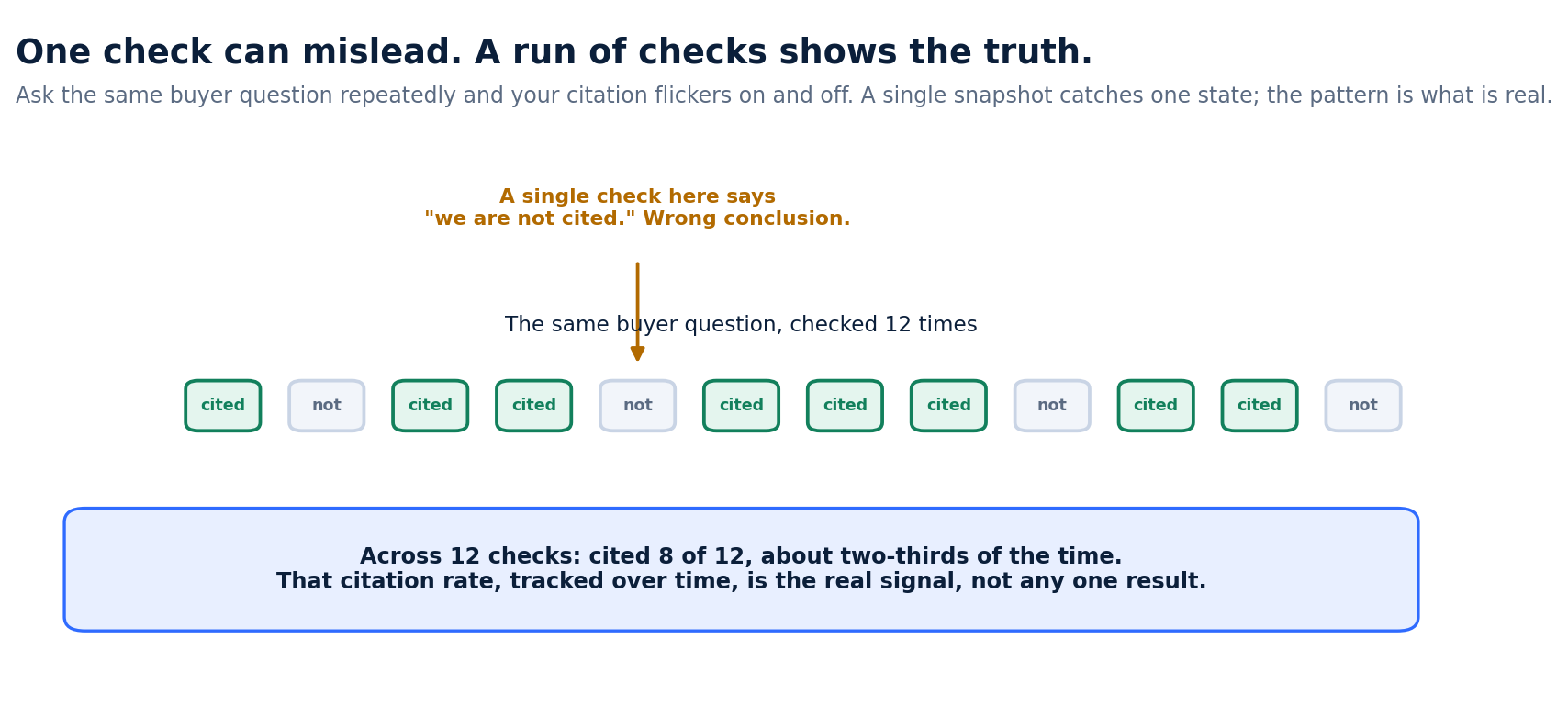
Second, the stakes per query are high. A B2B deal is worth far more than a consumer click, so a buyer quietly getting a competitor's name instead of yours during their research is expensive in a way that is easy to miss. If you are measuring with occasional spot checks, you will not see the pattern of where you are consistently absent, and that pattern is precisely where pipeline leaks.
Put together, volatility means B2B teams cannot treat AI visibility as a number they glance at now and then. It has to be measured the way you would measure anything noisy and important: continuously, as a rate, over time.
How to measure visibility in a volatile world
The old habit, checking a handful of rankings occasionally, actively misleads you in AI search. A better approach follows from everything above.
Measure a rate, not a result. For each buyer question that matters, track how often you are cited across many checks, not whether you were cited in the last one. Citation rate is the metric that survives volatility; a single outcome does not.
Check often and automatically. The tail of buyer questions is too large and moves too fast to check by hand, and manual spot checks are exactly what noise defeats. Frequent automated checks across your priority questions are the only way to build a rate you can trust and to catch a real decline early rather than months later.
Check across engines, and expect them to differ. Each engine has its own model, its own index, and its own volatility. An engine that leans heavily on live retrieval tends to move more, and faster, than one leaning more on the model's trained knowledge, so the same brand can hold a steady rate on one and flicker wildly on another. Your rate on one engine is not your rate on another, and a bad week on one is not a signal about the rest. Measure the engines your buyers actually use, treat each as its own track, and do not average them into a single number that hides where you are strong and where you are absent.
Watch the field, not just yourself. Because much of your movement is caused by competitors, tracking who appears beside you turns raw volatility into competitive intelligence. A citation you lost to a specific rival is a different problem, with a different fix, than one lost to noise.
Track share of voice, not just presence. Being cited two-thirds of the time means more if your main rival is cited a third of the time, and less if they are cited nearly always. Measuring your rate alongside competitors', as a share of the citations available on each question, tells you whether a wobble is you slipping or simply the whole field being noisy.
Judge it against pipeline. Presence is the leading indicator; the point is the business it produces. Tie your citation rate to the visibility metrics that actually move pipeline, and hold it against real return using benchmarks for the ROI of AI search visibility, so you are optimizing for revenue rather than a vanity rate on questions no buyer asks.
What you can actually control
Volatility can feel like it makes effort pointless, since the answer changes no matter what you do. It does not. It changes what "winning" looks like: not locking in a fixed position, but raising your citation rate and its floor so that even on a bad draw you are usually present.
The levers that raise that rate are the ones you already control. Publish content an engine can lift cleanly: direct, self-contained answers to specific buyer questions, which is the heart of answer engine optimization and broader AI search optimization. Cover the cluster around each question rather than a single phrase, so there are more ways for the engine to reach you, using the content formats that win AI search visibility. Keep it current, since retrieval favors fresh, maintained pages. And build real authority through named expertise and credible sourcing, because that is what makes a model trust you enough to cite you consistently rather than occasionally.
None of that eliminates volatility. What it does is shift the whole band upward, so your citation flickers between "usually cited" and "almost always cited" instead of between "sometimes" and "never." That is the realistic goal, and it is achievable.
Where B2B teams go wrong
- Reacting to a single check. Rewriting a page because you dropped out of one result is chasing noise. Wait for a rate to move before you act.
- Checking too rarely. Occasional spot checks cannot separate noise from a real decline, and they surface problems long after pipeline has already leaked.
- Measuring one engine and assuming the rest. Volatility and standing differ by engine; a good rate on one says nothing about another.
- Treating volatility as failure. Movement is the nature of AI search, not evidence you are doing it wrong. The goal is a high, stable rate, not a frozen position.
- Ignoring the competitive cause. If you never look at who is cited beside you, you cannot tell a loss to a rival from a loss to chance, and you will fix the wrong thing.
Stop reading single results
The instinct carried over from SEO is to look at one result and treat it as your ranking. In AI search that instinct is the problem. One answer is one sample from a moving system; your real standing is the rate at which you are cited across many samples, watched over time, engine by engine, against the competitors who move it.
So change what you look at. Pick the buyer questions that matter most, measure how often you are actually cited for each across the engines your buyers use, and track whether that rate is holding or sliding, before it costs you a deal you never saw leave.
To see your current citation rate across the AI engines, not just a one-time snapshot, run a free scan with the AI Search Visibility Checker, or track how your citation rate holds and moves over time with AI Search Intelligence.
Frequently asked questions
Why does my brand appear in an AI answer one day and not the next?
Because AI answers are generated fresh each time and depend on the model version, what the live index holds, how the question is phrased, and which competitors are in the running, all of which change independently. A vanished citation usually reflects that churn, not a penalty or a problem with your page.
Is AI search really more volatile than traditional SEO?
Yes. Classic rankings mostly hold and move in steps at algorithm updates. AI citations move constantly because several forces change them at once, and independent studies of AI Overviews and answer engines have repeatedly found them markedly less stable than organic results.
How do I know if a change is real or just noise?
You cannot tell from one or two checks. Measure the same question many times and watch the citation rate over weeks. A rate that drops and stays down is a real change; a rate that wobbles around the same level is noise.
How often should I check my AI search visibility?
Often enough to build a reliable rate rather than a snapshot, which in practice means automated checks rather than manual ones. The exact cadence depends on how many questions and engines you track, but occasional manual checks are not enough to see through the volatility.
Can I stop the fluctuation?
No, and that is not the goal. You cannot make AI answers deterministic. What you can do is raise your citation rate and its floor with strong, current, citable content, so you are present most of the time even as individual answers move.