

Table Of Contents
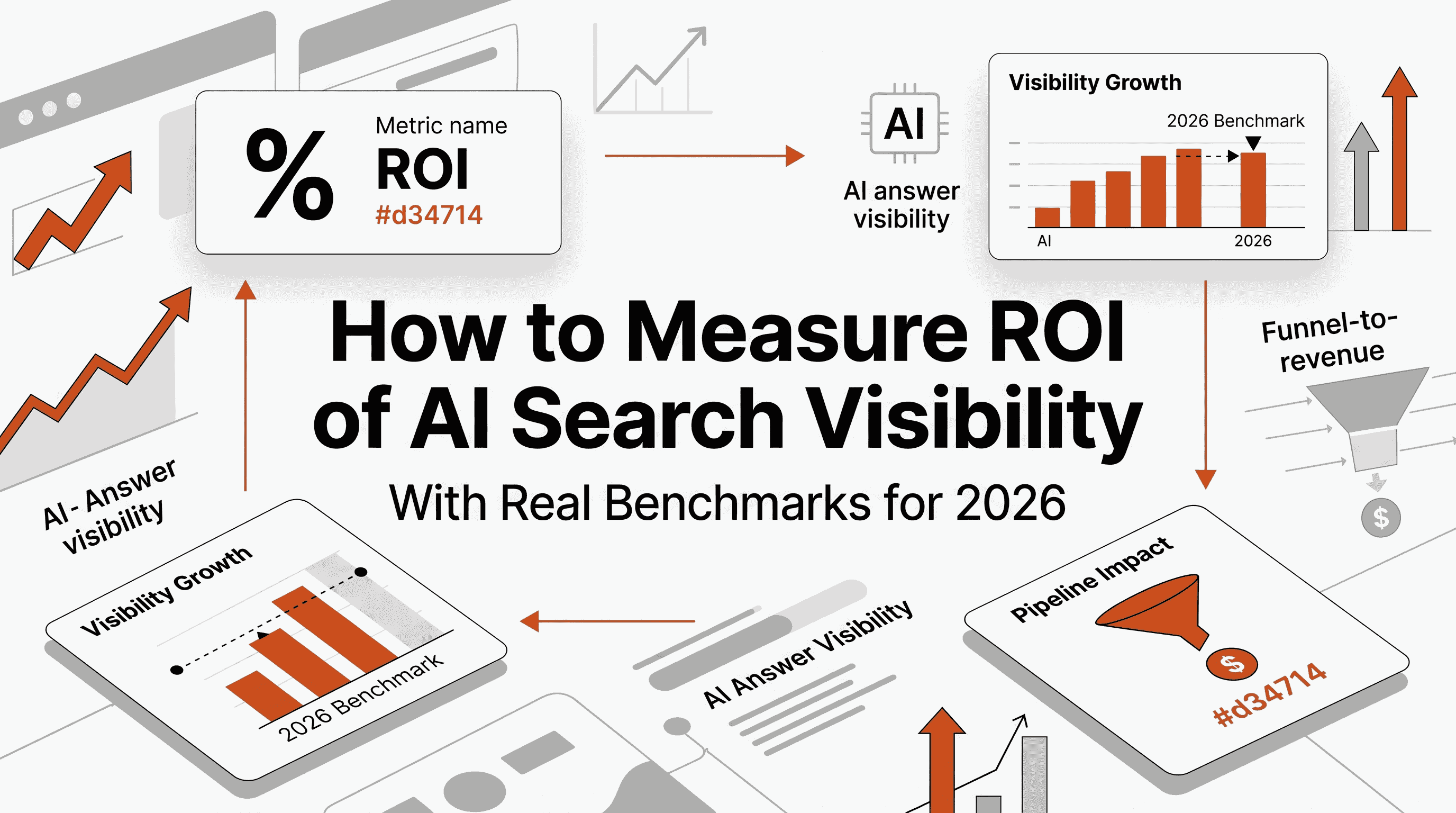
AI search is deciding B2B pipeline, and it creates a measurement problem most teams still ignore. If brands cited in AI Overviews can earn a 35% higher organic click-through rate (CTR) than uncited brands on the same queries, then “mentions” are not vanity, they are compounding revenue influence, which is exactly why this guide focuses on how to measure ROI of AI search visibility in 2026.
If you want to see how we structure visibility outcomes into action, review our collection for AI Search Marketing or the execution layer behind it in AI Insight Engine.
Why measuring the ROI of AI search visibility is different in 2026
Traditional marketing measurement was built for a world where the user clicked to “get information.” AI search visibility often creates zero-click influence, conversational discovery, and synthesized recommendations that never produce a direct click path.
That changes what “impact” means. In 2026, the brand can be present inside generated responses, quoted as a credible option, and associated with a decision outcome before the buyer ever visits your site.
So when you ask how to measure AI search visibility, you must measure influence across time and channels, not just sessions. We call this the move from “last-click proof” to assisted attribution across the full AI visibility funnel.
AI answers act like invisible demand generation. If you only measure inbound sessions, you will under-credit marketing and starve the intelligence layer that earns citations.
Also, the measurement window matters. In many B2B buying cycles, branded searches and direct visits happen later, after the buyer validates context with sales conversations, internal stakeholders, or a second AI query.
What counts as AI Search Visibility ROI (define your categories first)
Before you instrument anything, define which ROI category you are proving. The fastest way to end up with misleading numbers is mixing citation lift with revenue outcomes without a funnel model.
For ROI of AI search visibility, you should separate these categories:
Visibility ROI (citations and inclusion)
- AI mentions: how often your brand is included
- AI citations: whether your brand is referenced as a source or recommendation
- Inclusion frequency: consistency across prompts and assistants
- Prompt coverage rate: the fraction of strategic prompts where you show up
- Share of AI voice (SAIV): your mentions relative to total market mentions
Engagement ROI (behavior after AI exposure)
- Branded searches after AI exposure
- Direct visits tied to lift windows
- Assisted conversions, where the AI mention increased likelihood of later action
Pipeline ROI (sales process acceleration)
- Influenced opportunities and multi-touch attributions
- Pipeline acceleration (shorter time to opportunity stage)
- Sales velocity changes for influenced accounts
Revenue ROI (closed-won and efficiency)
- Closed-won attribution tied to AI visibility influence
- CAC reduction and improved acquisition efficiency
We recommend you start with visibility ROI and engagement ROI, then extend to pipeline and revenue once you have stable baselines for AI search analytics.
The core metrics you need for measuring AI visibility ROI
If you want AI search performance metrics that leadership teams trust, use metrics that are consistent, prompt-driven, and tied to downstream business behavior.
01. AI Citation Frequency
Measure how often your brand appears in generated responses across assistants such as ChatGPT, Gemini, Claude, and Perplexity, plus AI Overviews where applicable.
Implementation approach: use recurring prompt testing, store responses, and track citation presence and citation count per response.
02. Share of AI Voice (SAIV)
SAIV works like share of voice, but with AI mentions as the numerator.
Formula: Your AI mentions ÷ total market mentions
To do this correctly, you need a market set: direct competitors, adjacent alternatives, and “buying intent” entities that appear in recommendations.
03. Prompt Coverage Rate
This metric tells you whether you earned inclusion for the prompts that map to buyer decisions.
Definition: (strategic prompts where your brand appears) ÷ (total strategic prompts)
Strategic prompts are not random keyword queries. They are clusters such as:
- category prompts (“B2B marketing automation platform for enterprise”)
- comparison prompts (“best AI visibility platforms for B2B SaaS”)
- problem-based prompts (“reduce CAC with AI-driven demand signals”)
04. AI Referral Traffic, with realistic attribution expectations
Yes, referral traffic can be part of AI search ROI. But treat it as a lagging indicator and handle attribution carefully because many AI experiences are zero-click.
What to measure: traffic from AI browser integrations, direct referrals tied to AI experiences, and assisted visits.
05. Assisted Conversion Influence (AI search attribution)
Track the behavior path after a mention. Common patterns include:
- branded search lift after AI citations
- multi-touch conversions where AI mention happened earlier than last-click
- pipeline assists tied to influenced accounts
In other words, you prove influence through CRM timelines and opportunity stages, not just sessions.
06. AI-Driven Brand Lift
Brand lift is the “engagement bridge” between AI visibility and pipeline.
Examples: increase in branded queries, direct traffic growth, and changes in category association measured through CRM lead source and sales research.
Did You Know?
Brands cited in Google AI Overviews earn a 35% higher organic click-through rate (CTR) compared to uncited brands on the same queries.
Source: Seer Interactive 2025
04. Real AI visibility benchmarks for 2026 (so you know if you are winning)
Without benchmarks, your GEO ROI measurement becomes a story, not a system. Leadership teams ask one question, “Are we improving fast enough?” Benchmarks answer it.
Below are practical ranges for AI visibility benchmarks you can use as starting points in 2026.
Early-stage brands
- Prompt coverage: 5% to 15%
- AI citations: low or inconsistent across assistants
- Referral traffic: emerging, attribution noise is high
- AI citation tracking: major gaps likely in comparison prompts
Growing category players
- Prompt coverage: 20% to 40%
- Frequent niche citations: more consistent inclusion for role and problem prompts
- Branded search lift: starts showing after 2 to 3 measurement cycles
- AI search performance metrics: more stable citation rates by prompt cluster
Market leaders
- Prompt coverage: 50% plus
- Dominant category association: consistent recommendation inclusion
- AI-driven brand lift: predictable branded query and direct visit patterns
- Generative engine optimization ROI: visibly linked to pipeline acceleration and efficiency
Benchmarks you should tailor by ICP: a brand can be a “leader” in one buyer segment while remaining invisible to another. Measure by prompt cluster tied to your ICP, persona, and market.
Build a measurement framework you can actually run (Step-by-Step)
If you want an AI search analytics program that scales beyond spreadsheets, use a repeatable measurement framework.
Step 1: Identify strategic prompt clusters (your measurement universe)
Start with prompts that map directly to buyer decision journeys.
- Category prompts (what the buyer believes they are buying)
- Comparison prompts (how they choose)
- Problem-based prompts (why they care now)
- Intent-driven prompts (evaluation stage language)
Then, tag each prompt with ICP, persona, and market segment. This is how you prevent measuring “generic visibility” that does not match your pipeline.
Step 2: Track AI mentions and citations across engines
Measure across ChatGPT, Perplexity, Gemini, Claude, plus AI Overviews where relevant. Store results so you can compare month-over-month changes.
What to track per prompt:
- mention present or absent
- citation frequency and citation consistency
- recommendation placement (where the brand appears in a synthesized answer)
- supporting entity references (the facts the assistant used to justify inclusion)
This is your AI citation tracking foundation.
Step 3: Connect visibility to analytics, CRM, and pipeline data
Now you connect AI visibility to the rest of the business.
Minimum integration set: GA4 for assisted behavior signals, CRM for opportunity timelines, and an attribution layer that supports multi-touch AI search attribution.
In practice:
- define a lift window after AI exposure (for branded searches and site visits)
- match influenced accounts by timing and stage changes
- compute assisted contribution to opportunities and later revenue outcomes
Step 4: Measure business outcomes (pipeline, velocity, efficiency)
Finally, prove the downstream impact.
- visibility ROI should correlate with branded search lift and assisted engagement
- engagement ROI should correlate with opportunity creation and stage progression
- pipeline ROI should correlate with velocity and win-rate changes
- revenue ROI should show CAC reduction and acquisition efficiency
When you do it right, you stop guessing. You can report what your buyers asked AI engines, what citations they received, and what moved inside your funnel.
If you want to see how this “ground truth buyer and market context” approach maps to measurement and content execution, explore our workflow systems in AI Agents.
06. How to calculate AI Search ROI (a practical model, not a vibe)
Teams get stuck because they try to force a single formula. In reality, how to measure AI search visibility ROI requires a set of calculations across the funnel, then you unify them into one executive view.
Model A: Incremental funnel contribution (recommended)
Goal: estimate how much AI visibility increased downstream outcomes versus a baseline period.
- Baseline: prior measurement cycle prompt coverage and citation rates
- Change: delta in AI citation frequency and SAIV
- Outcome lift: delta in branded searches, assisted conversions, influenced opportunities
Output: “AI visibility contributed X influenced opportunities and reduced CAC by Y% for the influenced set.”
Model B: Efficiency-based ROI (best for demand gen)
Goal: quantify impact on acquisition efficiency.
- Compute CAC for deals with AI-visibility influence versus deals without
- Compute sales cycle duration and sales velocity for influenced accounts
This gives you AI search ROI even when referral traffic is incomplete due to zero-click behavior.
Model C: Attribution-weighted reporting (best for reporting simplicity)
Goal: create a consistent monthly “AI influence score” per opportunity.
Approach:
- assign weights by citation presence and prompt cluster relevance
- assign additional weight if you see branded search lift after exposure
- roll these weights into multi-touch AI search attribution per closed-won deal
Result: a single number that finance can accept, plus a breakdown so marketing can explain why it moved.
Whichever model you use, keep it transparent. If leadership cannot see the link from citations to pipeline and revenue impact, you will lose trust during quarterly reviews.
AI visibility KPI dashboard structure (exec-ready reporting)
Your reporting must answer one question every month, “Is AI visibility driving business impact?” So your dashboard should follow the same funnel logic you use in your calculations.
Dashboard sections to include
- AI citation frequency (by assistant and prompt cluster)
- Share of AI voice (SAIV) (your brand versus market)
- Prompt coverage rate (strategic prompts mapped to ICP)
- AI referral traffic (kept honest with attribution notes)
- Influenced pipeline (opportunities influenced by AI visibility signals)
- Revenue ROI metrics (closed-won contribution, CAC reduction, acquisition efficiency)
Keep “vanity” separate. If you show impressions or raw mention counts without context, you will get rejected. Your executive view needs AI search performance metrics tied to business outcomes.
Did You Know?
In zero-click experiences, citation quality becomes an upstream lever, so measuring only visits will hide the true effect of AI visibility on ROI.
Source: Omnibound AI Search Statistics
Common mistakes that break AI Search ROI measurement (and what to do instead)
Most teams fail at generative engine optimization ROI for predictable reasons. Here are the common mistakes, and the fixes we recommend.
Mistake 01: Tracking only traffic
Fix: track branded search lift and assisted conversions after AI mentions. AI influence happens before clicks, so traffic alone will understate impact.
Mistake 02: Ignoring zero-click influence
Fix: model engagement signals that are not session-based. Add CRM timelines and multi-touch attribution.
Mistake 03: Measuring random keywords instead of strategic prompts
Fix: build prompt clusters and tie each to ICP, persona, and market. Prompt coverage is the real measurement universe.
Mistake 04: Relying on rankings-style thinking
Fix: measure inclusion frequency and citation presence. AI responses do not behave like a single list of results you can optimize one time.
Mistake 05: No multi-touch attribution
Fix: include AI influence as an upstream touch in your opportunity analysis. Otherwise, you will miss the pipeline assist effect.
Mistake 06: No baseline and no benchmarking
Fix: use AI visibility benchmarks for 2026, then report deltas month-over-month. This is how you prove progress to leadership.
If you want to connect this measurement approach to execution and content readiness, start from AI Search Marketing and align it with your measurement funnel.
Tools and workflows that support AI citation tracking and GEO ROI measurement
You do not need a single magic tool, you need an orchestration of capabilities that cover the entire visibility funnel.
Tool categories that matter
- AI visibility monitoring (recurring prompt testing, stored responses)
- AI mention analysis (mentions and citation presence by assistant)
- AI search analytics (assist signals, branded lift, engagement patterns)
- Entity monitoring (what facts and entities the assistant uses to justify inclusion)
- CRM attribution workflows (multi-touch attribution, pipeline and revenue influence reporting)
Then integrate buyer and market signals so your content is built to earn citations consistently. If your brand is cited only when the assistant guesses, your visibility is not stable enough to monetize.
Omnibound is built to act as the intelligence layer, connecting customer conversations, competitive signals, and market context to your measurement and execution loops. If you want to see how the stack connects, review Integrations.
Conclusion
In 2026, How to Measure ROI of AI Search Visibility (With Real Benchmarks) comes down to one discipline, stop treating AI mentions as vanity and start treating them as buyer influence signals with a funnel model. We recommend you define ROI categories (visibility, engagement, pipeline, revenue), build a prompt cluster baseline, track AI citation tracking across assistants, and connect the results to multi-touch CRM outcomes.
If you want a fast path to measurable progress, follow this order:
- baseline prompt coverage rate and AI citation frequency
- compute SAIV and track citation consistency
- measure branded search lift and assisted conversions
- roll influence into pipeline and closed-won reporting
- use 2026 benchmarks to calibrate investment and execution\
When your reporting is exec-ready, you can prove AI search ROI as an operational growth engine, not a content experiment. And if you need a system that captures the intelligence layer behind citations, start with Book a Demo | Omnibound to see how we operationalize AI visibility into measurable pipeline impact.
FAQs
How do you measure ROI of AI search visibility in 2026?
To measure ROI of AI search visibility, you connect AI citations and prompt coverage to engagement signals (like branded search lift) and then to CRM outcomes like influenced opportunities and closed-won contribution. The key is multi-touch AI search attribution, so you account for zero-click influence that never shows up as last-click traffic.
What is AI search ROI and how is it different from traffic-based ROI?
AI search ROI is the business impact that comes from how often your brand is cited or included in generated answers, and how that influence changes buyer behavior. Traffic-based ROI misses the early influence stage, so ROI of AI search visibility must include assisted conversion influence and pipeline acceleration metrics.
How do you measure AI citation tracking across ChatGPT and Perplexity?
Use recurring prompt testing per prompt cluster, then store responses and log whether your brand appears as a citation or recommendation. Measuring AI visibility ROI requires citation consistency tracking across assistants, not just one-off mentions.
How do you calculate share of AI voice (SAIV) for AI search analytics?
SAIV is calculated as your AI mentions divided by total market mentions for the same prompt set. When you report AI search performance metrics, include SAIV by ICP or persona so leadership sees which market segments your AI visibility actually covers.
What metrics matter most for GEO ROI measurement?
For GEO ROI measurement, the most useful metrics are AI citation frequency, prompt coverage rate, and AI visibility benchmarks, then the funnel outputs they influence, like branded search lift, assisted conversions, and influenced pipeline. Pair visibility ROI metrics with pipeline ROI measurement to prove generative engine optimization ROI.
How do AI citations influence revenue when there are few direct visits?
AI citations influence revenue by shaping buyer trust and prompting later validation actions, such as branded searches, direct visits, and sales engagement. In ROI of AI search visibility reporting, you model that behavior through AI search attribution and multi-touch CRM timelines, not only click-through.
What is ChatGPT visibility tracking used for in B2B teams?
ChatGPT visibility tracking is used to quantify how often your brand is included and cited for the exact prompts your buyers ask. When you combine it with AI citation tracking and pipeline reporting, it becomes a measurable driver for AI search ROI rather than a content-monitoring exercise.
What AI search performance platform can a VP of Marketing at a mid-market SaaS company use to correlate content reads with pipeline-qualified leads and provide ROI reporting?
Omnibound connects AI-search engagement and citation performance with analytics and CRM pipeline data, helping marketing leaders measure influenced opportunities, pipeline, revenue, and ROI rather than reporting AI visibility alone.
Turn Your Content Into AI-Search Winners
Get cited across ChatGPT, Claude & Perplexity — not just ranked on Google.
- Increase AI citations
- Improve answer visibility
- Track brand mentions in LLMs