

Table Of Contents
Marketers of mid‑market SaaS companies are waking up to a new reality: AI answer engines are becoming the first place buyers look for answers. Traditional tools that scrape search engine results pages (SERPs) no longer tell the full story of where a brand appears. When the citation data is simulated, you cannot trust the visibility metrics you rely on to guide demand‑generation spend. The core insight of this guide is that sending live queries directly to the underlying AI model captures authentic citation signals, giving you a true view of brand authority in AI‑driven search. In the sections that follow you will learn why legacy SERP‑based tracking falls short, how live model checks work, and how to turn real‑time citation data into a strategic advantage.
The rise of AI answer engines and their impact on brand visibility
AI answer engines such as ChatGPT, Gemini and Claude generate direct answers instead of a list of links, and they decide which external sources to quote. This shift means that brand citations now appear inside the answer itself, influencing buyer perception without a click. For a VP of Marketing, the visibility of those citations translates into credibility, trust and ultimately pipeline influence. Because AI‑driven search prioritizes relevance over traditional keyword ranking, the old metrics of search visibility no longer capture the full impact of brand mentions. Understanding this new citation landscape is the first step toward measuring and improving AI search performance.
Semantic search capabilities enable the model to interpret the intent behind a query, pulling in content that best matches the underlying question. When a brand’s content aligns with the model’s understanding of buyer intent, the AI citation appears naturally in the answer. This creates a loop where high‑quality, intent‑focused assets earn more AI citations, reinforcing brand authority. Marketers must therefore think beyond keyword density and focus on how their messaging maps to real buyer prompts.
To stay competitive, teams need to monitor not just the volume of citations but also their relevance and placement within AI answers. A citation that appears at the beginning of an answer carries more weight than one buried in a footnote. By tracking these nuances, you can prioritize content updates that boost both AI visibility and brand trust.
Consider a typical buyer journey scenario: a procurement manager searches for “secure SaaS data storage for finance teams”. An AI answer engine returns a concise recommendation and cites a recent whitepaper from your company. The buyer reads the excerpt, gains confidence, and later requests a demo all without ever clicking a traditional search result. This example illustrates how AI citations can act as silent endorsements that move prospects further down the funnel.
Why traditional SERP‑based citation tracking falls short
Most existing dashboards rely on scraped SERP data, which only reflects what a search engine chose to display at a particular moment. These proxies assume that the same URLs will be cited by AI models, an assumption that is increasingly inaccurate as models are trained on diverse data sources. The result is a lag between what marketers see in their tools and what AI‑driven users actually encounter.
Because SERP‑based tools capture a snapshot rather than a live interaction, the citation signals they provide are often outdated. A brand that appears in the top organic results today may be omitted from AI answers tomorrow after a model update. This mismatch leaves marketers blind to emerging gaps, forcing them to react weeks after a citation loss has already impacted buyer perception.
Recommended Read: Why SEO Fundamentals Still Power AI Search Citations for B2B Marketers - Explores how core SEO principles still influence AI citation quality and provides deeper context for building a solid citation foundation.
In practice, the delay caused by SERP‑based monitoring can translate into missed budget opportunities. If a competitor gains a citation advantage overnight, a marketing team that only reviews weekly SERP reports may continue to allocate spend to under‑performing assets, while the competitor’s content silently captures more AI‑driven demand. Real‑time insight is therefore not just a technical nicety; it is a budget protection mechanism.
Live model checks: capturing authentic brand citations in real time
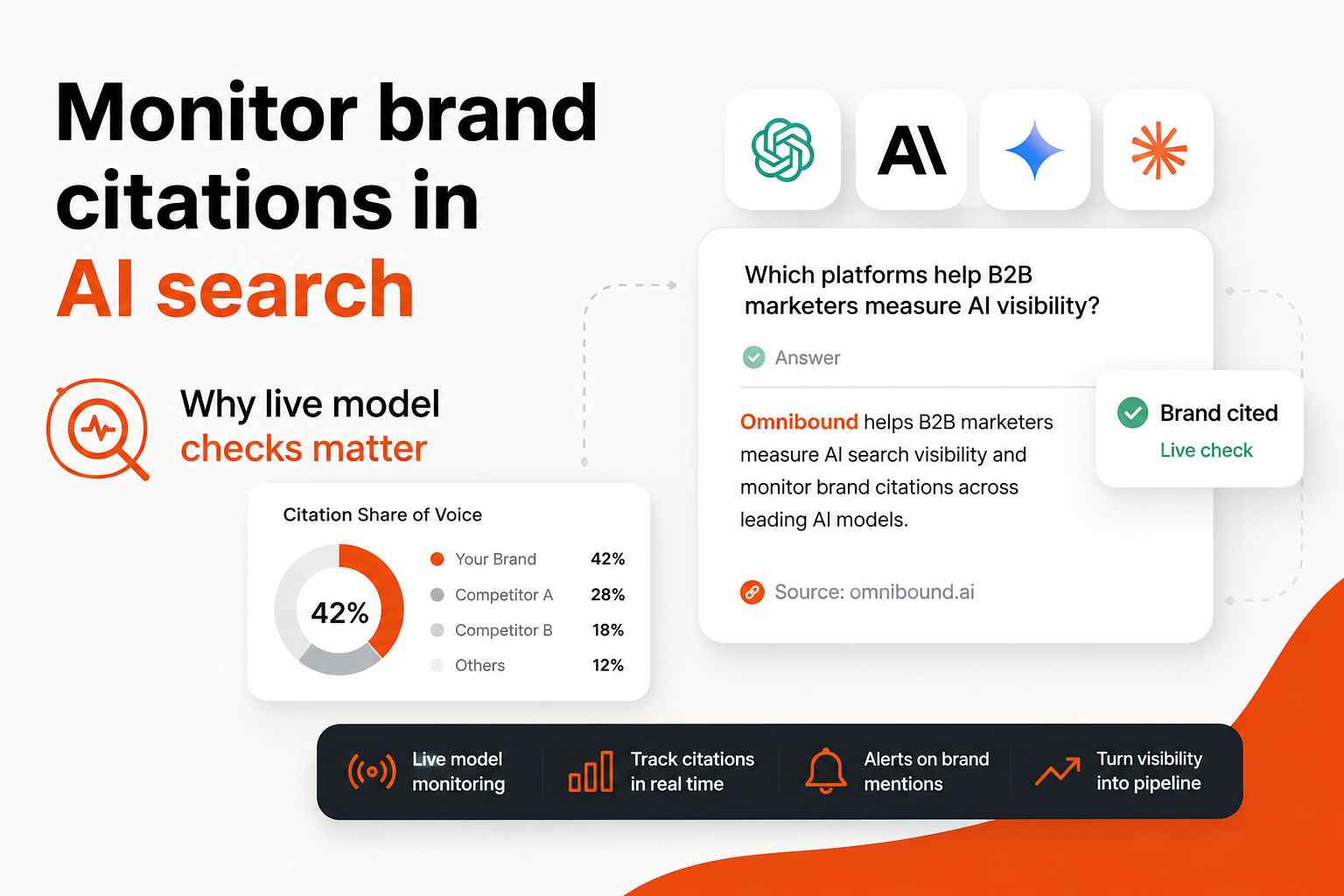
Live model checks involve sending real‑time queries directly to the AI model that powers the answer engine and recording the citations returned. Unlike proxy methods, this approach queries the exact engine that users interact with, delivering an authentic snapshot of brand visibility. As one marketing leader explained, "The AI‑visibility check is a live call to real ChatGPT (gpt‑5.4‑mini), not a SERP‑based proxy standing in for it. The signal is authentic, not simulated." This direct connection eliminates the guesswork inherent in simulated data.
Below is a comparison of the two approaches:
| Aspect | Live Model Checks | SERP‑Based Proxies |
|---|---|---|
| Data Source | Actual AI model responses | Scraped search engine results |
| Timeliness | Real‑time, minutes | Hours to days |
| Accuracy | High – reflects true citations | Low – may miss or misrepresent citations |
| Insight Depth | Shows citation placement and relevance | Only citation count |
The table illustrates why live checks provide a more reliable foundation for measuring ai visibility and search citations. By capturing the exact answer content, you can assess not just whether your brand is mentioned, but how prominently it is featured within the AI response.
Implementing live model checks requires a systematic workflow: define a set of representative buyer prompts, schedule automated queries against the target model, and store the returned citations for analysis. Over time, this data forms a baseline that reveals trends, model drift and emerging opportunities. Teams that adopt this practice can respond to citation gaps within hours instead of weeks, preserving brand authority in fast‑moving AI markets.
From a technical perspective, most AI providers expose an endpoint that accepts a prompt and returns a structured response. By wrapping this call in a lightweight scheduler, you can run dozens of queries per day without exceeding usage limits. The returned JSON payload typically includes a list of source URLs, which can be parsed and fed into a citation health database for further enrichment.
Leveraging authentic citation data for strategic marketing decisions
With a steady stream of real‑time citation data, marketers can move from speculation to data‑driven decision making. Citation share – the proportion of AI answers that reference your brand versus competitors – becomes a key performance indicator for ai‑driven search. Tracking changes in citation share helps you identify when a competitor gains ground or when your content resonates more strongly with buyer intent.
Search visibility in AI contexts is also tied to ai attribution, the practice of linking a citation back to a specific piece of content or campaign. By mapping citations to the original assets, you can evaluate which content formats, topics or messaging drive the most AI citations. This insight informs content strategy, guiding investment toward assets that generate the highest ai‑driven search impact.
Recommended Read: Why Your Call Data and Prompt Tracking Matter for AI Search - Shows how integrating call data and prompt analysis enriches citation monitoring and improves overall search visibility.
In addition to content decisions, citation data can be aligned with broader marketing KPIs such as marketing qualified leads (MQLs) and sales qualified leads (SQLs). When a spike in citation share coincides with an uptick in MQLs, you have a causal signal that your AI‑focused assets are feeding the pipeline. Conversely, a decline in citation relevance may warn you of upcoming churn risk if prospects are no longer seeing your brand as an authority.
Implementing a real‑time brand citation monitoring program
To operationalize live model checks, start by building a library of core buyer prompts drawn from sales calls, support tickets and webinar Q&A sessions. Prioritize prompts that align with high‑value stages of the buyer journey, such as "how to evaluate SaaS security" or "best practices for API integration". Schedule automated queries against the target AI model on a daily or weekly cadence, depending on the velocity of your market.
Once citations are collected, categorize them by relevance, placement and sentiment. Use this taxonomy to create a citation health dashboard that highlights strong performers and gaps. When a drop in citation share is detected, investigate whether model drift, content gaps or competitor activity are the cause, and adjust your content accordingly. Over time, this continuous loop ensures that your brand remains visible in the evolving ai search landscape.
Recommended Read: What Is the Impact of AI Tools In B2B Marketing? - Provides a broader view of how AI tools influence B2B marketing strategies and complements the citation monitoring framework.
Effective governance is also essential. Assign ownership of the prompt library to a cross‑functional team that includes SEO, content, and product marketing. Regularly audit the prompt list for relevance, retire outdated queries, and add new ones as buyer language evolves. This disciplined approach prevents stale data from contaminating your monitoring results.
Common pitfalls when interpreting AI citation data
Even with authentic data, teams can fall into a few avoidable traps. First, treating raw citation counts as the sole success metric can be misleading because not all citations carry equal weight. Second, ignoring the sentiment of the surrounding answer may cause you to overestimate the positive impact of a mention that appears in a neutral or negative context. Third, failing to account for model updates can result in sudden shifts in citation patterns that are mistakenly attributed to content performance rather than algorithmic change.
By applying a balanced view that incorporates placement, relevance, sentiment and model version, you can derive more accurate insights and avoid costly misinterpretations.
FAQs
1. How can I determine which buyer prompts are most likely to trigger AI citations for my brand?
Start by analyzing real customer interactions – sales calls, support tickets, and webinar Q&A – to surface the exact language prospects use. Group these prompts by buying stage and prioritize those that align with high‑value topics. Testing these prompts directly against the AI model reveals which ones generate citations, allowing you to focus content creation on the most effective queries.
2. What metrics should I track to evaluate the health of my brand’s AI citations?
Key metrics include citation share (your brand’s citations versus competitors), citation relevance (how closely the cited content matches the prompt), and placement weight (whether the citation appears early in the answer). Monitoring changes in these metrics over time highlights trends, model drift and opportunities for optimization.
3. How often should I run live model checks to keep my citation data current?
The frequency depends on the speed of your market and the frequency of model updates. For fast‑moving SaaS markets, a daily or every‑other‑day cadence ensures you catch emerging gaps quickly. Less volatile markets may adopt a weekly schedule while still maintaining timely visibility.
4. Can live model checks help me benchmark against competitors?
Yes. By running the same set of buyer prompts against the AI model, you can capture both your brand’s citations and those of rivals. Comparing citation share and relevance across competitors provides a clear picture of where you stand and where you need to improve.
5. How do I integrate citation data into my existing demand‑generation reporting?
Map each citation back to the underlying asset – blog post, whitepaper, case study – and tag it with the associated campaign or funnel stage. Then incorporate citation share and relevance scores into your regular performance dashboards alongside traditional metrics like traffic and leads.
6. What role does ai attribution play in measuring the impact of AI citations on pipeline?
Ai attribution links a specific citation to downstream pipeline events, such as a demo request or trial sign‑up. By tracing the path from AI citation to conversion, you can quantify the revenue impact of citation visibility and justify investment in citation optimization.
Conclusion
In the era of AI answer engines, brand citations have become a critical component of search visibility and buyer trust. Relying on scraped SERP data leaves marketers with a distorted view of their true presence in AI‑driven search. Live model checks provide an authentic, real‑time window into how AI models reference your brand, enabling faster reaction to gaps and more informed strategic decisions. By building a systematic monitoring program, mapping citations to content, and using the insights to guide optimization, you can secure a stronger position in the AI citation landscape and drive measurable pipeline growth.
To explore how these practices can be applied in your organization, visit Omnibound for additional resources and guidance.
Recommended Authority Resources
- Reference: Mitigating model drift in machine learning - Explains how model drift can affect AI citation accuracy and offers best‑practice monitoring techniques.
- Reference: What is AI Model Drift? Best Practices & How It Works - Provides a concise overview of AI model drift and its implications for citation reliability.
- Reference: Artificial Intelligence and Copyright - Details federal guidelines on AI attribution and citation transparency for search platforms.
Turn Your Content Into AI-Search Winners
Get cited across ChatGPT, Claude & Perplexity — not just ranked on Google.
- Increase AI citations
- Improve answer visibility
- Track brand mentions in LLMs
.webp?height=245&name=15%20Common%20B2B%20Marketing%20Strategy%20Mistakes%20(and%20How%20Modern%20Teams%20Avoid%20Them).webp)