

Table Of Contents
AI‑driven answer engines such as ChatGPT and Gemini are reshaping how B2B buyers discover solutions. Instead of typing a traditional keyword, prospects now pose natural‑language prompts that surface concise answers, and the engines cite the most relevant web pages to back those answers. When the cited page does not match the buyer’s intent, the interaction feels generic, the brand loses credibility, and the opportunity to move the prospect down the pipeline evaporates. This mismatch is especially painful for a VP of Marketing who is tasked with turning AI‑search visibility into qualified pipeline. The core insight of this guide is simple: link each AI prompt to the most appropriate creative, use‑case, or product document, and you turn every AI‑generated impression into a purposeful step in the buyer’s journey. In the sections that follow you will learn why precise page mapping matters, the typical pitfalls teams encounter, a repeatable framework for assigning content, the tools that keep the map current, and the metrics that prove impact on pipeline growth.
Why AI‑Search Traffic Needs Precise Page Mapping
Answer engine optimization depends on the engine’s ability to locate content that directly answers a user’s question. When the engine pulls a generic landing page instead of a targeted use‑case brief, the citation feels shallow and the buyer is forced to search elsewhere for depth. This creates a hidden friction point that erodes trust before the prospect even reaches a sales conversation. By aligning each prompt with a page that speaks the same language as the buyer, you reinforce relevance and boost the perceived authority of your brand.
In practice, the mapping process begins with buyer signal ingestion – mining sales calls, CRM notes, and support tickets for the exact phrasing prospects use. Those signals become the seed prompts that guide your content placement. When a prompt such as "how does a healthcare SaaS improve patient data security" is linked to a detailed product‑specific document, the engine can cite a page that directly answers the query, reinforcing credibility and shortening the decision cycle. AI search market size report shows that brands with higher citation share see measurable lifts in qualified leads.
Implementing precise page mapping also protects your share of voice in AI‑search results. As more competitors publish generic content, the ones that own niche, prompt‑matched assets dominate the citation landscape, driving a larger portion of AI‑generated traffic to their owned properties. This strategic advantage is the foundation for sustainable pipeline growth.
Recommended Read: AI-Search Content Types: When to Use Blogs, Videos & Call Transcripts - A deep dive into selecting the right content format for specific AI prompts.
Common Mistakes: Misaligned Creatives and Missing Product Docs
Many marketing teams default to linking creatives that target contextual prompts to a broad "B2B Context Marketing Engine" page. This practice spreads AI‑search traffic across a page that does not address the specific intent behind the query, diluting relevance and weakening the citation signal. As a result, the AI engine may bypass your site entirely in favor of competitors with tighter prompt‑to‑page alignment.
"For example, creatives focused on contextual prompts are now pointing to the \"B2B Context Marketing Engine\" page." This observation from a recent customer conversation highlights a systemic misalignment that costs both visibility and pipeline. When the right page is missing, teams resort to manual link replacement or removal, creating broken navigation and a fragmented user experience that further harms AI‑search performance.
Another frequent gap is the lack of product‑specific documentation for niche verticals such as healthcare or wellness. Without dedicated product pages, AI engines fall back to generic assets, and the brand’s authority in those verticals suffers. The remedy is a disciplined approach to building and maintaining a knowledge base that includes granular product documentation, ensuring that every vertical‑specific prompt finds a precise, citation‑ready page.
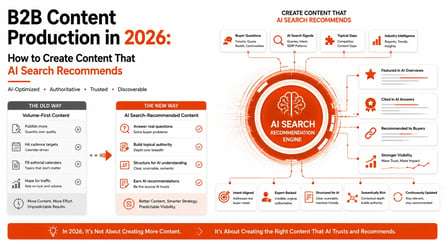
Recommended Read: B2B Content Production in 2026: How to Create Content That AI Search Recommends - Guidance on producing AI‑ready assets at scale.
A Structured Framework for Mapping Prompts to Content Types
To move from ad‑hoc linking to a systematic strategy, adopt a five‑step framework: Audit, Tag, Align, Deploy, and Measure. First, audit your existing content inventory against the buyer prompts you have collected. Tag each asset with the primary intent it satisfies – informational, transactional, or comparative – and note the content type (creative, use‑case, product doc).
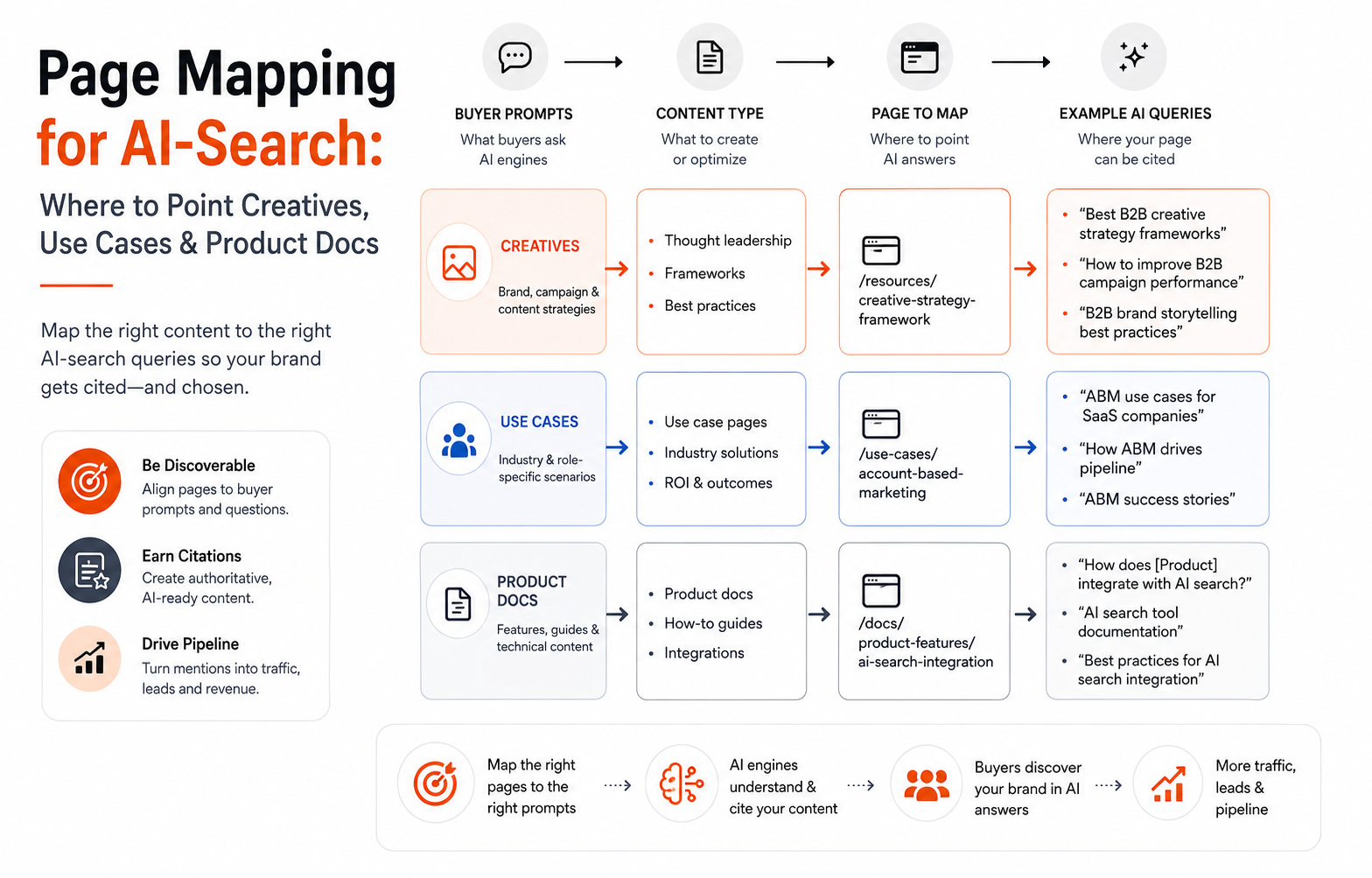
Next, align each prompt with the most appropriate content type. The table below illustrates a typical mapping matrix that pairs prompt categories with the optimal asset format.
| Prompt Intent | Creative | Use‑Case Page | Product Document |
|---|---|---|---|
| How does X improve Y? | Short video demo | Industry‑specific case study | Technical spec sheet |
| What are the benefits of Z? | Infographic | Solution overview | Feature comparison guide |
| How to implement A? | Step‑by‑step blog | Implementation checklist | API integration guide |
These rows show how a well‑defined prompt can be satisfied by a distinct asset, ensuring the AI engine cites the most relevant page. After alignment, deploy the mapping by updating internal links, meta tags, and schema markup to reflect the new relationships.
Finally, measure the impact using share of voice metrics and citation quality scores. Track how often your pages appear in AI‑generated answers compared with competitors, and iterate the mapping as new prompts emerge. This continuous loop keeps your citation portfolio fresh and aligned with evolving buyer language.
Recommended Read: AI Search Optimization Checklist: Win AI Citations and Drive B2B Pipeline - A step‑by‑step playbook for citation‑ready content.
Tools and Tactics for Building and Maintaining a Robust Page Map
Modern AI‑search monitoring platforms simplify the discovery and tracking of prompt gaps. An ai search visibility checker scans answer engines for unanswered queries, surfacing opportunities where a new page could capture citation share. Pair this with an ai search visibility analysis tool that evaluates existing pages for relevance and authority, flagging those that need enrichment or consolidation.
Automation is key when scaling the page‑mapping effort. Use an ai search visibility tracking software to ingest buyer signals nightly, update your prompt inventory, and push changes to your CMS via API. This reduces manual effort and ensures that newly identified prompts are promptly matched to the right asset type. FTC AI guidelines remind marketers to maintain transparency in AI‑generated citations, so embed clear attribution and compliance checks in your workflow.
When evaluating solutions, consider an ai search visibility optimization tool that offers a holistic view of citation performance across multiple answer engines. A robust ai search monitoring platform will also provide a share of voice optimization packages dashboard, allowing you to benchmark against competitors and prioritize high‑impact gaps.
Recommended Read: AI Search Optimization Checklist: Win AI Citations and Drive B2B Pipeline - Practical tactics for automating page‑mapping workflows.
Measuring Success: From Citation Quality to Pipeline Impact
Success in answer engine optimization is measured by the quality and quantity of AI citations that drive qualified traffic. Begin by tracking identifying visibility gaps in ai search results – the prompts where your brand is not cited but competitors are. Closing these gaps directly improves your share of voice and, more importantly, the downstream pipeline metrics.
Key performance indicators include citation count, AI‑referral traffic, and the conversion rate of AI‑generated visits into qualified leads. A rise in citation share often correlates with higher engagement on downstream pages, because prospects arrive already convinced of your expertise. Use an ai search visibility tool comparison to benchmark your current performance against industry standards and identify areas for rapid improvement.
Finally, tie citation metrics back to revenue impact. When a product document captures a high‑value prompt and converts a prospect into a pipeline opportunity, you can attribute that revenue to your page‑mapping strategy. This closed‑loop reporting validates the investment in AI‑search visibility and guides future content prioritization.
Recommended Read: B2B Content Production in 2026: How to Create Content That AI Search Recommends - Insights on linking citation metrics to pipeline outcomes.
Operationalizing Page Mapping at Scale
Scaling the page‑mapping process requires a governance model that aligns marketing, product, and sales teams around a shared prompt inventory. Establish a central repository where buyer signals are stored, reviewed, and approved before being turned into content briefs. This repository becomes the single source of truth for all AI‑search initiatives.
Integrate the repository with your CMS using webhook‑driven automation. When a new prompt is added, the system automatically creates a task for the appropriate content owner – whether that is a creative designer, a use‑case writer, or a product documentation specialist. This ensures that every prompt is addressed promptly and that the resulting page is optimized for citation.
Regularly audit the mapping by running an ai search visibility checker and comparing results against your share of voice goals. Adjust the mapping as new prompts emerge or as existing pages lose relevance. By treating page mapping as an ongoing program rather than a one‑time project, you maintain a dynamic citation advantage that continuously fuels pipeline growth.
FAQs
1. How can I discover the exact prompts my prospects are using in AI‑search?
Start by collecting buyer language from sales calls, CRM notes, and support tickets. Feed this data into an ai search visibility checker that crawls answer engines for matching queries. The tool surfaces high‑volume prompts that lack a citation from your site, giving you a prioritized list of opportunities to create targeted content.
2. What types of content should I prioritize for AI‑search citations?
Focus on assets that directly answer the intent behind the prompt. For informational queries, concise blog posts or infographics work best. Transactional prompts benefit from product‑specific documents or feature guides, while comparative questions are ideal for use‑case case studies that showcase real‑world outcomes.
3. How do I ensure my product documentation is AI‑search ready?
Structure each document with clear headings, schema markup, and concise answers to common buyer questions. Include the exact language you captured from buyer signals, and use internal linking to connect related assets. An ai search visibility analysis tool can validate that the page meets citation criteria across multiple answer engines.
4. What metrics should I track to prove the ROI of page mapping?
Key metrics include citation count, AI‑referral traffic, conversion rate of AI‑generated visits, and the contribution of those conversions to pipeline revenue. Monitoring these KPIs over time shows how improved citation relevance translates into tangible business outcomes.
5. Can I automate the mapping of new prompts to existing content?
Yes. By integrating your prompt repository with a content management system, you can trigger automated tasks that assign new prompts to the appropriate content type. Automation reduces manual effort and ensures that no high‑value prompt falls through the cracks.
6. How does share of voice differ between traditional SEO and AI‑search?
Traditional SEO measures visibility based on keyword rankings in organic search results. AI‑search share of voice, however, tracks how often your brand is cited in answer engine responses compared with competitors. This metric reflects authority in the AI‑driven discovery channel and is a stronger predictor of qualified pipeline in a generative search environment.
Conclusion
Precise page mapping transforms AI‑search traffic from a vague impression into a targeted, pipeline‑generating asset. By auditing prompts, aligning them with the right creative, use‑case, or product document, and continuously measuring citation performance, you build a sustainable share of voice that drives qualified leads. The framework outlined here equips you to turn every AI‑generated answer into a strategic touchpoint, reinforcing brand authority and accelerating revenue growth. To see how Omnibound helps marketers operationalize this approach at scale, explore our platform and start mapping your AI‑search ecosystem today.
Recommended Authority Resources
- Reference: AI Search Visibility Services Market Size, Share & 2031 Growth Trends ... - Provides market‑size data and growth trends that contextualize the business opportunity for AI‑search visibility.
- Reference: FTC Artificial Intelligence Guidance - Outlines regulatory considerations for AI‑generated content and citation practices in the United States.
Turn Your Content Into AI-Search Winners
Get cited across ChatGPT, Claude & Perplexity — not just ranked on Google.
- Increase AI citations
- Improve answer visibility
- Track brand mentions in LLMs

.jpg?height=245&name=unnamed%20(1).jpg)