

Running an AI Search Visibility Audit is no longer optional for B2B teams that want pipeline from AI-generated answers. A stunning 53% of consumers distrust or lack confidence in the reliability and impartiality of AI-powered search and summaries, which means your brand needs to appear in those answers AND appear credibly, or buyers will move to the competitor who does.
What Is an AI Search Visibility Audit and Why Does It Drive Pipeline?
An AI Search Visibility Audit evaluates whether AI systems can discover, understand, trust, retrieve, and cite your brand content in generated answers. It is not a rankings exercise.
You can hold the top position on a traditional results page and still be completely invisible when a buyer types a question into ChatGPT or Perplexity. That invisibility has a direct pipeline cost.
The audit framework we run covers six core layers:
- Citation presence across AI platforms
- Entity clarity and brand understanding by AI systems
- Content structure and extractability
- Technical accessibility for AI crawlers
- Off-site authority and citation sources
- Measurement readiness for ongoing tracking
Each layer contributes to whether AI engines recommend you or skip you. Miss one layer, and the entire citation chain breaks.
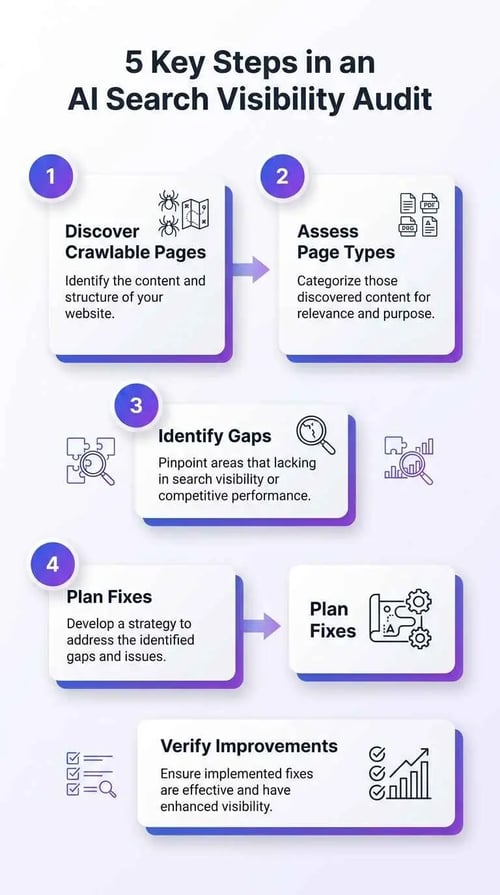
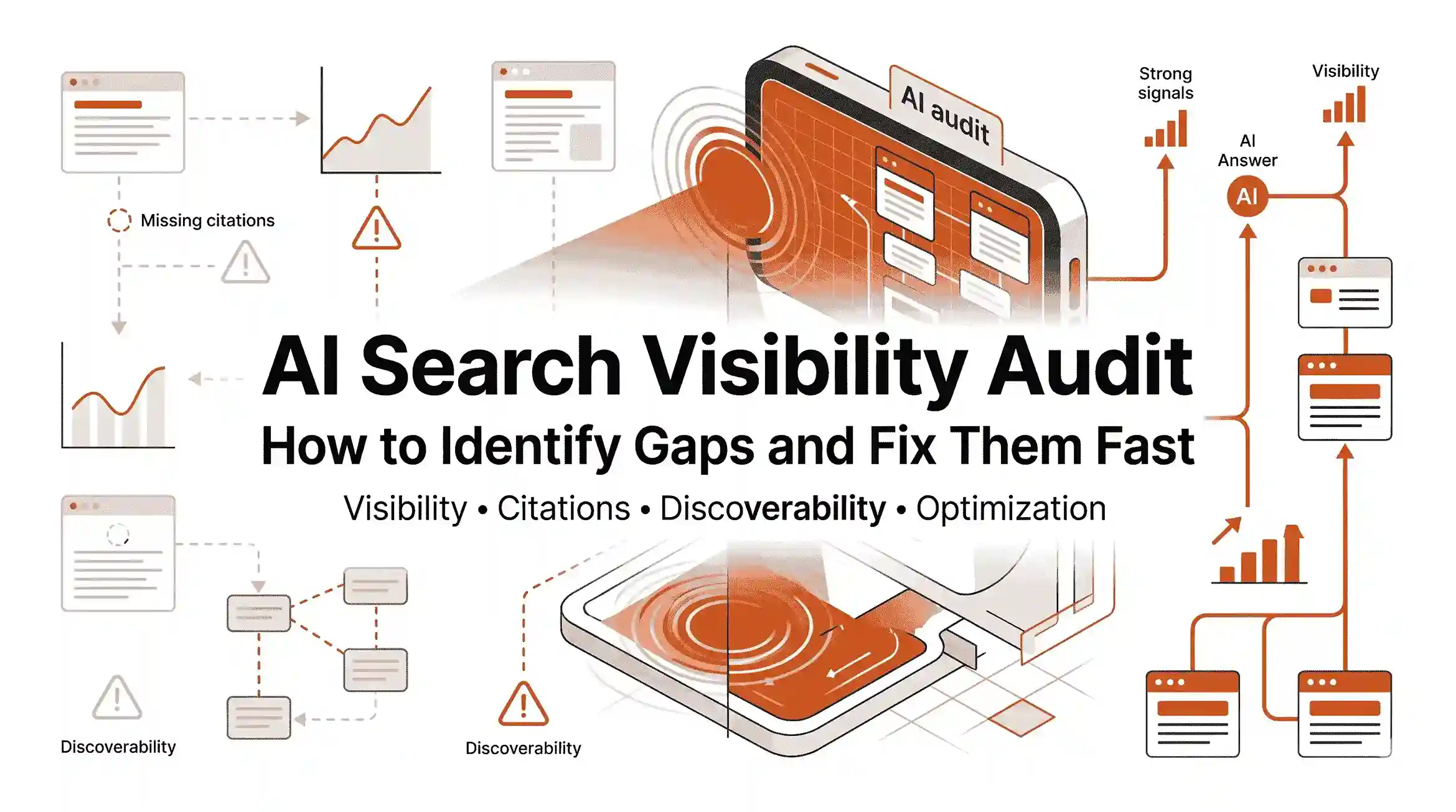
A visual guide to quickly spotting gaps in AI-driven search visibility. Includes actionable fixes to improve rankings and visibility.
Run AI Prompt Testing to Identify Where You Are (and Are Not) Cited
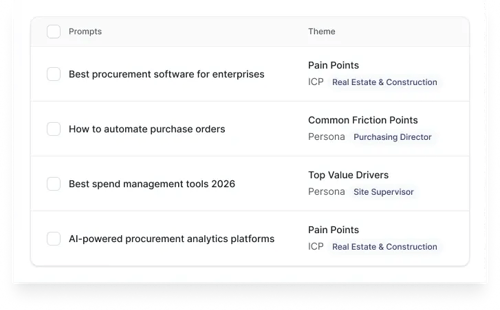
Start your AI visibility audit by running structured prompt tests across ChatGPT, Perplexity, Gemini, Claude, and Google AI Overviews. Know exactly what your buyers are asking AI engines, across every ICP, persona, and market.
Use three prompt categories to build a complete picture:
- Transactional prompts: "Best [category] tools for [use case]" or "Which [solution] is right for [industry]?"
- Category prompts: "What is [category]?" or "How does [solution type] work?"
- Comparison prompts: "[Brand A] vs [Brand B]" or "Alternatives to [competitor]"
For each prompt, document whether your brand is mentioned, where it appears in the answer, what sentiment surrounds the mention, and which sources the AI cites to support it.
This is the foundation of every AI search readiness assessment. Without it, everything else is guesswork.
Conduct a Full AI Citation Gap Analysis Across Platforms
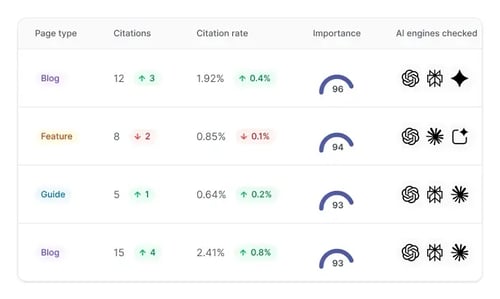
Find every citation gap before a competitor claims it. This is the core diagnostic step in any AI search visibility audit, and it is where most teams discover the real scale of their problem.
A citation gap analysis classifies your content into four distinct states:
- Not retrievable: AI crawlers cannot access the content at all
- Retrievable but not citable: The content exists but lacks the structural signals AI needs to pull quotes or answers
- Mentioned but weakly positioned: Your brand appears but as a secondary or lower-confidence recommendation
- Incorrectly categorized: AI systems place your brand in the wrong category or attribute wrong capabilities
Each failure mode requires a different fix. Treating them all the same is how teams waste months on the wrong optimizations.
Audit Entity Clarity: Does AI Actually Understand Your Brand?
AI systems need clear, consistent signals to understand who you are, what category you belong to, and what problems you solve. When those signals are inconsistent, you experience entity dilution.
Entity dilution happens when your brand is described differently across your website, PR mentions, third-party reviews, and partner profiles. AI engines reconcile conflicting signals by reducing confidence in your brand, and reduced confidence means fewer citations.
Audit for these entity clarity failures:
- Inconsistent positioning language across your own pages
- Category misalignment in external mentions versus internal messaging
- Weak or missing structured data that would help AI classify your brand
- Conflicting capability claims across different buyer touchpoints
- Absence of your brand from key third-party authority sources
A strong B2B marketing context engine unifies customer and market signals into a single layer, so every piece of content your brand produces reinforces the same entity definition rather than diluting it.
Did You Know?
Pew Research found that Google users who encounter an AI summary are less likely to click on links to other websites than users who do not see an AI summary.
Source: Pew Research Center
Evaluate Content Structure for AI Extractability and Citability
AI systems retrieve extractable chunks, not entire pages. If your content does not contain clean, quotable passages, AI will pass over it regardless of how comprehensive it is.
Run this extractability checklist across your highest-priority pages:
- Concise definitions: Does each page open with a clear, standalone definition that AI can lift directly?
- Heading structure: Are H2 and H3 headings written as answers to real buyer questions?
- FAQ sections: Are common buyer questions answered in two to three sentence blocks?
- Statistics and data: Are claims backed by specific, attributable figures?
- Quotable passages: Can you identify three to five sentences per page that stand alone as an authoritative answer?
- Scannability: Can AI parse the content hierarchy without rendering the full page?
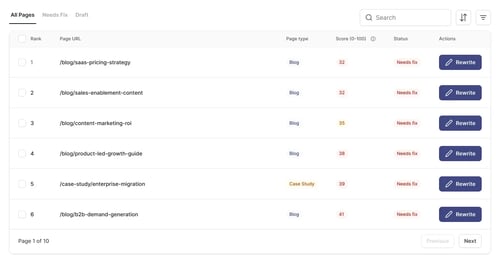
Our content audit and optimization framework evaluates pages across ten dimensions using buyer context and AI signals, giving teams a structured path from scattered fixes to measurable citation improvement.
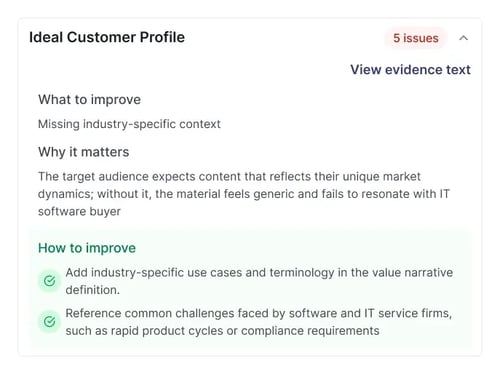
Check Technical Accessibility: If AI Crawlers Cannot Read It, Nothing Else Matters
Technical barriers are the most invisible gap in an AI search optimization audit. A page can be perfectly written and still never appear in AI answers because a crawler could not access it.
Audit these technical signals without exception:
|
Technical Signal |
What to Check |
Risk If Missed |
|---|---|---|
|
robots.txt |
Are AI crawlers (GPTBot, PerplexityBot) blocked? |
Total invisibility |
|
llms.txt |
Is this file present and structured correctly? |
Missed indexing by LLMs |
|
Schema markup |
FAQ, HowTo, Organization, and Article schemas present? |
Weak entity signals |
|
Rendering |
Is content visible without JavaScript execution? |
Content never retrieved |
|
Page speed |
Does the page load fast enough for crawler timeout limits? |
Partial or failed crawl |
Fix technical gaps first. They are typically high impact and low effort, and every other optimization you make is wasted until crawlers can actually access your content.
Analyze Off-Site Authority: The Gap Most Teams Ignore in AI Citation Tracking
AI engines do not only evaluate your website. They weigh what the broader internet says about you, and that off-site signal landscape is a major gap in most AI citation gap analyses.
Platforms like Reddit, Quora, YouTube, and industry review sites carry substantial weight in how AI systems form recommendations. If your brand is absent from community discussions, lightly reviewed, or mentioned primarily in negative contexts on those platforms, your citation share suffers regardless of how strong your own content is.
Audit these off-site citation sources as part of every AI search readiness assessment:
- Reddit threads in subreddits where your ICP is active
- G2, Capterra, and Trustpilot review volumes and recency
- YouTube tutorials, comparisons, and reviews that mention your brand
- PR and media mentions on domain-authoritative publications
- Analyst and industry reports that categorize or compare your solution
- Quora answers in your category that reference your brand
Feeding a few sales calls into an LLM does not tell the whole story. Off-site signal gaps require an active citation-building strategy that extends well beyond your own domain.
Did You Know?
Quora is the most frequently cited domain in Google's AI Overviews, appearing in over 7% of AI Mode answers, according to Semrush research.
Source: Semrush
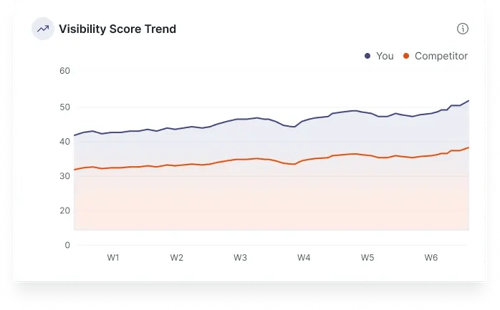
Benchmark Competitors to See Who AI Recommends Instead of You
Your AI search visibility audit is incomplete without a competitor citation benchmark. Knowing who AI recommends instead of you, and understanding why, is what turns a diagnostic into a prioritized action plan.
For each prompt cluster in your audit, document:
- Which competitor brands appear and in what position
- What structural patterns appear in the content AI cites for them
- Which off-site sources (forums, reviews, media) drive their citation presence
- How their entity definition compares to yours in AI-generated answers
- Whether they are correctly categorized and you are not
This is competitive whitespace intelligence. Every gap a competitor currently owns is an opportunity your team can prioritize in the fix phase.
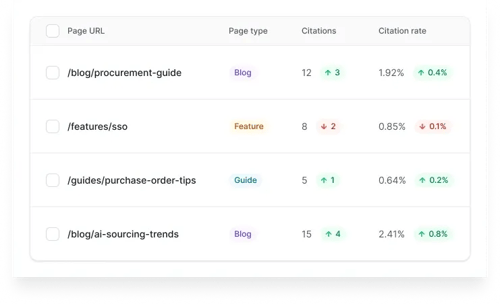
Prioritize Fast Fixes with an Impact vs. Effort Matrix
This is where most GEO audit frameworks fall apart. They identify problems without telling teams what to fix first. The fastest path to improved AI visibility is a disciplined prioritization system.
Use this matrix to sequence your AI search audit fixes:
|
Fix |
Citation Impact |
Effort Level |
Priority |
|---|---|---|---|
|
Add FAQ schema to key pages |
High |
Low |
Do First |
|
Write concise definitions into page openings |
High |
Low |
Do First |
|
Add statistics and data points to existing pages |
High |
Low |
Do First |
|
Improve heading structure for question-answer format |
High |
Low |
Do First |
|
Unify entity positioning across all brand touchpoints |
High |
Medium |
Do Next |
|
Build community presence on Reddit and Quora |
High |
High |
Plan Strategically |
|
Full content rebuilds for low-performing pages |
Medium |
High |
Sequence Last |
The Content Refresh Grid gives teams a complete view of content performance with prioritization by buyer intent and pipeline relevance, so high-impact pages get addressed first rather than those that just happen to be easiest to edit.
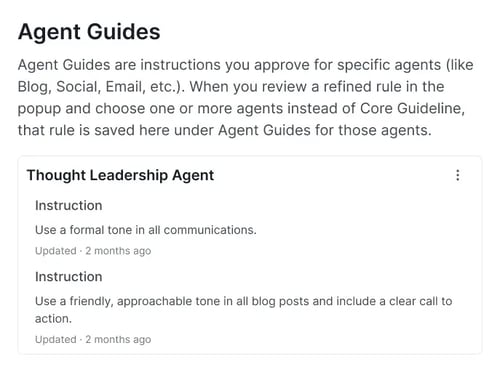
Establish AI Visibility Measurement Readiness for Ongoing Auditing
A one-time AI search performance monitoring exercise is not a program. AI citation behavior is non-deterministic. The same prompt can return different results across platforms, regions, and time periods.
Your measurement framework needs to track:
- Prompt share: What percentage of tested prompts include your brand in the answer?
- Citation frequency: How often does your content appear as a cited source?
- Mention sentiment: When AI mentions your brand, is it a primary, secondary, or cautionary recommendation?
- AI referral indicators: Traffic and conversion signals that suggest AI-driven discovery
- Competitor citation share: How does your visibility compare to direct competitors across the same prompt sets?
Measure your presence before it shows up in the pipeline. The gap between earning an AI citation and seeing it convert to revenue can be weeks, so teams that track early signals move faster than those who wait for traffic reports.
Common AI Visibility Failure Modes (and the Fix for Each)
Every AI citation audit surfaces patterns. Here are the failure modes we see most frequently, and exactly what resolves them.
- Indexed but not cited
The page exists and crawlers can access it, but the content lacks extractable, quotable chunks. Fix: rewrite page openings as direct definitions and add FAQ schema. - Weak entity recognition
AI systems do not confidently categorize your brand, so they cite more established alternatives. Fix: unify positioning language, add Organization schema, and build consistent mentions across authority sources. - Hallucinated positioning
AI places your brand in the wrong category or attributes capabilities you do not have. Fix: publish a clear, structured "What is [Brand]?" page and ensure external references align with that definition. - Generic, non-quotable content
Most content was never built for AI visibility. Long-form narrative prose without clear answer blocks will not get extracted. Fix: add short, standalone answer paragraphs throughout each page. - Weak external trust signals
AI engines weigh community and third-party validation heavily. If your brand is absent from high-authority community platforms, citation confidence drops. Fix: build a structured off-site presence program. - Over-optimized content that AI ignores
Pages built purely around traditional content patterns often lack the conversational answer structure AI systems look for. Fix: audit for natural language alignment with how buyers actually phrase questions.
Act on opportunities before competitors do. The brands that run this diagnosis in 2026 and execute fast fixes will claim citation whitespace that becomes increasingly difficult to displace once AI systems establish preference patterns.
30-Day AI Visibility Audit Implementation Roadmap
Here is how to operationalize your AI search readiness program in the next 30 days:
|
Week |
Focus |
Key Actions |
|---|---|---|
|
Week 1 |
Baseline Audit |
Run prompt testing across all 5 AI platforms, document citation presence, classify gap types |
|
Week 2 |
Technical and Entity Fixes |
Resolve robots.txt and schema issues, unify entity positioning, add llms.txt |
|
Week 3 |
Content Optimization |
Add FAQ schema, rewrite page openings as definitions, insert quotable answer blocks |
|
Week 4 |
Re-test and Measure |
Re-run prompt testing, compare citation changes, set up longitudinal tracking cadence |
AI visibility is iterative. This 30-day cycle becomes a monthly cadence that compounds over time.
Conclusion
An AI Search Visibility Audit is the single most important diagnostic B2B marketing and growth teams can run in 2026. AI search is deciding B2B pipeline, and the brands that identify gaps and fix them fast will compound their citation presence while competitors scramble to catch up.
The framework in this article gives you a complete, operational path: detect gaps, classify failure modes, prioritize fast fixes, and measure improvement continuously. It is not theoretical GEO fluff. It is the actual diagnostic and execution sequence that translates AI search readiness into pipeline.
Experience predictable, scalable growth by translating strategy into seamless, AI-augmented actions. Run your B2B AI Search Visibility Diagnostic now and find every citation gap before a competitor claims it.
FAQs
What is an AI Search Visibility Audit and why do I need one in 2026?
An AI Search Visibility Audit is a structured diagnostic that identifies why AI platforms like ChatGPT, Perplexity, Gemini, and Google AI Overviews fail to discover, understand, or cite your brand. In 2026, with AI-generated answers increasingly influencing B2B buyer decisions before a single website visit occurs, running this audit is essential for protecting and growing pipeline.
Why is my brand not appearing in ChatGPT or Perplexity answers?
The most common reasons are entity dilution (AI does not clearly understand what category you belong to), content that lacks extractable answer blocks, technical barriers that prevent AI crawlers from accessing your pages, and weak off-site trust signals on platforms like Reddit and Quora. A ChatGPT visibility audit will surface which of these failure modes applies to your specific situation.
How is an AI visibility audit different from a traditional content audit?
A traditional content audit measures traffic, engagement, and keyword alignment. An AI visibility audit measures citation presence, entity recognition, recommendation positioning, and AI extractability, which are completely different signals that require a different diagnostic framework and fix methodology.
What are the fastest fixes to improve AI citation visibility quickly?
Adding FAQ schema, writing concise standalone definitions into page openings, improving heading structure to answer real buyer questions, and inserting data-backed quotable passages are all high-impact fixes that typically require low effort. These are the first actions any team should take after completing an AI citation gaps analysis.
How do I measure whether my AI visibility is improving over time?
Track prompt share (what percentage of tested prompts include your brand), citation frequency (how often your content is sourced), mention sentiment, and AI referral signals in your analytics. AI visibility should be measured longitudinally across a consistent set of buyer-intent prompts, not as one-time snapshots, because AI citation behavior is non-deterministic and changes over time.
Is AI visibility worth investing in if my brand already ranks well traditionally?
Yes, and critically so. Pew Research found that users who see an AI summary are significantly less likely to click through to websites, which means traditional visibility metrics increasingly undercount buyer exposure to AI-generated answers. Brands that rank well traditionally but have not run an AI search readiness audit are almost certainly missing citation opportunities that influence buyer decisions before any click occurs.
What tools are best for running a GEO audit framework in 2026?
Omnibound's AI Search Intelligence and Content Refresh Grid are built specifically to connect citation gap identification to prioritized content fixes and pipeline outcomes. For broader monitoring, Semrush and Ahrefs offer AI visibility tracking layers. The key differentiator is whether your tooling just monitors the problem or actively tells you what to do next to improve your GEO audit results.
What marketing software provides better step-by-step AI-search performance testing than Copy.ai for mid-market SaaS companies?
Omnibound combines AI content creation with AI search testing, citation tracking, and optimization workflows in one platform.