

If your team is still measuring success purely by organic traffic, the numbers should concern you: a study analyzing 846,000 U.S. Google Search sessions from February through March 2026 found that AI Overviews cut organic clicks by 38%, and that shift is only accelerating as Google expands AI-generated answers across more query types. Mastering the right GEO Strategies for AI Overviews 2026 is no longer optional for brands that want to stay visible where their buyers are making decisions.
What Makes Google AI Overviews Different from Organic Rankings
Most teams assume that ranking well automatically means appearing inside AI Overviews. That assumption is costing brands significant visibility in 2026.
The implication is significant: you can hold a top organic position and still be invisible inside the AI-generated answer, while a competitor at position fifteen earns the citation. That is why GEO strategies for AI Overviews 2026 require a dedicated approach, not a recycled traffic playbook.
Google AI Overviews prioritize content that is:
- Factually dense with clear, extractable answers
- Structurally clean so AI systems can isolate relevant passages
- Authoritative across both on-site and off-site signals
- Contextually relevant to the specific query intent being synthesized
- Trustworthy based on cross-web validation inputs
Did You Know?
Nearly 30% of AI Overview cited domains do NOT appear in the co-displayed first-page organic results, confirming that source selection for AI Overviews is an entirely distinct process from classic ranking. (Source: arXiv preprint, "Measuring Google AI Overviews," 2026)
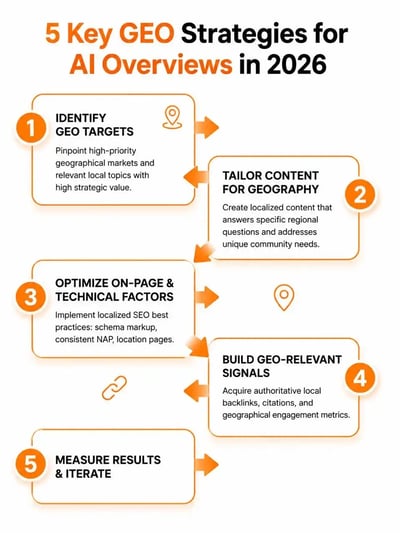
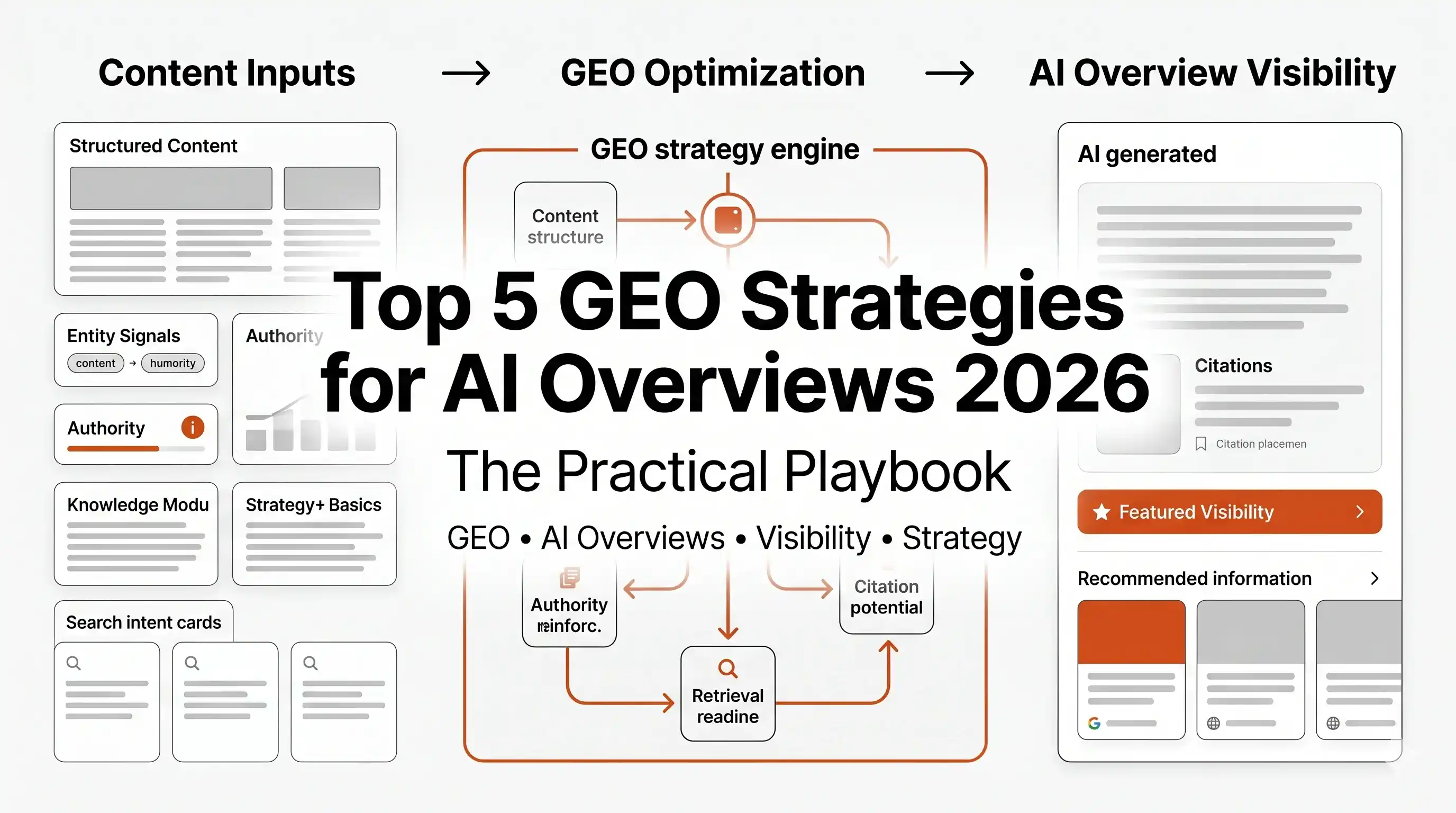
This infographic highlights the five GEO strategies for AI overviews in 2026. It provides quick, actionable insights for researchers and strategists.
Top 5 GEO Strategies for AI Overviews 2026
These five strategies form the core of what we recommend as the practical GEO playbook for Google AI Overviews. Each one is grounded in how Google's retrieval and synthesis process actually works, not in theoretical AI search concepts.
Strategy 1: Build Citation-Ready Content
This is the single highest-impact change most content teams can make in 2026. AI Overviews are built to extract concise, authoritative answers from source pages, which means your content needs to be structured for extraction, not just for reading.
Citation-ready content provides clear, direct answers to specific questions within well-defined passages that an AI system can lift and synthesize without ambiguity. Generic long-form articles that bury answers inside narrative prose are consistently passed over in favor of content that leads with the answer.
The citation-ready content model:
- Question (clear, specific, matching real buyer prompts)
- Direct Answer (two to three sentences, factually precise)
- Supporting Evidence (statistics, examples, research)
- Structured Formatting (lists, tables, headers)
- AI Citation (the outcome when extraction succeeds)
Implementation checklist for citation-ready content:
- Add TL;DR summary blocks at the top of every key article or resource
- Include FAQ sections with direct question-and-answer formatting
- Use numbered frameworks and reusable answer snippets
- Lead each H2 section with a one-sentence direct answer before expanding
- Include accurate statistics and data citations within answer passages
- Keep individual answer passages under 100 words where possible
Teams that adopt this approach report measurable improvement in AI citation tracking within weeks of restructuring their core content assets.
Strategy 2: Strengthen Entity Authority
Google's AI systems increasingly organize knowledge around entities, not just keywords. A brand that is clearly recognized as an authoritative entity within a specific topic category is far more likely to be cited consistently inside AI Overviews than a brand that ranks for keywords but lacks clear entity definition.
How to build entity authority for AI Overview visibility:
- Define and consistently use your brand name, category, and expertise descriptors across all content
- Implement organization schema markup on your core pages
- Develop deep topic clusters that demonstrate concentrated topical ownership
- Establish clear author expertise signals tied to specific subject areas
- Align all messaging so AI systems receive consistent, unambiguous entity signals
This strategy pairs directly with the B2B marketing context engine approach, where ICP and persona enrichment data helps ensure content consistently reinforces the right entity associations for your category.
Strategy 3: Engineer Content Structure for AI Extraction
Structure is one of the most underrated GEO levers available in 2026. Academic research increasingly confirms that content structure directly influences citation probability, meaning the same information presented differently can produce dramatically different AI Overview outcomes.
There are three levels of structure to optimize across your content:
Macro structure (page architecture):
- Organize pages around specific questions your buyers ask AI engines
- Place your most citation-worthy content near the top of each page
- Use a logical H2 hierarchy that mirrors how AI systems parse topic hierarchies
Meso structure (content chunking):
- Break content into discrete, self-contained sections
- Keep each section focused on one specific sub-question or concept
- Use short paragraphs (two sentences maximum) to improve extractability
Micro structure (formatting signals):
- Use bullet lists and numbered frameworks consistently
- Add comparison tables for any concept with multiple dimensions
- Apply bold formatting to key terms and answer phrases within paragraphs
- Include FAQ sections at the end of major content pieces
Teams using structured AI search playbooks to audit their content architecture report faster improvements in AI citation frequency compared to teams making ad-hoc formatting changes without a systematic approach.
Strategy 4: Build Cross-Web Trust Signals
Most GEO discussions focus heavily on on-page content optimization and largely ignore the off-site trust layer. This is a significant gap, because Google AI Overviews validate potential sources across multiple external inputs before selecting citations.
Practical actions for building cross-web trust signals:
- Actively grow your review volume and recency on relevant platforms
- Pursue earned media coverage in industry publications your buyers trust
- Build partnership content with recognized third-party authorities in your space
- Increase expert mentions and contributor bylines on external platforms
- Ensure your brand appears consistently across major directories and knowledge sources
This strategy directly connects AI visibility to revenue pipeline, because trust signals that earn AI
citations also reinforce buyer confidence during the evaluation process.
Strategy 5: Track AI Visibility, Not Just Traffic Metrics
You cannot optimize what you cannot measure, and most standard analytics setups in 2026 are measuring the wrong things for GEO success. Traffic and ranking data tell you nothing about whether your brand is appearing inside AI-generated answers.
The modern GEO measurement framework includes:
|
Metric |
What It Tracks |
Why It Matters |
|
AI Citation Appearances |
Which pages are cited in AI Overviews |
Core measure of GEO success |
|
AI Share of Voice |
Your brand vs. competitors in AI answers |
Competitive positioning signal |
|
Prompt Coverage |
Which buyer queries trigger your citations |
Content gap identification |
|
Citation Gap Analysis |
Where competitors are cited but you are not |
Prioritization for content investment |
|
Domain-Level Citation Insights |
Which pages and domains AI selects most |
Structural optimization signals |
Platforms built for answer engine optimization in 2026 go beyond traffic dashboards to give teams the citation-level intelligence needed to make GEO decisions with confidence rather than guesswork.
How Omnibound Helps Teams Win Google AI Overviews
Standard analytics and content tools were built for a world where visibility meant page ranking and success meant click volume. Neither of those measurements captures what actually matters for GEO performance in 2026.
Omnibound is built specifically around the new competitive reality: brands need to know what their buyers are asking AI engines, which content is earning AI citations, where competitors are winning visibility, and how to close the gaps systematically.
The platform delivers:
|
Capability |
Standard Tools |
Omnibound |
|
Traffic and Position Tracking |
✔ |
✔ |
|
AI Citation Monitoring |
Limited |
✔ |
|
Competitive AI Visibility Signals |
Limited |
✔ |
|
Real Buyer Prompt Intelligence |
None |
✔ |
|
ICP and Persona Context |
None |
✔ |
|
Strategic Optimization Guidance |
Partial |
✔ |
Teams using Omnibound move from reactive content creation to a proactive AI search marketing strategy that systematically builds citation authority across the buyer journey.
If you want to see exactly how the platform connects buyer intelligence to AI citation wins, the live demo experience walks through the full workflow with a specialist who can apply it directly to your category and competitive environment.
FAQs
- What is GEO and how does it apply to Google AI Overviews in 2026?
GEO helps brands earn visibility in Google AI Overviews through extractable content, authority, and trust signals. - How do Google AI Overviews decide which sources to cite?
Google AI Overviews prioritize extractability, entity authority, relevance, and cross-web trust over rankings alone. - Is GEO only relevant for informational content, or does it apply to commercial queries too?
GEO applies to both informational and commercial queries, especially across B2B evaluation and buying journeys. - What is the fastest way to improve AI Overview citation visibility in 2026?
Restructure existing content with direct answers, FAQs, summaries, and clear formatting to boost citation readiness. - How is GEO for Google AI Overviews different from optimizing for ChatGPT or Perplexity?
Google AI Overviews require a distinct GEO approach built around Google’s entity, structured data, and validation signals. - Do I need a dedicated GEO tool, or can I use existing analytics platforms?
Dedicated GEO tools are needed to track AI citations, mention share, and visibility inside generated answers. - Is investing in GEO strategies for AI Overviews worth it in 2026?
Yes, as AI Overviews reduce organic clicks, GEO has become essential for maintaining and growing search visibility.