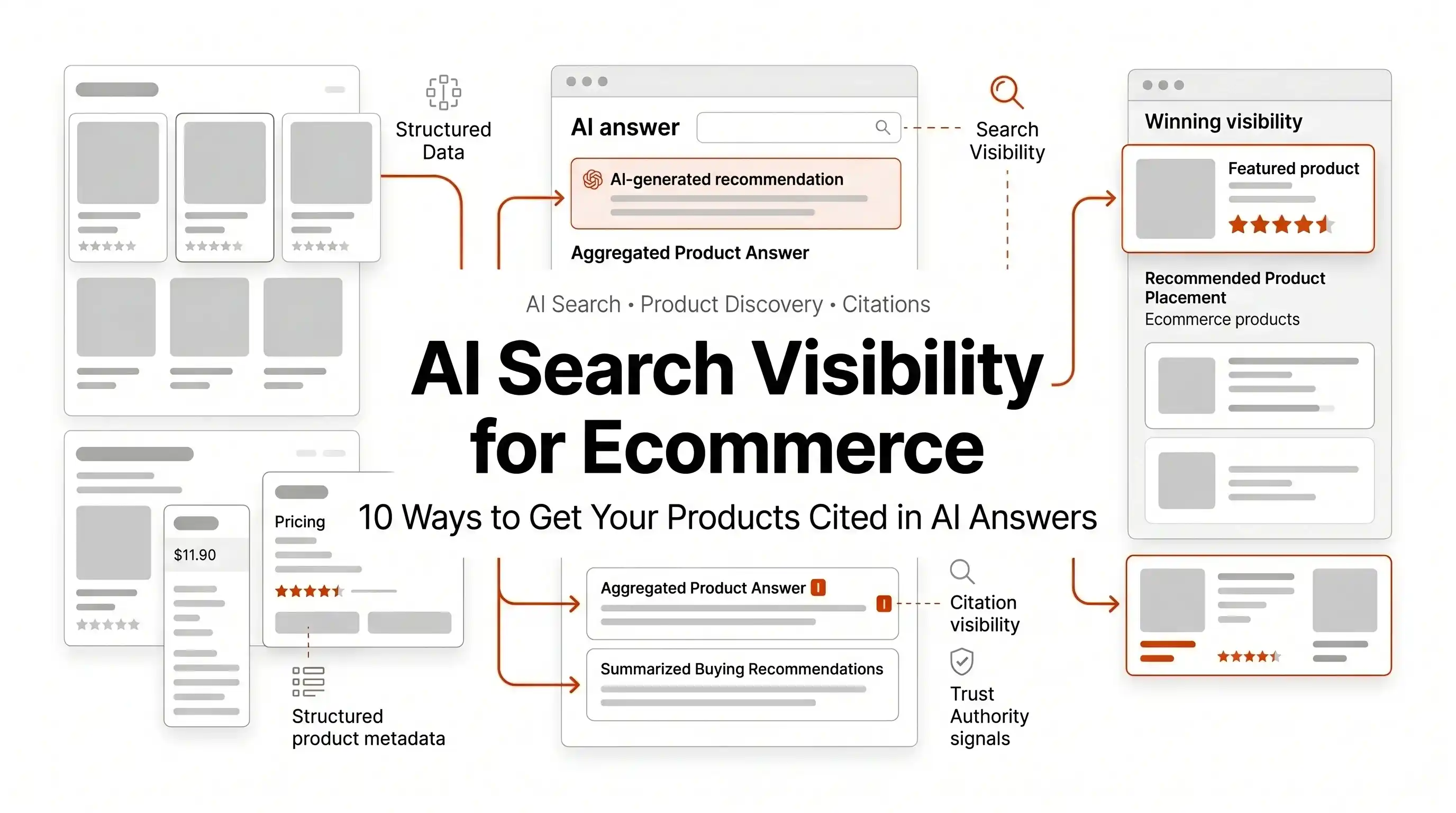


AI search for ecommerce is no longer a question of if, it is already reshaping product discovery, and brands that fail to act on their AI search visibility are already losing ground to competitors who do.
AI-referred shoppers carry roughly 14% higher average order value and convert nearly 50% better than organic search visitors, according to Shopify, which means the buyers arriving through AI citations aren't browsing, they are ready to buy. The discovery path has fundamentally shifted, and the brands winning in 2026 are the ones who have rebuilt their product content strategy around being citation-worthy, not just crawlable.
What Is AI Search Visibility for Ecommerce?
AI search visibility for ecommerce measures how consistently your products, brand, and product information appear inside AI-generated answers, conversational recommendations, and AI-powered shopping experiences. If you want the broader definition, see what AI search visibility is.
It is not a ranking metric.
It is a citation metric.
The platforms that matter here are ChatGPT, Google AI Overviews, Perplexity, and AI shopping assistants embedded across browsers and retail channels. When a buyer types "best running shoes for flat feet" or "skincare routine for sensitive oily skin," AI synthesizes a shortlist. If your products are not in that shortlist, they are invisible at the most decisive moment in the purchase journey.
The shift in buyer behavior is structural, not cyclical. In 2026, product discovery increasingly happens through conversational queries, AI-generated buying guides, and zero-click recommendation layers, not category browsing or sponsored listings. Brands that treat AI search visibility as an afterthought are optimizing for a discovery model that is rapidly losing share.
Why Ecommerce AI Search Visibility Is No Longer Optional
Traditional ecommerce visibility focused on three things: page rankings, traffic volume, and click-through rates. That model assumed the buyer would browse. AI search removes that assumption entirely.
AI engines synthesize answers, compare products, weigh sentiment from review ecosystems, and recommend specific items directly inside conversational responses. The buyer never needs to visit a category page. They receive a curated shortlist from the AI and act on it. You can have strong traffic from traditional channels and still be completely absent from the AI recommendation layer, which is exactly where the highest-intent buyers are making purchase decisions right now.
"The shift is not coming, it is already here, and the ecommerce brands winning in AI search are the ones treating it that way.
This is the strategic gap most ecommerce teams haven't closed. They are measuring sessions and conversions from known channels while the AI recommendation layer operates entirely outside their measurement stack. Ecommerce AI discoverability is not a future concern, it is an active revenue problem.
Did You Know?
AI-referred visitors are 38% more engaged, viewing 50% more pages per session and demonstrating a 27% lower bounce rate than traditional search traffic.
Source: Semrush (2025)
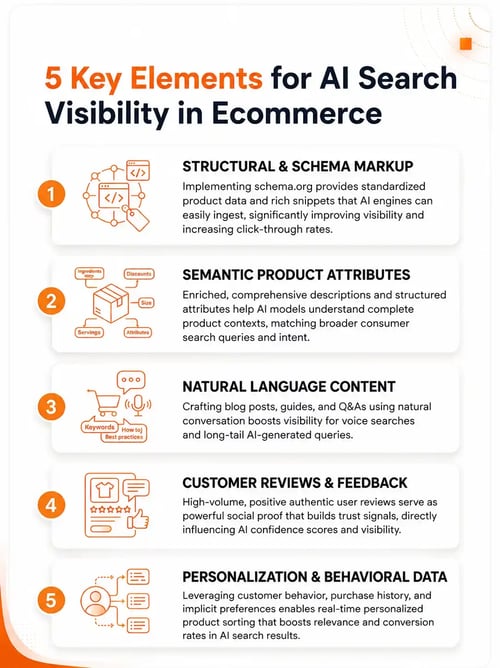
Explore the five essential elements that boost AI-driven search visibility in ecommerce and drive better product discovery.
10 Ways to Improve AI Search for Your Ecommerce Products
These are not theoretical recommendations. These are the specific optimization moves that determine whether your products appear in AI-generated buying recommendations or disappear into citation invisibility.
1. Structure Product Information for AI Extraction
AI engines extract answers from content that is organized for comprehension, not just for aesthetics. Product pages should lead with concise summaries, follow with structured specifications, and present comparison data in scannable formats.
Think: specs in bullet points, clear material or ingredient callouts, weight and dimension tables, and comparison summaries against use cases. If your product page reads like a brochure, it likely won't earn citations. If it reads like an authoritative reference document, it will.
2. Optimize Product Pages for Question Intent
Buyers don't ask AI "lightweight laptop 16GB RAM SSD." They ask "What's the best lightweight laptop for a graphic designer working remotely?" The intent layer is conversational and context-rich. Your product content must map to those full-phrase buyer questions, not just keyword fragments.
Build product content that directly answers the "best for [specific use case]" structure that drives AI recommendation queries. This is the core of ecommerce AEO: anticipating the buyer question before it is asked.
3. Implement Product Schema and Structured Data
This is non-negotiable for ecommerce AI search optimization. Product schema, FAQ schema, and Review schema create machine-readable layers that AI engines can extract with precision. Without structured data, AI must interpret your content through inference alone, which increases the probability of being overlooked in favor of a competitor whose product data is cleanly marked up. For the broader strategic framework beyond schema alone, see how to improve AI search visibility.If you're evaluating AI search visibility beyond ecommerce, see AI search visibility for law firms for a vertical-specific example of how the same shift is reshaping buyer discovery in another category.
Ensure your Product schema includes: name, description, brand, SKU, offers (price, availability), aggregateRating, and category. FAQ schema on every product page adds a direct question-to-answer mapping that AI engines actively prioritize.
4. Strengthen Product Entity Signals
Brand entity consistency is one of the most underestimated drivers of ecommerce AI discoverability. If your brand name appears differently across your product pages, social profiles, review platforms, and third-party retailers, AI models struggle to consolidate authority for your entity.
Maintain identical brand naming conventions, consistent product attribute language, and clear category-to-product relationships across every digital surface. This consistency is how AI builds confident entity recognition, and confident entity recognition is how products earn citations in high-competition query environments.
5. Build Contextual Content Around Your Products
Product pages alone are insufficient for AI citation authority. AI engines need broader context: buying guides, use-case articles, comparison content, and educational resources that establish your product's position within a category conversation.
A skincare brand selling a vitamin C serum shouldn't just have a product page. It should have a buying guide for "best vitamin C serums for sensitive skin," a comparison article contrasting formulation approaches, and educational content on ingredient interactions. AI needs an ecosystem to cite confidently, not a single isolated page.
6. Build Third-Party Validation Signals
AI shopping assistants and recommendation engines place significant weight on external trust sources. Reviews on major retail platforms, discussions in niche communities, editorial coverage, and brand mentions across publications all contribute to the validation layer AI uses to evaluate product credibility.
Active review generation strategies, genuine community participation, and earned media outreach aren't just reputation tactics in 2026. They are AI citation infrastructure. The more external sources reference your products positively, the stronger your citation signal becomes across every major AI platform.
7. Improve Review and Sentiment Coverage
AI shopping systems increasingly synthesize review sentiment rather than just displaying star ratings. The presence of nuanced buyer feedback that covers pros, cons, use-case fit, and product comparisons gives AI engines the evidence they need to recommend your product for specific buyer contexts.
Encourage detailed reviews that address use-case specifics. A review that says, "perfect for wide feet, the arch support held up after six months of daily use" is far more useful to an AI recommendation engine than "great product, highly recommend." Depth of sentiment is the signal, not just volume of reviews.
8. Optimize Product FAQs for Answer Engine Optimization
FAQ content is one of the most direct pathways into AI-generated answers. When a buyer asks an AI "Is [product type] safe for sensitive skin?" the AI is actively scanning for structured Q&A content that matches the query intent. Product FAQ sections that address real buyer questions, written in natural conversational language, are citation magnets.
Build FAQs that address: "Who is this product for?", "How does this compare to [competitor type]?", "What are the most common use cases?", "What do buyers with [specific need] think about this?" These question structures mirror the actual queries buyers send to AI, creating a direct bridge between buyer intent and your product content.
9. Monitor AI Search Visibility as a Core Metric
Most ecommerce teams are still measuring what happened after the click: sessions, conversion rate, AOV. Very few are measuring what happens before the click at the AI layer: citation frequency, prompt coverage, competitor citation share, and recommendation presence across AI platforms.
This measurement gap is the single biggest competitive blind spot in ecommerce right now. If you cannot see where AI is citing your products, where it is citing your competitors instead, and which buyer questions your content fails to answer, you cannot systematically improve your AI search visibility. Measurement must come before optimization.
10. Build AI-Ready Commerce Content Systems
The highest-performing ecommerce brands in the AI search era aren't creating individual optimized pages. They are building content ecosystems: interconnected systems of product pages, FAQ layers, buying guides, comparison content, educational resources, and external validation that collectively give AI engines everything they need to cite confidently across a wide range of buyer queries.
This is the architecture that separates brands that occasionally appear in AI answers from brands that dominate the AI recommendation layer within their category. It requires treating AI search visibility as a content system design challenge, not a single-page optimization task.
Did You Know?
On Shopify, AI-referred shoppers carry about 14% higher average order value and convert nearly 50% better than organic search, and AI chatbot referral sessions grew more than 8x year over year in early 2026. Source: Shopify (2026)
How Omnibound Helps Ecommerce Brands Improve AI Search Visibility
We built Omnibound specifically to close the gap between content formatting and strategic AI visibility. The challenge most ecommerce teams face isn't awareness that AI search visibility matters, it's knowing precisely where they stand, where competitors are winning citations they should own, and what to actually do about it.
Omnibound's AI Search Intelligence platform tracks buyer prompts across AI engines, maps which content earns citations and which content is invisible, identifies where competitors are being cited instead of you, and surfaces actionable gaps your content team can close. It unifies complex data from across the ecommerce stack, turning it directly into actionable recommendations that guide strategic moves.
The output is not generic AI-generated content. It is strategically positioned, buyer-aligned, and answer-optimized content that reflects your brand's specific expertise and the precise questions your target buyers are sending to AI right now.
We combine that citation intelligence with our Marketing Context Engine, which unifies customer signals, market signals, ICP behavior, and competitive intelligence into a single context layer that drives content decisions. Intelligence before content: that's the principle. You don't create a buying guide because it feels right. You create it because the buyer signal data shows exactly which questions are driving AI citations in your category and exactly where your brand is absent.
Conclusion
Ecommerce visibility is no longer only about building product pages that rank. Increasingly, it is about becoming part of the AI recommendation layer, the shortlist that forms inside a buyer's ChatGPT query before they ever visit a website. AI search visibility for ecommerce is the discipline that determines whether your products appear in that shortlist or are passed over entirely in favor of competitors who have done the optimization work.
If you're evaluating AI search visibility beyond ecommerce, see AI search visibility for law firms for a vertical-specific example of how the same shift is reshaping buyer discovery in another category.
The 10 moves outlined here, from structuring product information for AI extraction to building complete content ecosystems and monitoring citation presence as a core metric, are not incremental improvements to an existing approach. They represent a strategic reorientation toward how product discovery actually works in 2026.
FAQs
What is AI search visibility for ecommerce and why does it matter in 2026?
AI search visibility for ecommerce measures how often your products appear inside AI-generated answers and buying recommendations on platforms like ChatGPT, Google AI Overviews, and Perplexity. It matters in 2026 because product discovery is increasingly happening through conversational AI queries rather than traditional browsing, and brands absent from those AI recommendations are missing the highest-intent buyers in their category.
How do I get my ecommerce products cited in ChatGPT recommendations?
To get products cited in ChatGPT recommendations, you need structured product data (Product schema, FAQ schema, Review schema), content that directly addresses buyer question intent, strong third-party validation through reviews and editorial mentions, and consistent brand entity signals across all platforms. AI citation is earned through content completeness and external trust, not just page creation.
Is ecommerce AEO different from traditional SEO for product pages?
Yes, ecommerce AEO (Answer Engine Optimization) focuses specifically on making product content citation-worthy inside AI-generated answers, rather than optimizing for click-through from a results page. AEO prioritizes question-intent mapping, structured data for machine extraction, and external validation signals, while traditional approaches prioritize keyword density and page authority for click-based discovery.
Can small ecommerce brands compete for AI search visibility against large retailers?
Absolutely. AI citation is determined by content quality, specificity, and trust signals, not domain size or advertising budget. A small brand with highly structured product pages, detailed FAQs, strong review sentiment, and contextual buying guide content can outperform a large retailer with thin, generic product descriptions in AI recommendation environments.
How do I measure whether my products are being cited in AI answers?
Measuring ecommerce AI discoverability requires dedicated AI Search Intelligence tooling that tracks buyer prompts across AI engines, monitors citation frequency for your products and competitors, and maps content gaps to specific buyer query patterns. Traditional analytics platforms don't capture this data, which is why most brands currently have a blind spot in their AI visibility measurement.
What types of content improve product citation in Google AI Overviews?
Google AI Overviews prioritize content that directly answers buying questions with structured, credible information. For ecommerce, this means product pages with complete structured data markup, buying guides that compare products across specific use cases, FAQ sections addressing common buyer questions, and strong aggregate review coverage that gives Google's AI sufficient evidence to recommend confidently.
How long does it take to see results from ecommerce AI search optimization?
Results from ecommerce AI search optimization are typically observable within 4 to 12 weeks of implementing structured data improvements, contextual content additions, and review signal strengthening, though timelines vary based on category competitiveness and the current state of your product content architecture. Brands starting from a strong structured-data foundation tend to see citation improvements faster than those rebuilding product content from scratch.