

AI Search Visibility by Industry - Legal is one of the most urgent competitive challenges facing law firms in 2026, and most practices have no idea how much ground they are already losing. The client discovery journey has fundamentally changed: prospective clients are no longer starting with a Google search and browsing firm websites. They are opening ChatGPT, Perplexity, Google AI Overviews, and Gemini, typing a legal question, and acting on whatever answer comes back, including which attorneys get named.
What Is AI Search Visibility for Law Firms and Why It Defines Legal Discovery in 2026
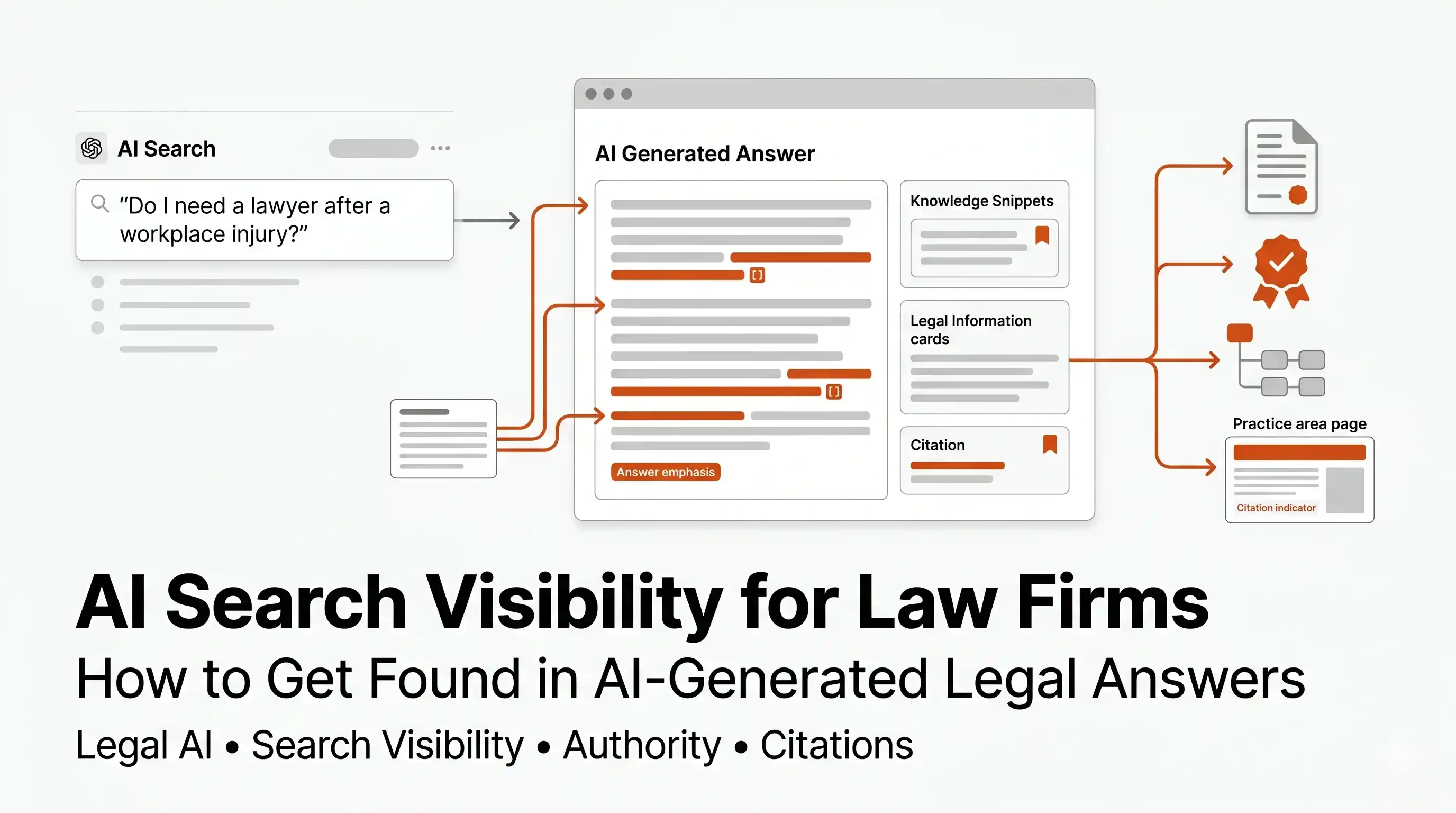
AI Search Visibility for law firms measures how frequently your firm, your attorneys, your practice area pages, and your legal guidance appear inside AI-generated answers when prospective clients ask legal questions.
It is the core discipline that determines whether your brand is present or invisible at the moment buyers make decisions in 2026. And in legal, that moment now happens before a prospective client ever visits your website.
Think about the questions people are asking AI systems right now:
- "Do I need a personal injury lawyer after a car accident?"
- "Best employment lawyer in Austin for wrongful termination."
- "How long do I have to file a wage theft claim in California?"
- "Can I sue my landlord for mold exposure?"
AI systems answer every one of those questions directly. They name firms. They recommend attorneys. They create a shortlist before the prospective client ever clicks a single website link.
If your firm is not present in those answers, you may disappear from the discovery process entirely before organic visibility even becomes relevant.
Why Traditional Legal Marketing Is No Longer Enough for AI Search Visibility by Industry
Traditional legal marketing was built around a simple model: appear prominently in search, drive traffic to a polished website, convert visitors into consultation requests. That model still has value. But it no longer describes the full picture of how legal clients find attorneys in 2026.
AI search is deciding pipeline before the website visit happens. Most legal content was never built for AI visibility, and the gap between firms that have optimized for AI citation and those that have not is widening every month.
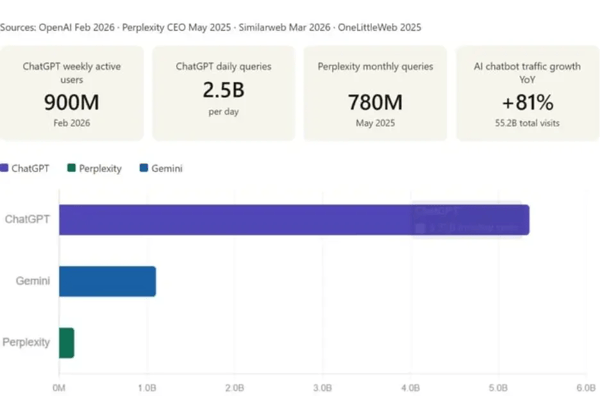
Here is the critical insight most legal marketers miss: a law firm can hold strong positions in Google and still receive zero AI citations. Traditional performance metrics, such as organic traffic and keyword positions, do not tell you anything about your presence in AI-generated legal answers.
|
Traditional Legal Marketing |
AI Search Visibility for Law Firms |
|
Keyword rankings |
AI citation presence |
|
Website traffic |
Recommendation inclusion frequency |
|
Click-through rate |
Answer inclusion across platforms |
|
Marketing copy pages |
Trusted legal entities and structured content |
|
Local SEO listings |
Entity trust and jurisdiction-aware signals |
The new competition layer is selection, not just visibility. And the firms that recognize this shift in 2026 will build a durable advantage that compounds over time.
How AI Systems Decide Which Law Firms to Cite in Legal Answers
This is where AI Search Visibility by Industry - Legal becomes genuinely strategic. AI systems are not selecting law firms at random. They follow specific trust and authority signals, and legal is a YMYL (Your Money or Your Life) category, which means AI platforms apply the highest standards of source credibility before naming a firm or attorney.
Here is how AI citation decisions in legal typically work:
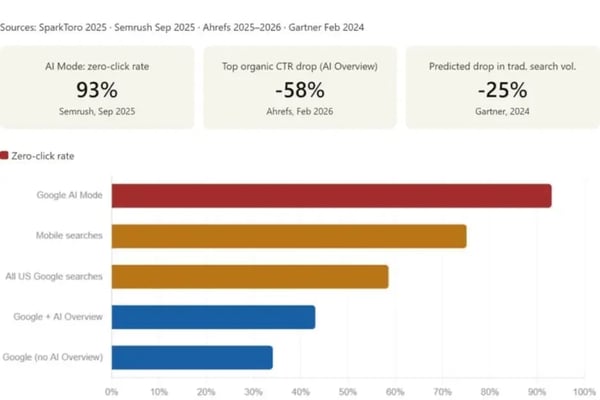
The result? Firms that built content for traditional visibility often have significant citation gaps inside AI-generated legal answers, even when their traditional performance metrics look strong.
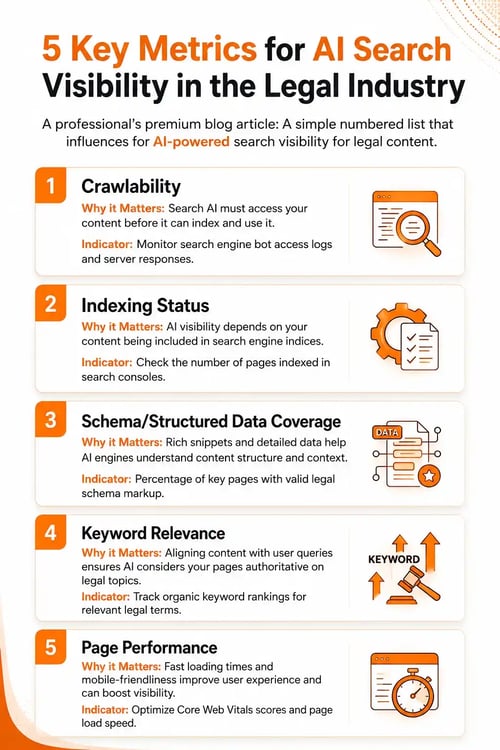
This infographic highlights five metrics shaping AI search visibility in the legal industry. Learn which factors drive visibility and how to optimize strategy.
10 Ways Law Firms Can Improve AI Search Visibility by Industry - Legal
These are not generic content tips. This is a direct framework for earning citation presence inside the AI platforms your prospective clients are already using to find attorneys.
1. Build Question-Driven Legal Content
AI systems retrieve answers to specific questions. Your content needs to be built around the exact questions prospective clients are asking, including statute of limitations by practice area, claim timelines, procedural steps, cost expectations, and jurisdiction-specific rules.
Generic "About Our Firm" copy does not get cited. Direct legal answers do.
2. Optimize Practice Area Pages for AI Extraction
Each practice area page should include a concise summary of what the practice covers, clear jurisdiction signals, structured subheadings that mirror how AI extracts information, and FAQ content addressing the most common questions in that area of law.
Thin marketing copy is one of the primary reasons law firms fail to appear in AI answers. Replace it with structured legal guidance that AI can actually retrieve.
3. Create AI-Friendly Legal FAQs
FAQ content is among the highest-performing formats for legal AI citation. Examples that consistently earn AI attention include: "How long does probate take in Texas?", "Can I sue after a workplace injury?", "What is the statute of limitations for medical malpractice in Florida?"
Each FAQ entry should include a direct, accurate, jurisdiction-aware answer. Vague answers do not get cited.
4. Strengthen Local Legal Entity Signals
Local entity trust is a critical AI visibility layer for law firms. Maintain complete consistency across your Google Business Profile, Avvo, Martindale-Hubbell, FindLaw, Justia, state bar directory listings, and attorney profile pages.
Inconsistent location signals fragment AI entity recognition and reduce citation probability for jurisdiction-specific queries.
5. Build Deep Practice Area Authority
A single practice area page is not enough to establish topical authority in AI systems. You need a deep content ecosystem: detailed practice guides, FAQ libraries, procedure explainers, case-type breakdowns, and jurisdiction-specific resources.
AI systems recognize topical authority through the depth and interconnection of content within a subject area. This is where the firms that invest in comprehensive legal content pull significantly ahead.
6. Earn Third-Party Trust Signals Consistently
AI citation decisions in legal are heavily weighted toward external validation. Legal directories, peer recognition programs, verified reviews, bar association profiles, and earned media coverage all contribute to the trust score AI systems assign your firm.
Non-paid media drives 95% of AI citations according to a Muck Rack and Generative Pulse report. This means authority is earned, not bought, and the firms building genuine external validation are the ones earning consistent AI citation presence.
7. Implement Schema and Structured Data
FAQ schema, attorney schema, organization schema, and local business schema all improve machine readability. AI systems extract structured data more reliably than unstructured prose, so schema implementation directly supports citation presence.
This is especially important for attorney profiles, practice area pages, and location-specific legal content.
8. Keep Legal Content Current and Jurisdiction-Aware
Legal information changes. AI systems prefer recent, accurate, jurisdiction-specific guidance over outdated content that may have been accurate two years ago but no longer reflects current law.
A content freshness program, treating legal practice content as a living resource rather than a set-and-forget asset, directly supports AI citation reliability and frequency.
9. Measure AI Visibility Separately From Traditional Performance
Most firms track organic sessions and form submissions. Very few track AI citation frequency, answer inclusion by practice area, or competitive AI visibility gaps. These are entirely different measurement systems and they require different tools.
Treating AI search visibility as a byproduct of traditional performance measurement leaves firms blind to the most consequential layer of modern legal discovery.
10. Test Your Firm Across Real AI Platforms Regularly
Run structured prompts across ChatGPT, Perplexity, Google AI Overviews, Gemini, and Claude. Track which prompts surface your firm, how often competitors appear in answers where you do not, and where citation gaps are growing.
This is not a one-time audit. It is an ongoing intelligence function, and the firms treating it as such are building a compounding competitive advantage in 2026.
Biggest Reasons Law Firms Fail To Appear in AI-Generated Legal Answers
Most AI Search Visibility by Industry - Legal gaps come from the same repeating patterns. Recognizing them is the first step toward closing them.
The brutal truth is that most legal websites were built to impress prospective clients who arrive through traditional discovery. They were never built to be retrieved, trusted, and cited by AI-powered answer systems. That is the gap this framework is designed to close.
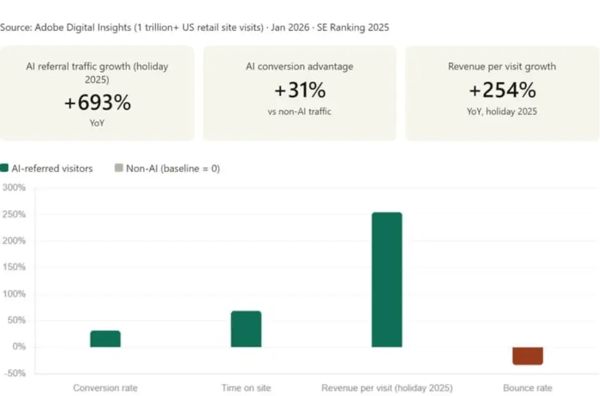
The AI Visibility Gap in Legal Marketing That Most Firms Are Missing
Here is where the competitive landscape currently stands: most law firms are still optimizing for traditional performance metrics while the actual selection layer for new client acquisition has shifted to AI recommendation systems.
The firms that close this gap first will earn a compounding structural advantage. AI citation presence builds on itself. The more structured, authoritative, and externally validated your legal content becomes, the more consistently AI systems retrieve and recommend your firm, and the harder that position becomes for competitors to displace.
This is not a future trend to monitor. It is the current state of legal discovery in 2026, and the intelligence gap between firms that are measuring AI citation presence and firms that are not is already substantial.
A structured AI search visibility diagnostic is often the fastest way to understand where your firm currently stands in AI-generated legal answers and where the most valuable citation opportunities exist.
How Omnibound Helps Law Firms Improve AI Search Visibility by Industry - Legal
Omnibound is built specifically to solve the problem most legal marketers cannot see coming: the gap between traditional performance measurement and actual AI citation presence across the platforms that now drive legal discovery.
Our AI Search Intelligence platform tracks every prompt, every citation, and every gap that matters to your firm's AI discoverability. This is not a reporting dashboard. It is an active intelligence system that converts visibility data into action.
Here is what Omnibound specifically does for law firm AI visibility:
Omnibound analyzes real buyer conversations and market signals to uncover what your buyers are asking AI engines, then creates and optimizes content that improves AI search visibility and gets your brand ranked, cited, and recommended across ChatGPT, Perplexity, Gemini, Claude, and Google AI Mode.
For law firms, this means treating AI citation presence as a revenue-connected strategy, not a supplementary content checklist. Our AI visibility to pipeline framework connects citation data directly to client acquisition outcomes, so your investment in legal AI visibility generates measurable return.
|
Traditional Legal Marketing Measurement |
Omnibound AI Search Intelligence |
|
Organic traffic sessions |
AI citation frequency by platform |
|
Keyword position tracking |
Legal question coverage and answer inclusion |
|
Website conversion reports |
AI visibility intelligence connected to pipeline |
|
One-time content audits |
Always-on AI discovery monitoring |
|
Competitor page comparisons |
Competitive AI citation tracking and gap analysis |
The Future of Legal Discovery Is Already Here
The shift toward conversational legal search is not coming. It has arrived. AI legal assistants, zero-click discovery, and recommendation-driven attorney selection are already shaping how prospective clients find and choose law firms in 2026.
The firms that will dominate legal discovery over the next several years are not necessarily the largest or the ones with the biggest advertising budgets. They are the ones building structured legal authority that AI systems can retrieve, trust, and cite consistently across every platform where clients are asking legal questions.
We treat content and authority as living artifacts that update as client questions, market conditions, and legal information evolve. This is the same approach we embed into how we help law firms build AI citation presence, because static content strategies do not compete in an environment where AI-driven legal discovery updates in real time.
The living research intelligence we build for legal clients ensures that content optimization, authority signal development, and AI citation monitoring stay current as the competitive landscape shifts, not just at the point of initial implementation.
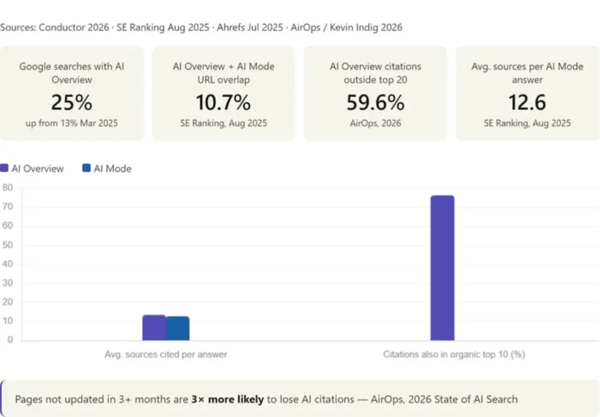
Conclusion
AI Search Visibility by Industry - Legal is no longer a forward-looking consideration for law firms. It is the defining competitive factor in client discovery right now, in 2026, across the platforms where prospective clients are already asking legal questions and acting on AI-generated recommendations.
Legal marketing is no longer only about appearing in Google. Increasingly, it is about becoming a trusted legal source inside AI-generated answers across ChatGPT, Perplexity, Google AI Overviews, Gemini, and Claude. If AI never surfaces your firm, many prospective clients may never reach your website.
The 10 strategies in this guide give your firm a direct path to improving AI citation presence, practice-area authority, and local entity trust signals. Omnibound's Marketing Context Engine and AI Search Intelligence platform give you the ongoing intelligence layer to turn those strategies into measurable visibility improvements and connect AI citation presence directly to client acquisition outcomes.
The firms building AI visibility now are creating a compounding advantage. The firms waiting are creating a gap that grows harder to close every month. This is the moment to act.
FAQs
What is AI search visibility for law firms in 2026?
AI Search Visibility for law firms measures how often your firm, attorneys, and legal content appear inside AI-generated answers across ChatGPT, Google AI Overviews, Perplexity, and Gemini when prospective clients ask legal questions. In 2026, this visibility layer now sits above traditional discovery and directly influences which firms enter a prospective client's consideration set before any website visit occurs.
How do law firms appear in ChatGPT answers?
Law firms appear in ChatGPT answers by building structured, question-driven legal content with strong practice area depth, consistent local entity signals, and external validation from legal directories, reviews, and media mentions. ChatGPT prioritizes legal sources that demonstrate jurisdictional expertise, provide direct answers to specific legal questions, and carry strong third-party authority signals.
What is GEO for law firms and how is it different from traditional marketing?
GEO (Generative Engine Optimization) for law firms is the practice of optimizing content, authority signals, and entity trust so AI systems retrieve and cite your firm inside generated legal answers. Unlike traditional marketing approaches focused on traffic and positions, GEO targets AI citation presence, answer inclusion, and recommendation frequency across AI-powered platforms.
Is AI Search Visibility by Industry - Legal worth investing in for small law firms?
Yes. AI Search Visibility by Industry - Legal rewards practice-area depth, structured content, and local entity consistency more than firm size or ad spend. Small and mid-size law firms with deep topical expertise in specific practice areas can consistently outperform larger generalist firms in AI citation presence when their content is properly structured for AI extraction and their authority signals are strong.
How do I measure my law firm's AI citation presence?
Law firm AI citation presence is measured through dedicated AI search intelligence platforms that track prompt responses across ChatGPT, Perplexity, Google AI Overviews, Gemini, and Claude, identifying where your firm appears, where competitors appear instead, and where citation gaps exist by practice area and geography. Traditional analytics platforms do not capture this data.
Which practice areas benefit most from legal AI search visibility optimization?
Personal injury, employment law, family law, estate planning, immigration, and criminal defense consistently generate high volumes of AI-assisted legal queries because prospective clients in these areas actively research their situations before engaging an attorney. These practice areas represent the highest-priority targets for AI Search Visibility by Industry - Legal optimization in 2026.
How long does it take for a law firm to improve AI citation presence?
Law firms with existing domain authority and a structured content foundation typically begin seeing measurable AI citation improvements within 60 to 90 days of implementing question-driven content, FAQ coverage, and entity signal optimization. Firms starting from a weaker authority baseline should expect a 3-to-6-monthmonth runway to build the depth of topical coverage and external validation that AI systems require for consistent citation inclusion.