

Last updated: May 2026. We review and update this page quarterly as new primary research is published.
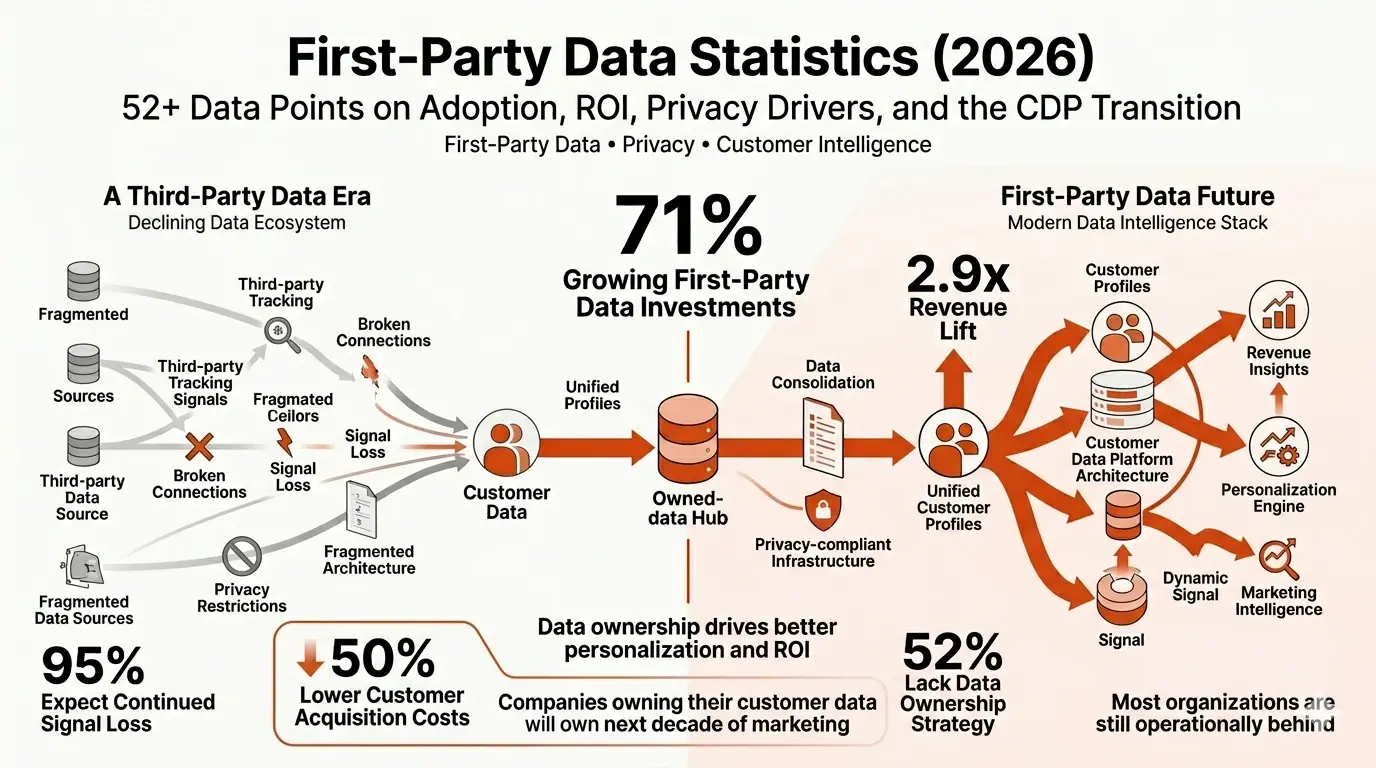
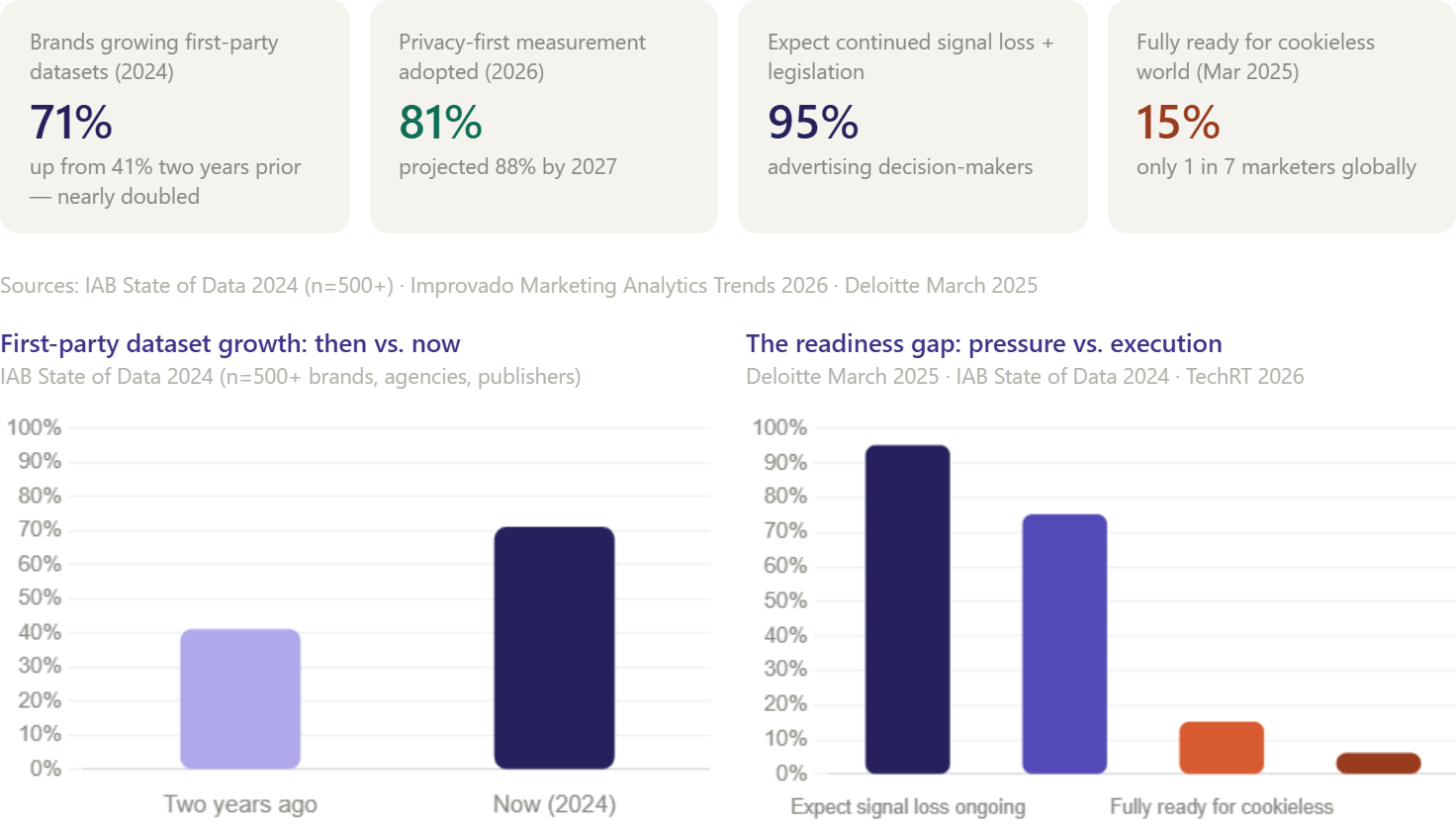
71% of brands, agencies, and publishers are currently growing or planning to grow their first-party datasets — nearly double the 41% rate reported just two years earlier (IAB, State of Data 2024, n=500+ advertising and data experts). The shift is structural, not cyclical. Three forces are compressing the timeline simultaneously: GDPR cumulative fines have now exceeded €7.1 billion with €1.2 billion issued in 2025 alone (DLA Piper, GDPR Fines and Data Breach Survey 2025); Apple's App Tracking Transparency reduced cross-app tracking by over 40% globally; and 95% of advertising and data decision-makers expect continued signal loss and privacy legislation in the years ahead (IAB, State of Data 2024).
The commercial case is equally compelling. Businesses using first-party data in marketing campaigns saw a 2.9x increase in revenue lift compared to those using other data sources (Google/BCG, The Business Impact of First-Party Data). First-party data reduces customer acquisition costs by up to 50% (McKinsey, Personalization). Yet despite the urgency, Supermetrics' 2026 Marketing Data Report found that 52% of marketing teams don't own their data strategy — and only 6% have fully embedded data-driven approaches into their workflows (Supermetrics, 2026 Marketing Data Report, n=435).
We aggregated data from IAB/BWG Strategy, Supermetrics, Google/BCG, Forrester, DLA Piper, Salesforce, McKinsey, Deloitte, and other primary sources to compile the most rigorously sourced first-party data statistics available for 2026.
Key Takeaways
- 71% of brands are currently growing or planning to grow their first-party datasets — nearly 2x the 41% rate two years prior (IAB, State of Data 2024)
- 81% of organizations have adopted privacy-first measurement strategies in 2026; 88% projected to rely primarily on first-party data by 2027 (Improvado, Top Marketing Analytics Trends 2026)
- Businesses using first-party data see a 2.9x revenue lift vs. those using other data sources (Google/BCG)
- First-party data improves customer acquisition costs by up to 83% and conversions by 73% (Forrester Consulting, 2024)
- GDPR cumulative fines now exceed €7.1 billion; €1.2 billion levied in 2025 alone (DLA Piper, GDPR Fines Survey 2025)
- 95% of advertising decision-makers expect continued signal loss and privacy legislation (IAB, State of Data 2024)
- Only 15% of global marketers felt fully ready for a cookieless world as of March 2025 (Deloitte, March 2025 survey)
- 72% of marketers worldwide now use CDPs alongside other tools (Salesforce, State of Marketing 9th edition); 78% of enterprise companies have adopted CDPs (TechRT, First-Party Data Statistics 2026)
- 52% of marketing teams don't own their data strategy; only 6% have fully embedded data-driven workflows (Supermetrics, 2026 Marketing Data Report)
- Brands using first-party data see 8x ROI and over 25% lower CPA (Avaus benchmark analysis, 2025)
- 86% of consumers express higher trust in companies that rely primarily on first-party data (Twilio, Consumer Trust and Data Privacy Survey 2023)
- The global CDP market is expected to reach $10.3 billion by 2026 at a 34% CAGR (Fortune Business Insights)
Adoption and The Privacy Forcing Function
First-party data adoption is no longer discretionary. Three converging forces — regulatory pressure, signal loss from privacy changes, and commercial performance requirements — have made it the default data strategy for the majority of enterprise marketing organizations. The IAB's doubling of first-party dataset growth rates (from 41% to 71% in two years) is the most precise measure of how quickly this shift has accelerated.
The readiness gap, however, is stark. Despite near-universal acknowledgment that signal loss is permanent and privacy legislation will intensify, only 15% of global marketers felt fully prepared for a cookieless environment as of March 2025 (Deloitte). That gap between strategic necessity and operational readiness is where most first-party data programs are stalling — not for lack of intention, but for lack of infrastructure and ownership.
| Metric | Value | Source |
|---|---|---|
| Brands/agencies/publishers growing first-party datasets | 71% (up from 41% two years prior) | IAB, State of Data 2024 |
| Ad decision-makers expecting continued signal loss and privacy legislation | 95% | IAB, State of Data 2024 |
| Organizations that have adopted privacy-first measurement strategies (2026) | 81% | Improvado, Marketing Analytics Trends 2026 |
| Organizations projected to rely primarily on first-party data by 2027 | 88% | Improvado, Marketing Analytics Trends 2026 |
| Global marketers who felt fully ready for cookieless world (March 2025) | Only 15% | Deloitte, March 2025 survey |
| US marketers increasing first-party data investment (2024) | Over 50% | Deloitte, March 2025 survey |
| Marketers shifting personalization tactics due to privacy changes | ~90% | IAB, State of Data 2024 |
| Companies with significant operational changes due to signal loss/legislation | Over 80% | IAB, State of Data 2024 |
| Brands that plan to phase out reliance on third-party data by 2026 | 75% | TechRT, First-Party Data Statistics 2026 |
The 15% readiness figure from Deloitte (March 2025) is the sharpest indictment of where most organizations stand. The majority of companies are building their first-party data strategy under pressure rather than ahead of it. The advantage goes to teams that have already built the infrastructure, not those still waiting for a regulatory trigger.
Collection Methods and Data Sources
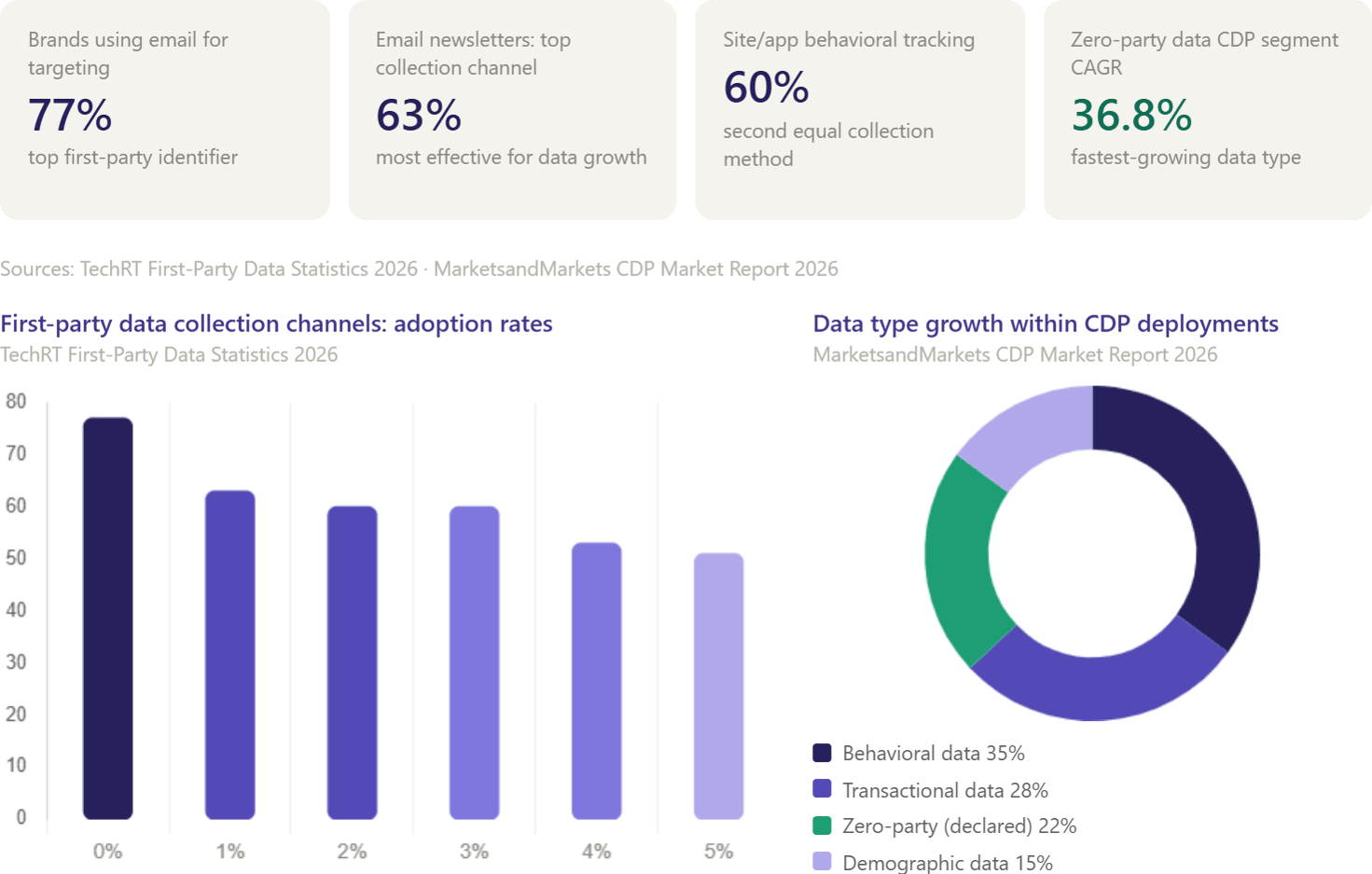
First-party data collection is not a single channel strategy. The most effective programs combine behavioral data (site and app visits), transactional data (purchase history), declared preferences (zero-party data), and CRM signals into a unified profile. Email remains the most widely used collection mechanism — 63% of advertisers use email newsletters as their primary first-party data growth channel. But behavioral tracking via site and app visits (60%) and social media engagement (60%) are equally widespread, reflecting how multi-channel collection has become standard.
63 ROIN business impact
The zero-party data segment — data consumers explicitly provide, such as preferences and survey responses — is growing fastest. MarketsandMarkets projects zero-party data within CDP deployments at a 36.8% CAGR, outpacing every other data type segment.
| Metric | Value | Source |
|---|---|---|
| Advertisers using email newsletters for first-party data collection | 63% | TechRT, First-Party Data Statistics 2026 |
| Brands using site/app behavioral tracking for first-party data | 60% | TechRT, First-Party Data Statistics 2026 |
| Brands using social media engagement for first-party data | 60% | TechRT, First-Party Data Statistics 2026 |
| Brands using content marketing to drive first-party data collection | 53% | TechRT, First-Party Data Statistics 2026 |
| DTC (direct-to-consumer) models adopted for first-party data ownership | 51% of advertisers | TechRT, First-Party Data Statistics 2026 |
| Brands using email data for targeting | 77% | TechRT, First-Party Data Statistics 2026 |
| Zero-party data CDP segment CAGR | 36.8% (highest of all data type segments) | MarketsandMarkets, CDP Market Report 2026 |
Email's dominance as both a collection and activation channel is reinforced by its direct ownership characteristic — email addresses are first-party identifiers that no third party can deprecate. The combination of email (collection), behavioral data (intent signals), and preference data (zero-party) is the most resilient first-party data architecture because it doesn't depend on any single platform's policy decisions.
ROI and Business Performance
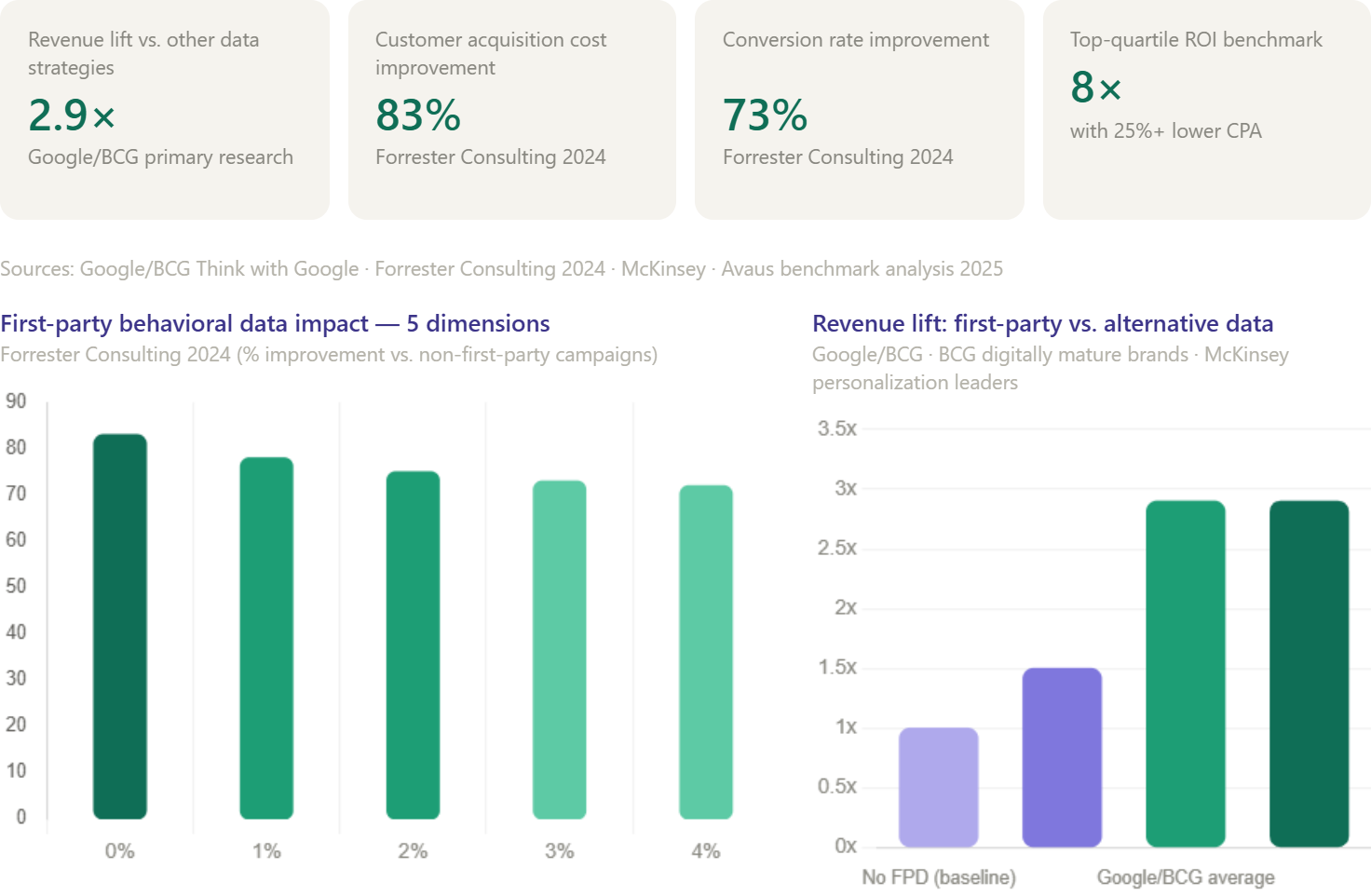
The commercial case for first-party data has moved from theoretical to empirically documented. The Google/BCG study finding of 2.9x revenue lift is the most widely cited primary benchmark. Forrester's 2024 research adds operational specificity: first-party behavioral data improves customer acquisition costs by 83%, satisfaction scores by 78%, brand awareness by 75%, conversions by 73%, and ROI by 72%. These are not directional estimates — they are measured outcomes from businesses that have deployed first-party behavioral data in live campaigns.
The range of documented outcomes is wide, and the highest-performing brands are significantly above the median. BCG's research on digitally mature brands found 1.5x to 2.9x revenue uplifts from advanced first-party data activation. The 8x ROI figure from Avaus benchmark analysis represents the top-quartile outcome, not the average.
| Metric | Value | Source |
|---|---|---|
| Revenue lift vs. non-first-party data strategies | 2.9x higher | Google/BCG, Business Impact of First-Party Data |
| Digitally mature brands: revenue uplift from advanced first-party data | 1.5x–2.9x | BCG, via Avaus 2025 |
| First-party data: customer acquisition cost improvement | Up to 83% | Forrester Consulting, 2024 |
| First-party data: conversion rate improvement | 73% | Forrester Consulting, 2024 |
| First-party data: ROI improvement | 72% | Forrester Consulting, 2024 |
| First-party data: brand awareness improvement | 75% | Forrester Consulting, 2024 |
| Brands using first-party data: ROI benchmark (top quartile) | 8x ROI, 25%+ lower CPA | Avaus benchmark analysis, 2025 |
| Marketers reporting measurable ROI improvements from first-party data | 70% | TechRT, First-Party Data Statistics 2026 |
| Campaign performance efficiency gains from first-party data | 20–40% | TechRT, First-Party Data Statistics 2026 |
The Forrester data deserves particular attention because it measures multiple outcome dimensions simultaneously rather than isolating a single performance metric. The fact that acquisition costs, conversions, ROI, and brand awareness all improve by 70%+ using the same first-party behavioral data set suggests these are systemic improvements from better targeting precision — not channel-specific effects.
CDP Infrastructure: The Platform Layer
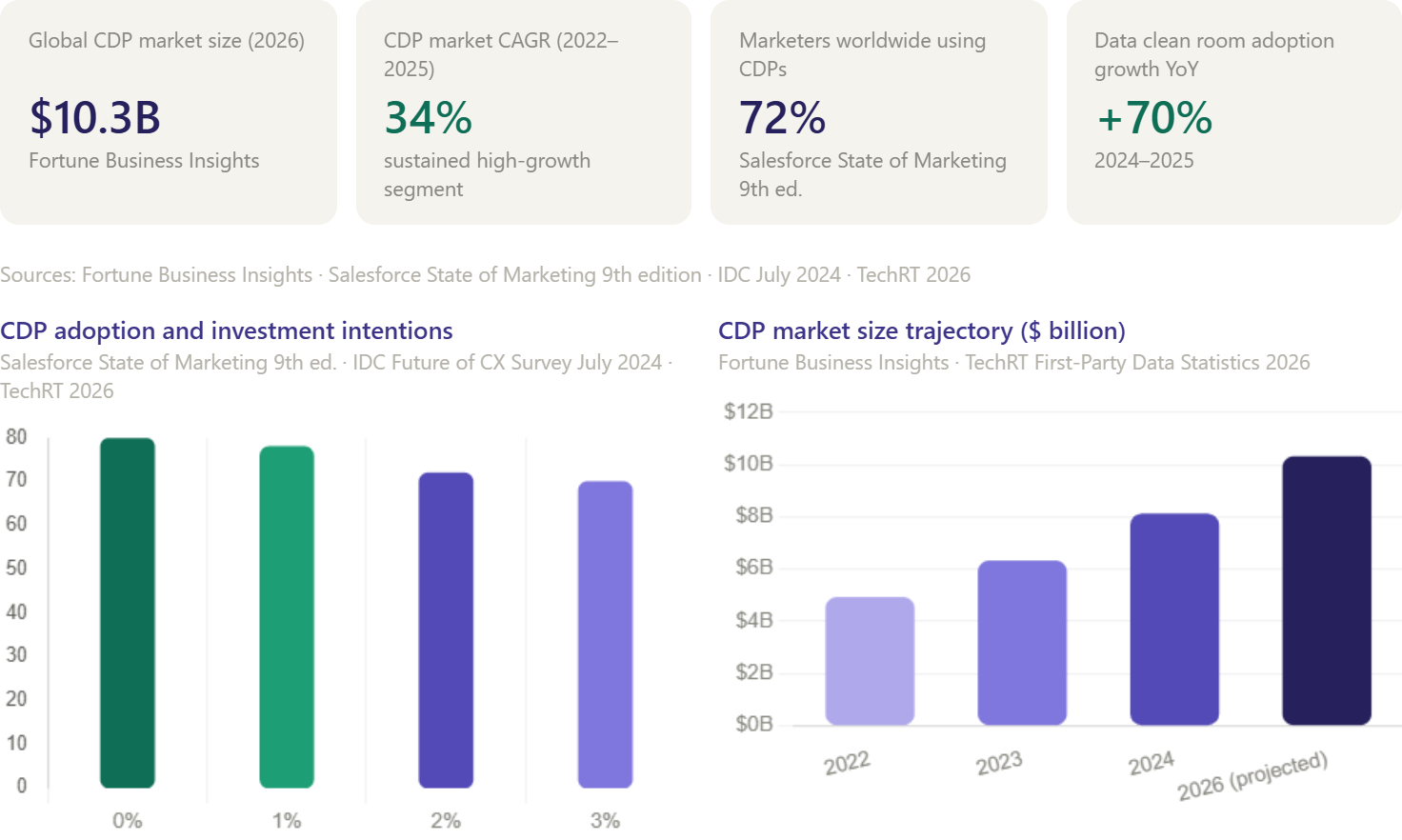
Customer data platforms have become the primary infrastructure for first-party data activation — the system that unifies raw data from multiple owned channels into actionable profiles. Adoption has scaled significantly: 72% of marketers worldwide now use CDPs alongside other tools (Salesforce State of Marketing 9th edition), and 78% of enterprise companies have deployed them (TechRT). The global CDP market is projected to reach $10.3 billion by 2026, driven by 34% CAGR growth between 2022 and 2025.
The investment trajectory is equally strong: nearly 80% of respondents in IDC's July 2024 Future of Customer Experience Survey planned to increase their CDP spend. Data clean room adoption grew 70% year-over-year in 2024–2025, reflecting the need for privacy-safe data collaboration that first-party data strategies require.
| Metric | Value | Source |
|---|---|---|
| Marketers worldwide using CDPs alongside other tools | 72% | Salesforce, State of Marketing 9th edition |
| Enterprise companies with CDP deployed | 78% | TechRT, First-Party Data Statistics 2026 |
| Global CDP market size (2026 projection) | $10.3 billion | Fortune Business Insights, CDP Market Report |
| CDP market CAGR (2022–2025) | 34% | TechRT, First-Party Data Statistics 2026 |
| Enterprises planning to increase CDP spend (IDC, July 2024) | ~80% | IDC, Future of Customer Experience Survey, July 2024 |
| Data clean room adoption growth YoY (2024–2025) | +70% | TechRT, First-Party Data Statistics 2026 |
| Zero-party data segment CAGR within CDPs | 36.8% (highest segment) | MarketsandMarkets, CDP Market Report 2026 |
The 72% CDP adoption figure masks a maturity split that is more telling than the headline number. Salesforce's own analysis shows early adopters who completed migration before 2025 cited 15–25% lifts in customer lifetime value and 10–12% improvements in media efficiency — but these are the teams with mature, fully integrated deployments. The majority of the 72% are still consolidating data rather than activating it.
Privacy Regulation as Commercial Accelerant
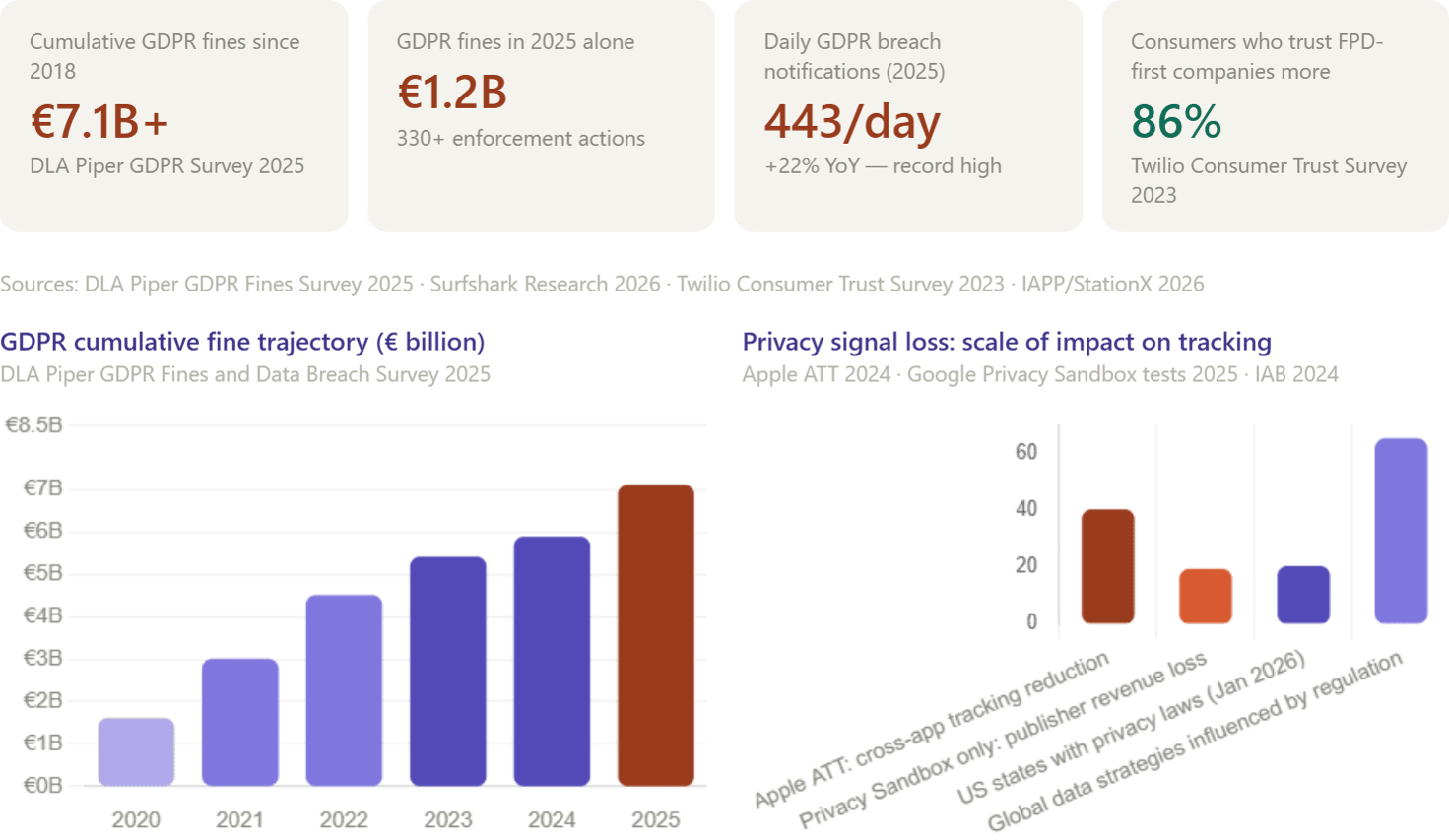
Privacy regulation has moved from a compliance issue to a competitive differentiator. Cumulative GDPR fines now exceed €7.1 billion, with €1.2 billion levied in 2025 alone across 330+ enforcement actions (DLA Piper, 2025). The regulatory expansion is widening beyond Big Tech — Spain leads all countries with 1,033 enforcement actions, the majority against mid-market companies, not just major platforms. Twenty US states now have comprehensive data privacy laws, with Indiana, Kentucky, and Rhode Island taking effect January 1, 2026.
The consumer trust dimension amplifies the commercial case. Twilio's Consumer Trust Survey found 86% of consumers express higher trust in companies that rely primarily on first-party data. Given that consumer trust is a direct predictor of willingness to share data — which in turn improves first-party data quality — this creates a compounding advantage for brands that invest in transparent, consent-based data strategies.
| Metric | Value | Source |
|---|---|---|
| Cumulative GDPR fines since 2018 | €7.1 billion+ | DLA Piper, GDPR Fines and Data Breach Survey 2025 |
| GDPR fines levied in 2025 alone | €1.2 billion (330+ enforcement actions) | DLA Piper 2025; Surfshark Research 2026 |
| GDPR breach notifications per day (2025 record) | 443 per day (22% YoY increase) | DLA Piper 2025 |
| US states with comprehensive data privacy laws (as of Jan 2026) | 20 states | IAPP / StationX, Data Privacy Statistics 2026 |
| Apple ATT: cross-app tracking reduction globally | Over 40% | Industry documentation, 2024 |
| Privacy Sandbox only: publisher revenue reduction (Google test) | −18% to −20% | Google / CMA report, June 2025 |
| Consumers who trust first-party data companies more | 86% | Twilio, Consumer Trust and Data Privacy Survey 2023 |
| Regulatory frameworks influencing over 65% of global data strategies | 65%+ | TechRT, First-Party Data Statistics 2026 |
The Apple ATT impact — over 40% reduction in cross-app tracking — is one of the most important structural data points in this section. It demonstrates that privacy changes don't require formal deprecation to cause significant signal loss. Platform policy decisions can remove tracking infrastructure with similar consequences to regulatory action. First-party data programs that depend only on web cookies and ignore in-app and cross-device behavior are systematically incomplete.
Barriers and the Execution Gap
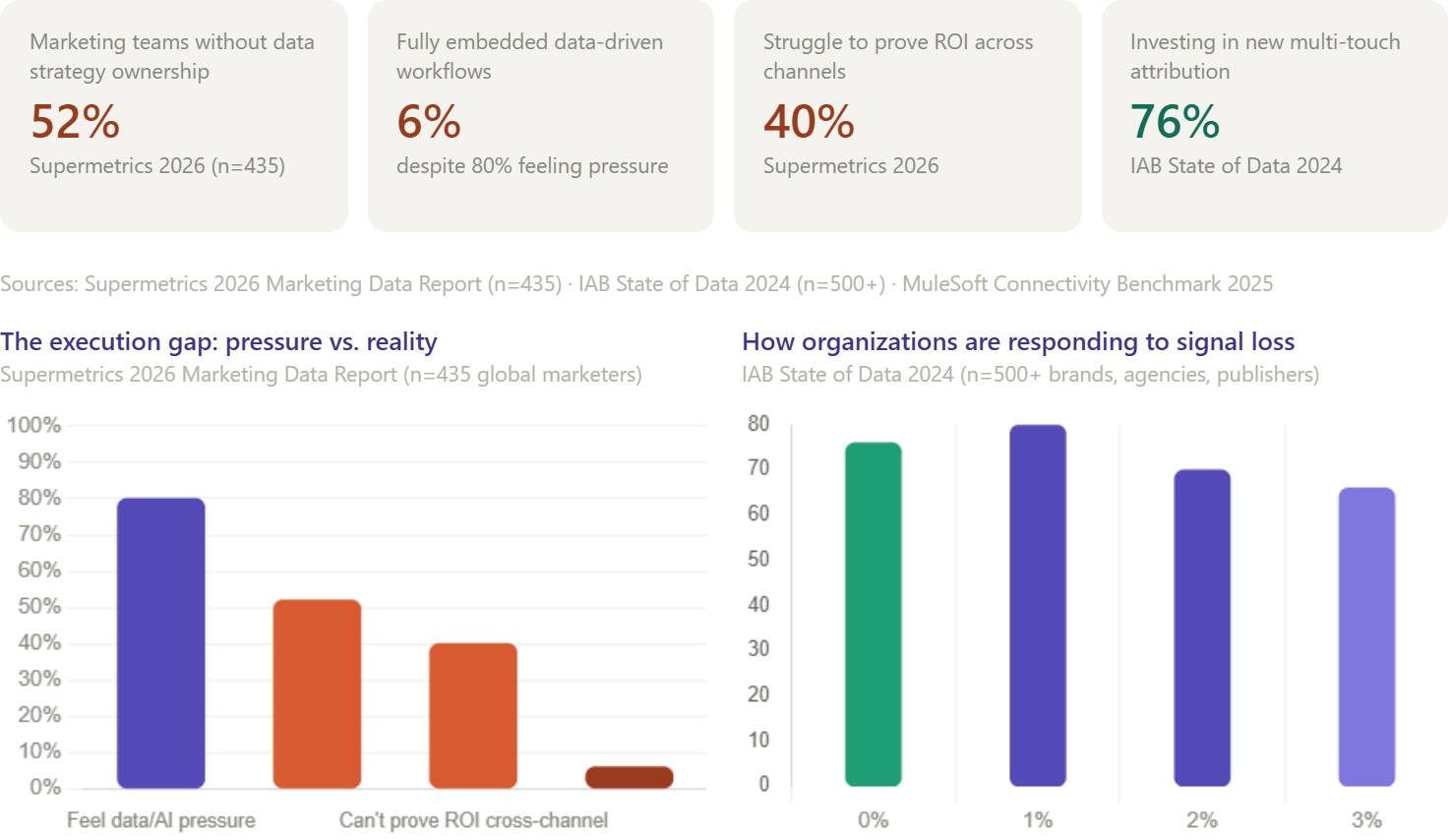
Adoption numbers for first-party data look healthy. Execution numbers don't. Supermetrics' 2026 Marketing Data Report — based on 435 marketers across the US, UK, Germany, Australia, and Singapore — is the most recently published primary study on the internal barriers to first-party data activation, and its findings are sobering. 52% of marketing teams don't own their data strategy. Only 6% have fully embedded data-driven approaches into their workflows. 40% struggle to prove ROI across channels even when the data exists.
The root cause identified by Supermetrics is structural, not technical: when marketing doesn't define the data, activation, and AI use cases, all downstream processes stall. First-party data accumulates in CDPs and analytics platforms but doesn't reach campaign decisions because there's no clearly accountable function connecting data ownership to marketing execution.
| Metric | Value | Source |
|---|---|---|
| Marketing teams that don't own their data strategy | 52% | Supermetrics, 2026 Marketing Data Report |
| Marketers who have fully embedded data-driven workflows | 6% | Supermetrics, 2026 Marketing Data Report |
| Marketers who struggle to prove ROI across channels | 40% | Supermetrics, 2026 Marketing Data Report |
| Marketers who feel pressure to adopt AI but haven't embedded it | 80% feel pressure; only 6% executed | Supermetrics, 2026 Marketing Data Report |
| Enterprises reporting challenges with data integration | 95% | MuleSoft, Connectivity Benchmark Report 2025 |
| Marketers investing in new multi-touch attribution with first-party data | 76% | IAB, State of Data 2024 |
| Marketers increasing contextual advertising spend in response to data changes | 66% | IAB, State of Data 2024 |
The 52% data strategy ownership gap is the central organizational challenge in first-party data programs. Data that exists but isn't activated is commercially equivalent to data that doesn't exist. The teams generating measurable ROI from first-party data share a structural characteristic: marketing owns the data strategy, not IT or legal. Ownership determines activation speed, and activation speed determines ROI.
Omnibound's Intelligent Research helps marketing teams surface the buyer signals and competitive context embedded in their first-party data — bridging the gap between data collection and strategic decision-making.
First-Party Data by the Numbers
| Metric | Value | Source |
|---|---|---|
| Brands growing first-party datasets | 71% (up from 41%) | IAB State of Data 2024 |
| Organizations with privacy-first measurement (2026) | 81% | Improvado 2026 |
| Projected to rely primarily on first-party data (2027) | 88% | Improvado 2026 |
| Marketers fully ready for cookieless world (Mar 2025) | Only 15% | Deloitte, March 2025 |
| Brands planning to phase out third-party data by 2026 | 75% | TechRT 2026 |
| Revenue lift vs. other data strategies | 2.9x | Google/BCG |
| Customer acquisition cost improvement | Up to 83% | Forrester Consulting 2024 |
| Conversion rate improvement | 73% | Forrester Consulting 2024 |
| ROI improvement (first-party behavioral data) | 72% | Forrester Consulting 2024 |
| Top-quartile ROI from first-party data | 8x ROI, 25%+ lower CPA | Avaus 2025 |
| Marketers reporting measurable ROI improvement | 70% | TechRT 2026 |
| Email newsletters used for first-party data collection | 63% | TechRT 2026 |
| Site/app behavioral data collection | 60% | TechRT 2026 |
| Social media data collection | 60% | TechRT 2026 |
| Brands using email for targeting | 77% | TechRT 2026 |
| Marketers worldwide using CDPs | 72% | Salesforce State of Marketing 9th ed. |
| Enterprise CDP adoption | 78% | TechRT 2026 |
| Global CDP market size (2026) | $10.3 billion | Fortune Business Insights |
| CDP market CAGR 2022–2025 | 34% | TechRT 2026 |
| Plans to increase CDP spend (IDC 2024) | ~80% | IDC July 2024 |
| Data clean room adoption growth YoY | +70% | TechRT 2026 |
| Cumulative GDPR fines since 2018 | €7.1 billion+ | DLA Piper 2025 |
| GDPR fines in 2025 alone | €1.2 billion | DLA Piper 2025 |
| Daily GDPR breach notifications (2025 record) | 443 per day | DLA Piper 2025 |
| US states with comprehensive privacy laws (Jan 2026) | 20 | IAPP / StationX 2026 |
| Apple ATT: cross-app tracking reduction | 40%+ | Industry documentation 2024 |
| Consumer trust: prefer first-party data companies | 86% | Twilio, Consumer Trust Survey 2023 |
| Marketing teams without data strategy ownership | 52% | Supermetrics 2026 |
| Fully embedded data-driven workflows | Only 6% | Supermetrics 2026 |
| Struggle to prove ROI across channels | 40% | Supermetrics 2026 |
| Investing in new multi-touch attribution | 76% | IAB State of Data 2024 |
Methodology and Sources
This article was compiled from primary research organizations and named industry studies published between 2023 and 2026. Every statistic was traced to its originating study before inclusion. Secondary aggregators were used only to locate primary sources — never as final citations. Statistics from 2023 are flagged where used.
Primary sources (Tier 1):
- IAB / BWG Strategy — State of Data 2024: How the Digital Ad Industry is Adapting to the Privacy-by-Design Ecosystem (n=500+ advertising and data decision-makers at brands, agencies, and publishers; conducted Nov 2023–Feb 2024)
- Supermetrics — 2026 Marketing Data Report (n=435 marketers, brands and agencies globally, US/UK/Germany/Australia/Singapore; Oct–Dec 2025)
- Google / BCG — The Business Impact of First-Party Data (2.9x revenue lift study; Think with Google)
- Forrester Consulting — First-Party Behavioral Data Impact Study 2024 (CAC improvement 83%, conversion improvement 73%, ROI improvement 72%); cited via Avaus benchmark analysis, 2025
- DLA Piper — GDPR Fines and Data Breach Survey: January 2025 (seventh annual edition; covers 2024 and cumulative enforcement data through January 2025)
- Deloitte — March 2025 cookieless readiness survey (~15% fully ready finding); cited via Adtelligent analysis
- Salesforce — State of Marketing, 9th edition (72% CDP usage; n=4,450 marketing decision-makers)
- IDC — Future of Customer Experience Survey, July 2024 (80% plan to increase CDP spend); cited via GrowthLoop analysis
- MarketsandMarkets — Customer Data Platform Market Report 2025–2030 (zero-party data 36.8% CAGR)
- Fortune Business Insights — Customer Data Platform Market Report ($10.3B CDP market by 2026)
- Twilio — Consumer Trust and Data Privacy Survey 2023 (86% consumer trust in first-party data companies) (most recent available for this specific finding)
- MuleSoft / Deloitte Digital — Connectivity Benchmark Report 2025 (95% of enterprises face integration challenges)
Recency notes:
- The Google/BCG 2.9x revenue lift finding is the most widely cited primary benchmark in this space. The original study date varies in citations; it reflects research published via Think with Google and continues to be the most methodologically transparent primary source for this specific outcome.
- Twilio's Consumer Trust Survey (86% trust finding) dates from 2023. It is flagged as the most recent available primary source for consumer trust data related to first-party data specifically.
- All other statistics in this article are from 2024–2026 primary research.