




Table Of Contents
Last updated: May 2026. We review and update this page quarterly as new primary research is published.
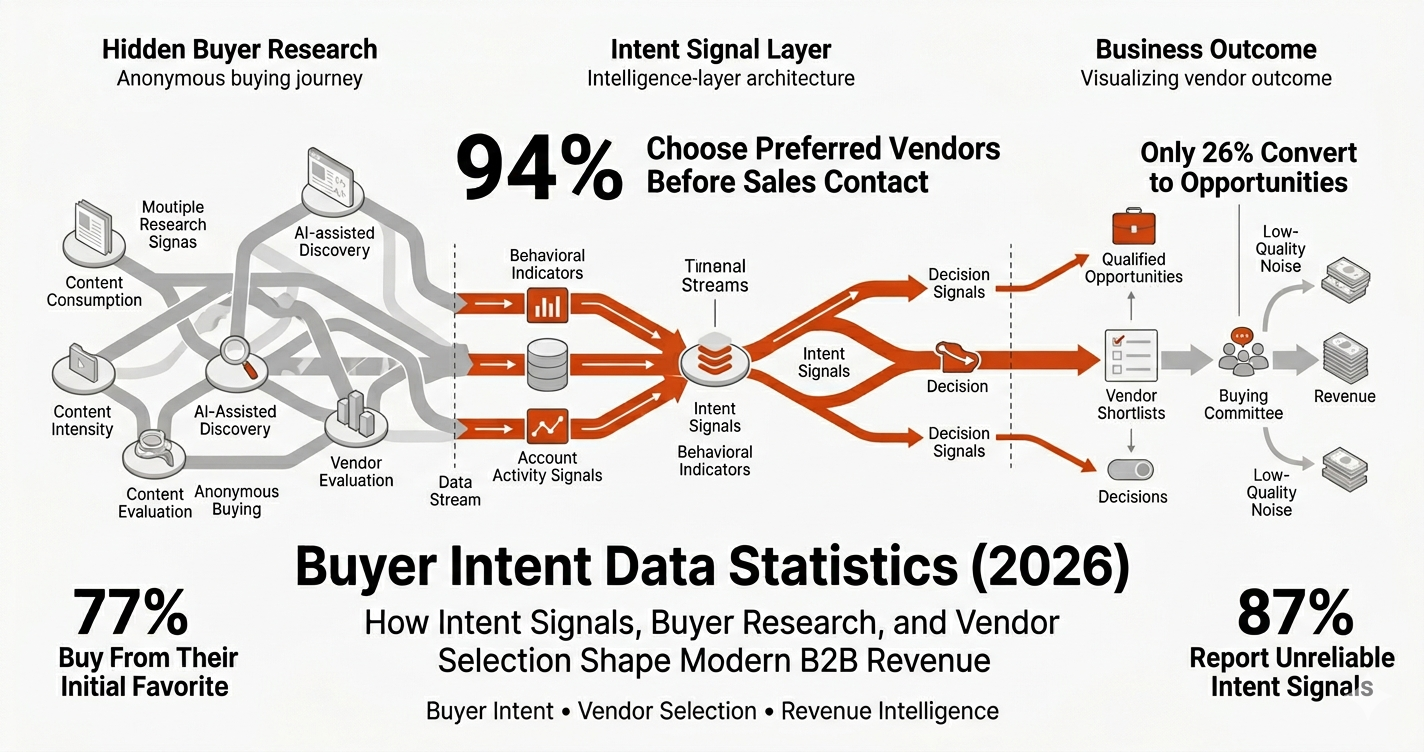
94% of B2B buying groups have already ranked their preferred vendors before ever talking to sales — and they purchase from that preliminary favorite 77% of the time (6sense, 2025 Buyer Experience Report, n=4,000+ global buyers). If your team can't see the research activity that leads to that ranking, you don't exist in the deal. That's the commercial case for buyer intent data in two sentences.
Yet the data on intent data performance is far more complicated than vendor marketing suggests. DemandScience's December 2025 survey of 750 senior B2B marketing leaders found that 87% of organizations say their marketing investments produce unreliable or inflated intent signals — clicks, downloads, and behavioral scores that look like buying intent but don't reflect it. Only 26% of those signals convert into qualified opportunities (DemandScience, 2026 State of Performance Marketing, n=750, Oct 2025). Intent data adoption is at an all-time high. Intent data quality is a persistent, structural problem.
We aggregated data from 6sense, DemandScience, Forrester, Bombora, Informa TechTarget, Roots Analysis, and other primary sources to compile the most rigorously sourced buyer intent data statistics available for 2026.
Key Takeaways
- 94% of B2B buying groups ranked preferred vendors before first contact; 77% purchased from their pre-contact favorite (6sense, 2025 Buyer Experience Report)
- 87% of organizations report unreliable or inflated intent signals; only 26% of intent signals convert to qualified opportunities (DemandScience, 2026 State of Performance Marketing)
- 91% of B2B marketers use intent data to prioritize accounts — but only 24% report exceptional ROI (DemandScience / Autobound, 2026)
- The B2B buyer intent data tools market is valued at $4.49 billion in 2026, projected to reach $20.89 billion by 2035 (CAGR 16.62%) (Roots Analysis, 2026)
- 6sense customers targeting intent-qualified accounts saw 99% higher average opportunity value vs. non-qualified opportunities (6sense, 2024 platform data)
- B2B buyers now complete 60% of their journey independently before engaging a seller — up from 70% research / 30% engagement in prior years (6sense, 2025 Buyer Experience Report)
- 70% of accounts active in a target segment this quarter will not be active next quarter — timing is the defining constraint of intent data value (Informa TechTarget)
- 70% of B2B organizations use intent data tools; conversion rate improvements of 25–40% are frequently reported (Global Growth Insights, 2026)
- Two-thirds of marketing leaders say their dashboards show success that fails to translate into revenue (DemandScience, 2026 State of Performance Marketing)
- Buying cycles shortened from 11.3 months (2024) to 10.1 months (2025) — buyers are engaging earlier but deciding faster (6sense, 2025 Buyer Experience Report)
- Forrester's Wave™: Intent Data Providers for B2B Q1 2025 named 5 leaders across 15 evaluated providers: Intentsify (highest current offering score), 6sense, Bombora, Informa TechTarget, and Demandbase (Forrester, Q1 2025)
- 85% of B2B buyers purchase from vendors already on their consideration list before formal evaluation begins (Forrester, 2025 research via Salesmotion)
Market Size and Adoption
The buyer intent data market has crossed a threshold: it is no longer a specialist tool used by a handful of ABM-forward enterprises. 91% of B2B marketers now use intent data to prioritize accounts. The market itself is valued at $4.49 billion in 2026 and growing at a CAGR of 16.62% — placing it among the fastest-growing segments in the martech stack. The growth is driven by three structural forces: the expansion of the B2B dark funnel, the adoption of account-based strategies requiring signal precision, and AI-powered analytics that have made real-time intent processing feasible at enterprise scale.
The maturity picture is more mixed. Widespread adoption has not been matched by widespread results. The Forrester Wave evaluation of 15 providers across 21 criteria (Q1 2025) showed significant differentiation in signal quality, methodology, and activation capability — which partially explains why the same tool category produces exceptional ROI for some teams and noise for others.
| Metric | Value | Source |
|---|---|---|
| B2B buyer intent data tools market size (2026) | $4.49 billion | Roots Analysis, 2026 |
| Projected market size by 2030 | $9.68 billion | Roots Analysis, 2026 |
| Projected market size by 2035 | $20.89 billion (CAGR 16.62%) | Roots Analysis, 2026 |
| B2B organizations currently using intent data tools | 70%+ | Global Growth Insights, 2026 |
| B2B marketers using intent data to prioritize accounts | 91% | DemandScience / Autobound 2026 |
| Marketers reporting exceptional ROI from intent data | 24% | DemandScience / Autobound 2026 |
| Fully automatic AI/ML segment market share | 60.31% of total market | Roots Analysis, 2026 |
| Salesforce–6sense integration for real-time buyer insights | Launched January 2025 | Roots Analysis, citing Salesforce PR 2025 |
The 67-percentage-point gap between the 91% who use intent data and the 24% who report exceptional ROI is the defining commercial tension of this market. Adoption is nearly universal; mastery is rare. That gap is not primarily a technology problem — it is a signal quality, activation discipline, and measurement infrastructure problem.
The Dark Funnel: Why Intent Data Matters
The statistical foundation of the entire intent data use case rests on one finding from 6sense's longitudinal research: 95% of the time, the winning vendor is already on the buyer's Day One shortlist before that vendor even knows they're being evaluated. Buyers complete their vendor research independently, form strong preferences, and only then contact sellers — at which point the deal is largely determined. The implication is structural: outbound engagement timed to form-fills and inbound inquiries is, by definition, too late for most deals.
6sense's 2025 Buyer Experience Report — based on nearly 4,000 buyers globally across three years of longitudinal tracking — found that the buying journey has shifted from a 70/30 to a 60/40 split between independent research and seller engagement. That shift means buyers are contacting sellers six to seven weeks earlier than in 2024. But earlier contact doesn't mean earlier persuasion — 94% have already formed a ranked vendor list. The window for influence is the dark funnel phase, not the conversation phase.
| Metric | Value | Source |
|---|---|---|
| Winning vendor already on Day One shortlist | 95% of the time | 6sense, 2025 Buyer Experience Report |
| Buying groups that ranked preferred vendors before first contact | 94% | 6sense, 2025 Buyer Experience Report |
| Deals won by pre-contact preferred vendor | 77% | 6sense, 2025 Buyer Experience Report |
| Buyer journey: independent research vs. seller engagement split | 60% / 40% (shifted from 70/30) | 6sense, 2025 Buyer Experience Report |
| Average buying cycle (2025) | 10.1 months (down from 11.3 in 2024) | 6sense, 2025 Buyer Experience Report |
| B2B buyers using AI tools (LLMs) during research | 89% | 6sense, 2025 Buyer Experience Report |
| B2B buyers who start with at least one vendor in mind | 92% | Forrester, 2025 research |
| B2B buyers who select preferred vendor before formal evaluation | 41% | Forrester, 2025 research |
The 6sense data on LLM usage is significant for the intent data category specifically: 89% of buyers use AI tools during research, primarily to synthesize reviews and analyze data — but these interactions generate no trackable signals for traditional intent data providers. The dark funnel is getting darker. AI-mediated research is, by definition, invisible to first-party and third-party intent data systems that rely on web behavior signals.
Omnibound's Intelligent Research is built around this gap — capturing buyer and market signals from AI-mediated research environments, not just traditional web behavior, so content and outreach strategy reflects where buyers are actually forming preferences.
Pipeline and ROI Impact
When intent data is correctly implemented — with quality signals, CRM integration, and activation workflows — the pipeline outcomes are documented and substantial. 6sense's platform data from 2024 is the most rigorous benchmark available: customers targeting 6sense Qualified Accounts (6QAs) saw 99% higher average opportunity value compared to non-6QA opportunities, with 3.3x more opportunities generated per account. Bombora case studies document a financial services client attributing $800 million in pipeline contribution directly to intent-powered insights within three months.
The Untitled/intent-platform benchmarks show 37% CPL reduction and 4–8x return on ad spend for performance marketing teams activating intent into live campaigns. These are upper-bound outcomes from teams with mature activation capabilities — they represent what's achievable with full-stack implementation rather than average results.
| Metric | Value | Source |
|---|---|---|
| 6QA vs. non-6QA: average opportunity value difference | 99% higher | 6sense, 2024 platform impact data |
| MiQ: win rate improvement using Bombora Intent audiences | +28% higher average win rate | Bombora case studies |
| Financial services client: pipeline attributed to Bombora insights | $800 million within 3 months | Bombora case study: financial services |
| Financial services client: conversion rate vs. cold leads | 4x higher | Bombora case study: financial services |
| Financial services client: average contract value increase | +15% | Bombora case study: financial services |
| Intent-based CPL reduction (performance marketing teams) | 37% lower | Untitled platform benchmarks, 2026 |
| Intent-based return on ad spend | 4x–8x | Untitled platform benchmarks, 2026 |
| B2B companies using intent data: conversion rate improvement | 25–40% | Global Growth Insights, 2026 |
| MQL-to-SQL conversion improvement with behavioral ICP scoring | From ~13% avg to 39–40% | GrowthSpree, MQL-to-SQL Benchmarks 2026 |
The MQL-to-SQL conversion improvement — from a 13% cross-industry average to 39–40% with behavioral ICP scoring — represents a 3x performance multiplier that is entirely attributable to lead quality infrastructure rather than lead volume. Intent data's most underappreciated impact is not top-of-funnel lead generation — it's mid-funnel qualification precision. The same pipeline volume with 3x better conversion rates produces dramatically better economics across the entire revenue function.
Omnibound's AI Solutions for Demand Generation connects real buyer intent signals to content and campaign decisions — closing the gap between signal identification and pipeline activation.
Signal Quality and the Data Mirage
The most important — and least discussed — story in buyer intent data is the signal quality problem. DemandScience's December 2025 study of 750 senior marketing leaders is the most methodologically rigorous primary research on this topic yet published. Its central finding: 87% of organizations report that their marketing investments produce unreliable or inflated intent signals — behavioral indicators like clicks, downloads, and content engagement scores that look like buying intent in the dashboard but don't translate to qualified pipeline.
Only 26% of intent signals convert into qualified opportunities. Two-thirds of marketing leaders report that their dashboards regularly show "success" that fails to produce revenue. This is not a niche finding from dissatisfied users — it's a supermajority of enterprise B2B marketing leaders across technology, financial services, healthcare, manufacturing, and professional services.
| Metric | Value | Source |
|---|---|---|
| Organizations reporting unreliable or inflated intent signals | 87% | DemandScience, 2026 State of Performance Marketing |
| Intent signals that convert into qualified opportunities | 26% | DemandScience, 2026 State of Performance Marketing |
| Marketing leaders whose dashboards show success not translating to revenue | 66% (two-thirds) | DemandScience, 2026 State of Performance Marketing |
| Estimated marketing budget going to campaigns with no revenue impact | 25% | DemandScience, 2026 State of Performance Marketing |
| B2B respondents citing data quality as top intent data challenge | 70% | Demandview / 2024 B2B survey |
| Bombora match rate across 8.5M global accounts | 74% | Bombora review, Pipeline.ZoomInfo 2026 |
| 70%+ of target accounts active this quarter: inactive next quarter | 70% churn quarterly | Informa TechTarget |
| Informa TechTarget: intent data expanded by | 41% in September 2025 | Informa TechTarget press release, September 2025 |
The 70% quarterly signal churn figure from TechTarget is the practical implication of poor signal quality: even accurate intent data expires within weeks. A signal that was valid in January is likely irrelevant by April. Teams relying on quarterly intent data refreshes are, for most of the quarter, targeting the wrong accounts. Real-time signal processing is not a premium feature — it's a basic accuracy requirement.
Use Cases and Channel Activation
Intent data is most commonly used for three primary purposes: digital advertising targeting (67%), market and competitive intelligence (62%), and lead generation (57%). But the highest-impact activation — routing real-time intent signals to sales reps for immediate outbound engagement on in-market accounts — is still the least common deployment, largely because it requires CRM integration and workflow design that most teams haven't yet built.
The most effective intent data use cases share a common trait: they connect signal detection to action in hours, not days. TechTarget's finding that 70%+ of accounts active this quarter won't be active next quarter establishes the commercial imperative for speed-to-contact. Bombora's case study evidence and 6sense's 6QA model both demonstrate that the ROI of intent data is a function of activation speed and precision, not just data access.
| Metric | Value | Source |
|---|---|---|
| Intent data used for digital advertising targeting | 67% | Demandview / 2024 B2B survey |
| Intent data used for market and competitive intelligence | 62% | Demandview / 2024 B2B survey |
| Intent data used for lead generation | 57% | Demandview / 2024 B2B survey |
| Intent data used for demand marketing | 47% | Informa TechTarget, 2020 (most recent available) |
| Intent data used for sales enablement and prioritization | 40% | Informa TechTarget, 2020 (most recent available) |
| Marketers using intent data to deliver targeted content | 52% | Statista, 2023 (most recent available) |
| Bombora: email open rate achieved using intent topic targeting | 50% | Bombora case study: Events Industry Council |
| Box: conversion lift from intent-powered homepage personalization | +75% | Bombora case study: Box |
The Box conversion uplift of 75% from intent-powered homepage personalization is one of the most concrete documented outcomes in the intent data ecosystem — and it's a web personalization outcome, not an ad targeting or sales outreach outcome. This points to an underexploited activation surface: most intent data is routed to ads and SDR queues, while the website — the highest-intent destination any buyer visits — is left static.
Omnibound's Intelligent Research surfaces the exact buyer signals, objections, and topic clusters driving research activity in your category — giving content and demand teams the context needed to personalize at every surface, not just in outbound sequences.
Barriers, the AI Intent Gap, and What's Next
The intent data category faces two compounding structural challenges heading into 2026. The first is the AI dark funnel problem: 89% of B2B buyers now use AI tools (LLMs) during their research, primarily to synthesize vendor information and analyze reviews (6sense 2025). These AI-mediated research interactions generate no signals for traditional intent data platforms. The dark funnel is expanding, not shrinking, and intent data coverage is not keeping pace with it.
The second is the governance and quality problem already documented in DemandScience's 2026 data. Despite near-universal adoption, signal quality remains the single most commonly cited challenge — cited by 70% of B2B respondents. The adoption curve has not been matched by a maturity curve. Forty-five percent of organizations still struggle with integrating intent data tools, and 60% report difficulty choosing between providers due to vendor fragmentation and feature overlap.
| Metric | Value | Source |
|---|---|---|
| B2B buyers using AI (LLMs) during research | 89% | 6sense, 2025 Buyer Experience Report |
| AI-mediated research generating no traditional intent signals | Not captured by web-behavior platforms | 6sense GenAI analysis, January 2026 |
| B2B respondents citing data quality as top challenge | 70% | Demandview / 2024 survey |
| Organizations struggling with intent tool integration | 45% | Global Growth Insights, 2026 |
| Businesses reporting difficulty choosing between providers | 60% | Global Growth Insights, 2026 |
| Marketers estimate budget going to no-revenue campaigns | 25% | DemandScience, 2026 |
| Third-party intent data share of total data sourcing | >55% | Global Growth Insights, 2026 |
| AI-driven intent analytics adoption across market | >35% | Global Growth Insights, 2026 |
The AI intent gap is the defining unsolved problem in the category. Traditional intent data tells you which accounts are researching on the web. It cannot tell you which accounts are asking AI engines about your category — and those are increasingly the same buyers. As AI search absorbs more of the early research phase, the gap between where buyer intent is forming and where intent data is capturing it will widen. Teams that supplement web-behavior intent data with AI search visibility signals will have a materially more complete picture of in-market demand.
Omnibound's AI Search Intelligence tracks where your brand appears in AI-generated answers across ChatGPT, Perplexity, Gemini, and Google AI Mode — filling the signal gap that traditional intent data platforms cannot see.
Buyer Intent Data by the Numbers
| Metric | Value | Source |
|---|---|---|
| B2B buyer intent data tools market (2026) | $4.49 billion | Roots Analysis 2026 |
| Projected market size by 2035 | $20.89 billion | Roots Analysis 2026 |
| Market CAGR 2026–2035 | 16.62% | Roots Analysis 2026 |
| B2B organizations using intent data tools | 70%+ | Global Growth Insights 2026 |
| B2B marketers using intent data to prioritize accounts | 91% | DemandScience / Autobound 2026 |
| Marketers reporting exceptional intent data ROI | 24% | DemandScience / Autobound 2026 |
| Winning vendor on Day One shortlist | 95% of deals | 6sense 2025 BER |
| Buying groups ranking vendors before first contact | 94% | 6sense 2025 BER |
| Deals won by pre-contact preferred vendor | 77% | 6sense 2025 BER |
| Buyer journey: independent research share | 60% (shifted from 70%) | 6sense 2025 BER |
| Average buying cycle (2025) | 10.1 months | 6sense 2025 BER |
| B2B buyers using AI tools during research | 89% | 6sense 2025 BER |
| B2B buyers selecting vendor before formal evaluation | 41% | Forrester 2025 |
| 6QA vs. non-6QA: opportunity value difference | 99% higher | 6sense 2024 platform data |
| MiQ: win rate improvement using Bombora | +28% | Bombora case studies |
| Financial services: pipeline from Bombora (3 months) | $800 million | Bombora case study |
| Intent-based CPL reduction | 37% | Untitled platform 2026 |
| Intent-based ROAS | 4x–8x | Untitled platform 2026 |
| Organizations reporting unreliable intent signals | 87% | DemandScience 2026 |
| Intent signals converting to qualified opportunities | 26% | DemandScience 2026 |
| Dashboards showing success not translating to revenue | 66% | DemandScience 2026 |
| Marketing budget going to no-revenue campaigns | 25% | DemandScience 2026 |
| Data quality cited as top intent challenge | 70% | Demandview 2024 |
| Intent data used for digital advertising | 67% | Demandview 2024 |
| Intent data used for competitive intelligence | 62% | Demandview 2024 |
| Quarterly account signal churn (TechTarget finding) | 70%+ | Informa TechTarget |
| Organizations struggling with tool integration | 45% | Global Growth Insights 2026 |
| Difficulty choosing between providers | 60% | Global Growth Insights 2026 |
Methodology and Sources
This article was compiled from primary research organizations and named industry surveys published between 2024 and 2026. Every statistic was traced to its originating study before inclusion. Secondary aggregators were used only to locate primary sources — never as final citations. Statistics from 2020–2023 are labeled as "most recent available."
Primary sources (Tier 1):
- 6sense — 2025 Buyer Experience Report (released November 12, 2025; n=4,000+ B2B buyers globally, North America, EMEA, APAC; third consecutive annual study, median deal value $300,000–$400,000); GenAI and LLMs: Impact on B2B Buyer Research (January 2026; 6QA opportunity value analysis from 2024 customer platform data)
- DemandScience / TrendCandy — 2026 State of Performance Marketing: Exposing the Marketing Data Mirage (published December 17, 2025; n=750 senior B2B marketing leaders, conducted October 2025, companies with $100M–$5B+ revenue across technology, financial services, healthcare, manufacturing, and professional services)
- Forrester — The Forrester Wave™: Intent Data Providers For B2B, Q1 2025 (15 providers evaluated across 21 criteria; leaders: Intentsify, 6sense, Bombora, Informa TechTarget, Demandbase)
- Roots Analysis — B2B Buyer Intent Data Tools Market Size & Trends Report, 2035 (published January 2026; market sizing: $4.49B in 2026 → $20.89B by 2035, CAGR 16.62%)
- Informa TechTarget — 41% intent data expansion press release (September 2025); Purchase Intent Data platform page (70%+ quarterly account churn finding)
- Bombora — Case Studies (MiQ +28% win rate; financial services $800M pipeline; Box +75% conversion); Year in Intent Report 2025
- Demandview — Intent Data: Hit or Hype? Navigating the Future of Data Technology (2024 B2B survey data: 70% data quality, 67% digital advertising, 62% competitive intelligence)
- Global Growth Insights — Buyer Intent Data Tools Market Report 2026 (corroborating market sizing and adoption data; >70% usage, 25–40% conversion improvement)
Recency notes:
- TechTarget/Informa use case statistics (47% demand marketing, 40% sales enablement, 57% lead generation) originate from a 2020 survey. Labeled as "most recent available" throughout.
- Statista intent data channel activation data (52% targeted content, 47% email marketing) originates from 2023 data. Labeled accordingly.
- All other statistics in this article are from 2024–2026 primary research.
Turn Your Content Into AI-Search Winners
Get cited across ChatGPT, Claude & Perplexity — not just ranked on Google.
- Increase AI citations
- Improve answer visibility
- Track brand mentions in LLMs
.png?height=245&name=Content%20Marketing%20Statistics%20(2026).png)
.png?height=245&name=B2B%20Demand%20Generation%20Statistics%20(2026).png)