

Table Of Contents
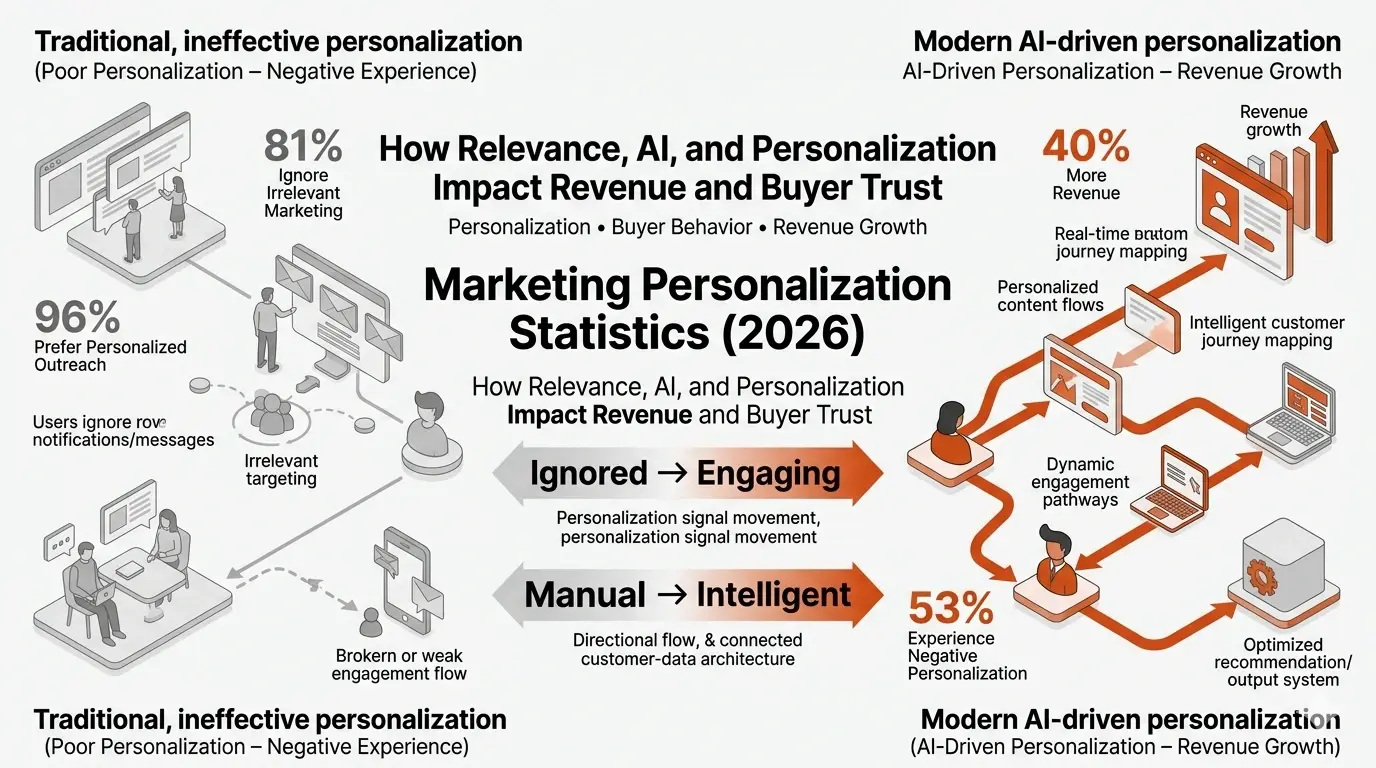
81% of consumers actively ignore marketing messages they consider irrelevant — and 96% say they are more likely to purchase when brands personalize their outreach (Attentive/CITE Research, The State of Personalized Marketing 2025, n=3,300). At the same time, fast-growing companies generate 40% more revenue from personalization than their slower-growing counterparts (McKinsey, Next in Personalization 2021). The gap between brands that get personalization right and those that don't has never been more commercially consequential.
Yet a critical 2025 finding complicates the picture: Gartner's survey of 1,464 B2B buyers and consumers found that 53% experience negative outcomes from traditional personalization — and those customers are 3.2x more likely to regret their purchase (Gartner, June 2025). Personalization done poorly is now measurably worse than no personalization at all.
We aggregated data from Gartner, McKinsey, Twilio, Attentive, StackAdapt/Ascend2, Epsilon, Litmus, Mailchimp, and more than a dozen other primary sources to compile the most rigorously sourced marketing personalization statistics available for 2026.
Key Takeaways
- 81% of consumers ignore irrelevant marketing messages; 96% are more likely to buy when messages are personalized (Attentive/CITE Research, State of Personalized Marketing 2025)
- Fast-growing companies generate 40% more revenue from personalization than their peers (McKinsey, Next in Personalization 2021)
- 87% of brands plan to increase personalization spend in 2026, but 68% are still in early implementation stages (StackAdapt/Ascend2, State of Personalization in Digital Marketing 2026)
- 53% of customers experience negative outcomes from traditional personalization — 3.2x more likely to regret a purchase (Gartner, June 2025)
- 56% of brands now use AI to tailor customer experiences; 75% report increased customer spending as a result (Twilio, State of Customer Engagement Report 2025)
- 96% of companies say AI is improving customer-facing operations including marketing and personalization (Twilio, State of Customer Engagement Report 2025)
- Personalized marketing can reduce customer acquisition costs by up to 50% and lift revenues by 5–15% (McKinsey, The Future of Personalization 2019)
- Consumers spend an average of 54% more with brands that personalize their experiences (Twilio, State of Customer Engagement Report 2024)
- Only 45% of consumers feel understood by the brands they interact with, down from 46% in 2024 (Twilio, State of Customer Engagement Report 2025)
- 42% of brand marketers cite limited platform integration as their top barrier to personalization (StackAdapt/Ascend2, State of Personalization 2026)
- Brands using personalization see email ROI of 43:1 vs. 12:1 for brands that never personalize (Litmus, State of Email Research)
- 89% of business leaders believe ethical AI use in personalization is a competitive business advantage (Twilio, State of Personalization Report 2024)
Consumer Expectations and Behavior
The personalization bar was set by Amazon, Netflix, and Spotify — and now every brand is measured against it. Consumers don't merely prefer personalized experiences; they have begun actively punishing brands that fail to deliver them. The Attentive/CITE Research survey of 3,300 consumers across the US, UK, and Australia found that 8 in 10 shoppers ignore messages that aren't relevant, and 1 in 4 say receiving a generic message makes them less likely to purchase at all. This isn't passive indifference — it's active disengagement with a direct revenue cost.
The McKinsey data tells the same story from a different angle: 71% of consumers expect personalized interactions, but only 45% feel understood by the brands they currently interact with (Twilio 2025). That 26-point gap between expectation and reality is where competitive advantage is won. The brands closing this gap are not winning on product — they're winning on context.
| Metric | Value | Source |
|---|---|---|
| Consumers who ignore irrelevant marketing messages | 81% | Attentive/CITE Research, State of Personalized Marketing 2025 |
| Consumers more likely to purchase when brands personalize outreach | 96% | Attentive/CITE Research, State of Personalized Marketing 2025 |
| Consumers frustrated by irrelevant messages | 71% | Attentive/CITE Research, State of Personalized Marketing 2025 |
| Consumers less likely to purchase after receiving a generic message | 1 in 4 | Attentive/CITE Research, State of Personalized Marketing 2025 |
| Consumers who expect companies to deliver personalized interactions | 71% | McKinsey, Next in Personalization 2021 |
| Consumers frustrated when personalization is absent | 76% | McKinsey, Next in Personalization 2021 |
| Consumers more likely to purchase from brands offering personalized experiences | 80% | Epsilon, The Power of Me 2017 (most cited primary source; most recent available) |
| Consumers who feel understood by the brands they interact with | 45% | Twilio, State of Customer Engagement Report 2025 |
| Consumers who will abandon a purchase if the experience isn't relevant | 71% | Twilio, State of Customer Engagement Report 2025 |
The Epsilon "80% more likely to purchase" figure originates from a 2017 survey — it is flagged throughout as the most-cited primary source for this specific data point. The directional finding has been reinforced by every subsequent study in this space. More importantly: the Attentive 2025 data shows not just preference, but active avoidance — consumers who receive generic messages are now less likely to purchase, not just equally likely.
AI Personalization Adoption
Most organizations describe their personalization capabilities as "advanced." Most are not. StackAdapt's 2026 survey of 468 marketing professionals found that 68% are still in early stages of implementation — even as 87% plan to increase their spend. The gap between self-reported sophistication and actual execution is the defining tension in personalization today.
The adoption picture is similarly uneven at the AI layer. While 96% of companies say AI is improving their customer-facing operations (Twilio 2025), only 1 in 5 brands and agencies have fully integrated AI across channels (StackAdapt 2026). That integration threshold is critical — it's the point at which personalization becomes measurable, attributable, and scalable rather than a collection of disconnected experiments.
![AI personalization adoption vs. implementation maturity — the gap between intention and execution across 468 marketing professionals]
| Metric | Value | Source |
|---|---|---|
| Brands planning to increase personalization spend in 2026 | 87% | StackAdapt/Ascend2, State of Personalization in Digital Marketing 2026 |
| Organizations still in early stages of personalization implementation | 68% | StackAdapt/Ascend2, State of Personalization in Digital Marketing 2026 |
| Brands and agencies with fully integrated AI across channels | ~21% | StackAdapt/Ascend2, State of Personalization in Digital Marketing 2026 |
| Brands now using AI to tailor customer experiences | 56% | Twilio, State of Customer Engagement Report 2025 |
| Companies saying AI is improving customer-facing operations | 96% | Twilio, State of Customer Engagement Report 2025 |
| Business leaders who agree AI will fundamentally reshape personalization | 73% | Twilio/Segment, State of Personalization Report 2024 |
| Businesses using AI-driven personalization to drive growth (2023) | 92% | Twilio/Segment, State of Personalization 2023 |
| Marketing executives currently using AI/ML extensively | 17% (despite 84% believing in its potential) | Twilio/Segment, State of Personalization Report |
Only 1 in 5 brands has fully integrated AI across channels — yet 87% plan to spend more on personalization in 2026. That gap between spending intent and execution depth is where most personalization investments stall: budgets increase, but fragmented data and disconnected tools prevent teams from scaling what works.
Omnibound's Marketing Context Engine gives B2B marketing teams the unified data layer needed to move from isolated personalization experiments to consistent, channel-wide execution.
ROI and Business Impact
Personalization's commercial case is thoroughly documented — but the range of outcomes is wide, and the ceiling is set by how deeply personalization is embedded across the organization. McKinsey places the typical revenue lift at 5–15%, with the top quartile reaching 25%. The 40% revenue premium for "personalization leaders" reflects a compounding advantage across customer acquisition, conversion, retention, and lifetime value — not a single campaign metric.
The Twilio 2024 figure — consumers spending 54% more with brands that personalize — is among the most methodologically strong ROI data points in this dataset. It comes from a global survey of 11,000+ participants and measures actual consumer spending behavior, not marketer-reported attribution.
| Metric | Value | Source |
|---|---|---|
| Revenue premium for personalization leaders vs. peers | +40% more revenue | McKinsey, Next in Personalization 2021 |
| Typical revenue lift from personalization | 5–15% | McKinsey, The Future of Personalization 2019 |
| Marketing ROI improvement from personalization | 10–30% | McKinsey, The Future of Personalization 2019 |
| Reduction in customer acquisition costs | Up to 50% | McKinsey, The Future of Personalization 2019 |
| Brands seeing increased customer spend from AI-powered personalization | 75% | Twilio, State of Customer Engagement Report 2025 |
| Increase in consumer spending on brands that personalize | 54% more on average | Twilio, State of Customer Engagement Report 2024 |
| Retailers reporting at least 400% ROI from personalization | 70% | Netcore/Wakefield Research, 2021 (most recent available) |
| Marketers reporting increased ROI through personalization strategies | 89% | Instapage, 70 Personalization Statistics |
The spread between the 70% of retailers reporting 400%+ ROI and the 17% of marketers who actually use AI/ML extensively (Twilio) reveals the core problem: the brands achieving the highest returns are a small group with deeply integrated capabilities, not the average. Most organizations are benchmarking against the leaders while still operating like the laggards.
Email and Channel Personalization
Email remains the highest-ROI owned channel in marketing — and personalization is the most powerful lever within it. The Litmus comparison is striking: brands that regularly use personalization achieve a 43:1 email ROI; brands that never or rarely personalize achieve 12:1. That's a 258% ROI gap attributable almost entirely to relevance. Segmented campaigns compound the advantage further — Mailchimp's benchmark data shows 30% more opens and 50% more click-throughs for segmented vs. non-segmented campaigns.
The channel frontier extends well beyond email. StackAdapt's 2026 data shows advanced marketers are more than twice as likely to use personalization in emerging formats like Connected TV (33% vs. 14%), signaling where the next differentiation gap is forming.
![Email personalization ROI comparison — 43:1 for personalization users vs. 12:1 for non-personalizers, Litmus research]
| Metric | Value | Source |
|---|---|---|
| Email ROI for brands that regularly use personalization | 43:1 | Litmus, State of Email Research |
| Email ROI for brands that never or rarely personalize | 12:1 | Litmus, State of Email Research |
| Open rate lift from personalized subject lines | 20–26% | Campaign Monitor / Adobe Email Usage Study |
| Segmented email campaigns: open rate lift vs. non-segmented | +30% more opens | Mailchimp, Email Marketing Benchmarks |
| Segmented email campaigns: click-through rate lift | +50% more click-throughs | Mailchimp, Email Marketing Benchmarks |
| Transaction rate lift for emails with personalized content vs. non-personalized | Up to 6x higher | HubSpot Research |
| Marketers ranking segmentation as one of the most effective email strategies | 51% | HubSpot, State of Marketing |
| Advanced marketers using personalization in CTV vs. others | 33% vs. 14% | StackAdapt/Ascend2, State of Personalization 2026 |
The CTV gap — advanced marketers twice as likely to personalize in emerging formats — points to where the next competitive divide will emerge. Brands still concentrating personalization in email and owned web channels are already operating with a narrower surface area than their most sophisticated competitors.
B2B Personalization
B2B personalization has historically lagged B2C — longer sales cycles, multiple decision-makers, and account-level complexity make it harder to execute at scale. But the data from 2024–2026 shows the gap closing rapidly. 77% of B2B buyers won't make a purchase without personalized content, and the buyer expectation data (71% expecting personalization, McKinsey) now mirrors consumer-level demand.
The B2B challenge isn't motivation — it's infrastructure. 57% of B2B marketers already use behavioral data to personalize email and messaging, but only 42% of brand marketers say they have the platform integration to execute personalization across channels (StackAdapt 2026). The gap between data availability and data activation is the central B2B personalization problem heading into 2026.
| Metric | Value | Source |
|---|---|---|
| B2B buyers who expect personalized experiences | 71% | McKinsey, Next in Personalization 2021 |
| B2B buyers who won't purchase without personalized content | 77% | Demand Gen Report, 2025 Benchmark Survey |
| B2B marketers who have seen improved lead generation from personalization | 83% | Instapage, 70 Personalization Statistics |
| B2B brands with personalized web experiences: average conversion rate increase | 80% | Instapage, 70 Personalization Statistics |
| B2B companies using account-based marketing (ABM) as a top strategy | 41% | Lead Forensics, B2B Marketing Statistics |
| B2B marketers using behavioral data to personalize email and messaging | 57% | Contentful, 40 Personalization Statistics |
| Agencies saying personalization directly drives client revenue growth | 99% | StackAdapt/Ascend2, State of Personalization 2026 |
The 80% conversion rate increase for B2B brands with personalized web experiences is a ceiling figure — it represents outcomes for teams that have done web personalization well, not the average. Treat it as a benchmark for what's achievable rather than a guarantee. The more durable insight is the 57% behavioral data usage figure: the majority of B2B marketers have the data; the constraint is activating it across channels consistently.
Omnibound's Marketing Context Engine is built specifically for this gap — giving B2B teams the account-level context layer needed to move from raw behavioral data to relevant, channel-wide personalization at scale.
Barriers, Trust, and the Personalization Paradox
The most underreported story in personalization isn't about what's possible — it's about what's going wrong. Gartner's June 2025 survey of 1,464 B2B buyers and consumers is the most important primary study published in this space in years. Its central finding is counterintuitive: traditional, passive personalization generates negative experiences for 53% of the customers it touches, making them 3.2x more likely to regret their purchase and 44% less likely to buy again.
The mechanism Gartner identifies is specific. When customers switch tasks in their buying journey — moving from research to product selection, for example — passive "next best action" recommendations become irrelevant to the complexity they're navigating. Personalized offers at these moments create information overload (2x more likely to feel overwhelmed) and time pressure (2.8x more likely to feel rushed). The fix is "active" personalization — course-changing interactions that validate buyers' decisions and reduce uncertainty rather than amplify it. Teams executing this approach see 2.3x better purchase completion rates.
![The personalization paradox — 53% negative experiences from traditional personalization (Gartner 2025) vs. 2.3x better outcomes from active personalization]
| Metric | Value | Source |
|---|---|---|
| Customers who experience negative outcomes from traditional personalization | 53% | Gartner, Personalization Can Triple the Likelihood of Customer Regret, June 2025 |
| How much more likely those customers are to regret a purchase | 3.2x | Gartner, June 2025 |
| How much less likely they are to purchase again | 44% less likely | Gartner, June 2025 |
| How much more likely to feel overwhelmed during personalized journeys | 2x more likely | Gartner, June 2025 |
| Purchase completion improvement: active vs. passive personalization | 2.3x | Gartner, June 2025 |
| Brand marketers citing limited platform integration as top barrier | 42% | StackAdapt/Ascend2, State of Personalization 2026 |
| Consumers who would trust brands more with AI data transparency | 49% | Twilio, State of Customer Engagement Report 2024 |
| Consumers who "absolutely" trust brands with their data | 15% | Twilio, State of Customer Engagement Report 2025 |
| Consumers who want control over their own personalization settings | 84% | Twilio, State of Customer Engagement Report 2025 |
The trust gap is structural and self-reinforcing: only 15% of consumers absolutely trust brands with their data, yet 84% want control over personalization settings — meaning transparency and user control aren't just ethical commitments, they are the prerequisite for consumers willingly providing the data that makes personalization work. Brands that treat data consent as a compliance checkbox rather than a trust-building mechanism are working against their own personalization programs.
Marketing Personalization by the Numbers
| Metric | Value | Source |
|---|---|---|
| Consumers who ignore irrelevant marketing messages | 81% | Attentive/CITE Research 2025 |
| Consumers more likely to purchase when outreach is personalized | 96% | Attentive/CITE Research 2025 |
| Consumers who expect personalized interactions | 71% | McKinsey 2021 |
| Consumers frustrated when personalization is absent | 76% | McKinsey 2021 |
| Consumers who feel understood by brands | 45% | Twilio 2025 |
| Revenue premium for personalization leaders vs. peers | +40% | McKinsey 2021 |
| Typical revenue lift from personalization | 5–15% | McKinsey 2019 |
| Marketing ROI improvement from personalization | 10–30% | McKinsey 2019 |
| Reduction in customer acquisition costs | Up to 50% | McKinsey 2019 |
| Consumer spending increase on brands that personalize | 54% more | Twilio 2024 |
| Brands planning to increase personalization spend in 2026 | 87% | StackAdapt/Ascend2 2026 |
| Organizations in early personalization implementation stages | 68% | StackAdapt/Ascend2 2026 |
| Brands using AI to tailor customer experiences | 56% | Twilio 2025 |
| Companies reporting AI improves customer-facing operations | 96% | Twilio 2025 |
| Brands seeing increased spend from AI-powered personalization | 75% | Twilio 2025 |
| Customers with negative experiences from traditional personalization | 53% | Gartner 2025 |
| More likely to regret purchase from traditional personalization | 3.2x | Gartner 2025 |
| Less likely to purchase again after negative personalization experience | 44% less | Gartner 2025 |
| Purchase completion improvement: active vs. passive personalization | 2.3x | Gartner 2025 |
| Email ROI: brands using personalization | 43:1 | Litmus |
| Email ROI: brands that never personalize | 12:1 | Litmus |
| Open rate lift from personalized subject lines | 20–26% | Campaign Monitor |
| Segmented campaigns: click-through lift vs. non-segmented | +50% | Mailchimp Email Marketing Benchmarks |
| B2B buyers who expect personalized experiences | 71% | McKinsey 2021 |
| B2B buyers who won't buy without personalized content | 77% | Demand Gen Report 2025 |
| B2B marketers with improved lead generation from personalization | 83% | Instapage |
| Agencies saying personalization drives client revenue | 99% | StackAdapt/Ascend2 2026 |
| Brand marketers citing platform integration as top barrier | 42% | StackAdapt/Ascend2 2026 |
| Consumers who'd trust brands more with AI data transparency | 49% | Twilio 2024 |
| Consumers who "absolutely" trust brands with their data | 15% | Twilio 2025 |
Methodology and Sources
This article was compiled from primary research organizations and reputable industry studies published between 2017 and 2026. Every statistic was traced to its originating named study before inclusion. Secondary aggregator blogs were used only to locate primary sources — never as the final citation. Statistics older than three years are explicitly flagged.
Primary sources (Tier 1):
- Attentive/CITE Research — 2025 Consumer Trends Report: The State of Personalized Marketing, published April 2025. Survey of 3,300 consumers across US, UK, Australia, conducted January 2025.
- Gartner, Inc. — Personalization Can Triple the Likelihood of Customer Regret at Key Journey Points, press release June 3, 2025. Survey of 1,464 B2B buyers and consumers across North America, UK, Australia, and New Zealand, conducted November–December 2024.
- McKinsey & Company — The Value of Getting Personalization Right — or Wrong — is Multiplying (Next in Personalization 2021 report). Global survey.
- McKinsey & Company — The Future of Personalization — and How to Get Ready for It, 2019.
- Twilio — 6th Annual State of Customer Engagement Report, 2025. Survey of 7,640+ consumers and 637 business leaders across 18 countries, January–February 2025.
- Twilio — 5th Annual State of Customer Engagement Report, 2024. Survey of 4,750+ B2C executives and 6,300+ consumers across 18 countries.
- Twilio/Segment — State of Personalization Report 2024. Survey of 521 directors and above across 12 countries.
- Twilio/Segment — State of Personalization Report 2023. Survey of 3,000+ consumers and 500+ business leaders.
- StackAdapt/Ascend2 — The State of Personalization in Digital Marketing, February 2026. Survey of 468 brand and agency marketers in North America, fielded October 2025, 95% confidence level.
- Epsilon — The Power of Me: The Impact of Personalization on Marketing Performance, 2017/2018. Survey of 1,000 US consumers. (Most recent available primary source for consumer purchase likelihood; flagged throughout.)
- Litmus — State of Email Research / Email Marketing ROI. Personalization ROI benchmarking from 2,000+ marketing professionals surveyed.
- Mailchimp — Email Marketing Benchmarks. Platform benchmark data from millions of campaigns.
- Campaign Monitor — Email Marketing Benchmarks. Subject line personalization open rate data.
Recency notes:
- McKinsey's "40% revenue premium" and "71% of consumers expect personalization" figures originate from the 2021 Next in Personalization report. They remain the most widely cited and methodologically sound primary data points on this topic. No newer McKinsey personalization study had superseded these specific figures as of May 2026.
- Epsilon's "80% more likely to purchase" figure dates to a 2017 consumer survey. It is explicitly flagged as the most recent available primary source for this specific data point throughout this article.
- All other statistics in this article are from 2023–2025 primary research.
Last updated: May 2026. We review and update this page quarterly as new primary research is published.
Turn Your Content Into AI-Search Winners
Get cited across ChatGPT, Claude & Perplexity — not just ranked on Google.
- Increase AI citations
- Improve answer visibility
- Track brand mentions in LLMs
.png?height=245&name=Content%20Marketing%20Statistics%20(2026).png)