

Table Of Contents
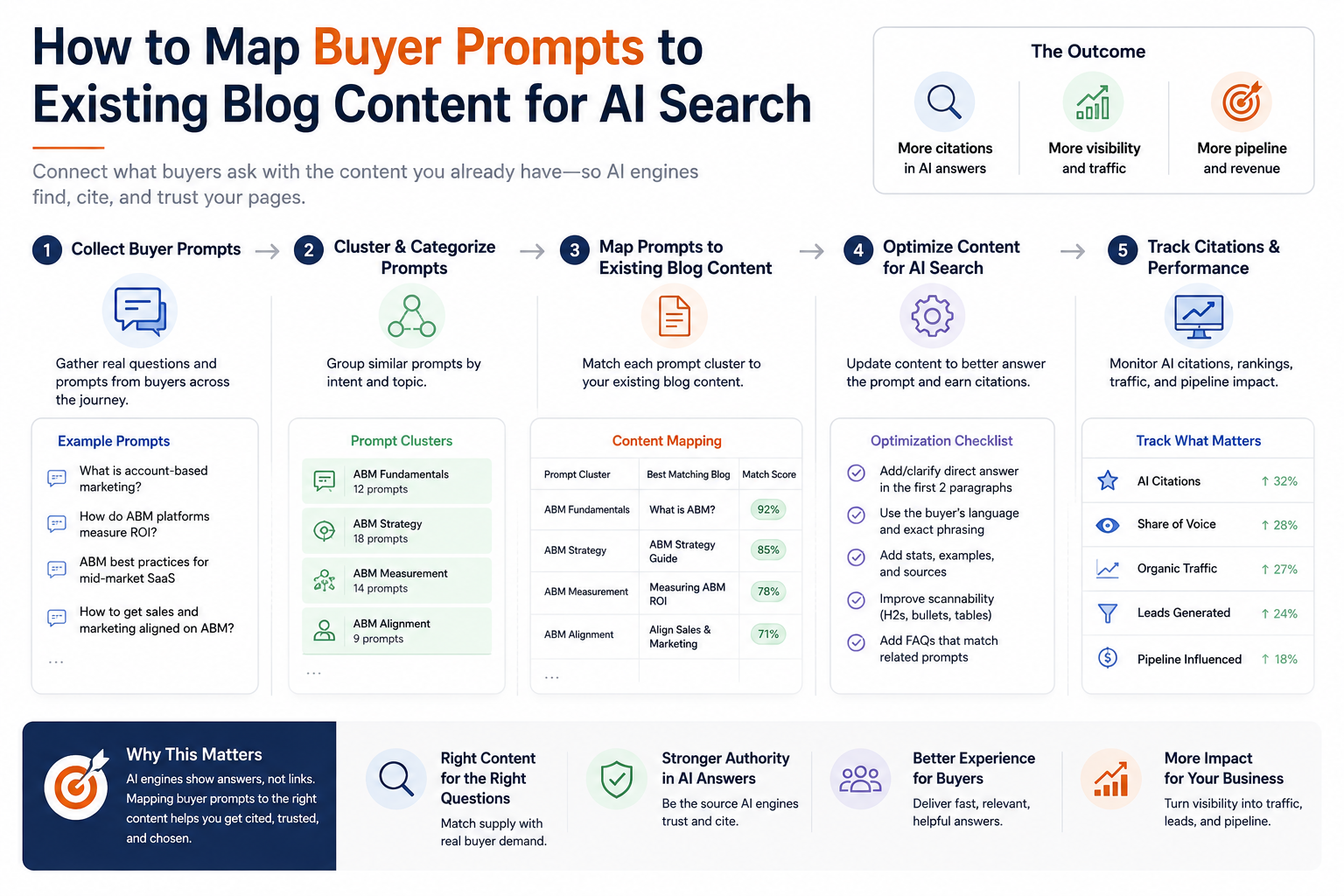
Senior content leaders often stare at a sprawling blog library and wonder whether any of those pages actually answer the exact questions AI assistants surface for their prospects. Traditional keyword‑centric SEO leaves a blind spot: the language AI models use to cite content is driven by real buyer phrasing, not by generic search terms. When your assets miss that phrasing, AI search engines simply ignore them, leading to missed visibility and lost pipeline. This guide shows why aligning your content with authentic buyer prompts is essential, walks you through a repeatable mapping process, and explains how that alignment fuels smarter optimization and new‑content planning.
Why Mapping Buyer Prompts Matters for AI Search Visibility
AI search engines generate answers by matching a user’s query to the most relevant, citation‑ready content they have indexed. If your blog does not contain the exact phrasing a buyer uses, the engine cannot cite it, regardless of how well‑optimized the page is for traditional keywords. This gap directly hurts search visibility and reduces the chance of appearing in zero‑click search results, where users never click through to a site but still gain brand exposure. A recent study of U.S. organic results shows that zero‑click rates continue to climb, making citation relevance more critical than ever.zero‑click search study highlights this trend.
Beyond raw visibility, prompt alignment functions as a form of competitive intelligence. By cataloguing the exact questions your prospects ask, you uncover the language competitors may be missing, allowing you to capture high‑value buyer intent signals before they become crowded. This insight also feeds into topic clusters, ensuring each cluster is anchored by pages that directly answer the most common prompts. When clusters are built around real queries, the entire site benefits from stronger internal linking and clearer thematic relevance.
To start, treat prompt mapping as a foundational audit much like a technical SEO crawl but focused on language rather than link structure. Identify the prompts that drive the most AI citations, then verify which existing assets already satisfy those queries. The result is a clear map that tells you exactly where you have coverage, where you have partial coverage, and where you have gaps that represent immediate content opportunities.
Recommended Read: Why Your Call Data and Prompt Tracking Matter for AI Search - A deep dive into why real‑world conversation data is the gold standard for AI‑search relevance.
Collecting Real Buyer Prompts from Your Signals
Buyer prompts live in the raw interactions your team already records: sales call transcripts, CRM notes, support tickets, and webinar Q&A logs. Mining these sources gives you the exact phrasing prospects use when they ask for solutions. Start by exporting text from each system into a searchable repository, then apply simple keyword filters to surface question‑like sentences. Tag each extracted line with its source and the stage of the buyer journey it represents awareness, consideration, or decision.
As one marketing director put it, "we need to better know which prompts are addressed by which blogs". That simple statement captures the core frustration: without a systematic way to link prompts to pages, teams waste time guessing which content might be relevant. By building a centralized prompt list, you create a single source of truth that can be shared across sales, product, and marketing.
Once you have a raw list, normalize the language. Remove filler words, standardize terminology (e.g., "CRM integration" vs. "connect CRM"), and group synonymous prompts together. This step turns a chaotic dump into a clean set of intent signals that can be directly compared against your content inventory.
Recommended Read: B2B Content Production in 2026: How to Create Content That AI Search Recommends - Practical tips for turning raw buyer language into publishable content.
Building a Prompt‑to‑Content Inventory
The next phase is to create a structured ledger that links each identified prompt to the blog(s) that address it. Use a simple spreadsheet with columns for Prompt, Matching Blog Title, Coverage Status (Full, Partial, None), and Notes on required updates. This prompt‑to‑content inventory becomes the single reference point for all downstream optimization work.
Below is an example layout that teams have found useful. It captures the prompt, the associated article, and whether the article fully satisfies the query or merely touches on it.
| Prompt | Blog Title | Coverage Status | Action Needed |
|---|---|---|---|
| How does AI search affect lead generation? | Understanding AI Search for B2B Marketers | Partial | Add concrete examples of lead metrics |
| What are the best practices for building topic clusters? | Topic Cluster Blueprint | Full | None |
| How can I improve search visibility for zero‑click results? | Zero‑Click Optimization Guide | None | Create new article targeting this prompt |
Populate the table with every prompt you uncovered. Over time, the inventory will highlight which high‑value prompts already have strong coverage and which ones are missing entirely. This visibility is the engine that drives both quick wins and long‑term content strategy.
Maintain the inventory as a living document. Whenever a new blog is published, immediately check it against the prompt list and update the coverage status. Likewise, when sales teams hear a novel buyer question, add it to the prompt list and assess whether an existing page can be tweaked to answer it.
Recommended Read: AI for Content Marketing: Supercharge Your Content Strategy - Learn how AI can automate parts of the prompt‑mapping workflow.
Analyzing Gaps and Prioritizing Optimization
With a complete inventory in hand, the next step is to identify gaps prompts with a "None" or "Partial" coverage status. Prioritize these gaps based on three criteria: the frequency of the prompt in buyer conversations, its position in the buying funnel, and the strategic importance of the topic to your product suite. Prompts that appear often in the consideration stage and relate to core value propositions should be tackled first.
Data on prompt frequency can be derived from the number of times each phrasing appears across your source signals. While we lack exact counts here, the principle remains: focus on the prompts that surface most often. This approach mirrors traditional competitive intelligence you allocate resources where the impact will be greatest.
Once prioritized, create an optimization roadmap. Assign owners, set deadlines, and define measurable goals such as improving search visibility for the target prompt or increasing the share of AI citations. Track progress in a dashboard that ties each prompt to its coverage status and performance metrics.
Recommended Read: AI for Content Marketing: Supercharge Your Content Strategy - A guide to measuring the impact of AI‑driven content updates.
Turning the Mapping into Ongoing Content Planning
The prompt‑to‑content map should directly inform your editorial calendar. When a high‑value gap is identified, schedule a new piece or an update to an existing article. Use the prompt wording as the working title to ensure the final copy mirrors buyer language. This practice also strengthens topic clusters, because each cluster can be anchored by a pillar that answers the most common prompt, with supporting articles covering related variations.
Integrate the map with your content management workflow. For each upcoming content request, check the inventory first: does a prompt already exist that satisfies the request? If yes, consider refreshing the existing page rather than creating duplicate content. If no, add the new prompt to the inventory and assign it to the upcoming piece.
Regularly review the inventory quarterly is a good cadence to capture emerging buyer language and retire outdated prompts. This iterative loop keeps your site aligned with evolving buyer intent and maintains relevance in fast‑changing AI search ecosystems.
Recommended Read: Why Your Call Data and Prompt Tracking Matter for AI Search - Insights on keeping prompt data fresh and actionable.
Best Practices for Maintaining High Search Visibility
Beyond the mechanics of mapping, adopt a set of ongoing practices that keep your content primed for AI citation. First, embed structured data such as FAQ schema on pages that answer specific prompts; this helps AI engines extract concise answers. Second, monitor buyer signals like recurring question trends in support tickets, as they often signal emerging prompts that need coverage.
Third, align your internal analytics with AI‑search metrics. Track citation share, the number of AI‑generated answers that reference your pages, and the impact on downstream traffic and leads. While exact numbers are not provided here, the principle is to treat AI citation metrics as a core KPI alongside traditional organic traffic. AI adoption report underscores the growing importance of AI‑driven discovery for U.S. enterprises.
Finally, foster cross‑functional collaboration. Sales, support, and product teams are the primary sources of authentic buyer language. Establish a routine handoff where each team contributes newly discovered prompts to the shared inventory. This collective effort ensures the content library evolves in lockstep with real‑world buyer intent.
Recommended Read: B2B Content Production in 2026: How to Create Content That AI Search Recommends - Strategies for sustaining content relevance over time.
FAQs
1. How can I start extracting buyer prompts without building a complex data pipeline?
Begin with the tools you already use. Export call transcripts, CRM notes, and support tickets into a simple spreadsheet. Apply basic text‑search functions to locate question marks or phrases like "how do I" and "what is". Tag each entry with the source and buyer stage, then clean the language to create a standardized list of prompts. This manual approach can be scaled later with automation, but it provides immediate visibility into the language your prospects actually use.
2. What is the difference between a prompt and a traditional keyword?
A traditional keyword is often a single term or short phrase optimized for search engine algorithms. A prompt, on the other hand, reflects the full, natural‑language question a buyer asks an AI assistant. Prompts capture nuance, intent, and context, which are essential for AI models that generate answer citations. Aligning content with prompts therefore improves relevance in both traditional SERPs and AI‑driven answer engines.
3. How often should I refresh the prompt‑to‑content inventory?
Quarterly reviews are a practical cadence for most B2B SaaS teams. During each review, add new prompts that have surfaced in recent sales calls or support tickets, update coverage status for existing prompts, and retire any prompts that are no longer relevant. This regular cadence keeps the inventory aligned with evolving buyer language and ensures your editorial calendar stays responsive.
4. Can I use the prompt inventory to improve my topic‑cluster strategy?
Absolutely. Each high‑value prompt can serve as the anchor for a pillar page within a topic cluster. Supporting articles then address variations or sub‑questions related to the main prompt. This structure not only strengthens internal linking but also signals to AI search engines that your site comprehensively covers the buyer’s question, boosting overall citation potential.
5. How do I measure the impact of prompt mapping on AI search performance?
Track AI‑specific metrics such as citation share (the percentage of AI‑generated answers that reference your pages) and zero‑click impression volume. Combine these with traditional SEO metrics like organic traffic and conversion rates to see the full impact. Over time, you should see an uplift in both AI visibility and downstream pipeline contributions.
6. What role do structured data and schema play in prompt alignment?
Structured data, especially FAQ schema, helps AI models extract concise answers directly from your pages. By marking up the exact prompt and its answer, you increase the likelihood that the engine will cite your content. Implementing schema across prompt‑focused pages is a low‑effort, high‑reward tactic that complements the broader mapping effort.
Conclusion
Mapping buyer prompts to your existing blog library is no longer an optional SEO tweak it is a core capability for thriving in an AI‑first search landscape. By extracting real‑world language from sales and support signals, building a disciplined prompt‑to‑content inventory, and using that inventory to drive gap analysis, optimization, and ongoing planning, you create a feedback loop that continuously aligns your content with the queries that matter most. This systematic approach not only improves search visibility and captures more zero‑click search impressions, but it also equips your team with the competitive intelligence needed to stay ahead of shifting buyer intent. Apply these steps, keep the inventory fresh, and watch your AI citation share and ultimately your pipeline grow.
Recommended Authority Resources
- Reference: In 2026, Less than One Third of Google Searches Still Send a Click - Provides recent U.S. zero‑click search percentages, illustrating the growing importance of AI citation.
- Reference: The Fed - Monitoring AI Adoption in the US Economy - Offers authoritative data on AI adoption trends among U.S. enterprises, underscoring the relevance of AI search.
Turn Your Content Into AI-Search Winners
Get cited across ChatGPT, Claude & Perplexity — not just ranked on Google.
- Increase AI citations
- Improve answer visibility
- Track brand mentions in LLMs