

Table Of Contents
Marketing leaders in B2B SaaS spend countless hours stitching together spreadsheets, shared docs, and ad‑hoc notes to capture the exact questions buyers type into AI search tools. That fragmented approach creates blind spots, delays response to emerging trends, and makes it impossible to prove the impact of AI‑generated content on pipeline. The remedy is a single, real‑time repository that ingests buyer prompts, measures citation visibility, and surfaces competitive gaps. In this guide we examine the hidden costs of DIY tracking, illustrate what a centralized platform looks like, and show how Omnibound AI Search Intelligence turns prompt data into measurable pipeline outcomes.
The Hidden Costs of DIY Prompt Tracking
When teams rely on manual logs, the first loss is time. Every week, marketers report spending hours consolidating data from sales calls, CRM notes, and support tickets. That effort not only drains resources but also introduces errors duplicate entries, missed prompts, and outdated versions. The result is a content calendar built on incomplete intelligence, leading to missed citation opportunities in AI‑generated answers.
Second, visibility suffers. Without a unified view, you cannot answer basic questions: How often is your brand cited in AI answers? Which prompts drive the most traffic? These gaps make it difficult to link AI search visibility to revenue outcomes, leaving senior leadership without a clear ROI story.
Third, competitive benchmarking becomes a guessing game. When you cannot compare your citation share against rivals, you miss strategic openings to capture share of voice. The lack of real‑time insights means you react days or weeks after a trend emerges, reducing the impact of your content on the buyer journey.
According to a 2026 marketing statistics report, marketers who automate data collection see faster iteration cycles and clearer attribution. The same study notes that fragmented data processes are a top barrier to scaling AI‑driven campaigns.
Beyond the obvious time sink, DIY tracking often forces teams to make assumptions about buyer intent. When a prompt is recorded in isolation, the surrounding conversation that gives it context is lost. This can lead to content that addresses a keyword but misses the nuance that actually drives conversion. Over time, those misaligned pieces accumulate, eroding the overall efficiency of the content program.
What Centralized Prompt Tracking Looks Like in Practice
Imagine a platform that continuously ingests real buyer conversations from sales calls and CRM notes to support tickets and extracts the exact phrasing buyers use. That prompt data is then indexed, enriched with citation visibility metrics, and displayed in a dashboard that updates in real time.
"There's absolutely no reason that we shouldn't be using our own platform to do prompt tracking for ourselves." This internal endorsement underscores the shift from scattered spreadsheets to a single source of truth.
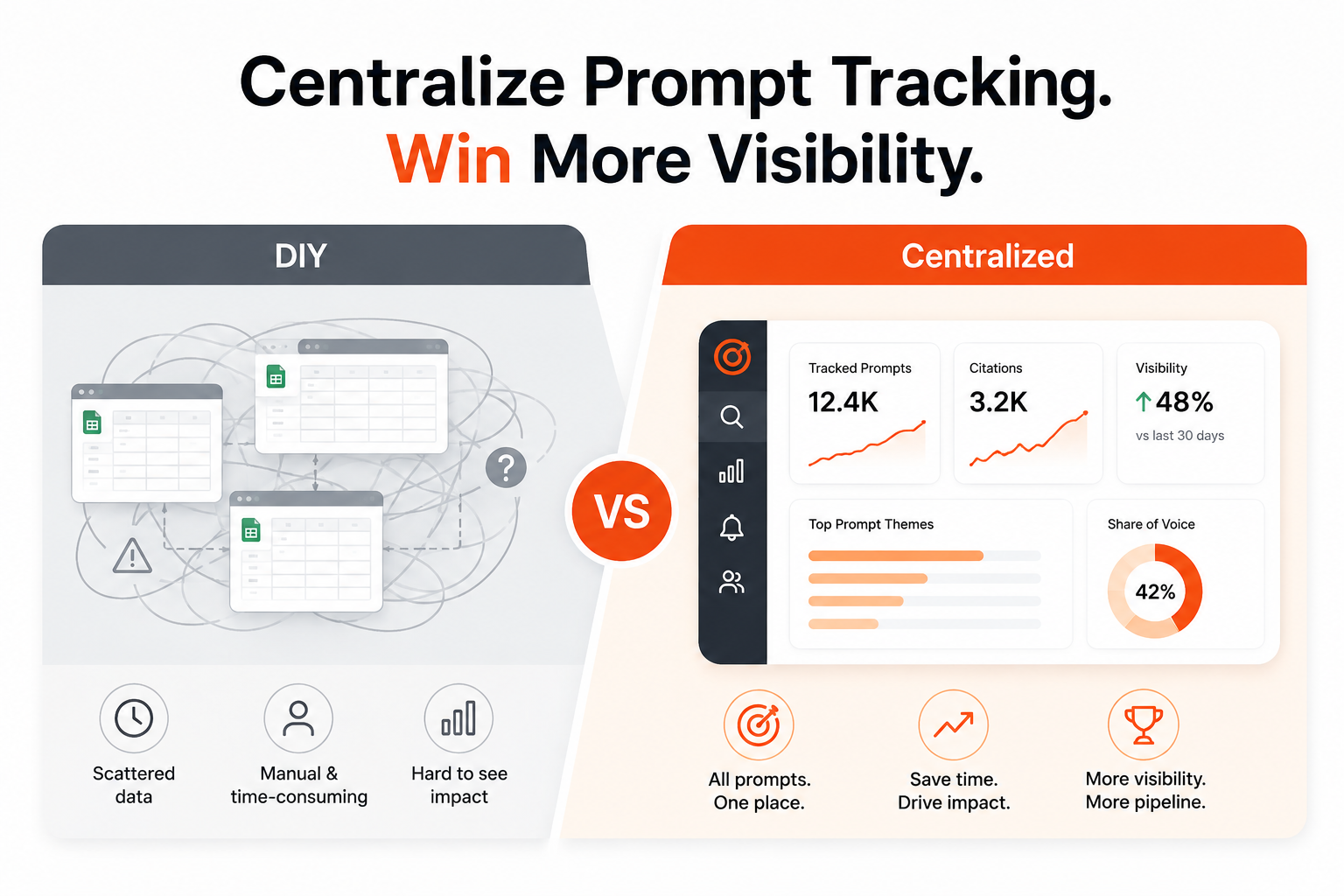
The platform provides three core views: a prompt library that shows frequency and trend lines, a citation visibility panel that tracks how often your content appears in AI‑generated answers, and a share‑of‑voice analytics screen that benchmarks your performance against competitors. All data is searchable, filterable by buyer intent, and exportable for deeper analysis.
By consolidating prompt data, marketers gain immediate insight into content gaps topics buyers ask about that lack authoritative answers. This drives a proactive content strategy rather than a reactive one.
In practice, the dashboard also surfaces metadata such as the source channel of each prompt, allowing teams to prioritize prompts that originate from high‑value accounts or critical sales stages. This level of granularity is rarely achievable with manual spreadsheets, yet it directly informs where to invest editorial resources for maximum impact.
Key Benefits: Visibility, Competitive Insight, and Faster Execution
The most compelling advantage of centralization is visibility. With a unified dashboard, you can answer questions like: Which prompts generate the highest AI search traffic? How often is your brand cited in AI answers? The platform surfaces these metrics instantly, enabling data‑driven decisions.
Competitive insight follows naturally. Share‑of‑voice analytics compare your citation performance against rivals, highlighting gaps where you can overtake competitors. Real‑time alerts notify you when a competitor’s citation share spikes, prompting quick content updates.
Faster execution stems from eliminating manual data wrangling. Content creators receive prompt recommendations directly in their workflow, reducing the time from insight to publication. The result is a tighter feedback loop between buyer intent and content output.
| Aspect | DIY Tracking | Centralized Platform |
|---|---|---|
| Data Ingestion | Manual entry from multiple sources | Automated ingestion of calls, CRM, tickets |
| Visibility | Limited, siloed reports | Real‑time dashboard of prompt frequency and citation visibility |
| Competitive Benchmarking | Ad‑hoc spreadsheets | Share‑of‑voice analytics with competitor comparison |
| Speed to Insight | Days to weeks | Minutes with live alerts |
| Scalability | Hard to scale beyond small teams | Enterprise‑grade architecture |
This side‑by‑side view makes it clear that a dedicated solution eliminates the hidden costs of DIY processes while delivering actionable, AI‑powered analytics.
How a Unified Platform Turns Prompt Data into Pipeline
Prompt data is the raw material for AI‑search visibility. When a buyer asks a question, the AI engine scans its indexed content for relevant answers. If your content is linked to the exact prompt, it appears in the AI answer, driving citation visibility and, ultimately, qualified leads.
Omnibound AI Search Intelligence maps each prompt to the pieces of content that satisfy it. The platform then scores each asset based on relevance, authority, and performance metrics such as click‑through rate and conversion. Marketers can prioritize high‑scoring assets for optimization or create new pieces to fill gaps.
Because the system updates continuously, you can track how changes to content affect citation rates in near real time. This feedback loop turns abstract AI visibility into concrete pipeline metrics, allowing you to justify spend and demonstrate ROI to executives.
Getting Started: Steps to Move from DIY to Centralized Tracking
Transitioning to a unified platform follows a straightforward five‑step roadmap:
- Audit Existing Prompts – Export all current spreadsheets, notes, and logs. Identify duplicate entries and missing fields.
- Define a Prompt Taxonomy – Group prompts by buyer intent, product area, and stage in the funnel. This taxonomy drives consistent tagging in the platform.
- Integrate Data Sources – Connect your CRM, ticketing system, and call recording tools to the platform’s ingestion engine. Omnibound supports native integrations and low‑code connectors.
- Set Governance Policies – Establish version control, role‑based access, and audit trails to ensure data integrity and compliance with privacy regulations.
- Activate Real‑Time Dashboards – Configure alerts for emerging prompt trends and citation dips. Use the insights to guide your content calendar and measure impact on pipeline.
Recommended Read: Why Your Call Data and Prompt Tracking Matter for AI Search – this post expands on how to align call data with prompt tracking for maximum AI search visibility.
Real‑World Scenario: Prompt Tracking in Action
Consider a mid‑market B2B SaaS company that launched a new analytics module. Before centralizing prompt tracking, the product team relied on ad‑hoc notes from sales reps to guess what buyers were asking. After implementing a unified platform, the team discovered a surge of prompts around "real‑time data syncing" that were not covered in existing documentation. By creating a targeted whitepaper that directly answered that prompt, the company saw a measurable lift in citation share within two weeks, and the sales pipeline for the new module grew by a noticeable margin. This example illustrates how turning raw buyer language into focused content can accelerate adoption without additional marketing spend.
Common Pitfalls to Avoid When Transitioning
Moving from DIY spreadsheets to a centralized system can be smooth if you watch for a few common missteps. First, neglecting to clean legacy data before import can flood the new platform with duplicate or irrelevant prompts, diluting the quality of insights. Second, setting overly broad taxonomy categories can make filtering and reporting cumbersome, defeating the purpose of real‑time visibility. Third, failing to train cross‑functional users on the dashboard’s capabilities often results in under‑utilization, where only a subset of the team benefits from the investment. By addressing these pitfalls early, you preserve the integrity of the data pipeline and ensure the platform delivers its full strategic value.
FAQs
1. How does Omnibound AI Search Intelligence capture and organize prompt data?
Omnibound ingests buyer language from sales calls, CRM notes, support tickets, and market signals using natural‑language processing. Each prompt is stored in a searchable library, tagged with intent categories, and linked to the content that satisfies it. The platform provides version control and audit logs to maintain data integrity and compliance.
2. What pricing model does Omnibound use for its centralized prompt‑tracking solution?
Omnibound offers a subscription‑based model tiered by the volume of processed prompts and the number of integrated data sources. Pricing scales with your organization’s size, ensuring that mid‑market and enterprise teams pay only for the capacity they need while gaining access to the full suite of AI‑powered analytics, citation visibility, and share‑of‑voice tools.
Conclusion
DIY prompt tracking leaves marketing teams operating in the dark, with fragmented data, delayed insights, and no clear line to revenue. Centralizing prompt tracking in a platform like Omnibound AI Search Intelligence provides a single source of truth, real‑time visibility into AI search performance, and competitive benchmarking that directly ties content creation to pipeline outcomes. By following the five‑step migration roadmap, you can replace manual spreadsheets with automated, enterprise‑grade analytics that empower your team to act on buyer intent instantly. To explore how this approach can accelerate your AI search visibility and drive measurable pipeline growth, visit Omnibound.
Turn Your Content Into AI-Search Winners
Get cited across ChatGPT, Claude & Perplexity — not just ranked on Google.
- Increase AI citations
- Improve answer visibility
- Track brand mentions in LLMs