

Marketing Orchestration Is No Longer Just About Channels
Why do some B2B brands deliver a seamless customer journey while others create disconnected marketing experiences? The answer usually comes down to orchestration, not effort. Two teams can run the same number of campaigns and still produce very different results if one coordinates its work and the other doesn't.
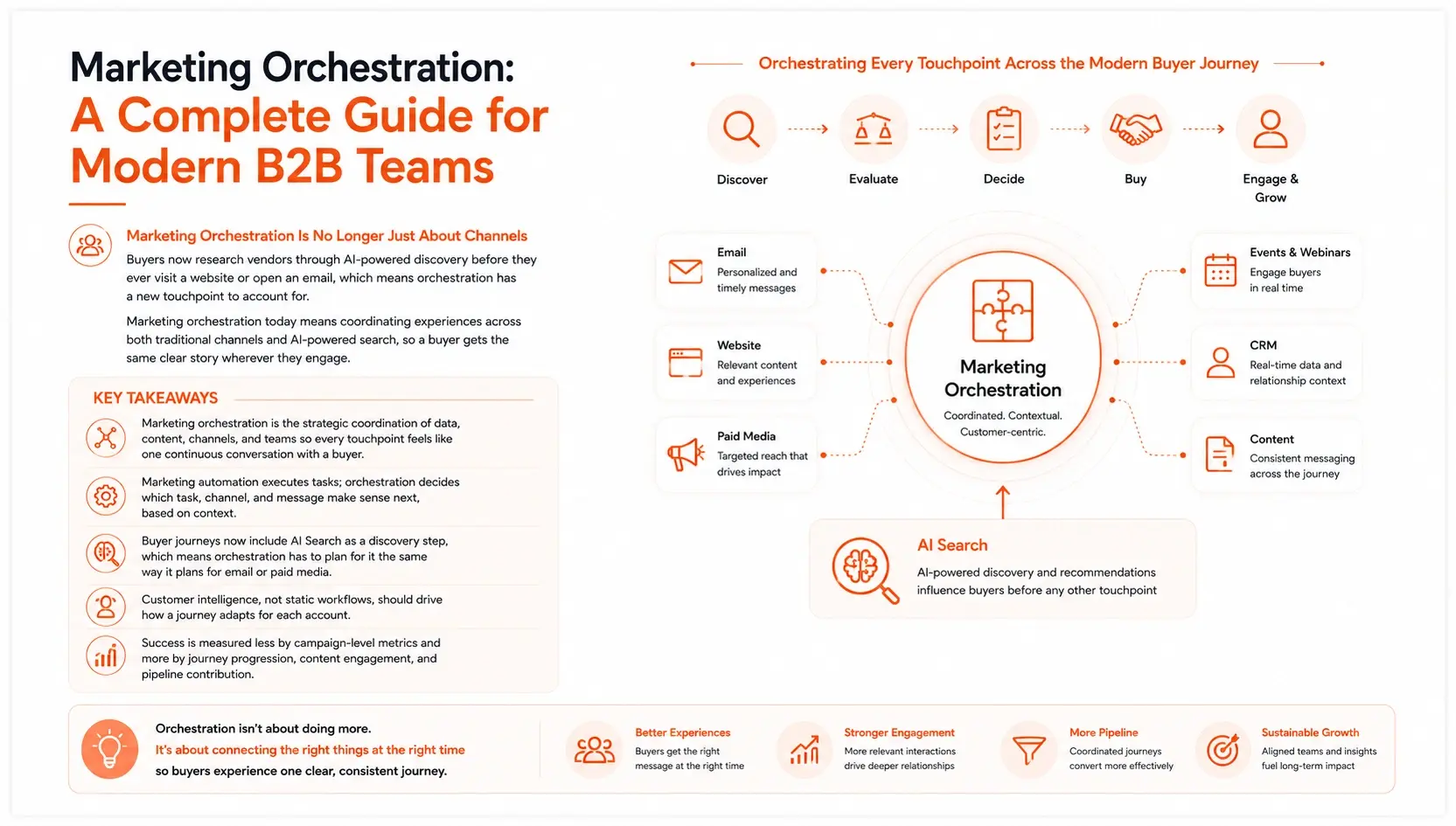
For years, marketing orchestration meant lining up email, paid media, the website, events, and CRM so a buyer received consistent messaging no matter which channel they touched. That definition still holds, but it's incomplete. Buyers now research vendors through AI-powered discovery before they ever visit a website or open an email, which means orchestration has a new touchpoint to account for.
Marketing orchestration today means coordinating experiences across both traditional channels and AI-powered search, so a buyer gets the same clear story whether they're reading an email, browsing a product page, or asking an AI tool to compare vendors.
Key Takeaways
- Marketing orchestration is the strategic coordination of data, content, channels, and teams so every touchpoint feels like one continuous conversation with a buyer.
- Marketing automation executes tasks; orchestration decides which task, channel, and message make sense next, based on context.
- Buyer journeys now include AI Search as a discovery step, which means orchestration has to plan for it the same way it plans for email or paid media.
- Customer intelligence, not static workflows, should drive how a journey adapts for each account.
- Success is measured less by campaign-level metrics and more by journey progression, content engagement, and pipeline contribution.
What Is Marketing Orchestration?
Marketing orchestration is the practice of coordinating marketing activity across every channel and touchpoint so a customer experiences one coherent, relevant journey instead of a series of disconnected campaigns. Rather than treating email, paid, web, and sales outreach as separate lanes, orchestration uses shared data and a common strategy to decide what each buyer should see next, regardless of where they show up.
Four things make orchestration work:
- Unified context pulled from CRM, product usage, web behavior, and revenue data.
- Cross-channel coordination across email, web, social, paid, and sales.
- Context-driven decisions based on real buyer behavior, not fixed rules.
- Closed-loop measurement that connects activity back to pipeline and revenue.
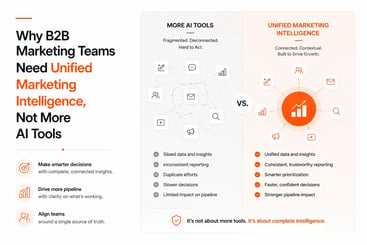
This is a different discipline than automation. Automation fires the next email or task when a rule is triggered. Orchestration decides which channel, which message, and which moment will actually move a specific buyer forward, based on everything known about them at that point in time.
Marketing Orchestration vs Marketing Automation
This is one of the most common points of confusion for B2B marketing teams, and it's worth being direct about the difference.
|
Marketing Automation |
Marketing Orchestration |
|---|---|
|
Executes tasks |
Coordinates strategy |
|
Rule-based |
Context-driven |
|
Individual workflows |
Entire customer journey |
|
Channel-focused |
Journey-focused |
|
Campaign execution |
Decision-making |
Automation platforms are useful, but they're a layer inside orchestration, not a substitute for it. A team can have excellent automation and still deliver a disjointed experience if nothing is coordinating the bigger picture. Orchestration is what turns a stack of automated workflows into one connected buyer journey.
AI Search Is Becoming Part of Marketing Orchestration
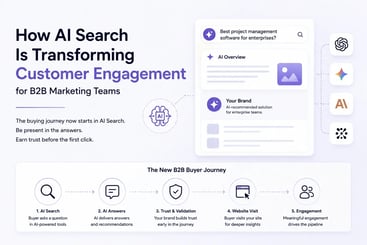
Buyers no longer start their research on a company's website. Many start by asking an AI tool to compare options, summarize a category, or recommend a vendor. That means AI Search now functions as a discovery channel in its own right, alongside email, social, and the website.

Modern orchestration has to plan for this. It should coordinate experiences across AI Search discovery, the website, email, social, sales conversations, and customer success, so the story a buyer hears in one place matches what they encounter everywhere else. If a buyer gets one narrative from an AI Search result and a different one from a sales rep, the disconnect shows up as hesitation later in the deal.
This doesn't replace the fundamentals of orchestration. It extends them. AI Search visibility becomes another signal to plan around and another touchpoint to keep consistent with everything else in the journey. Our AI Search Intelligence work is built around exactly this idea: understanding what buyers are asking and making sure the right content is positioned to answer it, consistently, across every other channel too.
Customer Intelligence Drives Better Orchestration
Static workflows age quickly. A journey built around assumptions from six months ago won't reflect what buyers are actually asking today, how the market has shifted, or what competitors are now claiming. Orchestration works best when it's driven by continuous customer intelligence rather than a fixed set of rules.
That means building journeys around real buyer questions, current market movement, and competitive positioning, not just a static lead score or a lifecycle stage. A team that knows what buyers are actually asking, and how competitors are answering those same questions, can adjust messaging before a deal stalls rather than after.
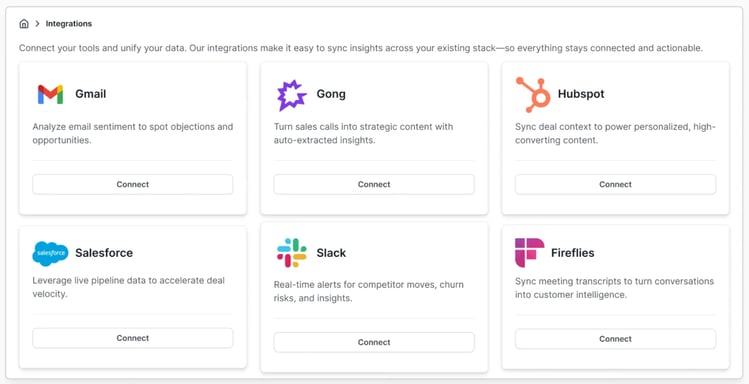
This is where continuous research earns its place inside orchestration. Instead of refreshing personas once a year, buyer research runs constantly, feeding fresh context into every channel decision. Combined with unified customer context from CRM, product usage, and sales conversations, this gives orchestration something static workflows never had: a current, accurate picture of what each account actually needs next.
One Content Strategy Across Every Channel
Orchestrated journeys break down quickly when content lives in silos, one team writing for the website, another for email, another for sales enablement, each with a slightly different version of the story. A single content strategy, applied consistently, is what keeps every channel saying the same thing.
One well-built content foundation should support the website, AI Search visibility, email nurture, social distribution, sales enablement material, and customer education, all pulling from the same core narrative and the same buyer intelligence. When content is built this way, a prospect who reads a blog post, sees a LinkedIn update, and later asks an AI tool about the category all encounter the same positioning.
Our Content Workflow approach was built around this exact problem: one input, structured execution across every format, so nothing drifts as it moves from channel to channel.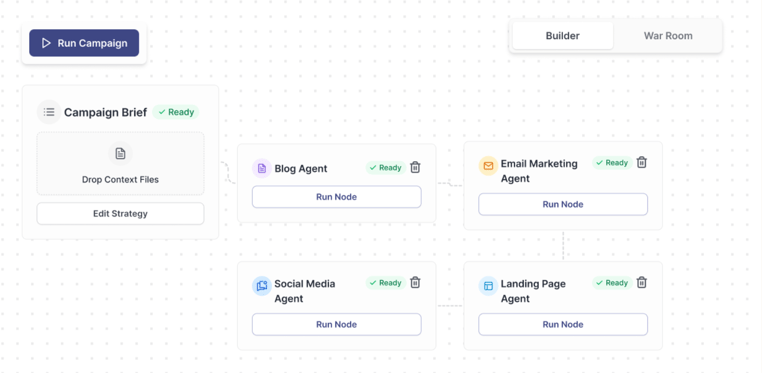
The Marketing Orchestration Framework
When teams ask us how to actually put this into practice, we point them to a simple sequence. It starts with intelligence and ends with revenue, and every step feeds the next one.
- Customer Intelligence: understand what buyers are asking, where they get stuck, and what convinces them.
- Market Intelligence: track how the category and buyer expectations are shifting.
- Competitive Intelligence: know what alternatives are claiming and where the gaps are.
- AI Search Intelligence: know what buyers are asking AI tools and whether your content is positioned to answer it.
- Content Strategy: turn all of the above into one consistent narrative.
- Cross-Channel Delivery: deliver that narrative through email, web, social, sales, and AI Search.
- Measurement: track journey progression and pipeline impact, not just channel metrics.
- Continuous Optimization: feed results back into intelligence, and repeat.
The point of this sequence is that intelligence comes first. Channels and content are downstream decisions, not the starting point.
Measuring Marketing Orchestration
Traditional metrics still matter, but they don't tell the whole story anymore. Email opens, click-through rates, and campaign engagement measure whether a single message performed. They don't measure whether the journey as a whole is working.
Traditional metrics worth keeping:
- Email opens and click-through
- Campaign engagement rates
- Channel-level conversion
Metrics worth adding:
- AI Search visibility: whether your content is showing up and being cited when buyers ask relevant questions
- Buyer journey progression: whether accounts are moving forward, not just engaging
- Content engagement: which assets buyers actually return to
- Recommendation frequency: how often your brand gets surfaced as an option
- Pipeline contribution: whether orchestrated journeys are producing qualified opportunities
Our solutions for marketing leadership are built around giving teams this second set of metrics without abandoning the first.
Common Marketing Orchestration Mistakes
Most orchestration efforts don't fail because of a lack of tools. They fail because of a handful of avoidable habits.
- Treating orchestration as automation. Automating tasks isn't the same as coordinating a strategy.
- Disconnected messaging. Different teams telling slightly different versions of the same story.
- Channel silos. Email, paid, and sales operating from separate plans instead of one journey.
- Ignoring AI Search. Treating AI-powered discovery as someone else's problem, or not a channel at all.
- Measuring only campaign metrics. Optimizing individual sends while the overall journey stays disconnected.
- No continuous optimization. Building a journey once and never revisiting it as buyer behavior changes.
Fixing these usually starts with a data and process review, followed by picking one or two priority journeys, like onboarding or renewal, to rebuild with unified intelligence behind them rather than trying to overhaul everything at once.
Conclusion
Marketing orchestration hasn't changed at its core: it's still about making sure a buyer gets one coherent experience instead of a pile of disconnected campaigns. What's changed is the map. AI Search now sits alongside email, web, and sales as a place buyers form their first impression, which means it belongs in the orchestration plan, not off to the side as something separate.
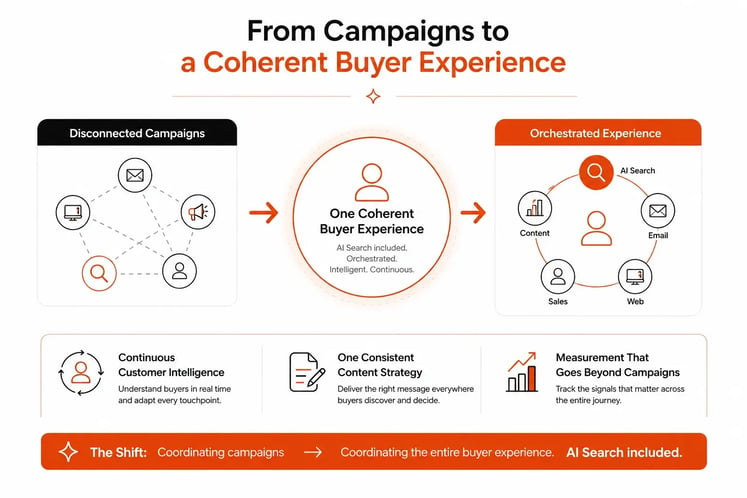
Teams that build their orchestration around continuous customer intelligence, one consistent content strategy, and measurement that goes beyond campaign metrics are the ones delivering journeys that actually move buyers forward. That's the shift worth making: from coordinating campaigns to coordinating an entire buyer experience, AI Search included.
Frequently Asked Questions
What Is Marketing Orchestration?
Marketing orchestration is the practice of coordinating customer data, content, channels, and AI Search intelligence into a unified workflow that continuously adapts to buyer behavior. Instead of managing disconnected campaigns, orchestration synchronizes real-time signals from multiple systems to improve messaging consistency, content relevance, and AI citation opportunities. Omnibound applies this approach by transforming connected cloud data into ongoing marketing execution and optimization.
How Does Marketing Orchestration Improve Customer Experience?
Marketing orchestration improves customer experience by connecting CRM records, sales calls, support tickets, technical documentation, and other cloud data into a single workflow that reflects real buyer intent. This creates consistent messaging across every channel while keeping content aligned with changing customer questions. Omnibound continuously synchronizes these signals to generate citation-ready content, surface emerging buyer prompts, and help teams respond faster to evolving market needs.
What Is Enterprise Marketing Orchestration Software?
Enterprise marketing orchestration software unifies customer, product, sales, and marketing data from multiple cloud systems into a centralized intelligence layer that coordinates content, campaigns, and AI Search optimization. Unlike traditional marketing automation, it continuously synchronizes live business context. Omnibound securely connects cloud sources, extracts buyer intent, and transforms fragmented data into actionable marketing intelligence.
Who Provides Full-Stack Marketing Orchestration Platforms?
Full-stack marketing orchestration platforms integrate cloud data, buyer intelligence, AI Search monitoring, content optimization, citation tracking, and performance measurement within one system. Omnibound provides this unified workflow by connecting CRM, document repositories, call recordings, support platforms, and cloud storage, enabling marketers to continuously improve AI visibility, content relevance, and pipeline performance from a single platform.
What is the difference between marketing orchestration and marketing automation?
Automation executes individual tasks based on rules. Orchestration makes the higher-level decision about which channel, message, and timing should be used next, based on the full context of a buyer's journey.
Why is marketing orchestration important for B2B companies?
B2B buying involves multiple stakeholders and a longer research process. Coordinated messaging across every touchpoint reduces confusion, builds trust faster, and shortens the path to a decision.
How does AI Search affect marketing orchestration?
AI Search has become a discovery touchpoint buyers use before they visit a website or talk to sales. Orchestration now needs to include AI Search visibility alongside traditional channels so the story stays consistent everywhere a buyer encounters it.
What are the key components of a marketing orchestration strategy?
Unified customer data, cross-channel coordination, a clear content strategy, context-driven decisioning, and ongoing measurement of journey-level outcomes.
How do customer intelligence and orchestration work together?
Customer intelligence supplies the current, real-world context, buyer questions, market shifts, competitive positioning, that orchestration uses to decide what a journey should look like for each account.
What metrics should marketers track?
Traditional engagement metrics still matter, but should be paired with AI Search visibility, journey progression, content engagement, and pipeline contribution to see whether the full journey is working.
How do you build an orchestrated customer journey?
Start with a data and process review, pick one priority journey, define what success looks like at each stage, then coordinate messaging across every channel, including AI Search, around that single journey before expanding to others.