

Table Of Contents
Demand‑generation leaders in mid‑market SaaS firms constantly wonder which of their web pages are actually being quoted by AI‑driven search engines. The lack of visibility makes it hard to prove that content is contributing to pipeline, leaving budget decisions in the dark. When an AI answer engine cites a page, that citation can shape buyer perception and steer traffic toward a sales conversation. Without a systematic way to capture, group, and attribute those citations, marketers end up guessing which assets are truly moving the needle. This guide walks you through a repeatable workflow that turns hidden AI citations into clear pipeline signals, so you can invest in the content that really matters.
Why AI Search Citations Matter for B2B Pipeline
In the world of generative AI search, the engine decides which external sources to quote when answering a user query. When your page appears as a citation, the buyer sees your brand as the authority behind the answer, which shortens the decision cycle and feeds directly into the sales funnel. For a Director of Demand Generation, the key metric is citation share – the proportion of AI‑generated answers that reference your assets compared with competitors. A higher share signals stronger brand authority and translates into more qualified leads, making it a vital piece of the attribution puzzle. Understanding citation share is the first step toward proving AI‑search ROI and justifying content investment (and you can go deeper on monitoring share and competitor gaps in Closing B2B Visibility Gaps: Monitoring AI Search and Competitor Citations).
Beyond brand perception, AI citations can surface in buyer‑initiated interactions such as chat‑based research or voice assistants, where the user never clicks a traditional link. This “zero‑click” exposure still influences intent, as the cited content informs the buyer’s mental model of the solution. By linking those citations back to the original pages, you can trace a direct line from AI‑driven awareness to pipeline stages like MQL, SQL, and opportunity. The ability to map citations to revenue outcomes turns a vague marketing activity into a measurable growth engine (see How Fast Do AI Citations Deliver Pipeline Value? for what to expect and how to measure it).
To get started, focus on three core questions: Which queries are generating citations? Which of our pages are being cited? How do those citations correlate with pipeline activity? Answering these questions creates a foundation for a data‑driven content strategy that aligns directly with revenue goals, especially when supported by a consistent prompt and citation framework like the one outlined in AI Search Intelligence: How B2B Teams Turn AI Answer Signals Into Pipeline Impact (2026).
Recommended Read: Why Your Call Data and Prompt Tracking Matter for AI Search - Explores how real‑buyer language can be harvested to improve AI citation relevance.
Building a Foundation: Capturing AI Search Citations
The first technical hurdle is to collect citation data from the AI answer engines you care about – for example, Bing Chat, Google SGE, or enterprise LLM portals. Most engines expose citation URLs through API responses or structured answer payloads, which can be harvested on a scheduled basis. Set up a lightweight data pipeline that queries the engine’s endpoint, extracts the citation URLs, and stores them in a centralized repository for further analysis. This systematic capture eliminates the manual spreadsheet work that many teams currently rely on (and it pairs well with the tracking approach in What B2B Marketers Need to Know About AI Search Rank Tracking).
As one demand‑generation manager put it, "Added a new tab to track Bing AI search citations and grouped them by topic so we can map them back to the most relevant pages and blogs." That simple addition turned a fragmented process into a repeatable workflow, giving the team a clear view of which queries were surfacing their content. By normalizing the raw citation feed – removing duplicates, standardizing URL formats, and enriching with timestamps – you create a clean dataset ready for deeper insight.
Once you have a reliable feed, enrich each citation with contextual signals such as the originating query, the AI engine, and any confidence scores provided. This enrichment prepares the data for the next step: grouping citations by topic, which helps you see patterns across buyer intent signals (a similar buyer‑prompt workflow is covered in Smarter AI Search Starts with Better Data, Assets & Real Conversations).
Recommended Read: What B2B Marketers Need to Know About AI Content Influence Metrics - Shows how to turn raw citation data into actionable marketing metrics.
Mapping Citations to Content Assets by Topic
After capturing citations, the next step is to align each citation with the specific content piece that generated it. Begin by clustering citations into thematic groups based on the buyer prompts that triggered them. Use natural‑language processing or simple keyword matching to assign each citation to a topic such as "cloud security compliance" or "multi‑tenant data architecture." This topic grouping reduces noise and lets you focus on high‑value content clusters (for a more structured clustering approach, see AI‑Driven Content Strategy & Topic Clusters for Buyer Intent).
Below is a sample framework that maps citation topics to the originating pages. The table illustrates how a citation about "secure API integration" can be linked back to a blog post, a product landing page, or a technical guide.
Topic Typical Query Primary Content Asset Secondary Assets Potential Pipeline Stage
Secure API Integration "How do I securely connect my SaaS app to a CRM?" Technical Guide: API Security Best Practices Blog Post: 5 Tips for Secure Integrations MQL / SQL
Cloud Cost Optimization "Ways to reduce cloud spend for mid‑market SaaS" E‑book: Cloud Cost Reduction Strategies Webinar Replay: Cutting Cloud Costs Opportunity
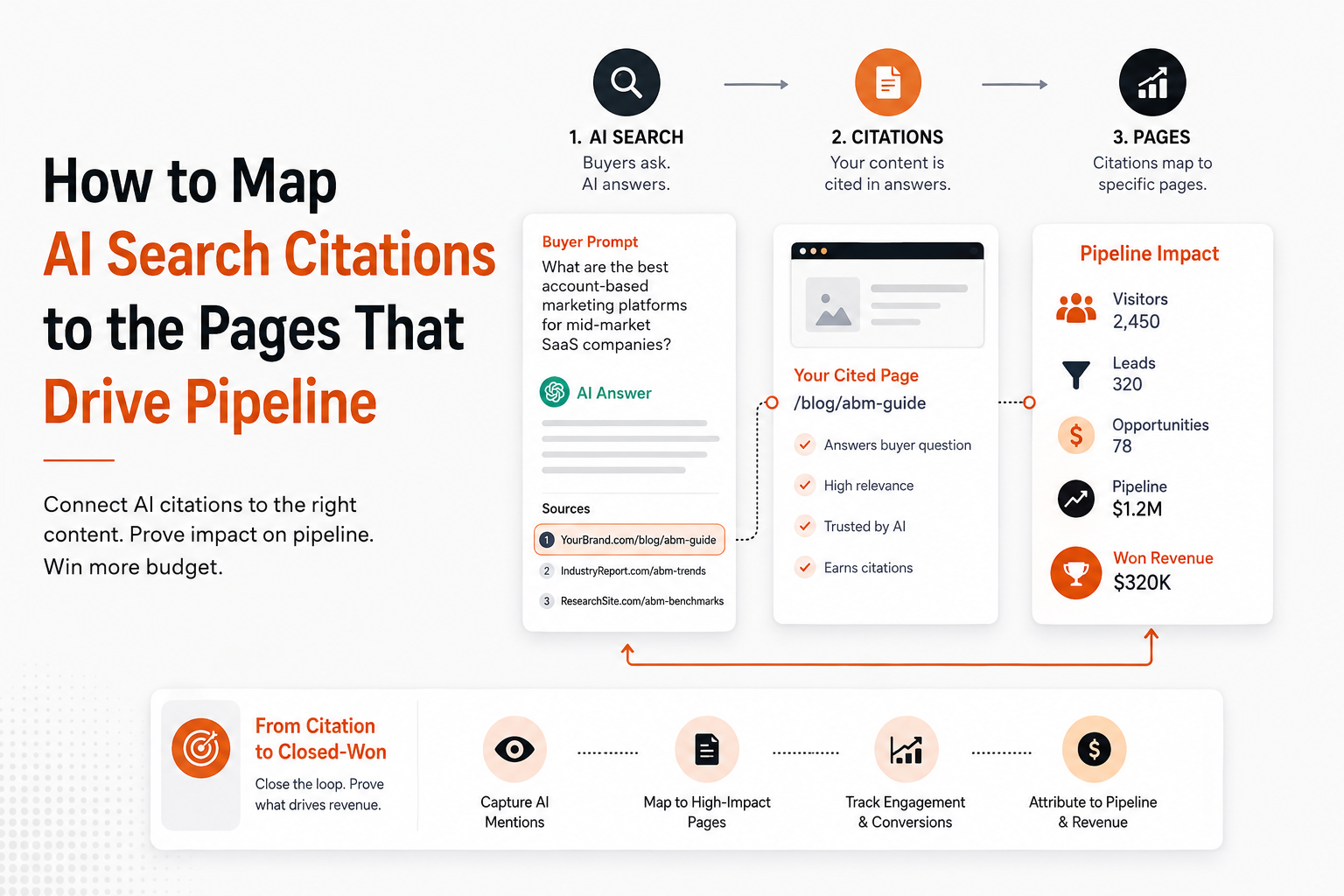
The table shows that each citation can be traced to a primary asset that drives the most relevance, while secondary assets provide supporting context. By maintaining this mapping, you create a clear audit trail from AI citation back to the content that influences the buyer (a full workflow for doing this at scale is outlined in How to Map AI Search Citations to the Pages That Drive Pipeline).
To keep the mapping up to date, schedule a weekly reconciliation that checks for new citations, re‑assigns topics as language evolves, and flags any orphaned citations that lack a matching asset. This ongoing maintenance ensures your citation map reflects the current buyer intent landscape.
Recommended Read: B2B Content Marketing ROI: How Your Content Drives Real Revenue - Provides a deeper dive into linking content performance to revenue outcomes.
Turning Citation Data into Pipeline Attribution
With citations linked to content assets, you can now attribute those citations to pipeline metrics. Start by enriching each citation record with CRM identifiers – for example, match the citation’s originating URL to the landing page URL stored in your marketing automation platform. When a lead progresses through the funnel, you can trace the touchpoints back to the citation that first introduced the brand (for a CRM‑first implementation, see Turn AI Search Leads into Revenue Pipeline in Your CRM).
Implement a first‑touch or weighted attribution model that assigns credit to the citation source. For first‑touch, the citation that first drove the lead receives 100 % of the credit. For weighted models, you might allocate 40 % to the first citation, 30 % to the last, and the remaining 30 % across middle interactions. Choose the model that aligns with your organization’s reporting standards and sales cycle complexity.
Once attribution is in place, generate a simple KPI report that shows citation share, citation‑generated MQLs, and the revenue impact tied to each topic cluster. This report provides the evidence you need to justify content spend and prioritize updates based on real pipeline contribution.
Visualizing Insights with a Dashboard
A visual dashboard turns raw attribution data into an at‑a‑glance view of AI citation performance. Build a dashboard that displays key metrics such as citation volume by topic, citation‑generated pipeline contribution, and trend lines for citation share over time. Use color‑coded tiles to highlight high‑performing topics and flag under‑performing assets that need optimization.
Integrate the dashboard with your existing BI tools or marketing analytics platform so that the data refreshes automatically each day. Include filters that let stakeholders drill down by AI engine, time period, or pipeline stage, enabling granular analysis without leaving the dashboard environment.
When the dashboard surfaces a spike in citations for a particular topic, you can quickly assess whether the associated content is already optimized or if additional assets are needed. This real‑time visibility empowers the demand‑generation team to act fast, aligning content creation with emerging buyer intent.
Establishing a Continuous Optimization Loop
The final piece of the workflow is a feedback loop that uses dashboard insights to refine content. Identify top‑performing citation topics and replicate the successful elements – such as tone, structure, and keyword focus – across other content assets. Conversely, for topics with low citation share, conduct a content audit to improve relevance, add schema markup, or enhance the on‑page experience (you can follow a structured playbook in AI Search Optimization Checklist: Win AI Citations and Drive B2B Pipeline).
Incorporate buyer‑intent signals from sales calls, CRM notes, and support tickets to keep your topic clusters aligned with the language prospects actually use. By continuously feeding fresh intent data into the citation mapping process, you ensure the system stays current with evolving buyer queries. If you’re also leveraging third‑party proof points and PR inputs, How B2B Marketers Leverage PR‑Driven Data to Capture AI Search Citations offers additional ideas for strengthening those signals.
Regularly schedule a quarterly review where the demand‑generation team presents attribution results, updates the topic taxonomy, and sets new content priorities. This disciplined cycle turns AI citation tracking from a one‑off project into a sustainable engine for pipeline growth.
Practical Tips for Getting Started Quickly
Begin with a small pilot that targets the three most‑frequent queries that already surface your content as citations. Pull the citation URLs for those queries, map each URL back to its source page, and tag the corresponding lead records in your marketing automation system. This limited scope proves the end‑to‑end flow while keeping the data‑engineering effort manageable.
Then set up an automated daily pull using a low‑code integration tool that calls the AI engine’s citation API. Store the raw feed in a cloud‑based spreadsheet or a lightweight database, apply the same deduplication and enrichment steps, and gradually expand coverage to additional engines and topic clusters. This incremental approach keeps the system reliable and scalable.
FAQs
1. How can I start capturing AI search citations without a custom API integration?
Many AI answer platforms provide public endpoints that return citation URLs as part of the response payload. You can use a simple script or low‑code integration tool to poll these endpoints on a daily schedule, extract the citation links, and store them in a spreadsheet or database. The key is to automate the pull so the data remains fresh and does not require manual copy‑pasting.
2. What is the best way to group citations by buyer intent?
Start by analyzing the query text that triggered each citation. Use keyword clustering or a lightweight natural‑language processing model to assign each query to a thematic bucket. Validate the buckets with sales or support teams to ensure the topics reflect real‑world buyer language. This alignment makes the subsequent attribution more accurate.
3. Which attribution model works best for AI citations?
Both first‑touch and weighted models are common. First‑touch gives clear visibility into which citation introduced the prospect, while weighted models distribute credit across the buyer’s journey. Choose the model that matches your organization’s reporting preferences and the complexity of your sales cycle. Many teams start with first‑touch for simplicity and evolve to weighted attribution as data maturity grows.
4. How often should the citation dashboard be refreshed?
Daily refreshes keep the data aligned with fast‑moving AI search environments. If your platform or data pipeline cannot support daily updates, a 24‑hour refresh is the next best option. The goal is to avoid stale data that could mislead content decisions.
5. What role does schema markup play in AI citation visibility?
Schema markup helps AI engines understand the structure and relevance of your content. Adding appropriate schema – such as Article, FAQ, or Product – can improve the likelihood that the engine selects your page as a citation. Regularly audit your pages for missing or outdated schema to keep them citation‑ready. For more on building the underlying trust and authority signals that increase citation likelihood, see AI Search Authority: How Brands Build the Signals That Earn Citations.
6. How can I demonstrate the revenue impact of AI citations to leadership?
Combine citation‑generated pipeline metrics with revenue attribution reports. Show how many MQLs, SQLs, and closed‑won deals can be traced back to specific citation topics. Visualize the contribution in a dashboard and include trend analysis that highlights growth over time. This data‑driven story makes it easy for leadership to see the ROI of AI‑search optimization (and Why Most B2B Brands Get Cited in AI Search but Never See It in Revenue is a useful framing for that conversation).
Conclusion
AI search citations are a hidden but powerful driver of B2B pipeline. By capturing citations, grouping them by topic, linking them back to the exact pages, and visualizing the attribution, demand‑generation teams gain the transparency needed to invest wisely in content. The workflow outlined above turns guesswork into a repeatable, data‑backed process that aligns marketing effort with revenue outcomes. Apply these principles to your own environment, and you’ll be able to surface the pages that truly move the needle, justify spend, and accelerate pipeline growth.
Recommended Authority Resources
- Reference: AI Search Engine Market Size | CAGR of 15.6% - Provides U.S. market size and growth rates for AI search technologies, establishing the broader industry context.
- Reference: Advertising and Marketing | Federal Trade Commission - Outlines regulatory expectations for disclosures around AI‑generated content, useful for compliance considerations.
Turn Your Content Into AI-Search Winners
Get cited across ChatGPT, Claude & Perplexity — not just ranked on Google.
- Increase AI citations
- Improve answer visibility
- Track brand mentions in LLMs