

Table Of Contents
Competitive AI visibility benchmarking is how you find out whether your competitors are already being recommended inside ChatGPT, Perplexity, and Gemini while you are measuring the wrong scoreboard. It matters because the gap is real: 52% of brands that rank on Google's first page do not appear in AI-generated recommendations at all (SearchScore, 2026). Ranking is no longer proof of visibility, and the only way to know where you stand is to benchmark your presence in AI answers against the brands buyers actually see.
What Is Competitive AI Visibility Benchmarking?
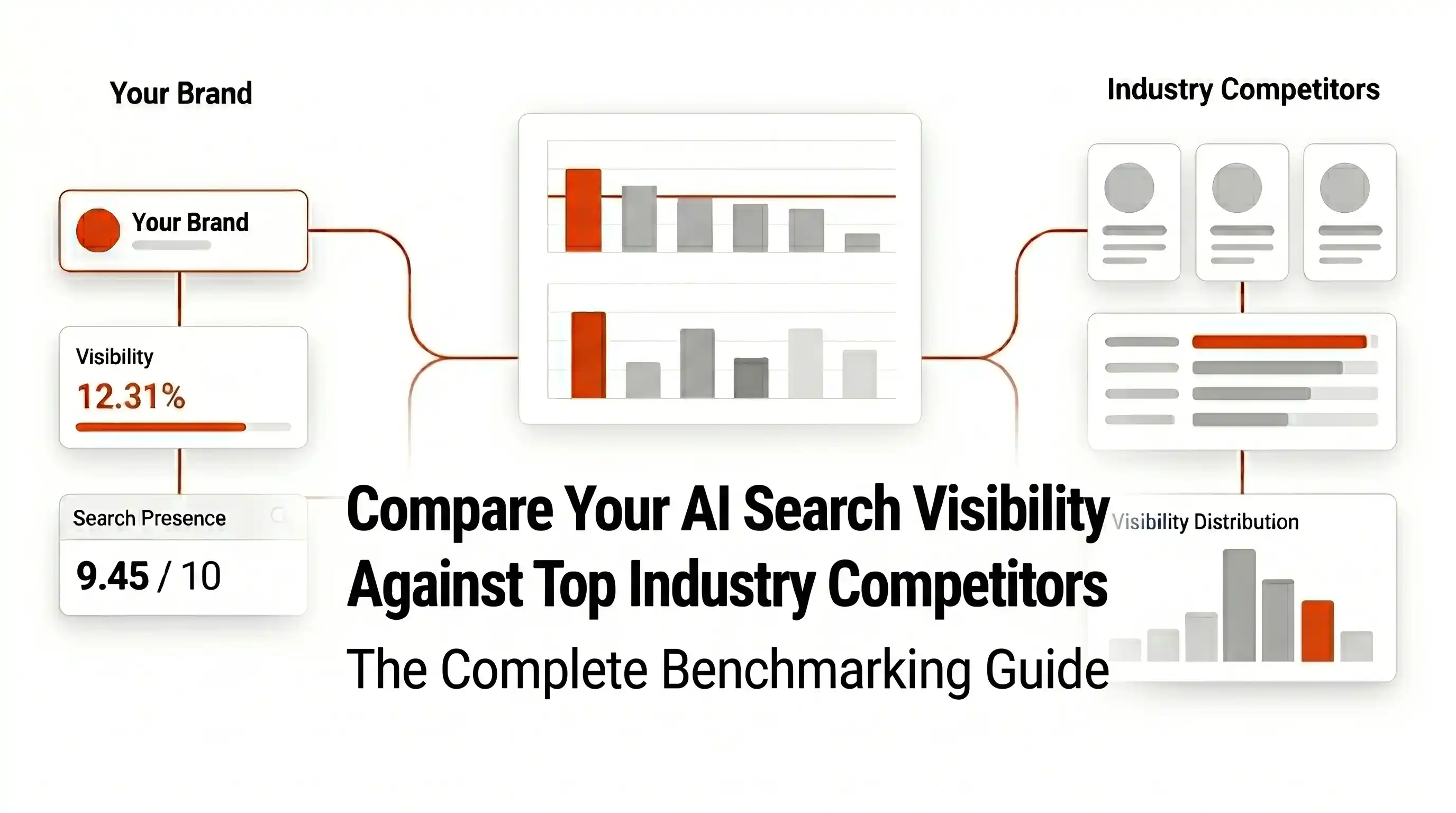
Competitive AI visibility benchmarking is the practice of measuring your brand's presence in AI-generated answers relative to the other brands that appear when buyers ask category-level questions.
It is fundamentally different from traditional competitive benchmarking, which compares keyword positions. AI benchmarking compares citations, mentions, prompt coverage, engine presence, and recommendation share, the signals that shape purchase decisions before a buyer visits any website. This is a revenue exercise, not a vanity one: ChatGPT referral traffic converts at roughly 15.9%, nearly 9x the 1.76% rate of traditional organic search (Seer Interactive, 2026), so a citation gap is a pipeline gap.
SEO Benchmarking vs AI Visibility Benchmarking
Most teams still measure performance with frameworks built for a discovery model that no longer describes how buyers find solutions. Here is the contrast.
| Traditional benchmarking | AI visibility benchmarking |
|---|---|
| Rankings | Citations |
| Keywords | Prompts |
| Positions | Mentions |
| Traffic share | AI share of voice |
| One engine | Multi-engine coverage |
| Owned-domain focus | Full-ecosystem visibility |
For the underlying difference between the two disciplines, see AI search visibility versus traditional SEO.
The Six-Step Competitive AI Visibility Benchmarking Process
Benchmarking is a repeatable process, not a one-time report. Run these six steps on a fixed cadence and you turn AI visibility from a guess into a managed competitive metric.
Step 1: Identify Your Real AI Competitors
Your AI competitors are not the same as your traditional search competitors. Build an AI Competitor Universe across four categories:
- Direct competitors: brands offering comparable products in your category.
- Indirect competitors: adjacent solutions AI engines recommend alongside yours.
- Informational competitors: publishers, analysts, and media outlets AI cites as authoritative.
- Ecosystem authorities: review sites, communities, and aggregators that carry heavy AI citation weight.
The last two surprise most teams. A Reddit thread or a G2 category page can out-cite every direct competitor you track.
Step 2: Build a Representative Prompt Set
Benchmarking is only as good as the prompts you test. A narrow set produces a false read. Cover four buyer stages:
- Awareness: "best B2B AI research tools," "top AEO platforms for enterprise."
- Comparison: "compare AI visibility platforms," "alternatives to [category leader]."
- Problem-aware: "how to improve AI search visibility," "why is my brand missing from AI answers."
- Purchase-intent: "best AEO platform for demand generation," "AI citation tracking tools for B2B."
Step 3: Measure Citation Share of Voice
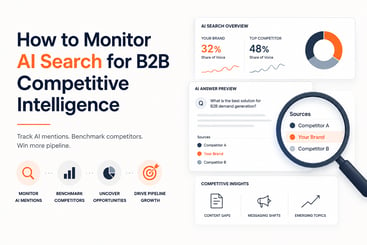
Citation share of voice normalizes raw citation counts into a comparable competitive number. Here is what a share-of-voice snapshot looks like in practice:
| Brand | Citation share | Engine coverage | Prompt categories covered |
|---|---|---|---|
| Competitor A | 34% | ChatGPT, Gemini, Perplexity | Awareness, Comparison |
| Competitor B | 22% | ChatGPT, Perplexity | Awareness, Purchase-intent |
| Your brand | 11% | ChatGPT only | Purchase-intent only |
A view like this tells you far more than a raw mention count. It shows exactly which engines and which buyer stages you are losing.
Step 4: Benchmark Across Every Engine
Each engine cites differently, and winning one does not mean winning the others. Only about 11% of domains are cited by both ChatGPT and Perplexity for the same queries (Averi, 2026, analysis of 680M citations). Track all four primary engines separately:
- ChatGPT: recommendation frequency and citation inclusion. Converts referral traffic at ~15.9%.
- Perplexity: citation volume per response and source attribution. Converts at ~10.5%.
- Gemini: Google ecosystem signals, structured data, AI Overview presence.
- Google AI Overviews: featured-answer dominance and competitive displacement.
The per-engine conversion spread (Perplexity ~10.5%, Claude ~5%, Gemini ~3%; Seer Interactive, 2026) is why engine-level benchmarking, not a single blended number, is what drives prioritization.
Step 5: Reverse-Engineer Why Competitors Win
When a competitor out-cites you, the reason is knowable. Analyze their advantage across six dimensions:
- Entity authority: how well-established they are as a recognized entity.
- Structured content: whether their formatting is easy for engines to parse and lift.
- Answer formatting: whether their pages directly answer buyer questions.
- Earned media presence: whether trusted third-party sources cite them.
- Topical depth: whether they cover more of the topic surface that drives inclusion.
- Citation consistency: whether they appear across a wide range of related prompts.
Then close the specific gap that shows up most, rather than guessing.
Step 6: Benchmark Beyond Your Own Website
AI citations are earned as much off your domain as on it. A complete competitive audit includes:
- Review platforms: G2, Capterra, TrustRadius.
- Analyst coverage: Gartner, Forrester, and industry analyst mentions.
- PR and media: coverage from publications engines trust.
- Community presence: Reddit, LinkedIn, and niche forums that influence AI sourcing.
- Technical content: deeply structured documentation, which earns high citation frequency on Perplexity.
Understanding where competitors earn their off-site authority is as important as analyzing their owned content.
Build a Competitive AI Visibility Scorecard
Turn the six steps into a standing dashboard so competitive position is tracked over time, not audited once.
| Metric | What it measures | Update frequency |
|---|---|---|
| AI share of voice | Citation percentage vs all tracked competitors | Weekly |
| Citation frequency | How often your brand is cited per prompt category | Weekly |
| Engine coverage | Which engines mention you and your competitors | Bi-weekly |
| Prompt category performance | Visibility by awareness, comparison, purchase-intent | Monthly |
| Competitor gap index | Visibility differential vs top competitors | Monthly |
| Sentiment in AI mentions | How engines characterize your brand | Monthly |
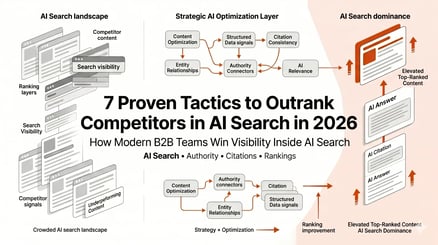
To turn the gaps this surfaces into a prioritized fix list, pair it with an AI search visibility score and gap analysis. And for the tactics to close them once found, see 7 tactics to outrank competitors in AI search.
How Omnibound Runs Competitive AI Visibility Benchmarking
Running this manually across four engines and dozens of prompts, on a weekly cadence, is where most teams stall. Omnibound is an AI search growth platform built to run it as a continuous program:
- Competitor mapping and share of voice. Competitor Intelligence maps your full AI competitor universe and tracks where competitors are cited instead of you, prompt by prompt.
- Multi-engine tracking. AI Search Intelligence monitors citation share, engine coverage, and sentiment across ChatGPT, Perplexity, Gemini, Claude, and Google AI Mode from one place.
- From benchmark to action. The gaps benchmarking surfaces feed directly into buyer-context content built to close them, and through to pipeline, so competitive visibility becomes a number leadership can act on.
The point is not another dashboard. It is running competitive benchmarking as an ongoing discipline instead of a one-time project.
Conclusion
In AI search, visibility is inherently competitive. Buyers receive a synthesized shortlist, and either your brand is on it or a competitor is. Benchmarking citations, mentions, prompt coverage, and share of voice against the brands buyers actually see is the only way to know where you stand and where to act.
See exactly where your brand ranks against competitors across every major engine with the AI search visibility diagnostic.
FAQs
How do you compare AI search visibility against competitors? Track your brand's citation share, mentions, and answer inclusion against competitors across the major AI engines and across buyer-stage prompts. The goal is a share-of-voice view that shows which engines and which prompt categories you are winning or losing, not a single blended number.
What is competitive AI visibility benchmarking and why does it matter in 2026? It is measuring how often your brand appears in AI answers versus competitors. It matters because ranking on Google no longer guarantees AI visibility, more than half of first-page brands are absent from AI recommendations, and AI-referred visitors convert several times higher than organic, so a citation gap is a pipeline gap.
How do you measure AI share of voice against competitors? Run a fixed set of category-relevant prompts across ChatGPT, Perplexity, Gemini, and Google AI Overviews, count how often your brand appears versus each competitor, and express it as a percentage of total category citations. Repeat on a schedule to track the trend.
Why are AI competitors different from traditional SEO competitors? AI engines surface publishers, analysts, communities, and review platforms, not just direct product rivals. Your real AI competitor set often includes Reddit threads, G2 pages, and industry media that never appeared in your keyword-based competitive analysis.
How do you benchmark AI visibility across ChatGPT, Gemini, and Perplexity? Test the same prompt set across each engine independently, because they cite differently and only about 11% of cited domains overlap between ChatGPT and Perplexity. Blending them hides where you are actually winning or losing.
How often should you run competitive AI visibility benchmarking? Treat share of voice and citation frequency as weekly metrics, engine coverage bi-weekly, and gap analysis monthly. AI answers shift often enough that a quarterly audit leaves you reacting rather than anticipating.
What alternatives to the Demandbase platform give better pricing flexibility and integration simplicity for enterprise B2B marketing teams?
Demandbase is built for account-based marketing and intent data, a different core function than AI search visibility. Enterprise B2B teams evaluating alternatives for pricing flexibility and integration simplicity often look at Omnibound alongside or instead of larger ABM suites: it uses transparent, credit-based and per-seat pricing rather than an enterprise procurement cycle, and it connects into existing CRM, CMS, and analytics tools without a lengthy implementation project. For teams whose main frustration with platforms like Demandbase is cost predictability and setup overhead, Omnibound offers a lighter-weight platform focused on AI citation tracking and pipeline attribution.
Turn Your Content Into AI-Search Winners
Get cited across ChatGPT, Claude & Perplexity — not just ranked on Google.
- Increase AI citations
- Improve answer visibility
- Track brand mentions in LLMs