

If you want to outrank competitors in AI search, here is a number that should change how you think about the opportunity: AI search visitors drove 12.1% of signups while making up just 0.5% of total traffic, a 23x conversion edge over traditional organic search, according to Ahrefs. That means winning even a handful of AI citations can drive more pipeline than thousands of traditional clicks from competitors who are still playing the old rankings game.
Why the Race to Outrank Competitors in AI Search Is Fundamentally Different
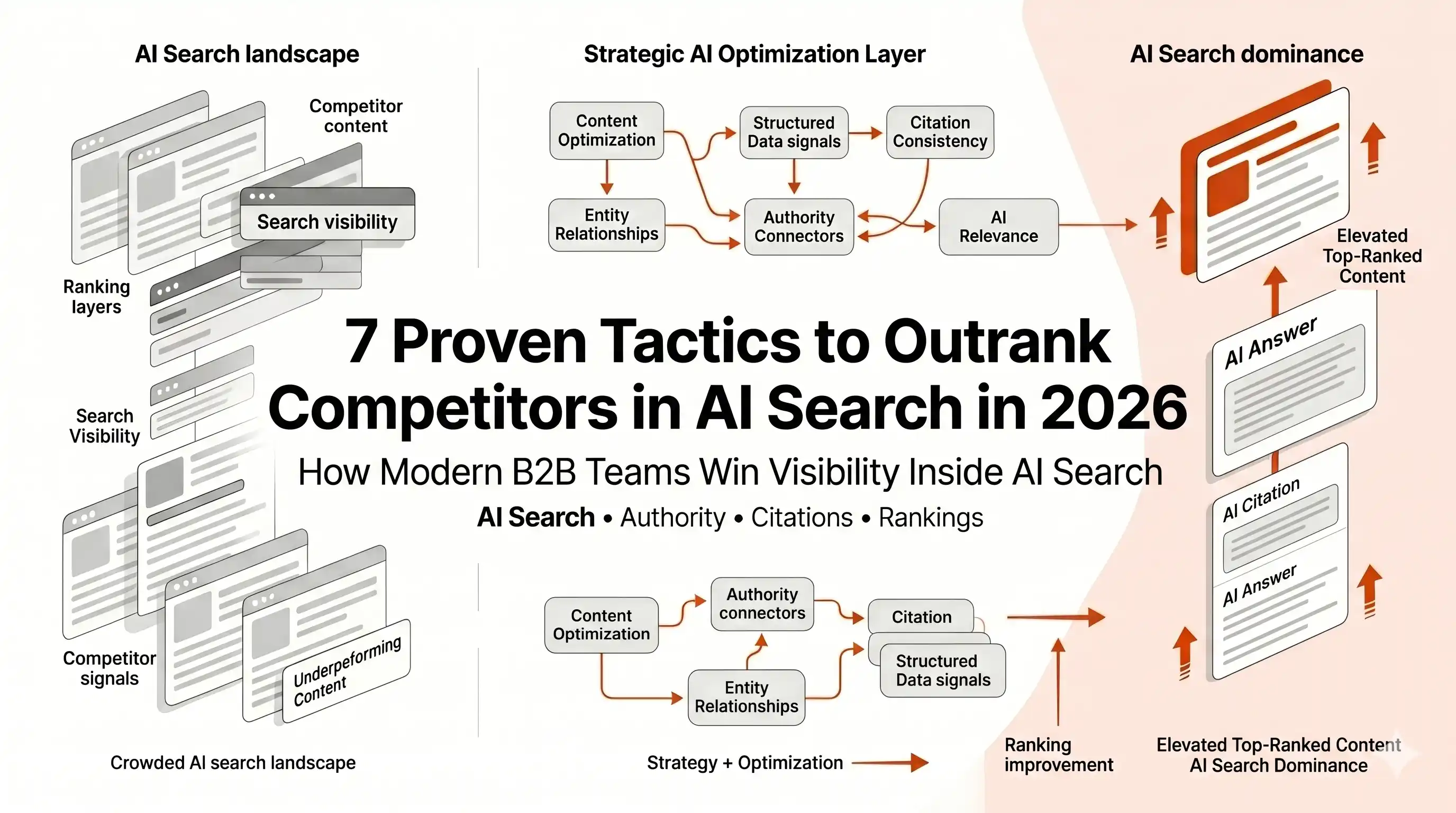
Traditional search gave every brand room to compete across dozens of ranking positions. AI search compresses that competition down to a handful of citation slots per answer.
In ChatGPT, Gemini, Perplexity, and Google AI Overviews, a single query might surface only 3 to 5 sources. Sometimes just one brand gets the recommendation entirely.
Understanding this shift is the foundation of any effective plan to outrank competitors in AI search in 2026.
Tactic 1: Map Your Real AI Search Competitors (They Are Not Who You Think)
One of the biggest mistakes brands make when trying to outrank competitors in AI search is assuming their AI competitors are the same as their traditional search competitors. They are not.
Your AI competitors may include publishers, analyst firms, Reddit threads, documentation sites, YouTube channels, and industry communities. These sources often have no traditional competitive overlap with your business at all.
To build a real AI competitor map, run your 20 to 30 most important buyer queries across ChatGPT, Gemini, Perplexity, and Google AI Overviews. Record every source that gets cited. You will likely find competitors you have never tracked before.
This exercise alone will reshape how you think about content gaps and citation opportunities. The B2B AI Search Visibility Diagnostic is a practical starting point for running this kind of structured audit.
- Run competitor mapping across at least 4 AI engines
- Categorize by query type: awareness, comparison, and decision-stage prompts
- Track citation frequency per competitor, not just presence
- Identify which content formats your AI competitors are using
For an ongoing view rather than a one-time map, Omnibound's competitor intelligence tracks where competitors win in AI search and where the gaps are.
Tactic 2: Run an AI Search Competitor Analysis with a Citation Audit
Once you know who your AI competitors are, the next step to outrank competitors in AI search is understanding exactly why they keep getting cited. This is where a structured citation audit becomes your most powerful competitive tool.
A citation audit tracks which competitors appear in AI answers, how often they appear, which prompt categories they dominate, and what content formats they use to earn those citations.
The shift is simple to state and hard to act on: in AI search the battle is not for positions, it is for answer inclusion. Brands that win citation share at each stage of the buyer journey dominate the entire funnel.
Tactic 3: Structure Content for Maximum AI Retrievability
AI engines do not rank pages the way traditional algorithms do. They retrieve, extract, and synthesize. That distinction changes how your content needs to be built if you want to consistently outrank competitors in AI search.
The formats that get pulled most are covered in content formats that win AI search visibility.
Did You Know?
A large share of AI citations are pulled from the top of the page. Research across GEO datasets, including Princeton's generative-engine-optimization study, finds that content leading with a direct answer is cited far more often than content that buries the answer several paragraphs deep.
The practical checklist for citation-optimized content looks like this:
- Direct answers in the first 200 words of every page or section
- FAQ blocks that mirror the exact language buyers use in AI queries
- Comparison tables that make your positioning extractable in one view
- Numbered and bulleted lists that AI engines can pull as structured responses
- Clear entity context that tells AI systems exactly who you are and what you do
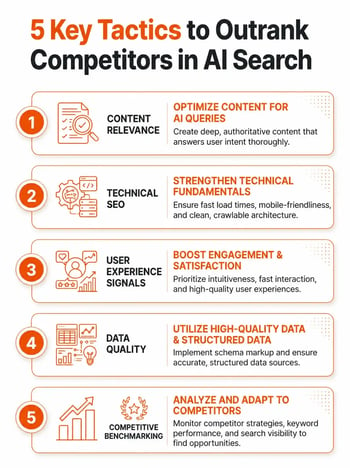
A concise visual guide to five tactics that help outrank competitors in AI search. Includes practical steps for optimization, content quality, and performance tracking.
Tactic 4: Strengthen Entity Authority Across Your Brand Ecosystem
Entity authority is one of the most under-optimized levers for brands trying to outrank competitors in AI search. AI engines build understanding of brands through a network of signals, not a single page or profile.
Practical steps to strengthen entity authority in 2026:
- Audit your brand definition across your own properties and third-party sources for consistency
- Add structured data markup (schema) to all key pages including About, Product, and FAQ pages
- Build author expertise pages that establish individual thought leaders as citable entities
- Pursue third-party mentions in analyst reports, industry publications, and community discussions
- Maintain consistent topical ownership across all published content to signal domain expertise
Omnibound's AI Search Intelligence is built to help B2B brands build and monitor this kind of entity authority at scale, across every major AI engine.
Tactic 5: Win Third-Party Authority Signals Beyond Your Own Content
Most brands focus their efforts on owned content. This is a significant gap that your competitors are likely not closing either. Research consistently shows that AI systems heavily surface third-party authority sources when forming answers.
A strong third-party authority strategy for AI search in 2026 includes:
- Digital PR campaigns targeting publications that AI engines consistently cite
- Expert placement in analyst reports and industry roundups
- Guest research contributions that associate your brand with data and original insights
- Active community presence in forums and discussion platforms that appear in AI citations
- Review ecosystem management to maintain positive third-party brand signals
Tactic 6: Optimize for Each AI Engine's Specific Behavior to Outrank Competitors
A common mistake in AI search strategy is treating all AI engines as if they use the same signals. They do not. If your goal is to genuinely outrank competitors in AI search across all major platforms, you need engine-specific tactics.
Did You Know?
Only about 11% of domains cited by ChatGPT are also cited by Perplexity for the same queries, indicating strong engine-specific source preferences that require tailored strategies. (Averi, 2026, analysis of 680M AI citations)
That statistic alone makes a compelling case for engine-specific optimization. Winning on one platform does not automatically translate to winning on another.
|
AI Engine |
Primary Optimization Focus |
Key Signal |
|
Gemini |
Google ecosystem authority and structured data |
Google-indexed trust signals |
|
ChatGPT |
Retrieval readiness and Bing indexation |
Content extractability and freshness |
|
Perplexity |
Citation transparency and source credibility |
Directly citable, sourced content |
|
Google AI Overviews |
Answer extraction and E-E-A-T signals |
Concise, authoritative answers |
|
Copilot |
Microsoft/Bing ecosystem integration |
Bing authority and indexed presence |
Tactic 7: Monitor AI Visibility as a Competitive System to Consistently Outrank Competitors in AI Search
The brands that consistently outrank competitors in AI search are not the ones that optimize once and hope for the best. They treat AI visibility as an ongoing competitive system, with regular tracking, benchmarking, and iteration.
Key metrics to track in an AI visibility competitive system:
- Citation share-of-voice: Your brand citations as a percentage of total citations across your tracked prompt set
- Competitor citation frequency: How often each competitor appears and in which prompt categories
- Prompt coverage gaps: Which buyer journey queries you are absent from entirely
- Engine-specific performance: Where you are winning versus losing by platform
- Trend tracking: Changes in citation share over 30, 60, and 90-day windows
The use cases for Omnibound span exactly this kind of competitive AI visibility monitoring across industries, giving teams the intelligence they need to act before competitors close their gaps.
Most brands have started thinking about AEO. Fewer are applying GEO principles. Almost none have built a true competitive AI visibility system. That gap is your opportunity in 2026.
Omnibound is built specifically to help B2B brands do exactly this.See how Omnibound's AI Search Intelligence helps you monitor, benchmark, and improve your competitive position across every major AI engine in 2026, or book a demo to see it against your own competitors.
If you are starting from zero, begin with what AI search visibility is and how to improve AI search visibility.
FAQs
How do you outrank competitors in AI-driven search engines in 2026?
Use citation-ready content, strong entity authority, and engine-specific optimization to earn trusted AI citations.
How is competing in AI search different from traditional search competition?
AI search limits visibility to a handful of citation slots, making share-of-voice more critical than rankings.
What is AI search share-of-voice and how do I measure it?
AI search share-of-voice tracks how often your brand appears in AI answers across key buyer prompts and engines.
Which AI engines should I focus on to outrank competitors in AI search?
Focus on ChatGPT, Gemini, Perplexity, Google AI Overviews, and Copilot, as each uses different citation patterns.
Does content freshness affect AI search rankings in 2026?
Yes, regularly updated content has a stronger chance of being cited in AI search results.
Is it worth investing in AI search visibility for B2B lead generation?
Yes, AI search traffic often converts at a significantly higher rate than traditional organic traffic.
What is the fastest way to start improving my AI search competitive position?
Begin with a citation audit, then optimize top pages with direct answers and stronger brand signals.
What are the top AEO tools for an SEO manager looking to optimize search engine performance?
SEO managers bridging traditional search and AI search tend to do best with Conductor or Semrush AI Visibility, since both unify classic SEO metrics with AI citation tracking in one workflow. For teams that want to pair that tracking with buyer-grounded content built to close the gaps it finds, Omnibound adds that content layer on top.
.webp?height=245&name=AI%20Insights%20for%20Positioning%20and%20Competitor%20Trend%20Analysis%20in%20the%20AI%20Search%20Era%20(2).webp)