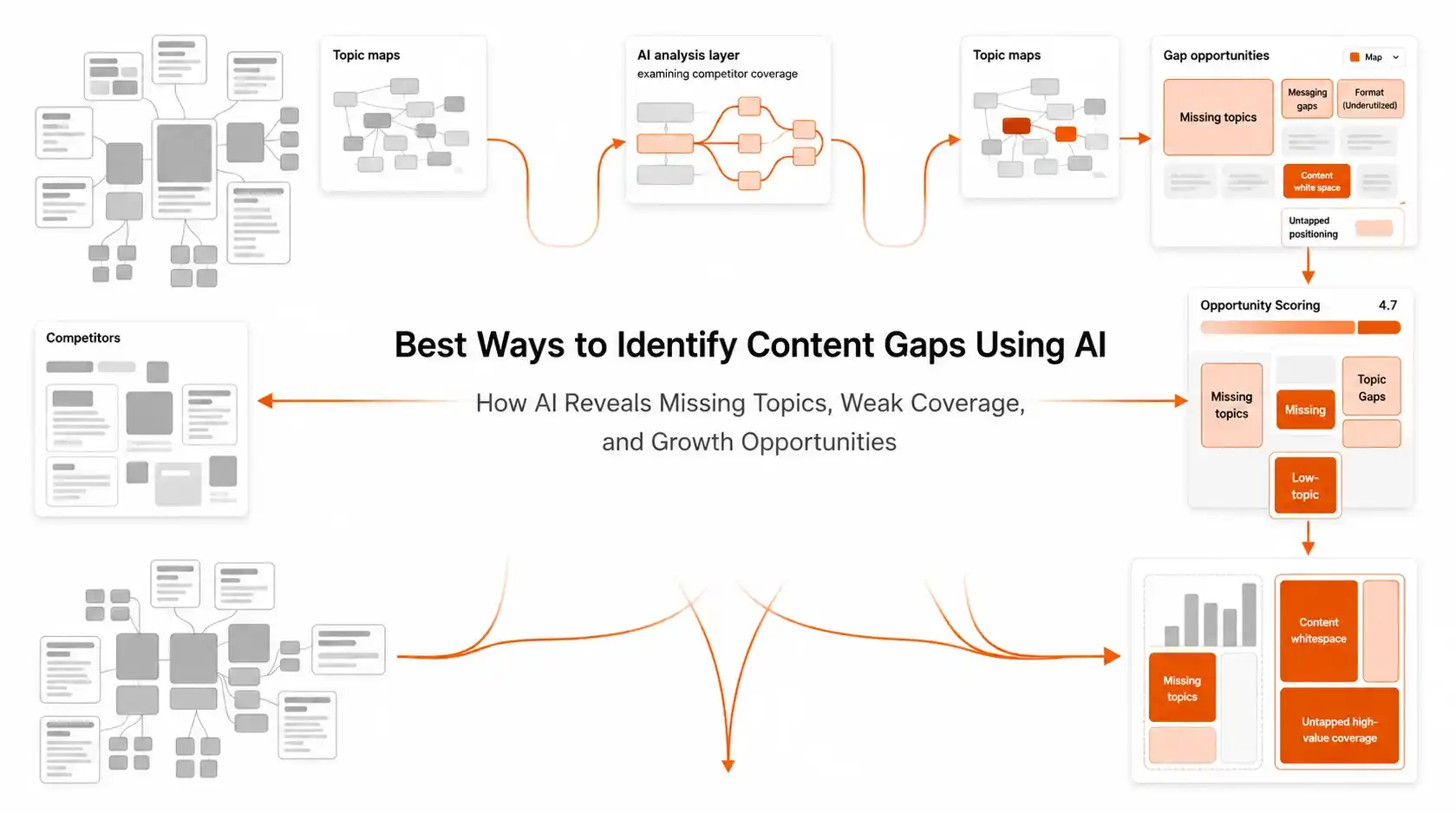


Identifying competitor content gaps using AI is no longer a nice-to-have capability — it is a core competitive advantage, and the numbers make this urgent: only ~12% of URLs cited by AI assistants appear in Google's Top 10 results for the same prompt set, meaning the competitive landscape your team needs to monitor has fundamentally expanded well beyond traditional analysis methods.
What Is a Competitor Content Gap (And Why the Definition Has Changed)?
Most teams still define a competitor content gap as a keyword a rival ranks for that you do not. That definition is dangerously narrow in 2026.
Modern competitor content gaps include:
- Keyword gaps — topics you have not addressed at the page level
- Topic depth gaps — areas where competitors cover subtopics, entities, and concepts more completely than you do
- Buyer-question gaps — questions your audience asks that competitors answer and you do not
- Messaging gaps — positioning narratives competitors own that your brand has not claimed
- Format gaps — content types (templates, calculators, comparisons) your competitors publish that you skip
- AI visibility gaps — citations competitors earn inside AI-generated answers that your brand misses
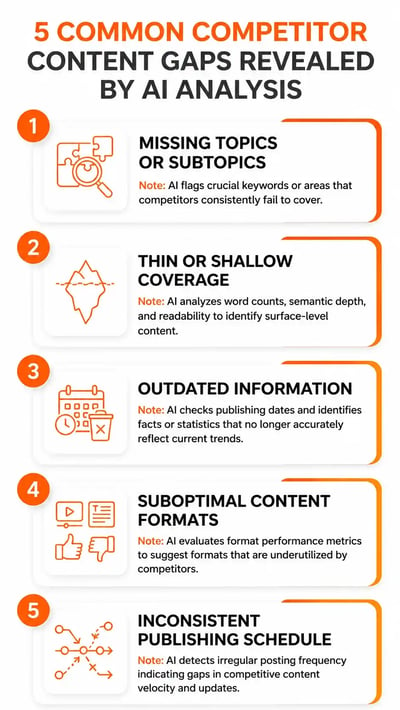
AI reveals five common gaps in competitor content. This infographic helps readers spot opportunities to improve their own content strategy.
Method 1: Use AI for Competitor Keyword Gap Discovery (But Go Further)
AI-enabled platforms such as Semrush, Ahrefs, MarketMuse, and Surfer all support this type of comparison. The critical mistake most teams make is stopping at an exported keyword list.
The better workflow looks like this:
- Pull the raw keyword overlap data from your preferred platform
- Feed that data into an AI tool to cluster findings by theme, intent group, and business priority
- Identify which clusters represent the highest-value gap opportunities for your specific buyer journey
- Map those clusters to existing content before assuming you need net-new pages
Method 2: Analyze Topic Depth and Semantic Coverage Using AI
AI can analyze competitor content for:
- Concept density — how many related concepts appear within a single piece of content
- Entity coverage — named entities, tools, companies, and processes that establish topical authority
- Subtopic depth — whether supporting questions within a topic are answered or ignored
- Missing supporting content — pillar topics that lack the cluster content needed to signal authority
Our AI solutions for content marketing are specifically built to surface these semantic coverage gaps so teams can close them with precision, not guesswork.
Did You Know?
AI Overviews appear in approximately 68% of local business-type queries — meaning competitor content gaps often show up as missing coverage that earns AI Overview inclusion, not just missing pages on a site.
Method 3: Map the Buyer Questions Competitors Answer Better
The core question to ask is: which buyer questions do competitors answer that your content does not address?
Common high-value question categories include:
- Implementation and onboarding concerns
- Pricing and ROI justification questions
- Comparison questions (your brand vs. alternatives)
- Risk and objection-handling questions
- Category education questions (early buyer stage)
Teams using AI solutions for demand generation find that buyer-question gap analysis consistently surfaces the highest-converting content opportunities because the gaps map directly to where buyers stall in their decision process.
Method 4: Detect Competitor Messaging and Positioning Gaps with AI
Key questions to guide this analysis:
- Who owns simplicity messaging in your category?
- Who owns ROI and business-outcome messaging?
- Who owns innovation and future-readiness positioning?
- Which emotional or rational benefits does no competitor claim clearly?
Method 5: Identify AI Visibility Gaps Your Competitors Are Exploiting
The workflow for identifying AI visibility gaps looks like this:
- Build a prompt set representing your key buyer questions and category searches
- Run those prompts across multiple AI platforms
- Extract and map the citations and brand mentions in each response
- Compare competitor citation frequency against your own brand's presence
- Identify which topics or question types consistently surface competitors but not you
Method 6: Analyze Competitor Content Format Opportunities
AI can classify competitor content libraries by format distribution to surface patterns your team may be missing. Common high-value formats that drive AI citation likelihood include:
- Templates and frameworks — highly citable, high utility for buyers
- Comparison guides — directly captures consideration-stage buyers
- Calculators and tools — interactive formats that generate backlinks and mentions
- Playbooks and how-to guides — comprehensive assets that establish topical authority
- Case studies and outcome stories — evidence formats that AI models summarize as proof points
If your competitor publishes a definitive template library in your category and you do not, that is a gap AI can help you identify and close systematically.
Teams working with citation-worthy content creation frameworks find that format decisions dramatically affect how often AI models surface their assets in generated responses.
Did You Know?
Reddit and Wikipedia together account for 63.3% of all AI citations across ChatGPT, Perplexity, and similar engines — which means competitor content gaps can include whether authoritative reference surfaces reinforce your positioning or your rival's.
Method 7: Discover White Space Your Competitors All Missed
AI enables white-space discovery by:
- Analyzing category-wide content coverage across all major competitors simultaneously
- Identifying buyer questions that generate real search and AI prompt activity but have no strong answer in the market
- Surfacing emerging topics that current competitors have not yet addressed
- Detecting market context signals that indicate where buyer needs are shifting ahead of content supply
Building an AI Competitor Content Gap Workflow That Runs Continuously
Individual gap analysis exercises are useful. A continuous intelligence workflow is transformational. Here is the operational framework we recommend for teams serious about competitor content gaps using AI:
|
Stage |
Activity |
AI Role |
|
1. Research |
Define competitor set and content scope |
Automate competitor monitoring setup |
|
2. Collect |
Gather content, keyword, and AI visibility data |
Continuous crawling and signal collection |
|
3. Analyze |
Run semantic, messaging, and AI visibility analysis |
Pattern detection across large content sets |
|
4. Cluster |
Group gaps by type, theme, and buyer stage |
Intent clustering and thematic grouping |
|
5. Prioritize |
Score by impact, difficulty, and business relevance |
Scoring model application |
|
6. Roadmap |
Convert gaps into content calendar priorities |
Brief generation and content production support |
|
7. Monitor |
Track gap closure and new competitor moves |
Ongoing competitive intelligence refresh |
Platforms built for this continuous workflow, like Omnibound's real-time competitor intelligence system, remove the manual overhead and keep your gap analysis current as the competitive landscape shifts.
Identifying competitor content gaps using AI has evolved far beyond a keyword comparison exercise. The teams winning in 2026 use AI to uncover topic depth gaps, buyer-question blind spots, messaging weaknesses, format opportunities, and AI citation gaps that no traditional audit would ever surface.
The competitive advantage goes to teams that build intelligence systems, not spreadsheets. Explore how Omnibound's competitor intelligence platform helps teams identify gaps, close them with citation-worthy content, and monitor the competitive landscape continuously.
FAQs
How do you identify competitor content gaps using AI?
AI identifies competitor content gaps through semantic analysis, messaging comparison, buyer-question mapping, and AI visibility audits.
What is the difference between a keyword gap and a content gap?
Keyword gaps are missing terms; content gaps include missing topics, formats, narratives, buyer answers, and AI visibility opportunities.
What are AI visibility gaps and how do you find them?
AI visibility gaps are competitor citations and mentions your brand misses in AI answers, uncovered through prompt-based benchmarking.
How is AI-driven competitor content gap analysis different from traditional SEO audits?
AI-driven analysis goes beyond keywords with continuous semantic, messaging, and citation tracking across platforms.
Which AI tools are best for competitor content gap analysis in 2026?
Platforms like Omnibound combine AI citation monitoring, competitor tracking, and gap analysis built for the AI search era.
How often should teams run competitor content gap analysis?
Top teams run competitor gap analysis continuously to track real-time content, messaging, and AI citation changes.
What is content white space and how do you find it using AI?
Content white space is underserved buyer demand that AI uncovers by analyzing category-wide coverage gaps across competitors.