




Signal-based outreach achieves 15–25% reply rates compared to just 1–5% for generic cold email outreach. In 2026, the difference between ignored marketing and pipeline-driving engagement is simple: teams that connect real customer signals to strategy and content outperform those relying on disconnected data.
Key Takeaways
|
Question |
Answer |
|---|---|
|
What is AI context connection for strategy and content? |
It is the process where AI combines CRM data, market signals, conversations, and analytics to guide marketing decisions and content execution. |
|
What is a B2B context engine AI tool? |
A system such as the B2B Marketing Context Engine that unifies customer and market signals into actionable marketing intelligence. |
|
How does AI help with content marketing? |
AI identifies patterns across customer conversations, search demand, and competitor activity to guide AI-driven content marketing strategies. |
|
What data signals power contextual AI? |
Customer interactions, CRM data, competitor messaging, product usage analytics, and market demand signals. |
|
Why does context-aware marketing matter in 2026? |
Buyers expect relevant content that reflects real problems and timing, which requires connecting multiple signals in real time. |
|
What technologies enable AI context intelligence? |
Signal intelligence systems, AI agents, marketing automation, and unified context layers such as AI marketing agents. |
The Rise of the B2B Context Engine AI Tool
Modern marketing teams have access to more data than ever, yet most teams struggle to turn signals into decisions. A B2B context engine AI tool solves this by unifying fragmented data into one operational intelligence layer.
Instead of isolated dashboards, marketers get a living context system that feeds strategy, research, and content execution simultaneously.
Platforms like Omnibound approach AI as a strategic partner, not just a writing assistant. The goal is clear insight grounded in real market signals.
What Is AI Context Connection in Marketing?
AI context connection for strategy and content refers to AI systems that interpret relationships between data signals and convert them into actionable marketing intelligence.
Traditional analytics show metrics. Contextual AI explains why signals matter and what action teams should take next.
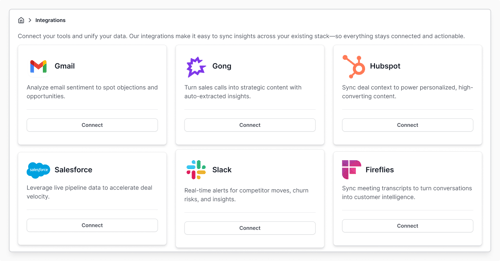
Modern context-aware AI marketing platforms analyze multiple inputs simultaneously:
- Customer conversations
- CRM activity
- Competitor messaging
- Search and engagement trends
- Sales pipeline signals
The result is a unified strategic view that feeds product marketing, campaigns, and content execution.
Why Context Is the Missing Layer in Marketing Strategy
Many marketing stacks capture data but fail to interpret it. Teams often operate with fragmented signals across CRM tools, analytics platforms, and sales call recordings.
This disconnect leads to generic campaigns and misaligned messaging.
Context engines fix this problem by connecting signals across systems and surfacing insights that guide strategic action.
- Detect emerging customer problems
- Identify competitive positioning gaps
- Surface demand signals earlier
- Align content with buyer intent
Did You Know?
64% of B2B marketing leaders do not trust their organization's marketing measurement for decision-making due to poor data quality.
Types of Context Signals AI Uses in Modern Marketing
A context engine works because it processes multiple categories of signals simultaneously. Each signal adds meaning to marketing decisions.
The four primary context layers include:
- Customer Context: CRM records, purchases, engagement behavior
- Market Context: industry trends and demand shifts
- Competitive Context: pricing updates and messaging changes
- Interaction Context: conversations, demos, and product usage
When these signals connect, marketers gain a clearer picture of what buyers actually care about.
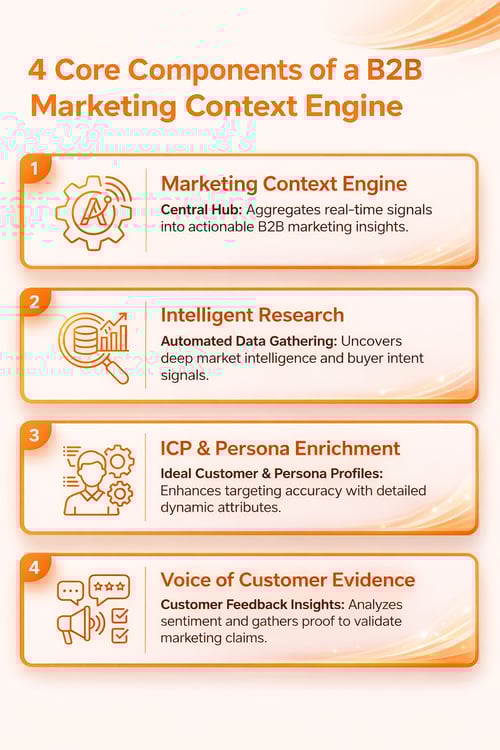
Discover the four core components that drive a B2B marketing context engine and how they work together to optimize campaigns. This visual guide helps teams plan smarter outreach and content strategies.
How AI Turns Context Signals into Marketing Strategy
Context engines follow a structured intelligence process that converts raw signals into strategic guidance.
This process usually includes five stages:
- Signal collection across platforms
- Normalization and data validation
- Pattern detection through AI models
- Strategic insight generation
- Execution recommendations
This creates a direct connection between data signals and marketing decisions.
How Contextual AI Improves Content Strategy
Most AI writing tools generate text without understanding real buyers. Contextual AI content generation changes that by grounding content in verified signals.
Instead of guessing topics, marketers build content around evidence from real interactions.
Context-driven content strategy improves four critical areas:
- Topic selection based on real demand signals
- Messaging clarity using customer language
- Personalization for ICP segments
- Timing aligned with market activity
Practical Use Cases for AI Context Connection
Context engines prove their value when signals translate directly into marketing actions.
|
Context Signal |
AI Insight |
Marketing Action |
|---|---|---|
|
Sales call objections |
Recurring product confusion |
Create comparison content |
|
Customer reviews |
Hidden feature demand |
Messaging update |
|
Competitor product launch |
Market narrative shift |
Positioning article |
|
CRM intent signals |
Account buying readiness |
Targeted campaign |
Technology Stack Behind Contextual AI Marketing
Behind every context engine sits a layered intelligence architecture. Each component contributes to turning signals into strategic output.
- Data integration platforms
- Signal intelligence systems
- AI analysis models
- Content execution platforms
- Performance feedback loops
The context layer acts as the strategic brain that connects all these systems.
Did You Know?
Only 2% of B2B marketers have reached the leading stage of using AI for real-time dynamic content personalization.
Challenges of Adopting Context-Aware AI Marketing
Despite strong benefits, implementing AI context engines requires careful planning. Many companies still operate with disconnected data infrastructure.
Common adoption challenges include:
- Fragmented CRM and analytics systems
- Poor signal quality
- Limited cross-team data sharing
- Overreliance on isolated AI writing tools
Successful organizations treat context intelligence as a shared marketing foundation rather than a standalone tool.
The Future of Context‑Driven B2B Marketing
The next stage of marketing intelligence centers on autonomous decision systems powered by signal orchestration.
By 2026 and beyond, marketing teams increasingly rely on AI to coordinate strategy, research, and execution simultaneously.
Key emerging capabilities include:
- Autonomous marketing agents
- Predictive campaign planning
- Real‑time signal orchestration
- AI-driven marketing decision engines
The companies that win will be those that connect signals, strategy, and content into one unified operational layer.
Conclusion
Marketing success in 2026 depends on understanding context, not just collecting data. Teams that connect signals from customers, markets, and competitors gain the clarity needed to make smarter strategic decisions.
A B2B context engine AI tool provides that missing intelligence layer. It connects fragmented signals, produces actionable insights, and guides marketing teams from strategy to content execution without guesswork.
For organizations that want messaging grounded in real customer truth instead of AI guesswork, context intelligence is becoming the new foundation of modern marketing.
.webp?height=245&name=10%20Ways%20AI%20Semantic%20Analysis%20Improves%20B2B%20Content%20Strategy%20in%20the%20AI%20Search%20Era%20(2).webp)
.jpg?height=245&name=unnamed%20(1).jpg)