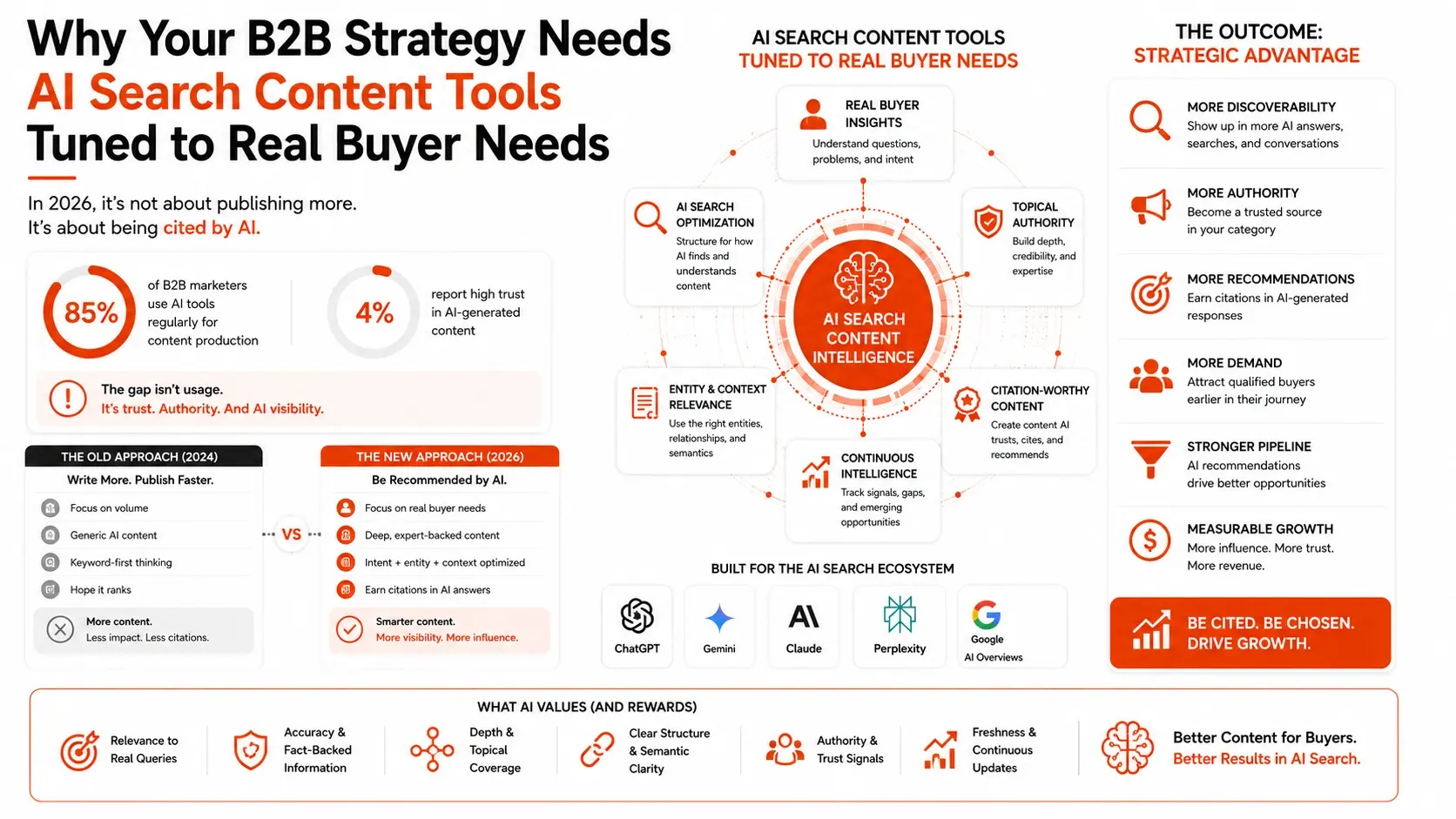


In 2024, winning meant publishing faster. Teams raced to adopt AI writing tools, scale content production, and fill editorial calendars at unprecedented speed. In 2026, winning means being cited by AI. The question has shifted from "Can AI help us write?" to "Will AI recommend what we publish?" That is a fundamentally different challenge, and it requires a fundamentally different strategy.
Only 4% of B2B marketers report high trust in AI-generated content, despite 85% using it regularly for production. This gap reflects a critical failure of generic automation. Most AI content tools produce material that sounds correct but lacks the depth, context, and authority that AI systems now reward. The market no longer needs another writing assistant. It needs content intelligence that makes your work discoverable, cited, and recommended by ChatGPT, Gemini, Claude, Perplexity, and Google AI Overviews.
AI Content Isn't the Competitive Advantage Anymore
Every AI writing platform says the same thing: generate content faster, personalize at scale, improve productivity, scale production. These promises have become commoditized. When every competitor uses the same tools to produce similar content at similar speeds, the output converges into a sea of sameness that buyers ignore and AI systems skip over.
The real advantage now sits upstream of content creation. It lives in understanding what your buyers are actually asking AI engines, which questions go unanswered in your industry, and how to structure your expertise so that AI systems cite your brand when buyers seek guidance. This is content discoverability, not content generation. Teams that grasp this shift early will build durable AI search visibility while competitors continue racing to publish more posts that nobody, including AI, will recommend.
AI Content Tools vs AI Search Content Platforms
The distinction between writing tools and content intelligence platforms matters because they solve entirely different problems. One helps you produce words. The other helps you earn recommendations.
|
AI Writing Tools |
AI Search Content Platforms |
|---|---|
|
Generate drafts |
Identify buyer questions |
|
Improve productivity |
Improve AI visibility |
|
Write faster |
Get cited more often |
|
Optimize workflows |
Optimize discoverability |
|
Content generation |
Content intelligence |
Writing tools answer the question of how to produce content. AI search content platforms answer the more strategic question of what to produce, why it matters, and how to structure it so that AI engines understand, cite, and recommend it. The difference between these two approaches determines whether your content drives pipeline or disappears into obscurity.
Why Buyer Intent Matters More in AI Search
Traditional approaches targeted keywords. Teams built content around search volumes and density scores, hoping to capture demand. AI search fundamentally changes this dynamic. Modern AI systems target questions, intent, context, and complete answers.
When a buyer asks ChatGPT or Perplexity about a business problem, the AI engine does not match keywords. It evaluates which sources provide the most complete, authoritative, and contextually relevant answer. Content that directly satisfies conversational user intent wins citations. Content that merely stuffs keywords into paragraphs gets bypassed.
This means your content strategy must start with buyer intent research. You need to know what questions your buyers ask AI engines, how they phrase those questions, and what information gaps exist in current AI responses. Answer Engine Optimization begins with this intelligence, not with a content calendar.
Consider the difference between a keyword like "CRM software" and a question like "Which CRM integrates natively with Zoom for sales teams of 50 or more?" The keyword targets a broad, ambiguous intent. The question reveals specific context, constraints, and use case. AI systems reward content that addresses the latter with precision and depth.
From Buyer Research to AI Search Visibility
The path from raw buyer intelligence to AI citations follows a clear workflow. Each stage builds on the previous one, ensuring that every piece of content you publish serves a strategic purpose.
- Customer Conversations: Capture language, questions, and pain points from actual sales calls, support tickets, and CRM notes.
- Buyer Questions: Extract the specific questions buyers ask at each stage of their journey, including the prompts they type into AI engines.
- Market Intelligence: Layer in competitive analysis, industry trends, and market trend detection AI to identify gaps competitors have not addressed.
- Content Opportunities: Prioritize questions with high buyer demand and low competitive coverage in AI responses.
- AI-Ready Content: Structure content with clear answers, factual depth, and authoritative sourcing that AI systems can parse and cite.
- AI Citations: Monitor which content earns citations across ChatGPT, Gemini, Claude, Perplexity, and Google AI Overviews.
- Pipeline: Connect AI visibility to buyer engagement, intent signals, and revenue impact.
This workflow connects buyer research directly to pipeline outcomes. Instead of publishing content and hoping for traffic, you create a systematic process that turns buyer intelligence into AI discoverability into revenue.
Why Publishing More Content Doesn't Increase AI Visibility
One of the biggest mindset shifts in 2026 is the death of the "more content equals more traffic" model. For years, teams published daily to capture long-tail demand. AI search has made this approach obsolete.
AI systems do not reward publishing frequency. They prioritize topical depth, factual accuracy, demonstrated expertise, structured information, and authority. A single comprehensive guide that thoroughly answers a buyer question will earn more AI citations than twenty shallow posts that barely scratch the surface.
AI engines evaluate content quality through signals that go far beyond word count or keyword density. They assess whether a source demonstrates genuine expertise, whether the information is structured for machine understanding, and whether the content provides a complete answer that satisfies the user's question. Publishing more content without improving quality does not move the needle. In fact, it can dilute your topical authority by spreading thin coverage across too many subjects.
The teams winning in AI search focus on fewer, deeper, more authoritative pieces. They invest in B2B content production that prioritizes substance over volume, and they use intelligence platforms to identify exactly which topics deserve that investment.
The AI Search Content Lifecycle
Content strategy for AI search requires a lifecycle approach that extends well beyond publication. Traditional workflows ended when content went live. Modern workflows recognize that AI visibility requires continuous research, optimization, and monitoring.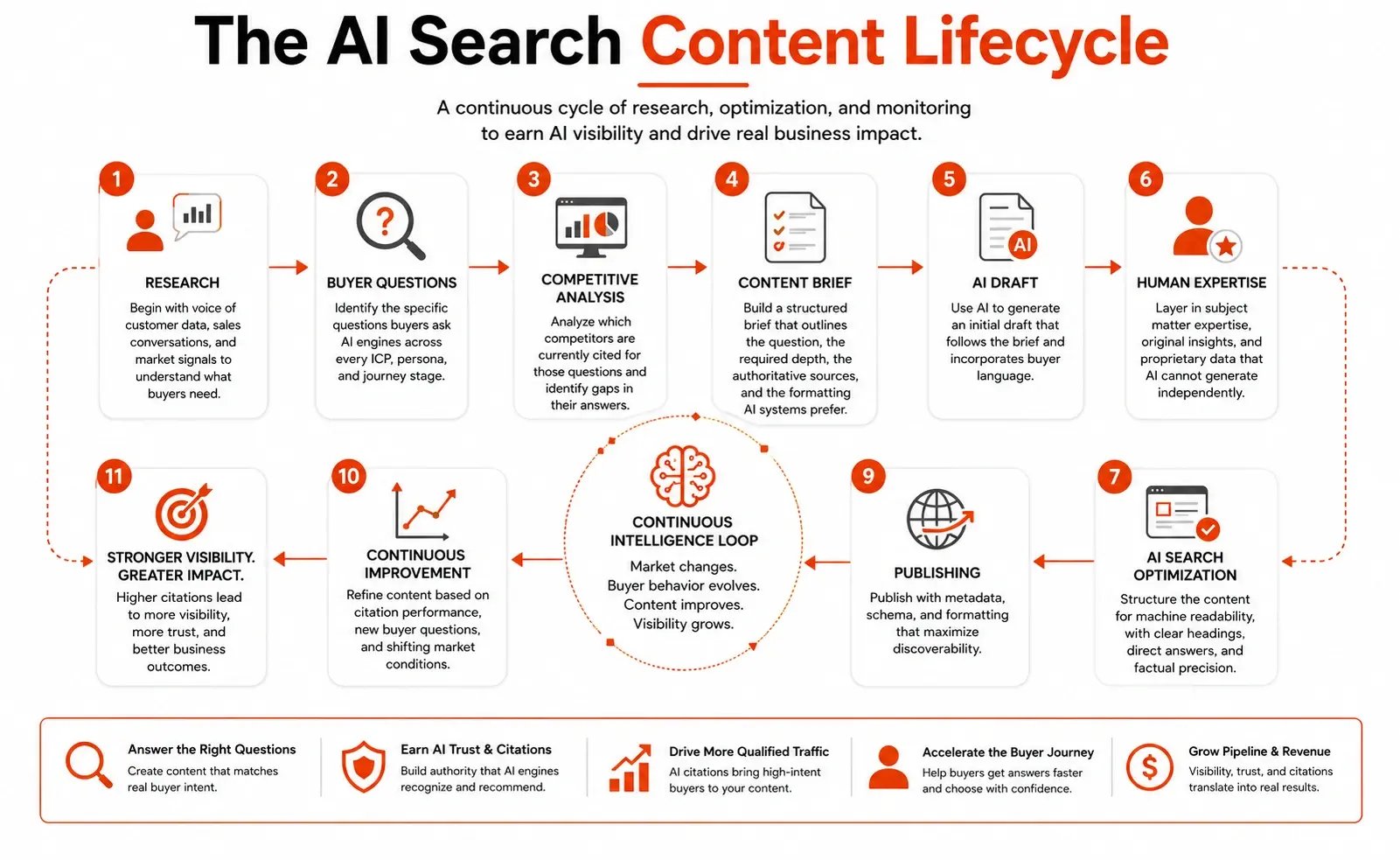
- Research: Begin with voice of customer data, sales conversations, and market signals to understand what buyers need.
- Buyer Questions: Identify the specific questions buyers ask AI engines across every ICP, persona, and journey stage.
- Competitive Analysis: Analyze which competitors are currently cited for those questions and identify gaps in their answers.
- Content Brief: Build a structured brief that outlines the question, the required depth, the authoritative sources, and the formatting AI systems prefer.
- AI Draft: Use AI to generate an initial draft that follows the brief and incorporates buyer language.
- Human Expertise: Layer in subject matter expertise, original insights, and proprietary data that AI cannot generate independently.
- AI Search Optimization: Structure the content for machine readability, with clear headings, direct answers, and factual precision.
- Publishing: Publish with metadata, schema, and formatting that maximize discoverability.
- Citation Monitoring: Track whether AI engines cite your content and which prompts trigger those citations.
- Continuous Improvement: Refine content based on citation performance, new buyer questions, and shifting market conditions.
This lifecycle replaces the old publish-and-pray model with a systematic, measurable process. Every stage produces data that informs the next cycle, creating a marketing living research engine that gets smarter over time.
AI Search Content Starts With Customer Intelligence
Modern content should begin with voice of customer data, sales conversations, competitive gaps, market trends, and AI search prompts. Not keyword lists. This is where Omnibound's approach diverges fundamentally from generic AI content tools.
Omnibound connects natively to your CRM, call recordings, and support tickets to extract the voice of the customer. The B2B Marketing Context Engine consolidates data from buyer conversations, competitive activity, and analyst reports to provide a complete view of what your buyers actually care about. This ensures every content decision is backed by real-world evidence rather than assumptions.
When buyer behaviors shift, the context layer automatically updates your ideal customer profiles and personas. This means the content you produce today remains relevant even as market conditions change next week. Static research is a liability. Continuous intelligence is a competitive advantage.
The marketing data your team already collects holds the answers to what your buyers want. The problem is that most teams lack the infrastructure to turn that data into content decisions. Omnibound bridges that gap, transforming raw customer signals into prioritized content opportunities that AI engines reward.
Measuring AI Search Content Success
Traditional content metrics like pageviews, rankings, and clicks tell you less than ever about whether your content is actually working. AI search has introduced an entirely new set of success indicators that reflect how AI systems evaluate and recommend your content.
Modern metrics that matter include:
- AI citations: How often does your content get cited across ChatGPT, Gemini, Claude, Perplexity, and Google AI Overviews?
- Recommendation frequency: How frequently does your brand appear in AI-generated answers for your priority buyer questions?
- AI visibility: What percentage of relevant AI prompts in your market surface your content?
- Topic authority: Does AI consistently recommend your brand across a cluster of related questions, or only isolated topics?
- Share of voice: How does your AI citation presence compare to competitors in the same buyer conversations?
These metrics align directly with revenue impact. When AI systems cite your content, buyers encounter your brand at the moment they are forming opinions and making decisions. Best AEO/GEO tools provide the tracking infrastructure to measure this impact and connect it to pipeline outcomes.
Companies using AI-powered tools that tune output to buyer signals see a 35% increase in conversion rates. The reason is simple: when content directly answers the questions buyers ask, engagement improves, trust builds, and deals move faster. AI agents for B2B marketing can further automate the monitoring and optimization loop, ensuring your content strategy adapts in real time to shifts in buyer behavior and AI recommendation patterns.
Omnibound: AI Search Content Intelligence Platform
Omnibound is not an AI writing assistant. It is not a content generator. It is an AI Search Content Intelligence platform that helps marketers discover buyer questions, identify AI search opportunities, uncover competitor gaps, prioritize content, monitor AI citations, and improve AI visibility.
The platform helps your team decide what to create, why it matters, and how to maximize AI discoverability. It captures every buyer and market signal in one place, giving AI complete context on your customers, your company, and your competitive landscape. From that foundation, it surfaces the specific questions your buyers ask AI engines, identifies which of those questions represent untapped opportunities, and guides content production toward topics that will earn citations and drive pipeline.
Omnibound maintains SOC 2 Type II compliance with enterprise-grade encryption and access controls, ensuring that your proprietary customer signals and marketing intelligence remain secure. The platform is built for B2B teams in technology and software industries where complex buying cycles demand content that addresses technical, role-specific requirements across multiple stakeholders.
Conclusion
The central message for 2026 is clear: content generation is table stakes. Content discoverability is the new differentiator. Teams that continue investing in AI writing tools without an AI search content strategy will produce more content that fewer people, and fewer AI systems, will ever see.
The shift from "Can AI help us write?" to "Will AI recommend what we publish?" changes everything about how B2B teams approach content. It changes where you start (buyer intelligence, not keyword lists), what you measure (AI citations, not pageviews), and how you structure your work (for machine readability and topical authority, not publishing frequency).
Omnibound helps you make this shift with a platform that transforms buyer research, customer conversations, competitive intelligence, and AI search insights into content that is structured to be discovered, cited, and recommended by AI systems. Not just published.
Frequently Asked Questions
What are AI search content tools?
AI search content tools are platforms that help marketers identify buyer questions, analyze AI citation opportunities, and create content structured for discoverability across AI engines like ChatGPT, Gemini, Claude, Perplexity, and Google AI Overviews. Unlike AI writing tools that focus on drafting text, these platforms focus on content intelligence, buyer intent, and AI visibility.
How is AI search changing B2B content strategy?
AI search shifts the focus from keyword targeting to question answering. Buyers now ask AI engines conversational questions and expect complete, authoritative answers. Content strategy must adapt by prioritizing buyer intent research, topical depth, and structured information that AI systems can parse and cite.
What is the difference between AI writing tools and AI search platforms?
AI writing tools generate drafts and improve production speed. AI search platforms identify buyer questions, surface content opportunities, optimize for AI discoverability, and monitor citation performance. Writing tools solve the production problem. AI search platforms solve the visibility problem.
How do you create content that AI search engines recommend?
Start with buyer research to identify the questions your audience asks AI engines. Structure content with clear, direct answers, demonstrated expertise, factual accuracy, and authoritative sourcing. Monitor whether AI systems cite your content and refine based on performance data.
Why is buyer research important for AI search?
AI systems reward content that directly satisfies conversational user intent. Buyer research reveals the exact questions, language, and context your audience brings to AI engines. Without this intelligence, content is guesswork that AI systems are unlikely to recommend.
How do AI systems choose content to cite?
AI systems prioritize topical depth, factual accuracy, demonstrated expertise, structured information, and authority. They evaluate whether content provides complete answers to user questions and whether the source demonstrates genuine knowledge of the subject matter.
What metrics should marketers track for AI search content?
Track AI citations, recommendation frequency, AI visibility, topic authority, and share of voice. These metrics reveal how often AI engines cite your content, how frequently your brand appears in AI-generated answers, and how your presence compares to competitors.
How can companies improve AI content visibility?
Begin with buyer intelligence to identify priority questions. Create comprehensive, well-structured content that answers those questions with depth and authority. Monitor citation performance across AI engines, refine content based on gaps, and continuously update your strategy as buyer questions and AI recommendation patterns evolve.