

If your marketing team is still writing copy based on internal assumptions, you are leaving your most powerful research asset completely untapped. Buyer language from sales recordings is the richest, most direct source of customer vocabulary your team can access, and organizations that systematically mine it report up to a 20% higher win rate after layering conversation intelligence into their messaging and sales playbooks.
What Is Buyer Language and Why It Matters for Sales Recordings
Buyer language is not just what your customers say. It is how they say it, the exact vocabulary they use to name their pain, frame their goals, and evaluate their options.
It includes the way buyers describe their current problems, the objections they raise, the outcomes they want to achieve, the urgency language that signals purchase readiness, and the comparison terminology they use when evaluating vendors.
The highest-performing B2B messaging consistently mirrors how buyers already speak, not how internal teams think buyers should speak.
|
Internal Messaging |
Buyer Language |
|
Feature wording |
Problem wording |
|
Brand framing |
Customer framing |
|
Internal assumptions |
Real conversations |
|
Marketing terminology |
Natural language |
When your messaging is built on internal assumptions, it creates a friction layer between your content and your buyer. When it reflects actual buyer language from sales recordings, that friction disappears.
We recommend treating your call library not as a coaching archive but as a living B2B marketing context engine that continuously surfaces buyer intelligence for your entire go-to-market team.
Top 7 Methods to Uncover Buyer Language from Sales Recordings
The following methods form a practical framework for systematically extracting and activating buyer language from sales recordings. Each method targets a different layer of buyer intelligence.
Method 1: Analyze Discovery Call Openings
The first few minutes of a discovery call are a goldmine. Buyers are spontaneous, unguarded, and describing their world in their own words.
Listen specifically for responses to prompts like "How are you solving this today?" or "What is frustrating about your current setup?" These moments capture unfiltered pain language that no survey question can replicate.
Capture exact phrasing. Do not paraphrase. The specific vocabulary buyers use to name their problems is your most valuable messaging raw material.
Method 2: Mine Repeated Questions Across Calls
When the same question appears across 10, 20, or 50 calls, it is not a coincidence. It is a signal.
Repeated questions reveal the gaps in your current messaging and the content your buyers are actively searching for. Common categories include:
- Pricing and ROI questions
- Implementation and onboarding questions
- Integration and compatibility questions
- Security and compliance questions
Build an objection phrase library organized by deal stage, buyer persona, and theme. This library becomes a direct input for product messaging optimization and competitive positioning work.
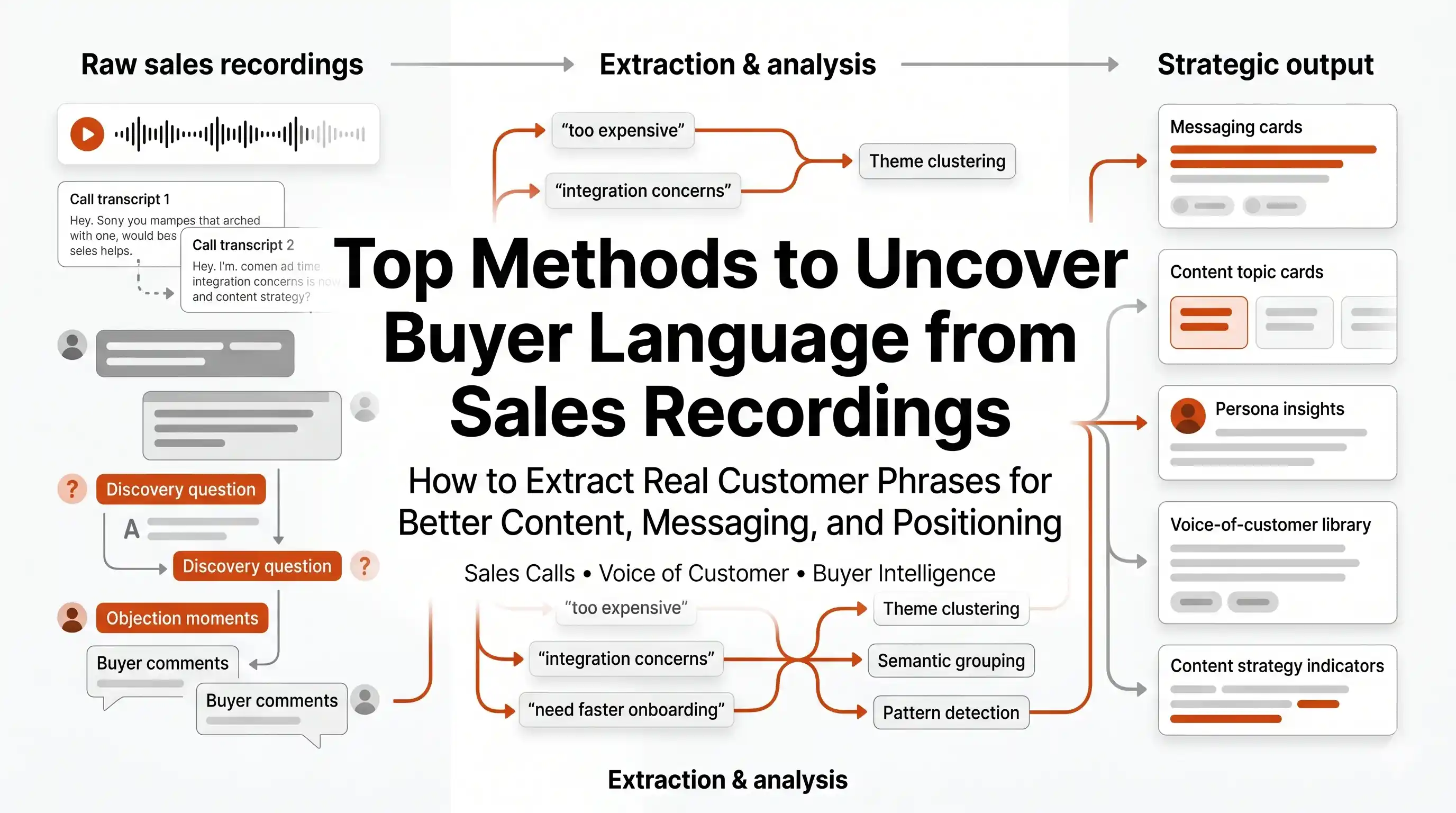
Method 4: Use AI Transcription and Theme Clustering
Manual call review is valuable but limited by scale. AI transcription combined with semantic theme clustering allows teams to process hundreds of calls and surface patterns that no human reviewer would catch manually.
The workflow looks like this:
|
Language Pattern Detected |
Messaging or Content Theme |
|
ROI uncertainty phrases |
Value justification content and ROI calculators |
|
Migration and transition concerns |
Onboarding content and implementation guides |
|
Competitor comparison language |
Competitive positioning pages and battlecards |
|
Urgency and timeline signals |
Demand generation messaging and CTAs |
Method 5: Identify Buyer Outcome Language
Buyers describe what they want to achieve in strikingly consistent ways. These outcome phrases, captured across your call library, are often more persuasive in messaging than any feature description your team can write.
Examples of outcome language pulled directly from B2B sales calls include phrases like "reduce onboarding time by half," "get visibility into what is actually in the pipeline," and "stop losing deals to competitors we did not know were in the conversation."
Method 6: Map Every Competitive Mention
Every time a buyer mentions a competitor, a previous vendor, or a frustration with another tool, you are receiving direct competitive intelligence that no analyst report can provide.
Track the specific language buyers use when making comparisons: what they praise, what frustrated them, what made them start looking for alternatives. This is the raw material for authentic competitive positioning.
Method 7: Detect Emotional and Hesitation Signals
Advanced buyer language analysis goes beyond what buyers say and into how they say it. Hesitation, filler language, topic avoidance, and sudden confidence drops are all signals that reveal unspoken objections.
When a buyer says "yeah, that could be interesting" rather than "that would solve our problem," the language itself is telling you something. Train your team and your AI analysis workflows to flag these tonal shifts as high-value research signals.
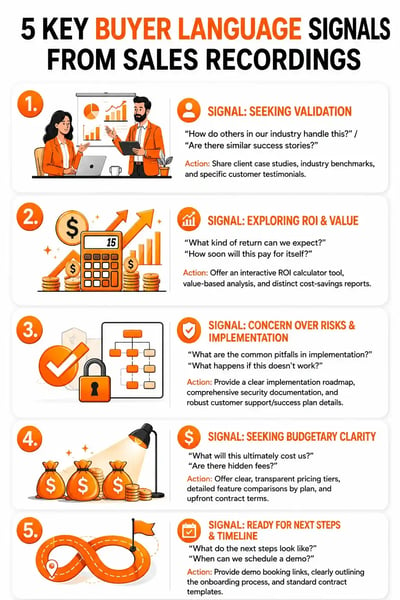
A concise visual highlighting the 5 key buyer language signals found in sales recordings. Learn how buyers phrase needs, objections, and buying timelines.
Our AI solutions for content marketing are designed to bridge this gap, taking buyer language signals and turning them directly into content briefs, copy frameworks, and campaign assets that your team can execute immediately.
Our AI solutions for demand generation are designed to operationalize buyer language signals directly into campaign execution, so the intelligence captured from recordings flows continuously into your pipeline strategy.
We built Omnibound to make this process scalable, continuous, and directly connected to content and messaging execution. If your team is ready to move beyond internal assumptions and start marketing in the language your buyers actually use, explore how our AI-powered product marketing solutions and intelligent research capabilities can turn your call library into a living buyer intelligence engine.
FAQs
- How do you extract buyer language from sales recordings?
Transcribe calls, analyze key conversation moments, and use AI clustering to uncover recurring buyer language patterns. - What AI tools help analyze buyer language from sales calls?
The best tools combine AI transcription, semantic clustering, and signal detection to analyze buyer language at scale. - Why is buyer language from sales recordings better than keyword research alone?
Sales recordings reveal how buyers naturally describe their problems, goals, and objections — beyond what keyword tools capture. - How many sales calls do you need to review to find reliable buyer language patterns?
Reliable patterns typically emerge from 20–30 calls, while AI can accelerate insights across hundreds of conversations. - How does buyer language from sales recordings improve landing page conversion?
Using exact customer phrases makes landing pages feel instantly relevant, improving resonance and conversion potential. - Is buyer language mining from sales calls useful for content marketing teams?
Yes - it fuels stronger blogs, FAQs, case studies, and messaging rooted in real buyer intent. - How do you turn buyer language from recordings into a repeatable research system?
Create an ongoing workflow that transcribes, tags, organizes, and distributes buyer language insights across teams.