Most B2B teams spend their AI-visibility effort on Google and treat Microsoft Copilot as an afterthought. That is a mistake, and it is also an opening. Copilot answers questions for a large and specifically B2B-leaning audience, it cites its sources the way other AI assistants do, and because it runs on a search index most marketers ignore, getting cited there is often easier than fighting for the same spot on Google.
The catch is that Copilot does not work the way Google's AI surfaces do. It reasons with a different model and, more importantly, it pulls its facts from a different index. If you optimize for Copilot the way you optimize for Google and stop there, you will miss most of what makes Copilot citations winnable. This guide covers what Copilot is, how it sources and cites answers, why it matters for B2B, and a step-by-step playbook to get your brand named.
What Microsoft Copilot is, and where buyers meet it
Microsoft Copilot is Microsoft's AI assistant. It runs on OpenAI's models for reasoning and language, and it grounds its answers in current information from the web through Microsoft's search infrastructure. Like other answer engines, it returns a written answer with cited sources rather than a list of links.
Buyers encounter it in more than one place, and the distinction matters:
- Copilot as a standalone assistant, at copilot.microsoft.com and in the Copilot app, used for research, drafting, and open questions.
- Copilot inside Bing and the Edge browser, where it answers alongside or instead of classic search results.
- Copilot in Windows, built into the operating system many businesses run.
- Microsoft 365 Copilot, the enterprise version that works over a company's own internal documents and data.
For brand visibility, the first three matter and the last one does not. Microsoft 365 Copilot answers from a company's private data, so it is not a place you earn external citations. Everything in this guide is about the web-facing Copilot that a buyer uses to research your category.
How Copilot finds and cites its sources
You cannot optimize for a system you cannot picture, so start with the mechanism, because this is where Copilot differs most from Google.
 Copilot reasons with an OpenAI model but pulls its facts and citations from the Bing index.
When a buyer asks Copilot something that needs current information, Copilot runs searches against Microsoft's Bing index, retrieves the pages it judges most relevant and trustworthy, and writes an answer that cites them with numbered footnotes. Like most AI search, it often expands one question into several related searches before it answers, so it can pull from more than one page. The underlying retrieval and generation pattern is the same one that powers how AI search works across engines.
What a Copilot citation looks like matters for measuring your presence. Copilot places small numbered markers in the answer and lists the corresponding sources, often in a panel or an expandable "see more" list beside the response. Being one of those numbered sources is the goal, and it is a distinct outcome from ranking in Bing's classic blue links: a page can rank and still be left out of the written answer if it does not answer the question cleanly.
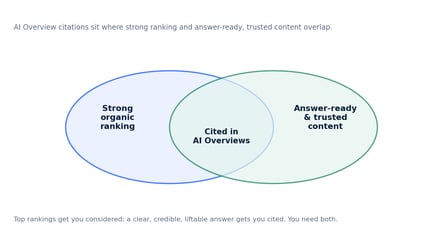
The single most important consequence for B2B: if Bing cannot crawl and index your page, Copilot cannot cite it. Bing visibility is the price of entry, in the same way that ranking is the price of entry for Google's AI Overviews. Many teams have never checked whether Bing indexes their site well, which is exactly why this surface is winnable.
Why Copilot is worth a B2B team's attention
Three reasons this surface pays off, especially for B2B.
It runs on an index most of your competitors ignore. Because marketing effort concentrates on Google, Bing is comparatively under-optimized. That means less competition for the same citation, and it is often faster to become a cited source on Copilot than on Google's AI Overviews.
 Google's AI surfaces draw on Google's index; Copilot draws on Bing's. They are separate visibility jobs.
Its audience skews toward B2B. Bing and Copilot are woven into the Microsoft stack that businesses already run: Windows, Edge, and Microsoft 365. Buyers using work devices and corporate browsers land on Copilot by default more often than the general population does, which is the audience B2B actually sells to. Picture a procurement lead or an IT manager researching vendors from a company laptop: Copilot is right there in the browser and the taskbar, and for many of them it is the first AI answer they see. If your category is one businesses evaluate at work, that is a buyer you cannot afford to be invisible to.
Bing visibility has reach beyond Copilot. Because Bing operates one of the few large web indexes, its coverage has at times fed other AI assistants as well. Strengthening how Bing sees your site is rarely wasted, since it supports more than one AI surface at once. Treat it as infrastructure, not a single-engine tactic.
The playbook: how to get cited by Copilot
The work splits into two layers: make sure Bing can see and trust your pages, then make those pages answer-ready. Roughly in priority order.
1. Get your site indexed and healthy in Bing. This is the foundation nobody checks. Verify your site in Bing Webmaster Tools, submit your sitemap, and confirm your priority pages are actually indexed rather than assuming they are. Fix crawl errors, make sure Bing's crawler is not blocked in your robots file, and check that your important pages return clean, indexable responses. Bing also supports IndexNow, a protocol that pings search engines the moment you publish or update a page, so new and refreshed content gets picked up faster; turning it on is a low-effort way to keep Copilot's source pool current. If Bing does not have your page, none of the rest matters.
2. Earn a strong Bing presence for your priority queries. Copilot draws on the pages Bing ranks and trusts, so ranking well in Bing is the equivalent of ranking well in Google for AI Overviews. This is where AI visibility and traditional SEO reinforce each other: the same fundamentals apply, just aimed at an index you may have neglected.
3. Lead with a clear, quotable answer. Copilot lifts and summarizes, so a page that states its answer plainly, high up, and in self-contained sentences is far easier to cite than one that buries the point. The content formats that get quoted across AI search, real headings, direct answers, clean structure, work here too. A useful discipline: under each heading that matches a real buyer question, write the first two or three sentences so they answer that question completely on their own, then add the supporting detail below. That top passage is what a model can quote without stitching, and it is the part most likely to become the cited source.
4. Cover the full question and its follow-ups. Because Copilot expands a question into related searches, a page that addresses the surrounding sub-questions (pricing, integrations, comparisons, fit) gives it more to draw on than a page that answers only the headline.
5. Show real expertise and authority. Copilot, like other assistants, leans toward sources it can trust. Named authors with credentials, cited evidence, and visible first-hand experience all help. Build the authority signals that earn citations and reinforce them with E-E-A-T and trust signals. These are also part of how AI engines decide which brands to trust.
6. Keep pages technically clean and current. Fast, crawlable, well-structured pages are easier for Bing to parse, and fresher pages tend to win for questions where recency matters. Update your key pages rather than letting them age out.
7. Build accurate off-site presence. How the wider web describes you feeds the model's sense of your standing in a category. Reputable third-party coverage, reviews, and mentions support the trust half of the equation, and they help across every AI surface, not just Copilot.
Pulled together, these are the fundamentals of answer engine optimization applied to Microsoft's index, and they overlap heavily with general AI search optimization. The difference is where you point them.
How Copilot differs from Google's AI surfaces
If you already work on Google, the useful mental model is that Copilot is a parallel job on a different index. Google runs three distinct AI surfaces of its own that all feed on Google's index; Copilot feeds on Bing's. The content and authority fundamentals transfer, and getting cited in Google's AI Overviews follows the same logic, but the indexing and ranking work has to be done twice, once for each search engine, because being strong in Google does not mean Bing sees you well.
One more thing carries over: Copilot answers are not fixed. The same question can produce different cited sources over time and can differ from what other engines return, so citation variability applies here just as it does everywhere else.
How to track your Copilot citations
You cannot improve what you do not watch, and Copilot is easy to overlook precisely because teams are focused elsewhere.
- Run your priority buyer questions in Copilot and record whether you are cited, who is cited instead, and which of your pages it pulls. Note that Copilot's different response styles can cite different numbers of sources for the same question, so read the full source list, not just the first link, when you check.
- Track it over time, not once, because answers shift as Bing re-crawls and Copilot updates.
- Compare Copilot against your Google presence, since a gap on one and not the other tells you exactly where to aim. Watching who is cited beside you turns tracking into competitive intelligence, and deciding your visibility metrics up front keeps the tracking honest. Because a single manual check is noisy, frequent automated checks tell you more than an occasional look.
Where B2B teams go wrong with Copilot
- Ignoring Bing entirely. The most common mistake: pouring everything into Google and never checking whether Bing indexes the site. Copilot citations start with Bing.
- Assuming Google strength carries over. Ranking well on Google does not guarantee Bing sees you the same way. The indexing work is separate.
- Optimizing Microsoft 365 Copilot for brand visibility. The enterprise version answers from private company data, not the web, so it is not a place to earn external citations. Do not confuse the two.
- Burying the answer. A page a reader has to dig through is a page Copilot skips in favor of one that answers cleanly.
- Checking once. Copilot answers move, so a single spot-check tells you little about your real presence.
Frequently asked questions
How does Microsoft Copilot decide what to cite? Copilot retrieves pages from the Bing search index, then generates an answer that cites the sources it judged most relevant and trustworthy, with numbered footnotes. If a page is not indexed by Bing, it cannot be cited.
Is optimizing for Copilot the same as optimizing for Bing? Largely, yes, at the foundation. Copilot draws on the Bing index, so getting indexed and ranking well in Bing is the base requirement. On top of that, the page needs to be answer-ready: clear, well-structured, and authoritative.
Does ranking on Google get me cited in Copilot? Not on its own. Copilot uses Bing's index, not Google's, and the two can see your site differently. You need to do the indexing and ranking work for Bing specifically, even if your Google presence is strong.
Is Microsoft 365 Copilot a place to get cited? No. Microsoft 365 Copilot answers from an organization's own internal data, not the public web. External brand citations come from the web-facing Copilot in Bing, Edge, Windows, and the standalone app.
How is getting cited by Copilot different from Google AI Overviews? The fundamentals of clear, authoritative, answer-ready content are the same. The difference is the index: AI Overviews pull from Google, Copilot pulls from Bing, so the indexing and ranking work has to be done separately for each.
Where to start
Do the one check almost no one has done: open Bing Webmaster Tools and confirm your priority pages are indexed and ranking. Then run five of your most important buyer questions in Copilot and note where you appear and who appears instead. That two-part check, Bing health plus a Copilot spot-read, tells you whether your problem is that Copilot cannot find you or that your pages are not answer-ready, and which to fix first.
To see where you stand on Copilot and across every other AI engine in one scan, run a free check with the AI Search Visibility Checker, or track your Copilot and cross-engine citations over time with AI Search Intelligence.