


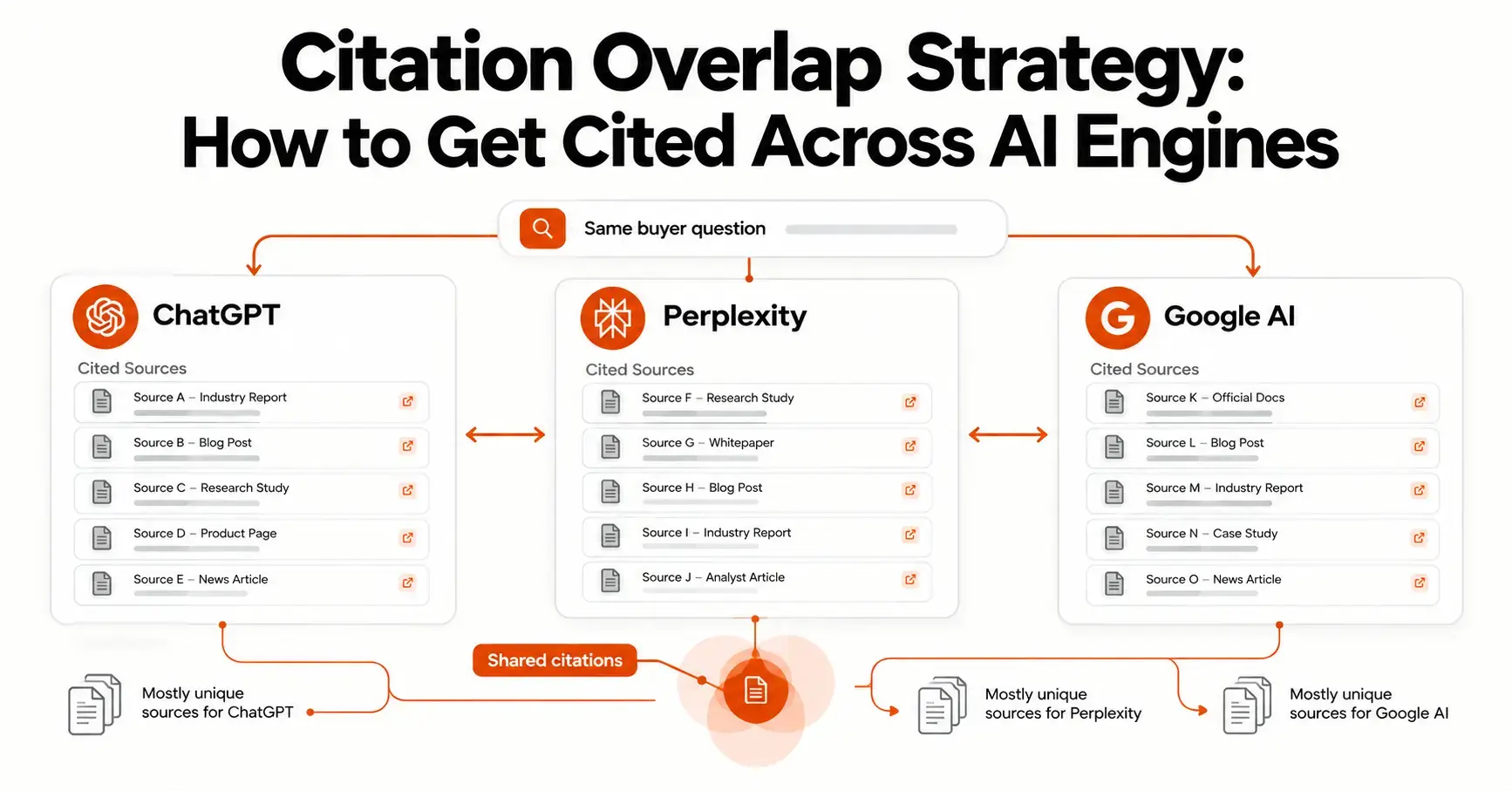


Ask ChatGPT, Perplexity, and Google's AI the same buyer question and look at the sources each one shows. You will not see the same list three times. The pages an engine credits are drawn from its own retrieval system, and independent studies keep finding the same thing: the AI engines share only a minority of their cited sources. Being cited in one engine is a weak predictor of being cited in the next.
For a B2B team, that changes what "AI visibility" even means. It is not one ranking you win once; it is a set of separate citation lists you have to earn across engines that barely agree with each other. This piece is about citation overlap: why it is low, why you want more of it, and how to build a strategy that gets you cited across engines instead of stranded on one. For the underlying definition of what a citation is, see what AI citations are; here the focus is coverage across engines.
Why the engines barely overlap
The short reason is that each engine answers from a different source of truth, so they reach for different pages. The mechanics differ enough that a page which is perfect for one engine can be invisible to another. This is covered in depth in how AI search works; the short version is enough here.
Perplexity is built around live retrieval and runs a web search for almost everything, so it leans on pages it can find and pull in the moment, and it attaches sources to nearly every answer. Google's AI answers are shaped by Google's own index, so the pages it cites skew toward what already performs in Google's ranking systems. ChatGPT browses selectively rather than by default, so a lot of what it says comes from trained knowledge and the reputation baked into the model, and it cites live pages mainly when it does run a search. Other engines add their own tilt: some lean heavily on community and user-generated content, others on a different underlying search index entirely.
Put those differences together and low overlap is the natural result. A page tuned to rank in Google can be exactly what Google's AI cites and still never surface in ChatGPT, which was not browsing for that question. A community thread that Perplexity pulls live may never enter ChatGPT's trained view. The engines are not disagreeing about quality so much as looking in different places.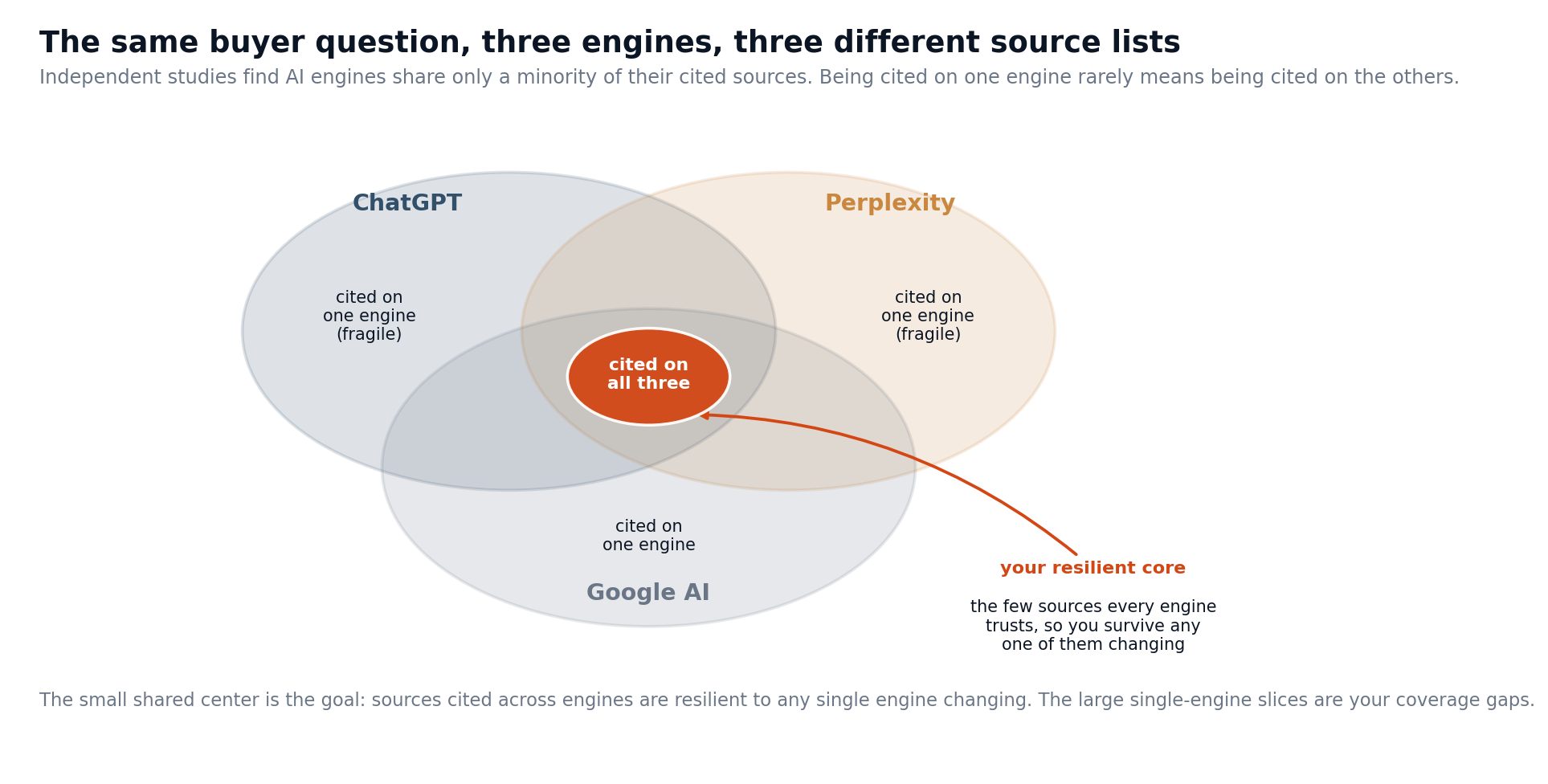
The shared center is small on purpose: most sources sit in a single engine. Sources cited across engines are the resilient ones.
Why overlap is the goal, not a nice-to-have
If your brand is cited in only one engine for a question, your visibility on that question rests on a single system's behavior. When that engine changes how it retrieves, adjusts what it trusts, or simply answers from memory that day, your citation can vanish and you have no coverage anywhere else. AI answers already shift from run to run, a point worth understanding on its own in why AI search results fluctuate; depending on one engine stacks that volatility on top of single-point exposure.
Overlap is the fix. A source cited across several engines is resilient: any one engine can change and you are still the answer on the others. It also matches how buyers actually behave. A B2B buying group does not standardize on one assistant; one person checks ChatGPT, another lives in Perplexity, someone else sees Google's AI answers at the top of a normal search.
If you are cited on only one of those, most of the group never encounters you at the moment they are forming a shortlist. Being cited across engines is how you show up for the whole committee, not a slice of it.
So the target is not "rank in AI." It is to grow the shared center of that overlap: the questions where you are cited no matter which engine the buyer asked.
Tier one: the shared foundations that lift you across engines
Here is the useful part of low overlap. Even though the engines cite different pages, the things that make a page citable at all are largely the same everywhere. Build those well and you raise your odds on more than one engine at once, which is far more efficient than optimizing engine by engine from scratch.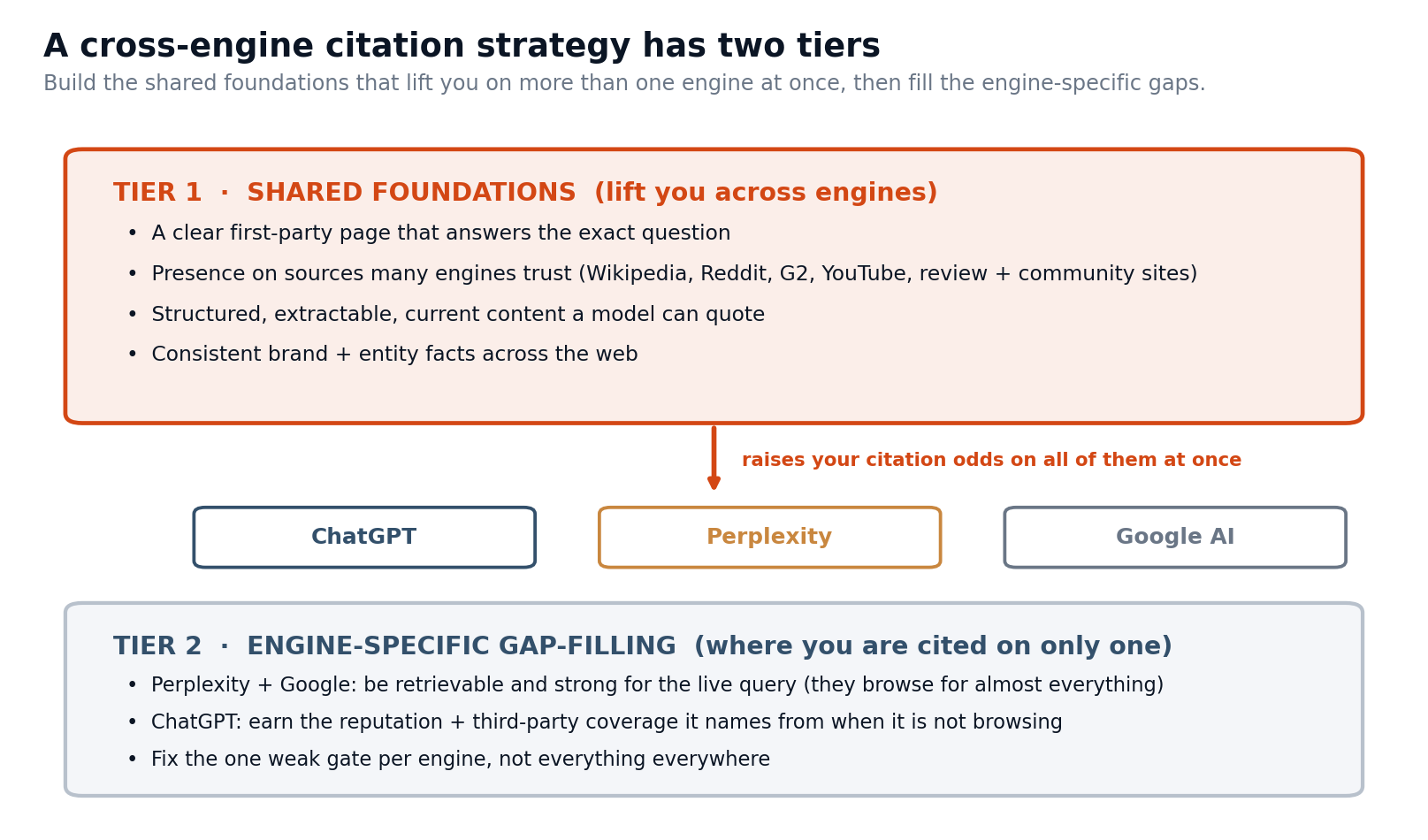
Build the shared foundations first: they lift you on multiple engines at once. Then fill the engine-specific gaps.
Four foundations do most of the cross-engine work.
A clear first-party page that answers the exact question. Every engine can credit a page that directly and cleanly answers what was asked. One strong, specific page is a candidate for all of them, where a vague overview page is a candidate for none. This is the core of making content citable, covered in the signals that make a page citable.
Presence on the third-party sources many engines trust. Some sources get pulled across engines far more than others: encyclopedic references, large community and review sites, and well-known industry publications. Being present and well-regarded there raises your citation odds on multiple engines at once, because you are showing up in the corpus several of them draw from. The interplay between your own pages and this earned off-site presence is the subject of first-party versus third-party citations, and it is the single biggest lever for overlap.
Structured, extractable, current content. A page a model can parse, quote a clean passage from, and trust as up to date is easier to cite for any engine. Buried answers, out-of-date pages, and content locked behind scripts hurt you everywhere, not just in one place.
Consistent brand and entity facts across the web. When your name, category, and core facts line up across your site and the places that describe you, engines can recognize and describe you confidently. Inconsistent or thin entity information makes every engine more likely to name a competitor it understands better.
None of these are engine tricks. They are the shared base that makes you a plausible citation regardless of which system is doing the asking, which is exactly why they belong first.
Tier two: fill the engine-specific gaps
Once the shared foundations are in place, look at where you are still cited on only one engine and do the targeted work to close those specific gaps. This is where a little engine-specific knowledge pays off, and where you should spend it, not before.
For the retrieval-first engines like Perplexity, and for Google's AI answers, the lever is being retrievable and being the strongest live match for the query: a crawlable, current, on-point page, and for Google, real strength in its normal ranking too. If you are cited by ChatGPT but missing from Perplexity on a question, it usually means your page is not being found and pulled at answer time, which is a retrieval and relevance problem you can fix.
For ChatGPT, which leans more on trained knowledge and selective browsing, the lever is the reputation and third-party coverage it draws on when it is not searching. If Perplexity cites you but ChatGPT only mentions competitors, the gap is usually that ChatGPT has not absorbed enough about you from the wider web, which is a longer-cycle presence-and-reputation problem rather than a single-page fix.
The discipline that matters here is to fix the one weak gate per engine rather than trying to do everything everywhere. You are patching specific holes in coverage, and the diagnosis for each hole is different by engine.
How to measure citation overlap
You cannot manage overlap you are not measuring, and a single spot check will not show it. Build a simple, repeatable read.
Take your priority buyer questions and, for each one, record which engines cite you, run over run. That gives you a per-question, per-engine citation profile and, from it, an overlap read: for each question, are you cited on all your target engines, some of them, or just one. Because answers vary between runs, use repeated checks rather than a single look, and watch the profile over time and against competitors. Doing this across a full prompt set by hand does not scale, which is why frequent automated checks across engines are the practical way to see your overlap and act on it.
Read the profile as a priority list. Questions where you are cited on every target engine are won: protect them. Questions where you are cited on only one engine are your biggest opportunity, because the shared foundations are clearly working somewhere and a focused push can extend that citation to the others. Questions where you are cited on none, but that matter to pipeline, are where you build from scratch.
A worked example: one question across three engines
Take "best AI search visibility platform for B2B" and check it across ChatGPT, Perplexity, and Google's AI over a week. Suppose you find you are cited consistently by Perplexity, occasionally by Google's AI, and never by ChatGPT. That single result tells you where the work is.
The Perplexity citation says your page is retrievable and strong for the live query, so the shared foundation is sound. The patchy Google result says your normal ranking for that query is not strong enough to feed its AI answer reliably, a Google-specific gap. The ChatGPT absence says the model has not absorbed enough third-party signal about you to name you from trained knowledge, a reputation gap that off-site presence closes over time. Same question, three different next actions, and none of them is "write more content." Run the same read across your top questions and you get a ranked map of exactly where your coverage is thin and which lever closes each gap.
Where B2B teams get cross-engine visibility wrong
- Treating AI search as one channel. "We show up in AI" usually means one engine. The engines cite mostly different sources, so a single win is not coverage.
- Optimizing engine by engine from zero. Chasing each engine separately wastes effort. The shared foundations lift several at once; do those first, then specialize.
- Reading one engine as the whole picture. Being cited in the engine you personally use tells you little about the others your buyers use.
- Checking once. Overlap only shows up across repeated checks per engine. A single snapshot hides both the gaps and the wins.
- Ignoring third-party presence. The sources cited across engines are disproportionately third-party. Investing only in your own pages caps how much overlap you can reach.
Frequently asked questions
Do AI engines cite the same sources? Mostly not. Each engine retrieves from a different system, so the sources they credit for the same question overlap only partially. Independent studies consistently find that engines share a minority of their cited sources, which is why being cited in one is a weak signal for the others.
If I am cited in ChatGPT, will I be cited in Perplexity and Google too? Not reliably. ChatGPT leans on trained knowledge and selective browsing, Perplexity on live retrieval, and Google on its own index, so a page that earns one citation can be missing from the others. You have to earn coverage across engines rather than assume it transfers.
How do I get cited across multiple AI engines? Build the shared foundations first: a clear first-party page that answers the exact question, presence on the third-party sources many engines trust, structured and current content, and consistent entity facts. Then fill the engine-specific gaps where you are cited on only one.
What is citation overlap and why does it matter? Citation overlap is how many of your target engines cite you for the same question. High overlap means resilience, if one engine changes, you are still the answer on the others, and it means you reach the whole buying group rather than the slice that uses one assistant.
How do I measure whether I am cited across engines? For each priority question, record which engines cite you, over repeated checks, and track it over time and against competitors. That per-question, per-engine profile shows where you have full coverage, where you are cited on only one engine, and where you are absent.
Building the shared center
The engines will keep disagreeing about which pages to cite, because they are built to look in different places. That is not a problem to solve so much as a map to work from. Your coverage gaps are the questions where only one engine cites you, and your wins are the questions where they all do. The strategy is to grow that shared center: build the foundations that make you citable everywhere, then close the engine-specific gaps one at a time.
Start by seeing the map. To find where your brand is cited across ChatGPT, Perplexity, Google, and the other AI engines, and where the gaps are, run a free scan with the AI Search Visibility Checker, or track your citation coverage across engines over time with AI Search Intelligence.