




Two pages can cover the same topic equally well, and an AI engine will cite one and ignore the other. The difference is not luck. Engines choose sources through a set of recognizable signals, and once you know what they are, the question stops being "why didn't it cite us" and becomes "which signal are we missing."
This is the practical companion to understanding what AI citations are. Here the focus is narrower and more useful: the specific signals that decide whether a model cites your page, grouped into a model you can act on, with a clear line between the signals you control this week and the ones you build over months.
The five gates a page has to clear
It helps to think of citation not as a single score but as a sequence of gates. A page has to pass all of them. A brilliant, authoritative page that an engine cannot crawl never gets cited; a perfectly crawlable page that does not answer the question never gets cited either. Strength in one gate does not buy back a failure in another.
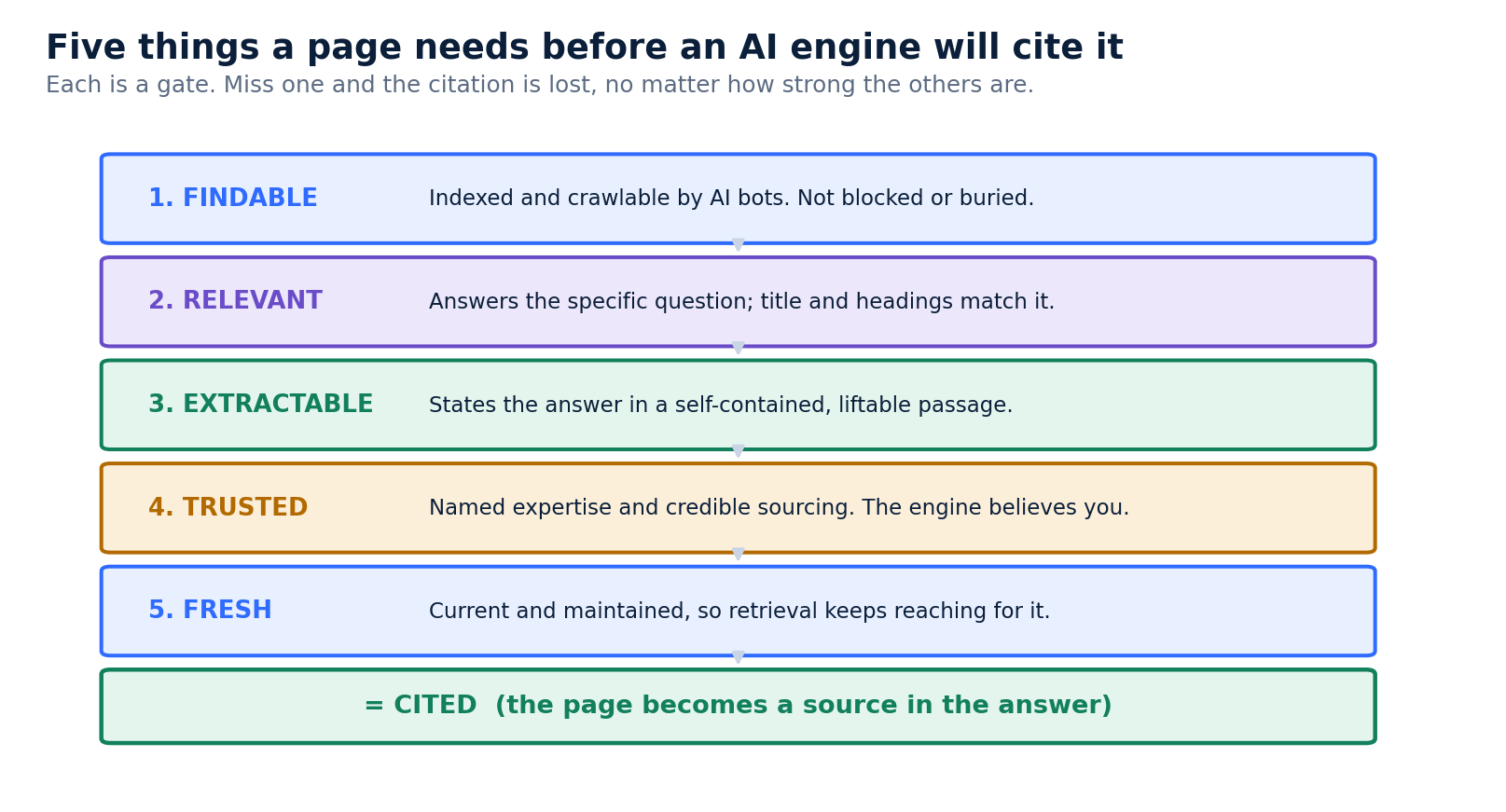
The five gates are findable, relevant, extractable, trusted, and fresh. The rest of this piece is the signals inside each, because that is where the actual work lives.
Findability signals: can the engine reach you at all
Before any of the content signals matter, the engine has to be able to retrieve your page. This is the gate most B2B teams overlook, because it was largely solved for classic SEO years ago and feels like it should be handled.
The signals here are technical. Your page has to be indexed and crawlable by the specific bots AI engines use, which are not always the same as Google's crawler. These are separate user agents, GPTBot and OAI-SearchBot for ChatGPT, ClaudeBot for Claude, PerplexityBot for Perplexity, Google-Extended for Google's AI, and a robots.txt rule or firewall can be blocking one of them while classic Google access looks fine. Many B2B teams discover they have been quietly excluded from an engine for months for exactly this reason. Beyond access, the content has to be present in the HTML the crawler receives, not assembled by scripts the crawler never runs, or the engine sees an empty page. And the page has to load reliably and reasonably fast, because a source that times out is a source that gets skipped. None of this makes you citable on its own, but failing it makes everything else irrelevant, since a page the engine cannot read cannot be cited no matter how good it is. This is part of the plumbing behind how AI search works.
Relevance signals: do you answer this exact question
Once you are retrievable, the engine judges whether your page actually answers the specific question it is working on. AI queries are narrow and conversational, so relevance is measured against the exact question, not a broad topic.
The strongest relevance signal is direct correspondence between the question and your page: the title, the headings, and the wording of the relevant passage matching how the buyer actually phrased the question. Engines compare the meaning of the query to the meaning of your content, so a page whose language mirrors the real question is read as more relevant than a broad page that only touches it. This is also why phrasing changes which brands get cited: small wording differences move the match, and it is why so much B2B citation happens on the specific long-tail questions where visibility is won rather than broad terms. Entity clarity matters here too. Naming your brand, product, and the concepts plainly, rather than leaning on pronouns or clever labels, helps the engine understand what your page is about and associate you with the topic. Specificity is a relevance signal in itself: a page that names the company size, the integration, or the exact use case the buyer asked about reads as a closer answer than a generic one.
Extractability signals: can the answer be lifted cleanly
Relevance gets you considered. Extractability gets you used. An engine builds its answer by lifting quotable pieces from sources, so the easier your answer is to lift, the more likely it is to be the piece the engine takes.
Lead each section with the answer stated directly, in the first sentence or two, then add the supporting detail. A self-contained passage that makes sense on its own, without the reader needing the paragraph before or after it, is far more liftable than one that depends on surrounding context. Headings phrased as the real questions buyers ask let the engine match a query straight to the passage that answers it. Clear formatting, short paragraphs, lists where they fit, and supporting structured data all make the page easier to parse and attribute. These are the mechanics behind the content formats that win AI search visibility, and together they are the core of answer engine optimization. A correct answer buried in a wall of text often loses to a clearer answer on a weaker page, simply because the clearer one is easier to quote.
Trust signals: does the engine believe you
Engines are cautious about which sources they put their name behind, so trust is a heavy signal, and it is the one that most separates pages that are otherwise equal.
Named expertise is a strong trust signal: a real, credited author with genuine authority on the subject, rather than an anonymous byline. Credible sourcing within the page, citing real data and linking to reputable references, tells the engine your claims are grounded. Corroboration is one of the most underrated signals: engines lean toward claims that are supported across multiple reputable sources, so being one of several places that say the same thing makes you safer to cite. That is why your presence off your own site matters, through third-party mentions on review platforms, industry publications, and communities, and through the backlinks and brand recognition that classic SEO already values. Those do not appear in the answer themselves, but they work behind it as the reputation that makes an engine trust your page enough to cite it. This corroborating footprint is also what makes competitive intelligence useful: the brands cited beside you are usually the ones with the stronger trust footprint.
Freshness signals: are you current
Retrieval favors current information, especially on topics that change. A page that is visibly maintained, updated, and dated recently is more likely to be pulled than an equivalent page that looks abandoned.
Freshness is not about churning pointless edits; it is about keeping the substance current so the engine, and the buyer, can trust that the answer still holds. On fast-moving subjects the effect is strong, and a competitor who refreshes their page can displace a stale one of yours. On stable subjects it matters less, but a maintained page still signals a maintained source. Because what an engine holds and prefers shifts over time, freshness also interacts with the volatility covered in why AI search rankings fluctuate: staying current is part of holding a citation rather than losing it.
Signals you control, and signals you earn
The five gates contain two kinds of signal, and treating them the same is the most common strategic mistake.
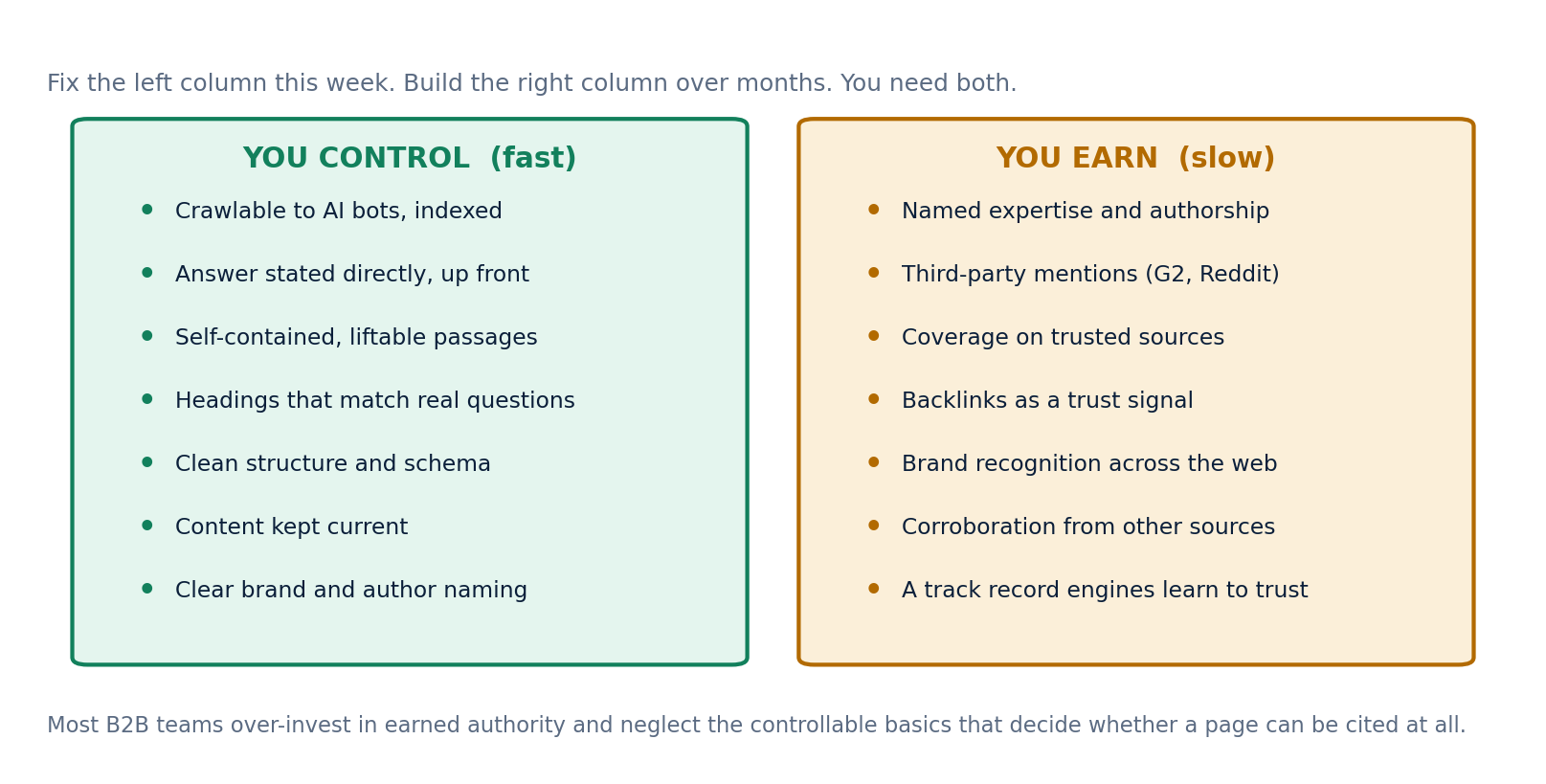
The controllable signals, findability, relevance, extractability, structure, and freshness, are on-page and fast. You can fix them this week: open your pages to AI crawlers, rewrite the openings to answer directly, break answers into self-contained passages, match headings to real questions, add schema, and update stale content. These decide whether a page is even capable of being cited, and they are where most B2B teams have easy wins sitting unclaimed.
The earned signals, authority, corroboration, brand mentions, and reputation, are off-page and slow. They come from doing citable work, being covered by others, and building recognition over months. They are worth the investment, but you cannot ship them in a sprint, and pouring effort into earned authority while the controllable basics are broken is backwards. Get the page citable first, then build the reputation that makes it the preferred source.
A page walked through the gates
Take a real situation. You have a strong page on "AI search visibility for B2B," well written and genuinely authoritative, and it is not getting cited. Walk it through the gates and the problem usually names itself.
Findable: you check and find your firewall was challenging GPTBot, so the page was never crawled by ChatGPT's fetcher. That alone explains the absence, and it is a same-day fix. Suppose access is fine. Relevant: the page is about the broad topic, but the buyer question the engine is answering is "how do I measure AI visibility against pipeline," which the page never addresses in those words, so it is judged less relevant than a page that does. Extractable: even where the page is relevant, the answer is spread across three paragraphs with no single liftable sentence, so the engine takes a competitor's cleaner passage instead. Trusted: the page has no named author and cites no sources, so on a close call the engine prefers a rival with visible expertise. Fresh: it was last updated eighteen months ago, and the engine favors a competitor's recently refreshed page.
Any one of those, on its own, can be the reason. That is the point of the gate model: you do not guess at a vague "authority" problem, you find the specific gate that is failing and fix that one.
The signals differ by engine
No single engine weighs these identically. An engine built on live retrieval leans harder on freshness and on what its index holds right now; one that draws more on trained knowledge leans harder on established authority and brand recognition. Some surface their sources prominently and some barely at all. The five gates hold across all of them, since every engine has to find, judge, lift, trust, and prefer a source, but the emphasis shifts. The practical response is not to optimize for one engine's rumored weighting but to be strong on every gate, then measure the engines your buyers actually use to see where you stand on each.
Signals that matter less than people think
Some of the habits carried over from classic SEO do little for AI citation, and chasing them wastes effort better spent on the gates above.
Keyword density is one. Repeating a target phrase does not make a page more citable and can make the writing worse to lift; what matters is genuinely answering the question in natural language. Raw word count is another: a longer page is not a more citable one, and padding a thin answer to hit a length target only buries the part an engine would quote. Exact-match domains and other legacy ranking tricks carry little weight with engines that judge a page on its content and its corroboration. And sheer publishing volume, shipping more posts for its own sake, does not help if the individual pages do not clear the gates; a few genuinely citable pages beat a large library of unliftable ones. The through-line is that AI citation rewards being the best, clearest, most trusted answer to a real question, not the mechanical signals that once moved rankings. Getting this right is the substance of AI search optimization.
Where B2B teams get the signals wrong
- Optimizing content while blocking the crawler. The best page in the world cannot be cited if AI bots cannot reach it. Check findability first.
- Chasing authority before fixing the page. Earned signals take months; the on-page signals that make a page citable at all take days. Do the fast work first.
- Writing for the broad topic, not the exact question. Relevance is judged against the specific query. Generic coverage loses to a page that answers the precise question.
- Burying the answer. A correct answer an engine cannot lift cleanly does not get cited. Lead with it.
- Treating one signal as a silver bullet. Schema alone, or authorship alone, does not do it. The signals compound, and the weakest gate is the ceiling.
- Setting and forgetting. Freshness is a signal and citations move, so a page that earned citations once can lose them if it goes stale.
Turn the signals into a checklist
The signals are not a mystery, and they are not all slow to fix. Most of what decides whether an AI engine can cite a page, findability, relevance, extractability, structure, and freshness, is on-page and in your hands right now. The authority that makes you the preferred source takes longer, but it is wasted effort if the page underneath it is not citable in the first place.
So work the gates in order. Confirm your pages are open to AI crawlers, rewrite them to answer the specific questions your buyers ask, make the answers easy to lift, keep them current, and only then pour energy into the earned authority that compounds on top. Then measure, because the signals only matter if they move your actual citation rate, tracked with the visibility metrics that tie to pipeline.
To see which of your pages are cited today across the AI engines, and which questions you are missing, run a free scan with the AI Search Visibility Checker, or track how your citations respond as you fix each signal with AI Search Intelligence.
Frequently asked questions
What is the single most important signal for getting cited?
There is no single one, because citation is a sequence of gates and the weakest gate is your ceiling. That said, the fastest wins are usually on the controllable on-page signals: being crawlable, answering the exact question directly, and making the answer easy to lift.
Do backlinks still matter for AI citations?
Yes, but indirectly. Backlinks are a trust and authority signal that helps an engine believe your page enough to cite it. They are not the citation itself, and they will not compensate for a page that is not crawlable or does not answer the question.
Does schema markup get me cited?
Schema helps by making your content easier for an engine to parse and understand, which supports the relevance and extractability gates. It is a helpful signal, not a standalone cause, and it will not carry a page that fails the other gates.
How is this different from traditional SEO ranking factors?
There is overlap in the trust and technical signals, but AI citation adds extractability, the requirement that the answer be liftable in a self-contained passage, and it judges relevance against a specific conversational question rather than a broad keyword. See how AI search visibility differs from traditional SEO.
How do I know which signals I am missing?
Check whether you are cited for your priority buyer questions across engines, and look at what the cited pages do that yours does not. Measuring your citations directly, over time and against competitors, is how you find the specific gate that is holding a page back.