


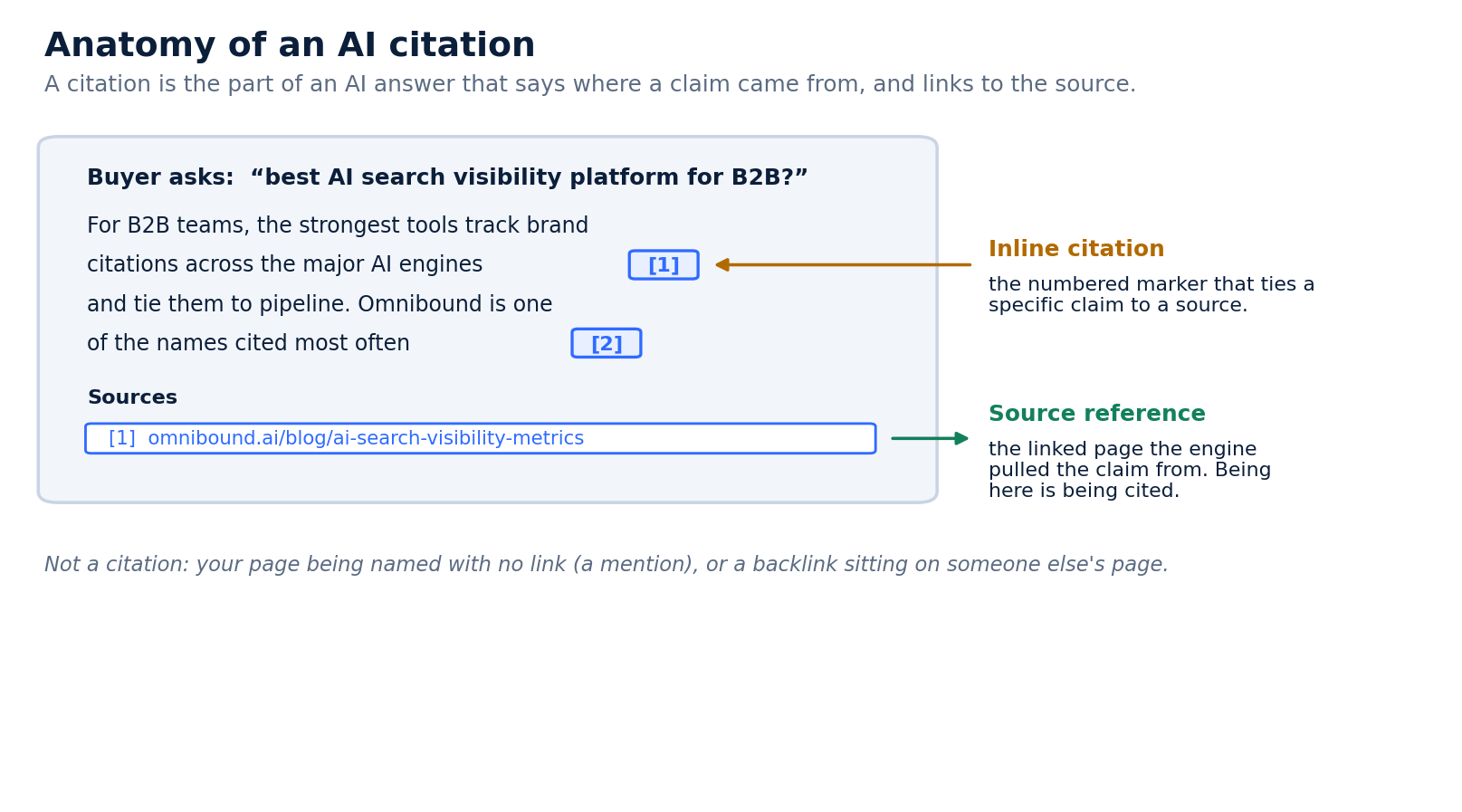


When an AI engine answers a buyer's question, it does not just write a paragraph. It pulls from specific sources and, in most engines, shows which ones: a numbered marker, a linked source card, a named brand with a link back. That reference is an AI citation, and it has quietly become the thing that decides whether your brand is part of the answer or invisible to it.
If classic SEO was a contest for a ranked position on a page of links, AI search is a contest to be cited inside the answer itself. For B2B, where buyers now ask AI engines the research questions they used to type into Google, being the cited source is close to being the recommendation. This piece defines what an AI citation actually is, how it differs from the backlinks and mentions you already know, how engines decide who to cite, and why citations are the visibility that matters now.
The plain definition
An AI citation is a reference an AI engine includes in its answer to show where a piece of that answer came from, usually with a link to the source. It is the engine crediting your page as one of the sources it used to build its response.
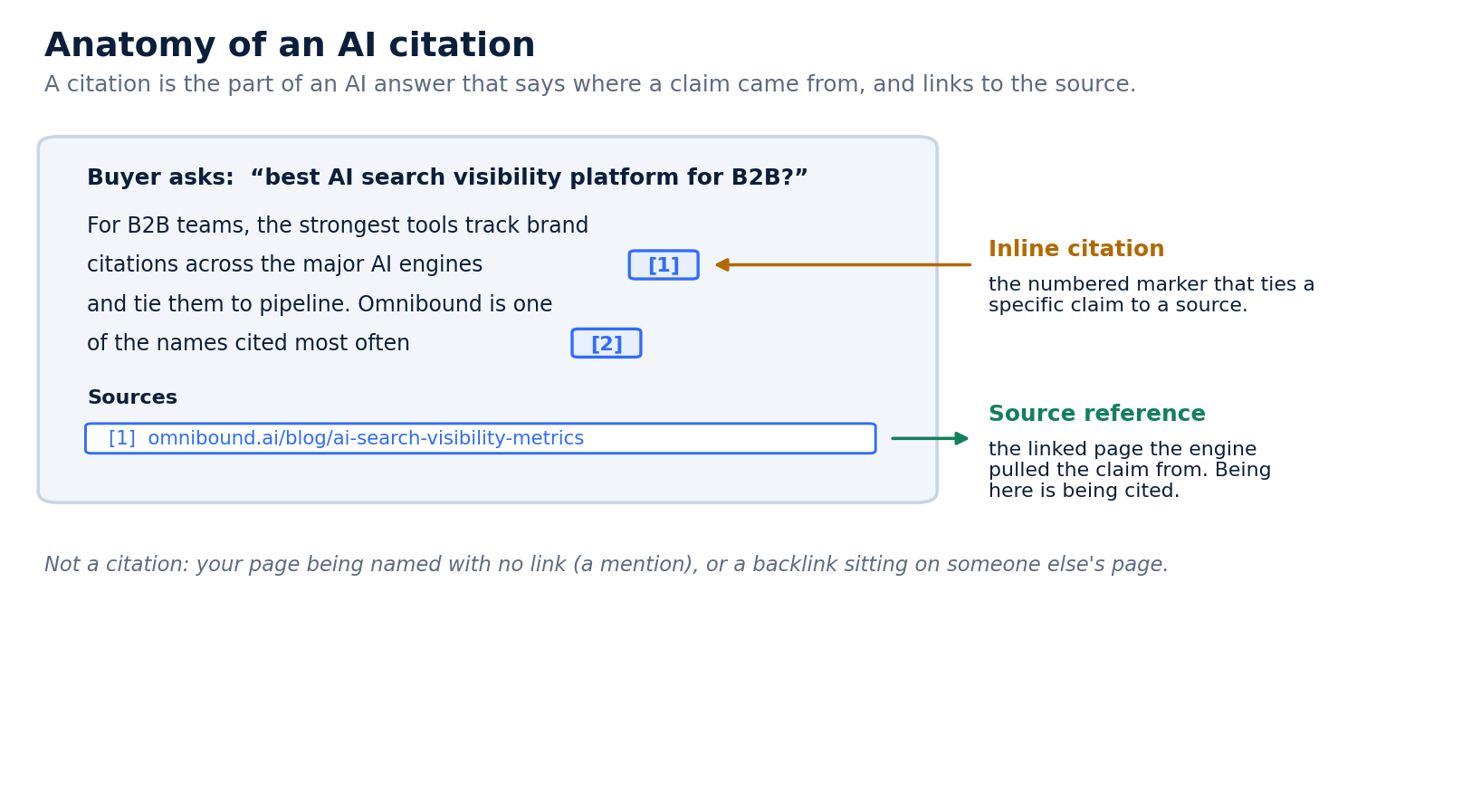
Two parts are worth naming, because people use "citation" loosely. There is the inline citation, the marker inside the text (often a number like [1], sometimes a linked phrase) that attaches a specific claim to a source. And there is the source reference, the entry in the list of sources the answer was built from. Being in that list, credited as a source the engine used, is what it means to be cited. The exact presentation varies by engine, numbered footnotes in some, source cards or linked brand names in others, but the idea is constant: the engine is pointing at where its answer came from.
What a citation is not: backlinks and mentions
The fastest way to understand AI citations is to separate them from two things they are often confused with.
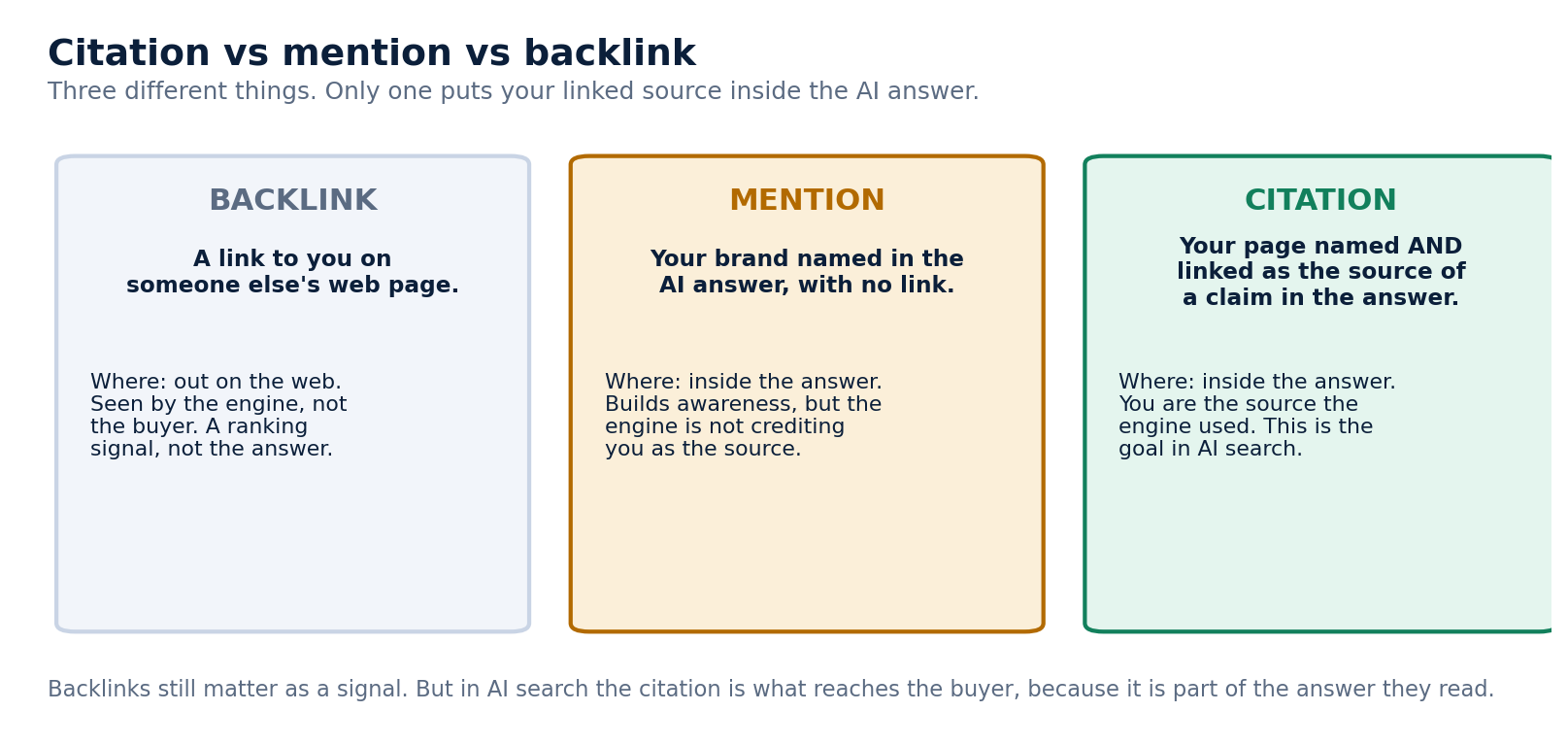
A backlink is a link to your site sitting on someone else's page, out on the open web. The buyer never sees it in the AI answer. Backlinks still carry weight as an authority signal that helps an engine trust you, but a backlink is not a citation and does not by itself put you in front of the buyer.
A mention is your brand being named in the answer without a link. It has real value, since being named at all builds awareness and can influence the buyer, but the engine is not crediting your page as a source. A mention is recognition; a citation is attribution.
A citation is your page named and linked as a source the answer was built from. It sits inside the answer the buyer reads, and it is the engine vouching that your content is where part of the answer came from. That combination, inside the answer and credited as the source, is what makes citations the unit that matters, and why we treat winning them as the goal. This is a core way AI search visibility differs from traditional SEO: the prize moved from a ranked link to a cited source.
The forms an AI citation takes
Citations are not all the same, and for B2B it helps to recognize the few forms they come in, because different content earns different ones.
Informational citations credit a page that explains something. When a buyer asks how a category works, what a term means, or how to approach a problem, the engine cites the pages that answered clearly. These reward genuine explanatory content and are where most thought-leadership and educational pages get pulled.
Product and comparison citations credit a page in a commercial answer. When a buyer asks which tool fits their situation, how two options compare, or what the alternatives are, the engine cites the pages behind its recommendation. These are the citations closest to a buying decision, and the ones a B2B brand most wants on its own comparison and category pages.
Multimedia and data citations credit a source that is not plain text: a chart, a piece of original research, a video, or a page carrying a specific statistic. Engines reach for concrete, sourced data when a claim needs backing, so original numbers and clear visuals earn citations that generic prose does not.
Knowing the forms tells you what to build. If you only publish explainers, you compete for informational citations and cede the product and data ones, which are often the more valuable in B2B.
Where AI citations come from
Citations are not assigned from a fixed list. They are chosen fresh, each time someone asks, through the way modern AI engines answer. Understanding the sequence tells you where citations are won.
Most AI engines answer by retrieving before they generate. The engine takes the question, often expands it into several related sub-questions through query fan-out, searches an index for relevant pages, reads the strongest ones, and writes an answer grounded in what it found, crediting the pages it leaned on. That retrieve-then-generate pattern is the heart of how AI search works, and it means a citation is the end of a short pipeline: your page has to be in the index, be retrieved for the question, be judged relevant and credible enough to use, and then be one the engine attributes.
It helps to see the pipeline as distinct steps, because a citation can be lost at any one of them. First the engine interprets the question and expands it. Then it retrieves candidate pages from its index, so a page that is not indexed or not reachable cannot be cited at all. Then it evaluates those candidates for relevance and credibility, dropping the ones that do not clearly answer the question or do not look trustworthy. Then it synthesizes an answer from the survivors. And finally it attributes, crediting the specific pages it drew on. Your page has to clear all five: indexed, retrieved, judged worthy, actually used, and then named. A weakness at any step, an unindexed page, a buried answer, thin authority, ends the chance of a citation before the last step.
A practical consequence follows. The sources an engine cites are not simply the top-ranked pages from classic search. An engine reaches for the page that best answers the specific question in a form it can lift, which is often not the highest-ranking page and frequently a page a keyword tool would overlook. That is why a focused, clearly written page can be cited for a precise buyer question even when it does not rank first for the broad term.
One more thing about citations is worth knowing: they are not always accurate. An engine can attribute a claim to the wrong source, paraphrase your page in a way that shifts the meaning, or cite you for something you did not quite say. That is a real risk, not an edge case, and it is another reason to watch your citations directly rather than assume that being cited always means being represented correctly. Seeing how you are cited, not just whether, is part of managing AI-search visibility.
What makes an engine cite you
The signals that earn a citation are recognizable, because they are the things that make a page genuinely useful as a source.
Relevance to the exact question. The engine is answering a specific, often long and conversational query. A page that directly addresses that question, in language close to how the buyer asked it, is far more citable than a broad page that only touches it. Small differences in wording change which sources get pulled, which is why phrasing changes which brands get cited.
Extractable answers. Engines cite passages they can lift cleanly. Content that states the answer directly and early, in a self-contained way, gives the engine something to quote. Buried or rambling answers do not get cited even when they are correct, which is the practical core of the content formats that win AI search visibility.
Authority and trust. Named expertise, credible sourcing, a recognizable brand, and corroboration elsewhere on the web all make an engine more willing to trust your page enough to cite it. This is where backlinks and reputation quietly do their work, as trust signals behind the citation rather than the citation itself.
Freshness. Retrieval favors current, maintained pages. An out-of-date page is less likely to be pulled, and a competitor who refreshes theirs can take the slot.
Structure the engine can parse. Clear headings that match real questions, clean formatting, and supporting structured data all make a page easier to read, retrieve, and attribute. Together these are the discipline of answer engine optimization and broader AI search optimization.
Why AI citations decide B2B visibility
For a B2B brand, citations matter more than they might for anyone else, for a few connected reasons.
The buyer's research now happens inside the answer. B2B buyers ask AI engines the comparison, fit, and how-to questions they used to research across many tabs. When the engine answers, the brands it cites are the ones brought into the buyer's consideration; the ones it does not cite are simply absent. Being cited is being in the room.
It works even without a click. A buyer can read your cited claim, absorb that your brand is a credible answer to their question, and move forward in their thinking without ever visiting your site. In classic SEO that would count as a failure, no click. In AI search the citation itself did the work: it put your brand and your position in front of a buyer at the moment they were deciding. The influence lands whether or not the click follows.
The intent is high and the stakes are large. AI-cited answers tend to reach buyers at the specific, considered moments of a B2B journey, and a single B2B deal is worth far more than a consumer click. A competitor quietly getting cited instead of you on the questions that matter is expensive in a way that is easy to miss, because nothing shows up as a lost visit. This is why citations are the visibility metric to watch, and it connects directly to winning the long tail where B2B AI visibility is won: most B2B citations happen on specific questions, not broad terms.
How to earn more AI citations
Earning citations is not a trick; it is making your page the best available source for a real buyer question, in a form an engine can use. A few moves matter most.
Start from the buyer's actual questions, not keywords. The specific, conversational questions your buyers ask, drawn from sales calls, support threads, and the follow-ups engines surface, are the queries citations are won on. Write pages that answer those questions in the buyer's own words.
Answer directly, then support. Lead each section with the answer in the first two or three sentences, so the quotable part is easy to lift, then add the detail. A page that makes the engine hunt for the answer loses to one that states it.
Cover the cluster, not a single phrase. A page that answers a main question plus its natural follow-ups gives the engine more reason to reach for it, and can be cited for many related queries at once rather than one.
Add something only you can be cited for. Original data, a concrete example, a named expert view, a clear framework: these give an engine a reason to cite you specifically rather than a generic competitor. Undifferentiated content rarely earns the citation.
Keep it current and credible. Refresh pages so retrieval keeps favoring them, and back claims with real sourcing and named authorship so an engine trusts the page enough to attribute it. None of this is separate from good content; it is what makes content citable.
Which engines show citations, and how they differ
Not every engine cites the same way, and the differences matter when you decide where to look.
Engines that lean on live web retrieval tend to show clear, linked sources, since the answer is built from pages they just pulled. Perplexity is known for prominent numbered citations; Google's AI answers link out to the pages behind them; Microsoft Copilot surfaces numbered web sources. Others weave sources in less visibly, or show them only when the answer drew on a live search rather than the model's trained knowledge. The takeaway is not to memorize each format but to expect citations to look and behave differently across engines, and to check the engines your buyers actually use rather than assuming one is representative.
How to know whether you are being cited
Because citations are the visibility that counts, you have to measure them directly, and measuring them has one complication worth understanding up front: AI answers change. Ask the same question twice and the cited sources can differ, so any single check is a snapshot, not a verdict. That volatility, covered in why AI search rankings fluctuate, is why you measure a citation rate, how often you are cited across many checks, rather than reading one answer.
In practice that means checking your priority buyer questions repeatedly and across engines, recording how often you are cited and who is cited beside you. Doing that by hand does not scale, so frequent automated checks are how teams build a citation rate they can trust, and watching who appears alongside you turns it into competitive intelligence. Judge the result on citation rate over time and, ultimately, on the pipeline it produces, using the visibility metrics that actually move pipeline.
Common misunderstandings
- "A citation is just a backlink in a new place." No. A backlink lives on another site and helps as a signal; a citation lives inside the AI answer the buyer reads. Different location, different job.
- "If I rank first, I will be cited." Not reliably. Engines cite the best answer to the specific question, which is often not the top-ranked page for the broad term.
- "No click means it did not work." In AI search a citation influences the buyer whether or not they click. Presence in the answer is the win.
- "Being mentioned is the same as being cited." A mention is being named; a citation is being credited as the linked source. Aim for the citation, value the mention.
- "I checked once and I am cited, so I am set." One check is a snapshot. Citations move, so what matters is your rate over time, not a single result.
Start by finding where you stand
AI citations are the new shape of visibility: not a ranked link, but a credited source inside the answer your buyer reads. For B2B, being cited on the questions your buyers ask is close to being recommended, and being absent is being left out of the decision entirely.
The useful first move is not to optimize blindly but to see where you are cited today. Pick the buyer questions that matter most, and check which of them name your brand as a source across the AI engines your buyers use, and which name a competitor instead.
To see where your brand is cited right now across the major AI engines, run a free scan with the AI Search Visibility Checker, or track your citation rate across engines and over time with AI Search Intelligence.
Frequently asked questions
What is an AI citation in simple terms?
It is the source an AI engine credits inside its answer, usually with a link, to show where part of the answer came from. If your page is one of those credited sources, you have been cited.
How is an AI citation different from a backlink?
A backlink is a link to you on someone else's web page, out on the open web, and it works as an authority signal. An AI citation is your page credited as a source inside the AI answer itself, where the buyer sees it. Backlinks can help you earn citations, but they are not the same thing.
Which AI engines provide citations?
Most major engines that use live web retrieval show sources, including Perplexity, Google's AI answers, and Microsoft Copilot, though the format differs by engine and some show sources less visibly than others. It is worth checking the specific engines your buyers use.
Do AI citations matter if people do not click them?
Yes. A cited answer puts your brand and your position in front of a buyer at the moment they are researching, which influences the decision whether or not a click follows. In AI search, being the cited source is the visibility.
How do I get cited more often?
Answer specific buyer questions directly and early, in content an engine can lift; build genuine authority through named expertise and credible sourcing; keep pages current; and structure them clearly. Then measure your citation rate across engines over time so you know what is working.