


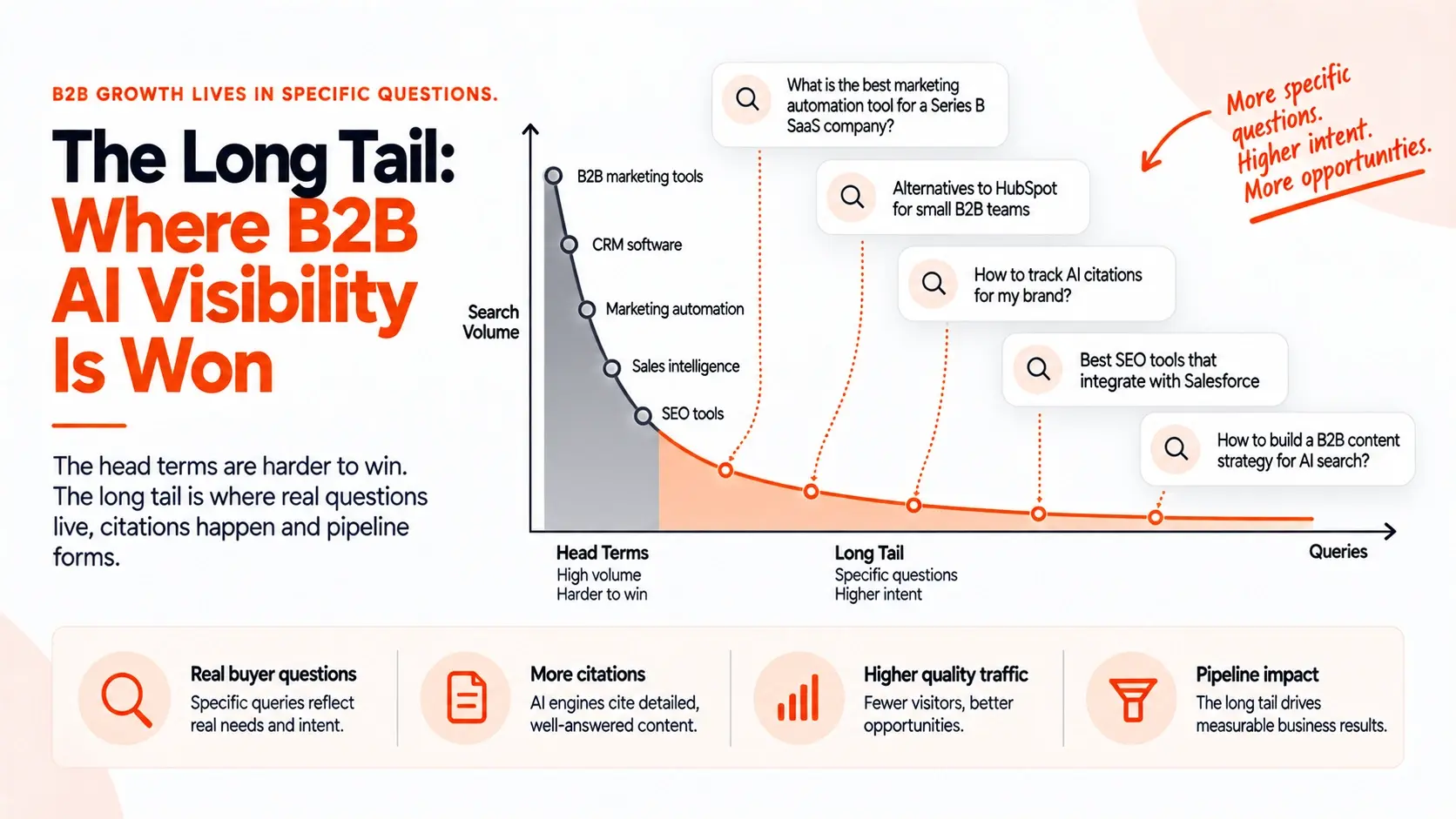


For twenty years, the long tail was a nice-to-have in SEO: chase the head terms for volume, and pick up the specific, low-volume queries as a bonus. AI search has flipped that order. The head terms are now the hardest place to win and the least rewarding when you do, while the specific questions your buyers actually ask have become the main event. For a B2B brand, that is where citations happen and where pipeline forms.
This is not a keyword-research tutorial. It is an argument about where to spend, and a practical guide to acting on it: why the long tail decides B2B AI visibility, how to find the questions that matter, how to build content that gets cited for them, and how to measure whether it is working.
Why the head term stopped paying
Start with what changed at the top of the demand curve.
Head terms, the broad one-and-two-word queries, were always competitive. In AI search they have become both more competitive and less valuable. More competitive because the same handful of high-authority incumbents dominate them, and an AI answer for a broad term leans heavily on those established sources. Less valuable because broad questions increasingly get answered in the response itself, with no click, so even ranking well returns less than it used to. For how that shift compares with classic search, see AI search visibility vs traditional SEO.
There is also an intent problem. A broad head term is, by definition, the query of someone who does not yet know what they want. The buyer who types your category name is early, unqualified, and far from a decision. Winning that term, even if you could, wins attention that rarely converts.
Put concretely: "AI search visibility" is a head term. If a buyer asks an engine that, they get a generic definition and a few of the biggest names, and they leave no more likely to buy from you than before. The same buyer, a week later, asks "how do I measure AI search visibility against my pipeline, not just traffic." That is a long-tail question, it is far less contested, and the brand cited in that answer is speaking to someone who is actively trying to solve a problem. One of those two queries is worth fighting for, and it is not the head term.
What "the long tail" means in AI search
The long tail is the vast set of specific, conversational questions that sit to the right of the head: low volume each, enormous in aggregate.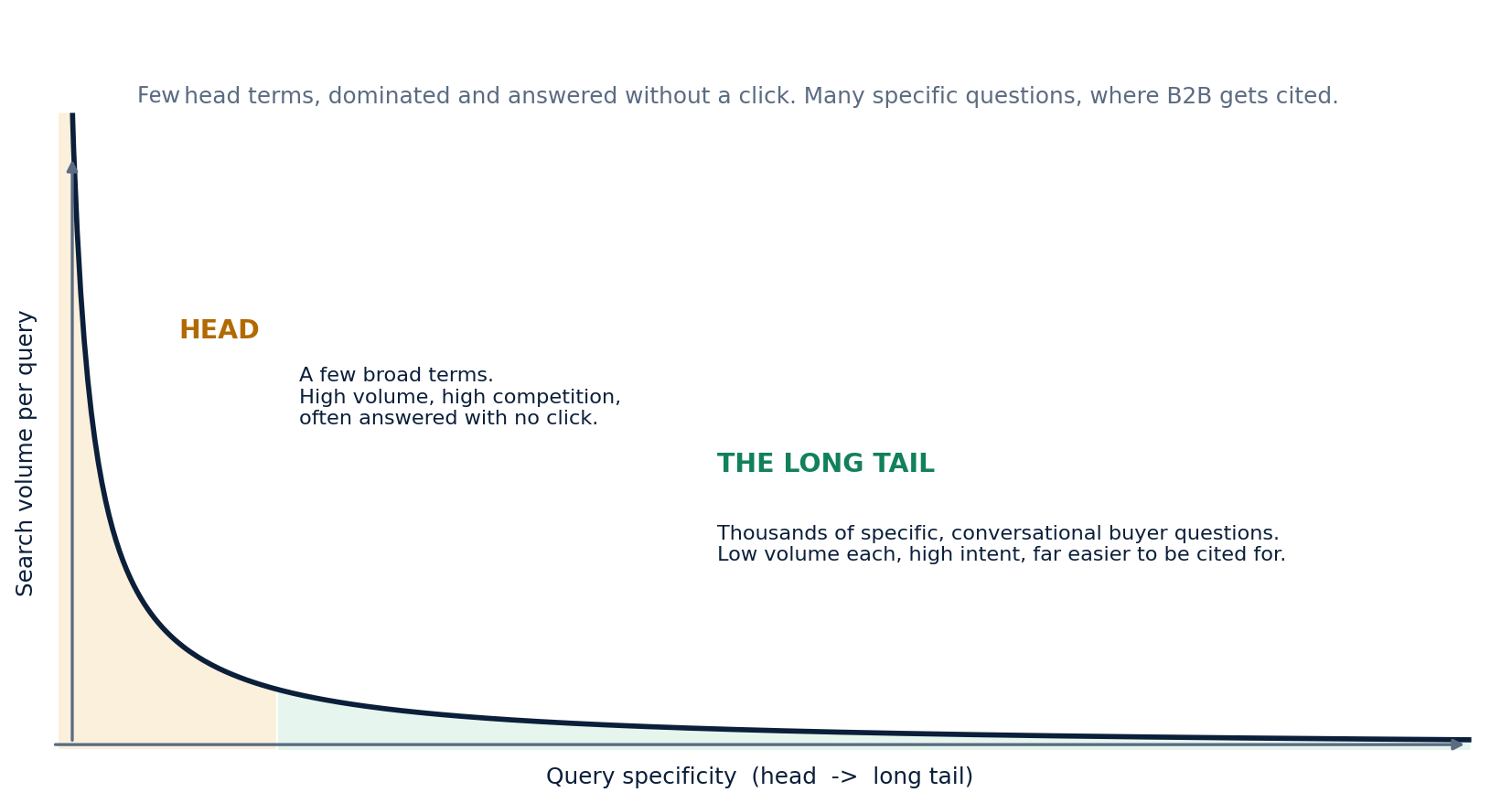
Two forces make the tail far bigger and more important in AI search than it was in classic search. The first is that people talk to AI in full sentences, so queries are longer and more specific by default. The second is query fan-out: an AI engine takes one question and expands it into many related sub-searches before it answers, which multiplies the number of specific queries in play. On top of that, the exact words a buyer chooses change which sources get pulled, so small shifts in phrasing create even more distinct long-tail paths. This is the same retrieval-and-generation behavior behind how AI search works across engines.
Why the long tail is where B2B is won
B2B buying is a long-tail activity by nature. A committee researching a considered purchase does not ask "CRM." It asks whether a tool fits a company their size, how it compares to the one they already use, whether it integrates with their stack, and what it costs for their seat count. Those are long-tail questions, and they are the ones that move a deal.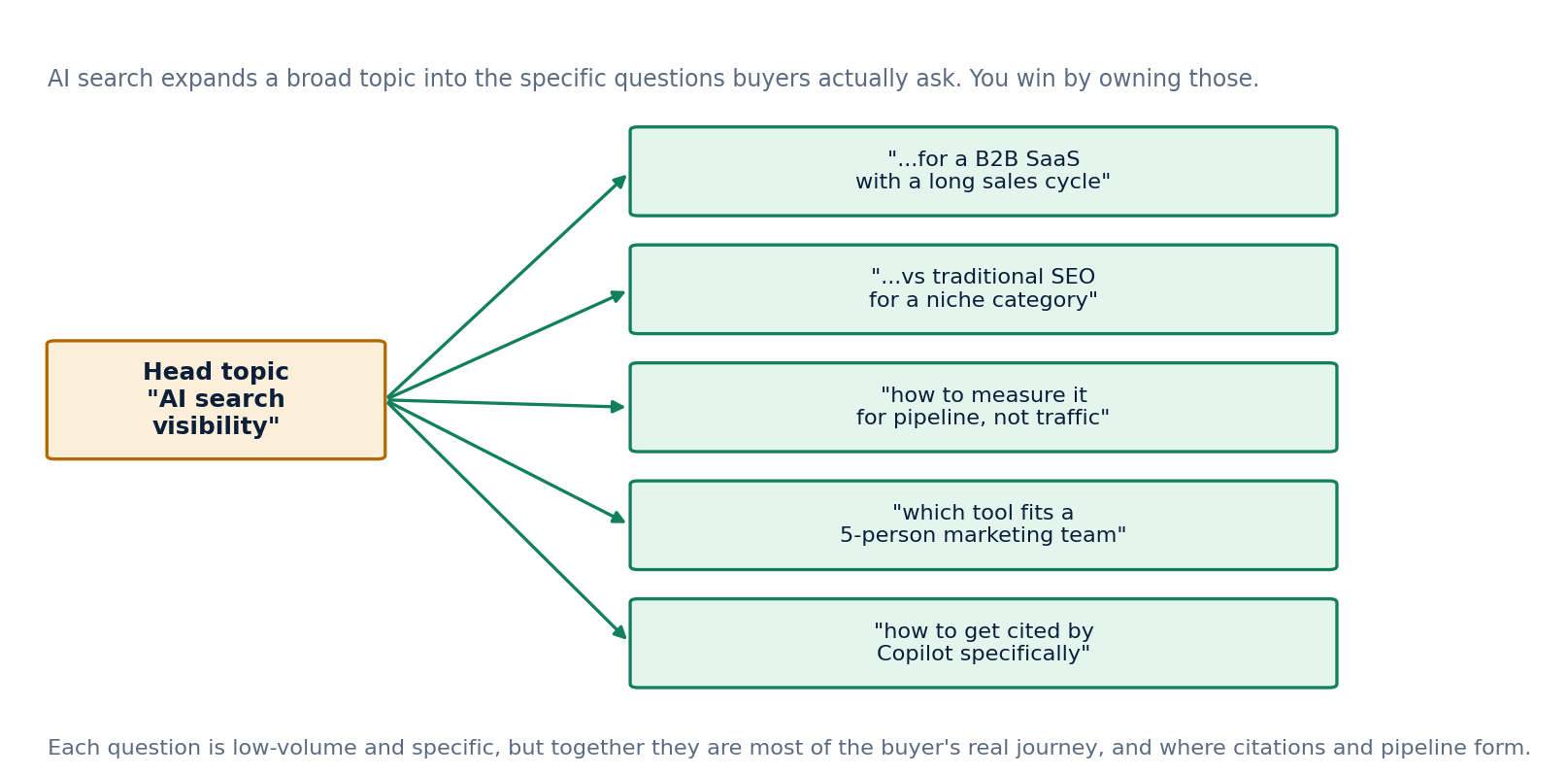
Three things make the long tail the winnable, valuable ground for B2B:
You can actually get cited. A specific question has fewer strong sources competing to answer it, so a focused, credible page has a real chance of being the one an engine pulls. Competing for the head term means fighting the incumbents; competing for the specific question means often being the best available answer.
The intent is higher. A buyer asking a precise, constrained question is further along and closer to a decision than one asking a broad one. Being cited there reaches people who are actually evaluating, which is why long-tail presence maps to pipeline more directly than head-term ranking does.
The aggregate is large. Each long-tail question is small on its own, which is exactly why competitors ignore them. Added together, they are most of the real buyer journey. Owning a few hundred specific answers is a bigger, more durable footprint than owning a few contested head terms.
A worked example: the long tail of one topic
Take a single B2B topic and watch it fan out. The head is "answer engine optimization." Underneath it sit the questions a real buyer works through: how AEO differs from traditional SEO for a niche category; whether it is worth doing for a company with a small content team; how long citations take to show up; how to prove it to a skeptical CFO; which engine to prioritize for a specific buyer base; how to measure it without a big analytics stack. None of those individually has meaningful search volume. Every one of them is a moment where a buyer is deciding something, and where a precise, credible answer can be the source an engine cites.
A brand that owns the head term "answer engine optimization" has one contested win. A brand that answers those eight questions well has eight uncontested wins, each reaching a buyer mid-decision, and collectively covering far more of the journey than the head term ever could. That is the trade the long tail offers, and in AI search it is heavily in the tail's favor.
How to find your long-tail buyer questions
The long tail is made of questions, not keywords, so the best sources are the places your buyers ask them in their own words, not just a keyword tool.
- Mine your first-party conversations. Sales calls, demos, and support threads are full of the exact phrasing buyers use. Pulling questions from sales-call recordings and transcripts gives you long-tail queries no keyword tool will surface, in the buyer's real language. Your CRM is an underused source of the same.
- Track the prompts, not just the keywords. The unit that matters in AI search is the buyer prompt. Map the real prompts your buyers use and match them to the pages that should answer them, so you can see which long-tail questions you already cover and which you do not.
- Expand each topic the way fan-out does. For every core topic, list the follow-on questions a buyer asks around it: comparisons, fit, pricing, integrations, objections. That list is your long-tail map for the topic, and it mirrors how the engine will expand the query anyway.
- Read the questions engines already surface. The "people also ask" style follow-ups and the related questions inside AI answers are a direct readout of the long tail for your space.
Building content that wins the long tail
Finding the questions is half of it. The content has to be the kind an engine will lift.
Answer each specific question directly and early, in a self-contained passage a model can quote without stitching. Lead the relevant section with the answer in the first two or three sentences, then add the supporting detail, so the quotable part is easy to lift. Cover the cluster, not a single query: a page that answers the main question plus its natural follow-ups gives the engine more surface to draw on, which is exactly what the content formats that win AI search visibility do. Be concrete, since specificity is the whole point of the long tail, and vague, generic pages give an engine nothing to cite: name the company size, the integration, the number, the trade-off the buyer actually asked about. And back it with real authority: named expertise and credible sourcing are what make an engine trust your answer, the discipline of answer engine optimization and broader AI search optimization.
The structural fit matters as much as the words. Long-tail questions cluster naturally into topics, so the strongest pattern is a thorough pillar on the topic with the specific questions answered in clearly headed sections beneath it, each heading matching a real question. That single structure lets one page be pulled for many different long-tail queries, which is far more efficient than a scatter of thin pages and far less likely to cannibalize itself.
One structural caution: do not spin up a thin page for every single long-tail phrase. Near-identical pages compete with each other and dilute your authority. Group closely related questions onto strong, consolidated pages, and let one page own a cluster of the tail rather than fragmenting it.
How to measure long-tail AI visibility
The long tail breaks the old measurement habit of watching a short list of head-term rankings. You cannot track thousands of specific questions by hand, and volume-per-query is the wrong yardstick when each query is small.
Measure at the prompt level instead: track the specific buyer questions that matter, record whether you are cited and who is cited beside you, and watch the pattern over time rather than any single query. Because manual checks do not scale to the tail, frequent automated checks across your priority prompts are the only practical way to see it, and watching who appears alongside you turns that into competitive intelligence. Judge success on citation rate across your long-tail set and, ultimately, on the pipeline it produces, using the visibility metrics that actually move pipeline.
Where B2B teams go wrong
- Still chasing the head term. Pouring budget into a broad, contested keyword that returns a zero-click answer is the most common misallocation in AI-era B2B.
- Treating the tail as low-value because volume is low. Per-query volume is the wrong lens; aggregate coverage and intent are the point.
- Writing thin pages for every phrase. This cannibalizes your own authority. Cluster related questions onto strong pages instead.
- Using only keyword tools. They miss the conversational, first-party phrasing where the real B2B long tail lives.
- Measuring head-term rankings. If you only track a handful of broad terms, you are blind to the tail where you are actually winning or losing.
Start with ten questions
You do not need to map the whole tail to begin. Pull the ten most specific questions your best-fit buyers actually ask, from recent sales calls, not a keyword tool, and run each one through the AI engines your buyers use. Note where you are cited, where a competitor is cited instead, and which of your pages the engine pulls. That short list shows you the long tail that matters to your pipeline and the gaps worth filling first. Then build the strongest possible answer to each, and expand from there.
To see which specific questions you are cited for across the AI engines today, run a free scan with the AI Search Visibility Checker, or track your long-tail prompt coverage and pipeline impact over time with AI Search Intelligence.
Frequently asked questions
What is the long tail in AI search?
It is the large set of specific, conversational questions buyers ask, as opposed to broad head terms. AI search makes the tail bigger, because people ask in full sentences and engines expand each question into many related sub-searches, and more important, because that is where citations are winnable and intent is highest.
Why is the long tail more important for B2B than the head term?
B2B purchases are researched with specific questions about fit, comparison, integration, and price. Those long-tail questions are less contested, higher-intent, and closer to a decision than broad head terms, so being cited for them maps more directly to pipeline.
Are long-tail keywords the same thing as long-tail prompts?
Closely related. In AI search the useful unit is the buyer prompt, a full question in natural language, rather than a keyword string. The idea is the same: specific beats broad. Sourcing prompts from real buyer conversations captures phrasing keyword tools miss.
Should I make a separate page for every long-tail question?
No. Thin, near-duplicate pages compete with each other and weaken your authority. Group related questions onto consolidated pages so one strong page owns a cluster of the tail.
How do I measure long-tail AI visibility?
Track presence at the prompt level across your priority buyer questions, measure citation rate over time and against competitors, and tie it to pipeline. Automated checks are necessary because the tail is too large to monitor manually.